November 14-15, 2010
Air Temperatures – The following maximum temperatures were recorded across the state of Hawaii Sunday afternoon:
Lihue airport, Kauai – 86
Honolulu airport, Oahu – 85
Kaneohe MCAS, Oahu – 82
Molokai airport – 85
Kahului airport, Maui – 87
Ke-ahole airport (Kona) – 84
Hilo airport, Hawaii – 77
Air Temperatures ranged between these warmest and coolest spots near sea level – and on the highest mountain tops…as of 4pm Sunday afternoon:
Honolulu, Oahu – 83F
Hilo, Hawaii – 72
Haleakala Crater – 46 (near 10,000 feet on Maui)
Mauna Kea summit – 36 (near 14,000 feet on the Big Island)
Precipitation Totals – The following numbers represent the largest precipitation totals (inches) during the last 24 hours on each of the major islands, as of Sunday afternoon:
0.06 Opaekuu Stream, Kauai
0.70 Nuuanu Upper, Oahu
0.04 Molokai
0.00 Lanai
0.00 Kahoolawe
0.29 Oheo Gulch, Maui
0.55 Hilo airport, Big Island
Marine Winds – Here’s the latest (automatically updated) weather map showing a strong 1042 millibar high pressure system far to the northeast of our islands, with a ridge extending southwest…to the north and northwest of Hawaii. Our local winds will remain moderately strong, locally stronger and gusty…gradually easing up Tuesday.
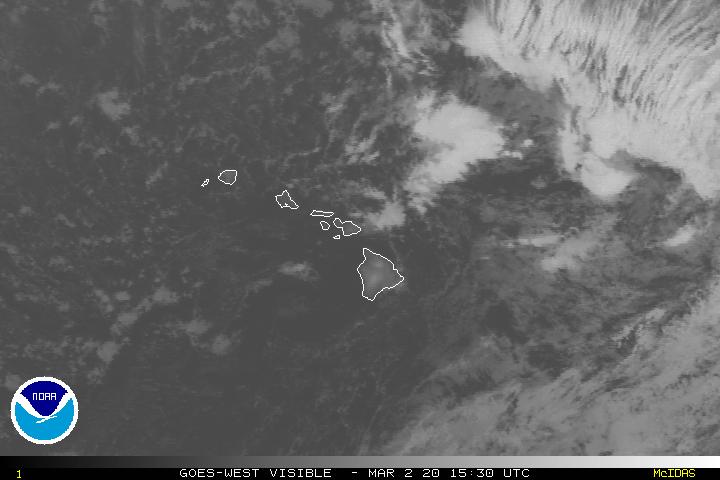
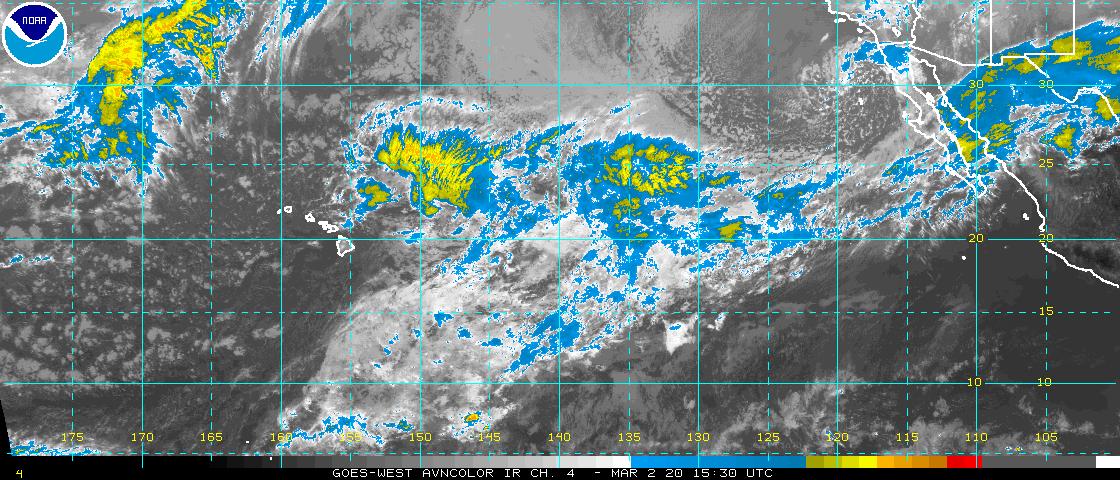
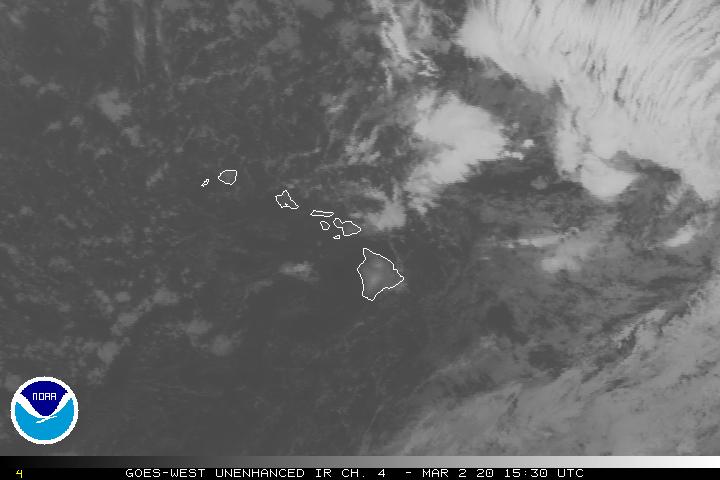
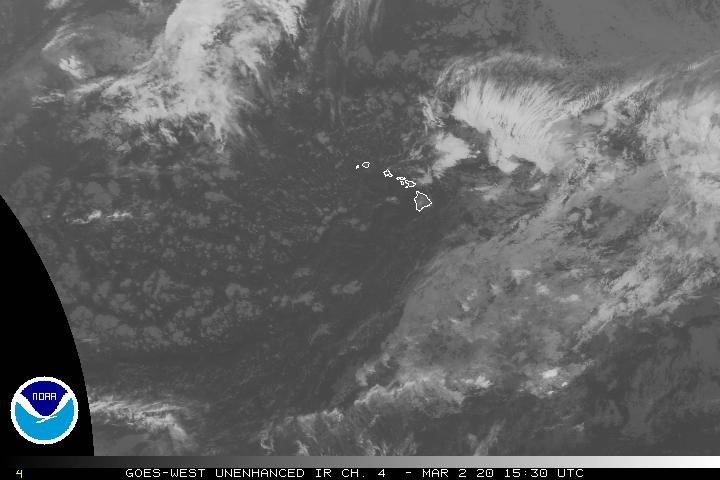
Satellite and Radar Images: To view the cloud conditions we have here in Hawaii, please use the following satellite links, starting off with this Infrared Satellite Image of the islands to see all the clouds around during the day and night. This next image is one that gives close images of the islands only during the daytime hours, and is referred to as a Close-up visible image. This next image shows a larger view of the Pacific…giving perspective to the wider ranging cloud patterns in the Pacific Ocean. Finally, here's a Looping IR satellite image, making viewable the clouds around the islands 24 hours a day. To help you keep track of where any showers may be around the islands, here’s the latest animated radar image.
Hawaii’s Mountains – Here’s a link to the live webcam on the summit of near 14,000 foot Mauna Kea on the Big Island of Hawaii. The tallest peak on the island of Maui is the Haleakala Crater, which is near 10,000 feet in elevation. These two webcams are available during the daylight hours here in the islands…and when there’s a big moon rising just after sunset for an hour or two! Plus, during the nights and early mornings you will be able to see stars, and the sunrise too…depending upon weather conditions.
Tropical Cyclone activity in the eastern and central Pacific – Here’s the latest weather information coming out of the National Hurricane Center, covering the eastern north Pacific. You can find the latest tropical cyclone information for the central north Pacific (where Hawaii is located) by clicking on this link to the Central Pacific Hurricane Center. Here’s a tracking map covering both the eastern and central Pacific Ocean. A satellite image, which shows the entire ocean area between Hawaii and the Mexican coast…can be found here. Of course, as we know, our hurricane season won't end until November 31st here in the central Pacific.
Aloha Paragraphs

Rough surf…north, west and east shores
Artist…Trey Surtees
Winds will be locally gusty Monday…although lighter beginning Tuesday. This weather map shows a strong 1042 millibar high pressure system northeast of the islands Sunday night. The winds remain strong enough now, and with a high surf advisory added into the mix…that small craft advisory has been extended to all coastal and channel waters. We'll find east to east-southeast winds blowing through the next couple of days. An approaching cold front during the new work week, will knock our wind speeds down in strength by Tuesday into Wednesday. Whether this front will pass down into the state from the northwest later Wednesday or Thursday is still a question.
Winds around the state are locally gusty, with the following numbers representing the strongest as of early Sunday evening:
17 mph Waimea Heights, Kauai
28 Kahuku training area, Oahu
31 Molokai
37 Kahoolawe
30 Kahului, Maui
10 Lanai Airport
37 South Point, Big Island
Our rainfall pattern will remain variable into Monday…with some localized heavy amounts here and there. There are patches of moisture being carried along in the east to east-southeast wind flow, which will keep some areas on the wet side overnight into the first day of the new work week. Here's a satellite picture showing the showery clouds across the state…which are particularly active on Oahu. We can take a look at this looping radar image, to see where these showers are located in the moment. An upper level trough of low pressure near the state, will enhance some of these showers at times into Monday. Looking ahead, a cold front now well northwest of Kauai, as shown on this satellite image, will stall for the time being. It may eventually move into the Aloha state just after mid-week.
It's Sunday evening as I begin writing this last section of today's narrative update. As pointed out above, we have an abnormally strong high pressure system to our northeast. This high is being rated at 1042 millibars, which is quite unusual. At the same time, an area of low pressure with a cold front is evident to our northwest. The alignment of these weather features, is veering our local winds to the east and east-southeast. In terms of showers, there will be some, the most generous of which will rain down from Oahu towards the Big Island, although the island of Kauai may see some localized showers at times too. At the time of this writing, the island of Oahu was under the gun in terms of heaviest precipitation.
~~~ Here in Kula, Maui, at 5pm the air temperature was 65.7F degrees…with light rain showers falling. It has been cloudy most of the afternoon, which continues as we push into the early evening. There have been off and on showers, none of which has been heavy. The heavy rain has been sticking pretty closely to Oahu, which may continue into Monday morning. The new week will find the east or ESE winds blowing, at least through Monday. An approaching cold front will push our high pressure ridge down closer to the islands Tuesday through Thursday, perhaps prompting a light wind convective weather pattern. This is often accompanied by clear mornings, with cloudy afternoons over and around the mountains…with at least a few upcountry showers. The mornings can be somewhat cooler than normal, with the days being somewhat warmer than usual, at least in those areas that remain sunny. Whether the cold front moves through Wednesday or Thursday, or just stalls before doing that…still isn't completely clear in my mind. We'll have to fine tune this prospect as we move through the next few days. ~~~ I'll be back here early Monday morning, when I'll have a new weather narrative waiting for you then. I hope you have a great Sunday night until then! Aloha for now…Glenn.
Interesting: Cleaning up oil spills is a time consuming, difficult process. But a novel approach developed at the Norwegian University of Science and Technology (NTNU) uses a new kind of vacuum cleaner that blows bark or other absorbent material onto oil spills, and then sucks the material up again. The vacuum cleaner is four times more efficient in cleaning up after oil accidents than conventional techniques. It started with a simple assignment for master's students in NTNU's Department of Product Design: make something useful that employs air and electronics.
Silje Rabben and three of her fellow students decided it was time to take oil cleanups out of the Stone Age, and developed the new kind of vacuum cleaner that speeds up oil spill cleanups. The design has been so successful that the students founded a company, Kaliber Industrial Design, and are now looking for investors to help market their invention, the MOSE — or "Mechanical Oil spill Sanitation Equipment."
The invention has already won a number of prestigeous Scandinavian innovation awards, including DnB NOR's Innovation Award for Mid-Norway, 2010; Tekna's Innovation Award 2010; second place in the 2010 Venture Cup National Finals; and the best student idea in the 2010 Venture Cup competition. No more hand scrubbing Today's oil spill cleanup technology usually involves the use of an absorbent material, such as bark or peat moss, to soak up the oil. Workers then have to remove the wet, heavy absorbent material, and the remaining oil residue may have to be scrubbed off the rocks.
"The oil vacuum cleaner automates what we currently do manually," says Rabben. "It is common to use bark to absorb the oil. So we have also used it. But it is also possible to use peat moss or chemical absorbents." The vacuum cleaner currently weighs about 10 kilos, but the engineers are working to cut its weight to 5 kilos. The equipment will also be changed so that it can be folded up to be more compact. But the secret of the design is all in the vacuum cleaner's head.
The machine first sprays bark or other absorbent material onto the spill. Rotating brushes in the head work the oil and the absorbent material together. When the oil and absorbent material are thoroughly mixed, the direction of the rotating brushes is reversed, enabling the bark to be sucked up into the equipment while the rocks are simultaneously scrubbed.
Small spills no problem Leif Gunnar Smistad, a fire engineer and oil spill manager at Trondheim's Fire and Rescue Service, says the advantage of the vacuum cleaner is that it is portable. Smistad helped develop the idea. "Every day we spread bark on small oil spills from overfilled oil tanks or from car accidents. Then we use a broom, a shovel and a bucket to clean up. We're very interested in mobile solutions that make these cleanups more effective," Smistad says.
The American Dream Company representatives participated in the recent Clean Gulf Training Event and Exhibition in Tampa, Florida, and then went to New Orleans to meet with authorities and companies who have been involved with the cleanup after the Macondo Deepwater Horizon accident. "Naturally, there is a lot of focus on oil spills and cleanup work in the Gulf of Mexico after the Macondo accident," Rabben says. "We just have to jump in."
Interesting2: In ecology class, students are taught the effects of keystone species, the dominant species in the ecosystem. They are the top dogs, the big fish. The keystone species have a disproportionate effect on their environment and can determine the types and numbers of species in their ecosystem, not just their prey. A recent study published in the journal Frontiers in Ecology and the Environment shows that this keystone species effect is similar for both terrestrial and ocean-based predators.
The study was recently conducted by Aaron Wirsing of the University of Washington and William Ripple of Oregon State University (OSU). They analyzed the behavioral effects on prey from both the wolf and the shark, two keystone species from much different ecosystems. The wolves were observed at Yellowstone National Park, and the sharks at Australia’s Shark Bay.
In both cases, the predators altered the behavior of the prey. In Yellowstone, the wolf's main prey, the elk, shifted to new, less-sensitive grazing areas when wolves were present. This had a ripple down effect on the streamside shrubs and aspen trees which the elks normally eat. These species could then re-grow and in turn support many other species. In Shark Bay, the tiger shark's main prey, the dugong altered its behavior similar to the elk.
It would avoid shallow waters when the sharks were present. This allowed the sea grass meadows to re-grow and in turn support other marine species. "For too long we've looked at ecosystem functions on land and in the oceans as if they were completely separate," said William Ripple, a professor in the Department of Forest Ecosystems at OSU. "We're now finding that there are many more similarities between marine and terrestrial ecosystems than we’ve realized.
We need to better understand these commonalities, and from them learn how interactions on land may be a predictor of what we will see in the oceans, and vice versa." In both marine and terrestrial environments, the prey not only shifted to new areas when the predators were around, they also radically shifted their behavior.
They displayed increased vigilance, always looking and listening for a silent stalker. They strove to leave room for escape if necessary, such as moving to areas where they would not feel boxed in, and keeping a safe distance from an approaching predator. The end result is less over-consumption of flora, leading to an overall healthier ecosystem.
Interesting3: A new study in Science has found that the incredible biodiversity of the Amazon rainforest goes back much further than expected, perhaps upending old ideas about how the Amazon basin became arguably the world's most bio-diverse ecosystem. According to the study, the origin of rich biodiversity in the Amazon likely goes back more than 20 million years when the Andean mountains were rising.
"The Andean mountain building profoundly affected the diversity and evolution of the Amazonian biota. It would be difficult to name any major group of Amazonian plants or animals whose fate had not been touched in some way by the formation of the vast Andean mountain chain," William Laurance, a conservation biologist at James Cook University who has spent decades working in the tropics, told mongabay.com.
Laurance was not involved with the study. By comparing biodiversity patterns today with geological and molecular datasets, researchers found that the highest diversity of species were in a region spanning over a million square kilometers which originated with the rising Andes. Given this, the authors believe they have found a strict the connection between the rich diversity Amazon rainforests and the rise of the Andes over 20 million years ago.
The researchers also note that as Andes rose they created a vast wetland appeared in the Amazonian region. This wetland also played a role. Around 10 million years ago when the Amazon River was formed, the wetland dried up, making way for the colonization of new plants and animals.
Interesting4: Chocolate was once the drink of Mayan and Aztec kings. Now a cocoa shortage may make chocolate an exclusive luxury again. Chocolate could become as rare as caviar, said John Mason of the Ghana-based Nature Conservation Research Council. Which means chocolate treats may become unaffordable for the average person.
The price of cocoa, the raw ingredient for chocolate, has been skyrocketing in international markets. Demand for chocolate, especially for dark chocolate which uses more cocoa, has helped fuel price increases.
But unfair trade and environmental problems have resulted in supply not keeping pace with demand. West Africa leads the world in cocoa production. But the profits don't come back to many of the farmers there, and that is one of the main causes of the shortage.
In the Ivory Coast, cocoa farmers often earn less than $1 a day, and in many cases the land they farm has lost its fertility, said Tony Lass, chairman of the Cocoa Research Association in the UK Independent. Ivory Coast farmers are leaving behind unprofitable, failing cocoa orchards for the cities.
 Email Glenn James: