











November 22-23, 2010
Air Temperatures – The following maximum temperatures were recorded across the state of Hawaii Monday afternoon:
Lihue airport, Kauai – 79
Honolulu airport, Oahu – 82
Kaneohe, Oahu – 81
Molokai airport – 81
Kahului airport, Maui – 83
Kona airport – 84
Hilo airport, Hawaii – 81
Air Temperatures ranged between these warmest and coolest spots near sea level – and on the highest mountain tops…as of 5pm Monday evening:
Kailua-kona – 81F
Lihue, Kauai – 75
Haleakala Crater – 50 (near 10,000 feet on Maui)
Mauna Kea summit – 37 (near 14,000 feet on the Big Island)
Precipitation Totals – The following numbers represent the largest precipitation totals (inches) during the last 24 hours on each of the major islands, as of Monday afternoon:
0.02 Anahola, Kauai
0.06 Wilson Tunnel, Oahu
0.00 Molokai
0.00 Lanai
0.00 Kahoolawe
0.03 Ulupalakua, Maui
0.24 South Point, Big Island
Marine Winds – Here’s the latest (automatically updated) weather map showing a strong 1038 millibar high pressure system far to our north-northeast of the Hawaiian Islands. Our light trade winds will gradually strength into Wednesday.
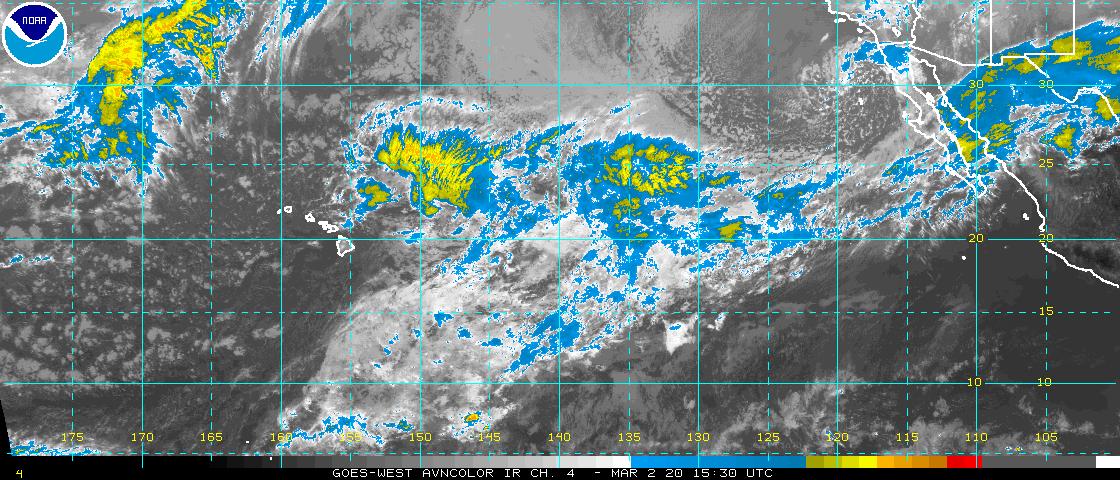
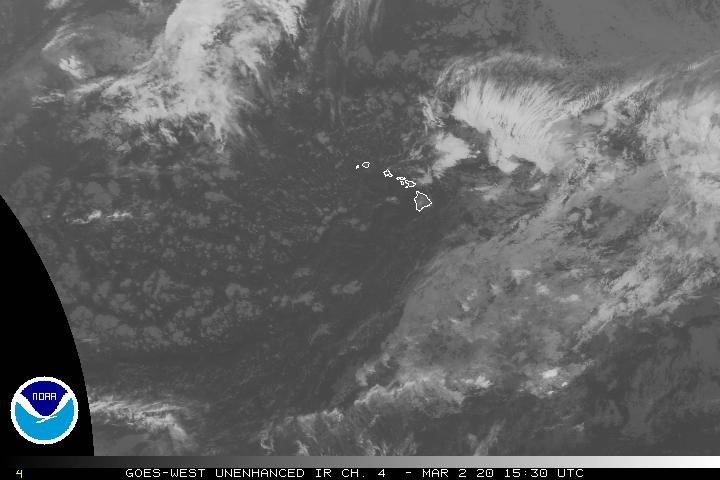
Satellite and Radar Images: To view the cloud conditions we have here in Hawaii, please use the following satellite links, starting off with this Infrared Satellite Image of the islands to see all the clouds around during the day and night. This next image is one that gives close images of the islands only during the daytime hours, and is referred to as a Close-up visible image. This next image shows a larger view of the Pacific…giving perspective to the wider ranging cloud patterns in the Pacific Ocean. Finally, here's a Looping IR satellite image, making viewable the clouds around the islands 24 hours a day. To help you keep track of where any showers may be around the islands, here’s the latest animated radar image.
Hawaii’s Mountains – Here’s a link to the live webcam on the summit of near 14,000 foot Mauna Kea on the Big Island of Hawaii. The tallest peak on the island of Maui is the Haleakala Crater, which is near 10,000 feet in elevation. These two webcams are available during the daylight hours here in the islands…and when there’s a big moon rising just after sunset for an hour or two! Plus, during the nights and early mornings you will be able to see stars, and the sunrise too…depending upon weather conditions.
Tropical Cyclone activity in the eastern and central Pacific – Here’s the latest weather information coming out of the National Hurricane Center, covering the eastern north Pacific. You can find the latest tropical cyclone information for the central north Pacific (where Hawaii is located) by clicking on this link to the Central Pacific Hurricane Center. Here’s a tracking map covering both the eastern and central Pacific Ocean. A satellite image, which shows the entire ocean area between Hawaii and the Mexican coast…can be found here. Of course, as we know, our hurricane season won't end until November 31st here in the central Pacific.
Aloha Paragraphs

Trade wind weather pattern…fair conditions through Tuesday
Photo credit: Donald B. MacGowan
Our local winds will remain on the light side, from the trade wind direction…strengthening at mid-week onwards. This weather map shows a strong 1037 millibar high pressure system located far to the north-northeast of Hawaii Monday night. The reason our winds aren’t stronger with such a hefty high pressure cell, is related to the location of a gale low pressure far to our north, and its associated cold front, cramping our high pressure ridge…close-in near Kauai and Niihau. Our winds will remain generally light or slightly stronger through the next few days, gradually picking up in strength later Wednesday into the Thanksgiving holiday…through the rest of this week.
Winds around the state remain generally light today…with the following numbers representing the strongest gusts Monday evening:
12 mph Lihue, Kauai
10 Kahuku, Oahu
08 Molokai
18 Kahoolawe
20 Maalaea Bay, Maui
06 Lanai Airport
09 Kona airport, Big Island
After some locally good showers this past weekend, our overlying atmosphere has stabilized and dried out for the time being, with the next chance of increased showers tied to the increase in trade winds…and a new upper level trough at mid-week. Here's a satellite image, showing generally clear skies, although with clouds having gathered around the mountains during the afternoon…at least on the Big Island and Maui. We can attribute this cloudiness to the daytime heating of the larger islands, plus the sea breezes due to the light trade wind flow. If we shift our gaze to a larger satellite view, we can see no lack of clouds, many of which are thunderstorms and high cirrus clouds. The bulk of this stuff resides to our northwest, east, and southeast…all of it relatively far away at the moment.
Looking a bit further ahead, and especially up the road towards our Thanksgiving holiday into the weekend…we see more showers on the horizon. As the satellite imagery in that paragraph above demonstrates, we are involved in a clear air condition for the most part. This will likely carry forth into the second day of this holiday work week. Good things don’t last forever though, as the saying goes. This doesn’t mean that we’ll move into terrible weather by any means, although there are liable to be some noticeable changes arriving on Wednesday. This will involve a trough of low pressure, with its cold air aloft, causing increased instability again…especially noticeable on the Big Island end of the chain. This will work to enhance whatever showers that around then. As the trade winds increase then too, they will drag in more cloudiness, and thus the wetter trade winds arriving then along our windward coasts and slopes. At the same time, we may see some generous showers breaking out near Maui and the Big Island then too, for a day or so. Those windward showers will extend longer however, likely right through the rest of the week.
It's Monday evening as I begin writing this last section of today's narrative update. The weather today was nice, that is unless you got underneath the afternoon cloud cover over the mountains, which extended out over the coasts locally. Those clouds did some raining, especially around the leeward sides of Maui and the Big Island. These clouds should clear out tonight however, with another generally clear morning on tap Tuesday. If the trade winds stay as light as they were on Monday, we could see a repeat performance during the afternoon on Tuesday. ~~~ Here in Kihei, Maui, it is mostly cloudy, with light winds blowing. While I was out at lunch today, I drove through a couple of light showers. I looked up into the upcountry area from down here, and saw low clouds and rather persistent showers falling up that way…a good thing for those dry pastures up in Ulupalakua and Keokea. ~~~ I'm ready to drive back up to Kula now, and will be back early Tuesday morning with your next new weather narrative. I hope you have a great Monday night until then! Aloha for now…Glenn.
Interesting: Up to 1,000 people have been evacuated from their homes after a volcano erupted in the Philippines. Mount Bulusan, in the south-east of the country, is spewing clouds of ash into the sky. The volcano suddenly became active on 6 November after it released a jet of ash approximately 600m high. Trucks have been helping to move people from the immediate area.
Interesting2: Around a billion people cannot afford any health services, and paying for healthcare pushes about 100 million people a year into poverty, the World Health Organization said on Monday. In a global report on financing health systems, the United Nations health body said all countries, rich and poor, could do more toward getting universal coverage and urged them to think about ways to increase efficiency and use new taxes and innovative fund-raising measures to boost access to healthcare.
"For many, health services just don't exist, for others they are not affordable. When they're not affordable it means you either choose not to use them or you suffer severe financial hardship," David Evans, the WHO's director of health systems financing, said in a briefing on the report's findings.
The World Health Report 2010 lays out steps countries could take to raise more funds and reduce financial barriers to obtaining healthcare, and to make health services more efficient. It found that to stop payment for healthcare impoverishing people, direct, out-of-pocket payments should make up less than 15 to 20 percent of a country's total health spending.
Yet currently, in 33 mainly low- and middle-income countries, direct payments from individuals receiving healthcare still account for more than 50 percent of total health spending. It suggested governments should look at diversifying sources of revenue from levies such as "sin" taxes on products like tobacco and alcohol, currency transaction taxes, and national "solidarity" taxes on certain sectors.
If India were to implement a levy of 0.005 percent on foreign exchange transactions, it could raise $370 million per year, the report said. Gabon raised $30 million for health in 2009 by imposing a 1.5 percent levy on companies handling remittances and a 10 percent tax on mobile phone operators.
HEALTH, OR FINANCIAL RUIN?
WHO director general Margaret Chan wrote in a foreword to the report that "no one in need of healthcare, whether curative or preventive, should risk financial ruin as a result." "As the world grapples with economic slowdown, globalization of diseases … and growing demands for chronic care … the need for universal health coverage, and a strategy for financing it, has never been greater," the report said.
"There is no magic bullet to achieving universal access. Nevertheless, a wide range of experiences from around the world suggests that countries can move forward faster." The WHO said that typically, 20 to 40 percent of health spending is wasted, often through spending on expensive but unnecessary drugs, hospital-related inefficiency and poor use of skilled professionals' time.
More than half all medicines globally are prescribed, dispensed, or sold inappropriately and half of all patients fail to take their medication as prescribed. Better use of medicines could save nations up to 5.0 percent of health spending, it said.
To improve efficiency, it suggested 10 areas where changes could be made, including reducing unnecessary spending on drugs, targeting medicines properly and adopting a generics policy whereby any branded medicine for which there is an equally effective generic version is substituted.
The report found some countries pay far more for medicines than others — in some places prices are up to 67 times the international average. France's strategy of generic substitution led to savings equivalent to $1.94 billion in 2008, it said.
Interesting3: Bangladesh has approved a law that sets jail terms of up to 12 years for deliberately killing tigers and other wild animals endangered in the South Asian country. A recent cabinet meeting chaired by Prime Minister Sheikh Hasina also agreed to provide reparations to the families of victims killed or maimed by the animals that range between 100,000 taka ($1,415) and 50,000 taka.
Each family will also get 25,000 taka as compensation if wild animals destroy assets such as houses and crops. "The cabinet approved jail terms from two years to 12 years for killing endangered snakes and animals including tigers," Hasina's press secretary Abul Kalam Azad told Reuters.
The minimum jail term will be two years for killing pythons and crocodiles and a maximum of 12 years for killing tigers and elephants, Azad said. Hasina will attend a conference on tigers in St. Petersburg, Russia, from Monday to discuss ways and means to protect the animals, officials said.
Bangladesh's southwestern mangrove forests, called Sundarbans and which also stretch across the border with India, are currently home to just 400 tigers and its southeastern Chittagong Hill Tracts have 300 elephants.
Many animals are killed in conflicts with humans, who are increasingly encroaching on their habitat, forest officials said. At least 80 people, and some 15 tigers, have been killed in last five years across Bangladesh-controlled areas of the Sundarbans, which are dotted with hundreds of small islands and criss-crossed by rivers.
Interesting4: Eight shrimp trawlers have been charged by NOAA with allegedly fishing this summer in the area of the Gulf of Mexico that was closed due to the Deepwater Horizon/BP oil spill. The notices of violation and assessment (NOVAs) were issued as part of NOAA’s effort to help ensure the seafood reaching America’s dinner tables was safe – and to protect the livelihoods of Gulf fishermen who were respecting the closures.
All of the eight shrimp trawlers’ catches – about 107,500 pounds of shrimp – were returned to the water to ensure the potentially tainted seafood did not come to market. All eight vessels were boarded by the U.S. Coast Guard off the coast of Louisiana in June, July, or August, with the most recent NOVA being issued Nov. 3.
“Throughout the oil spill event this summer, stringent enforcement of the closed areas was essential to ensuring both seafood safety and consumer confidence in Gulf seafood,” said Eric Schwaab, assistant NOAA administrator for NOAA’s Fisheries Service. “NOAA remains determined to protect the fishermen who follow the rules and the American public who eat the seafood they catch.”
NOAA’s Office of General Counsel for Enforcement and Litigation (GCEL) issued the first NOVA in July, five NOVAs in September, one in October and one earlier this month. NOVAs are issued after the Coast Guard and NOAA’s Office of Law Enforcement (OLE) complete their investigations.
Six of the shrimp vessels were assessed civil penalties of $15,000 for allegedly fishing in the closed area, and one of the six was assessed an additional $3,000 for two alleged violations involving bycatch reduction devices. Bycatch reduction devices are special openings sewn into a shrimp trawler's nets to allow non-targeted species such as red snapper to escape, while retaining shrimp.
A seventh shrimp trawler received a $50,000 NOVA — $30,000 for allegedly fishing in the closed area a second time after having been previously warned by state officials, and $20,000 for four alleged violations regarding turtle excluder devices, special nets with openings that allow turtles to escape and not drown. The openings in this vessel’s nets were allegedly too small to allow larger, mature turtles to escape.
Earlier this month, GCEL issued a $20,000 NOVA to an eighth shrimp vessel for allegedly fishing in the closed area in August, following significant public outreach and prior enforcement actions putting the regulated community on notice that fishing in the closed areas was prohibited.
“Our outreach and enforcement efforts worked, and most of the fishing industry readily complied with the closed areas resulting from the oil spill in order to ensure seafood safety,” said Hal Robbins, special agent in charge of NOAA’s Office of Law Enforcement southeast division.
The ships' owners and operators have 30 days to respond to NOVAs by paying the penalty, seeking to have it modified, requesting a hearing before an administrative law judge or requesting an extension of time to respond. To date, one respondent has paid in full, and that case has been closed. One has requested a hearing, which is set for Jan. 18, and the other parties still have time to respond.
NOAA also continues to work closely with the FDA and the Gulf states to ensure seafood safety. NOAA and FDA are working together on broad-scale seafood sampling that includes sampling seafood from inside and outside the closure area, as well as dockside and market-based sampling.
 Email Glenn James: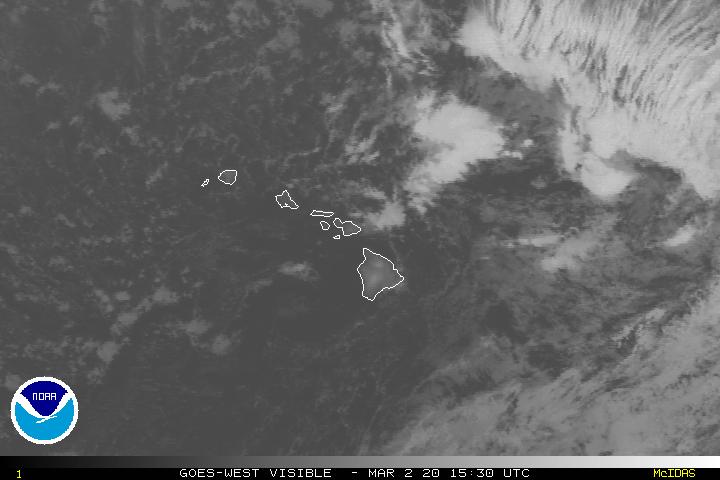


david Says:
It's been raining steadily , more or less, for the last two hours; even here in Kihei, we'll soon see green slopes looking mauka!
Thanks for your commentary all these years; it's been helpful in piecing together the disparate bits of information available.
David Wiltsie~~~Hi David, thanks for your note, and yes…there’s lots of clouds around this afternoon, with even some rain falling. I saw several short showers here in Kihei, and lots more than that upcountry. I appreciate our thoughtful feedback, I enjoy piecing together those disparate bit of information for you and others. Aloha, Glenn