











October 8-9, 2010
Air Temperatures – The following maximum temperatures were recorded across the state of Hawaii Friday afternoon:
Lihue airport, Kauai – 86
Honolulu airport, Oahu – 88
Kaneohe MCAS, Oahu – 84
Molokai airport – 84
Kahului airport, Maui – 88
Ke-ahole airport (Kona) – 85
Hilo airport, Hawaii – 84
Air Temperatures ranged between these warmest and coolest spots near sea level – and on the highest mountain tops…as of 5pm Friday evening:
Honolulu, Oahu – 84
Hilo, Hawaii – 77
Haleakala Crater – 54 (near 10,000 feet on Maui)
Mauna Kea summit – 43 (near 14,000 feet on the Big Island)
Precipitation Totals – The following numbers represent the largest precipitation totals (inches) during the last 24 hours on each of the major islands, as of Friday afternoon:
0.03 Lihue, Kauai
0.09 Punaluu Stream, Oahu
0.00 Molokai
0.00 Lanai
0.00 Kahoolawe
0.02 Puu Kukui, Maui
0.11 Kealakekua, Big Island
Marine Winds – Here’s the latest (automatically updated) weather map showing a high pressure system far to the northeast, and northwest of our islands. Our local winds will be picking up from the trade wind direction Saturday into Sunday.
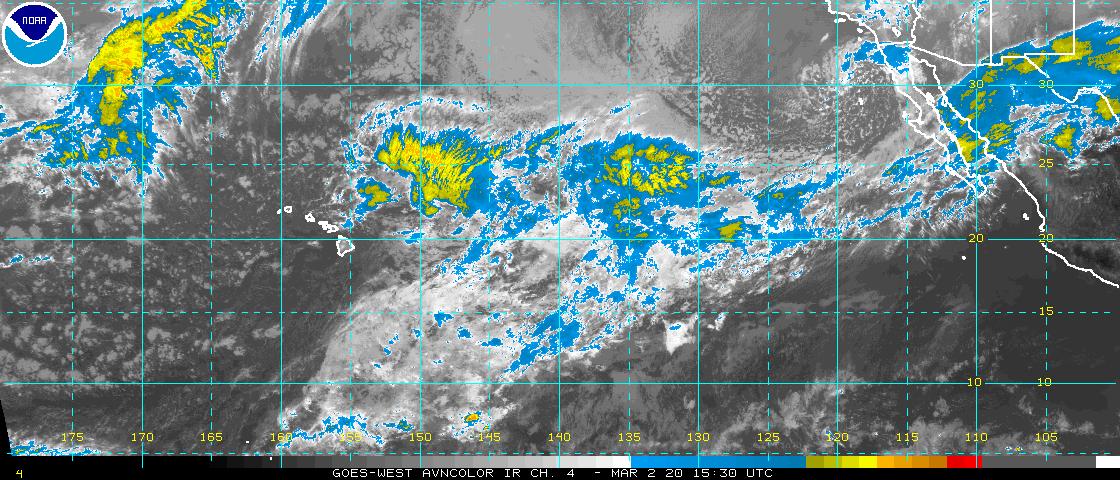
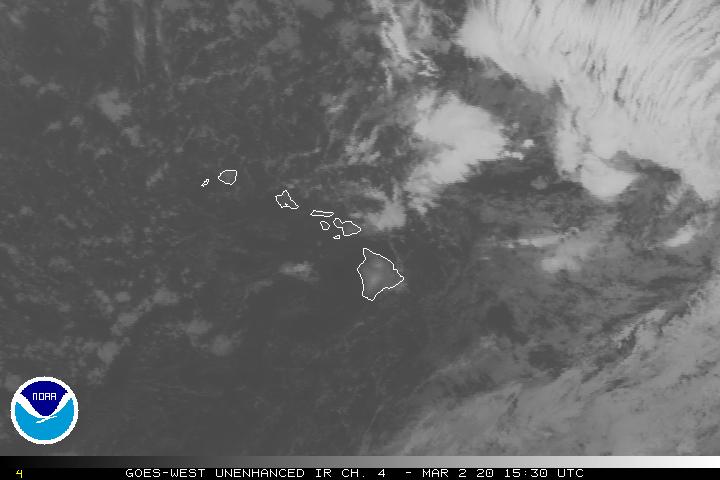
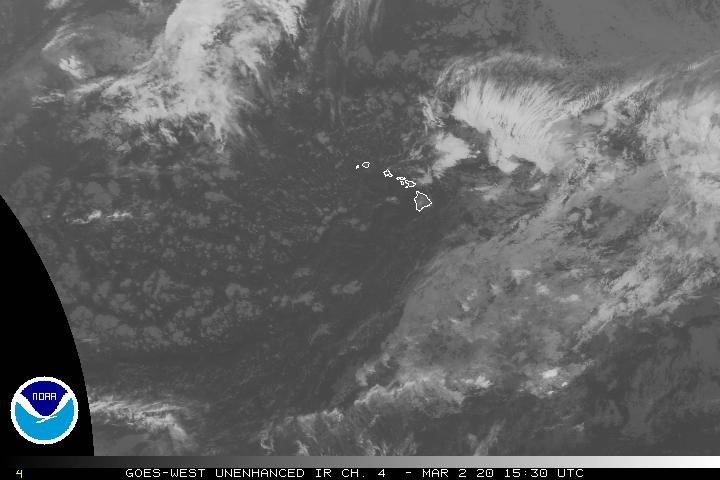
Satellite and Radar Images: To view the cloud conditions we have here in Hawaii, please use the following satellite links, starting off with this Infrared Satellite Image of the islands to see all the clouds around during the day and night. This next image is one that gives close images of the islands only during the daytime hours, and is referred to as a Close-up visible image. This next image shows a larger view of the Pacific…giving perspective to the wider ranging cloud patterns in the Pacific Ocean. Finally, here’s a Looping IR satellite image, making viewable the clouds around the islands 24 hours a day. To help you keep track of where any showers may be around the islands, here’s the latest animated radar image.
Hawaii’s Mountains – Here’s a link to the live webcam on the summit of near 14,000 foot Mauna Kea on the Big Island of Hawaii. The tallest peak on the island of Maui is the Haleakala Crater, which is near 10,000 feet in elevation. These two webcams are available during the daylight hours here in the islands…and when there’s a big moon rising just after sunset for an hour or two! Plus, during the nights and early mornings you will be able to see stars, and the sunrise too…depending upon weather conditions.
Tropical Cyclone activity in the eastern and central Pacific – Here’s the latest weather information coming out of the National Hurricane Center, covering the eastern north Pacific. You can find the latest tropical cyclone information for the central north Pacific (where Hawaii is located) by clicking on this link to the Central Pacific Hurricane Center. Here’s a tracking map covering both the eastern and central Pacific Ocean. A satellite image, which shows the entire ocean area between Hawaii and the Mexican coast…can be found here. Of course, as we know, our hurricane season won’t end until November 31st here in the central Pacific.
Aloha Paragraphs

Returning trade winds this weekend
The Kona coast
The trade winds will increase again this weekend…into early in the new week. These trade winds will become stronger, and may even require small craft wind advisories in those windiest places on both Maui and the Big Island. This weather map shows high pressure system to our northeast and northwest. This weather chart also shows numerous low pressure systems in the mid-latitudes of the north Pacific Ocean. As the ridge moves northward and strengthens Saturday and Sunday, our winds will become moderately strong, or a bit more than that…into the middle of the new week.
Whatever few light showers that fall through most of the weekend, will be focused along our windward sides. As we can see from checking this satellite image, there are patches of clouds in our vicinity Friday night, located mostly over the ocean. The atmosphere is dry and stable now, so that not very many showers will fall. As the trade winds pick up again this weekend, into early in the new week, we’ll see at least some increase in our windward biased showers…likely arriving later Sunday evening, then on into Monday morning. There still aren’t any other organized rain makers on the horizon at this time.
Back to the moment, and looking further afield, or across the big ocean in this case…we see some fairly impressive clouds. There are areas of thunderstorms located far to the southwest, south, and southeast. None of these areas are showing any spinning motion, which is a good thing of course. Glancing at this IR satellite image, we see lots of high cirrus clouds out to the west too. If the upper winds continue blowing in this direction, we could see these icy clouds extending over far enough, for us to see them in our local skies. They will show up to the west of Kauai, or to the southwest of all the islands perhaps. Depending upon how close they come, or if they swing right over our islands, we could see some form of sun dimming…or at least some nice sunrise or sunset colors with time.
It’s Friday evening as I begin writing this last section of this morning’s narrative update. The weather here in the islands will remain fine through the weekend. I don’t see any big changes coming up through at least the first half of the new week ahead. In other words, it looks like generally dry weather through most of the weekend, and then just a short spell, maybe, of showers arriving along our windward sides Sunday evening into Monday morning. Then, thereafter, back to just a pretty normal trade wind weather pattern. ~~~ Since it’s Friday, I’ll be seeing a new film this evening over in Kahului, Maui. This time I’m going to see the film called The Social Network (2010), starring Jesse Eisenberg and Justin Timberlake…among others. The synopsis: fictionalized story of Mark Zuckerberg, whose billion dollar idea became a revolution of communication, like in Facebook. This film is getting rave reviews, with the critics giving it an A grade, while viewers are giving it an A- grade, which sounds good to me! I’ll of course let you know what I think in the morning, when I’ll be back to provide the next new weather narrative. By the way, here’s the trailer for this film. I hope you have a great Friday night until then! Aloha for now…Glenn.
Extra: Happy Birthday John Lennon!…youtube video: Woman
Interesting: A recent study from researchers at the University of California (UC) Irvine has found that since 1994, the overall amount of fresh water flowing into the world’s oceans has increased significantly. They found that 18 percent more fresh water has reached the oceans between 1994 and 2006, an average annual rise of 1.5 percent. The biggest reasons for the increase are the more frequent and extreme storms which are attributable to global warming.
It is also a consequence of melting polar ice. The research team, led by UC Irvine Earth System Science Professor, Jay Famiglietti, focused on the issue of greater storm water runoff reaching the oceans. Unfortunately, the increased precipitation falls unevenly over the Earth’s surface. This is a phenomenon of global warming; the higher-rainfall areas of the world get wetter, and the more arid regions get drier. According to Famiglietti, "In general, more water is good.
But here’s the problem: Not everybody is getting more rainfall, and those who are may not need it. What we’re seeing is exactly what the Intergovernmental Panel on Climate Change predicted — that precipitation is increasing in the tropics and the Arctic Circle with heavier, more punishing storms. Meanwhile, hundreds of millions of people live in semiarid regions, and those are drying up."
The study found that global warming has triggered an acceleration of the evaporation and precipitation cycle. Higher temperatures over the oceans cause the fresh water to evaporate and form thicker clouds. It is then dumped on land in ferocious torrents, often in the form of hurricanes or monsoons (think Pakistan floods). The fresh water then finds its way back to the ocean via rivers and channels.
Therefore global warming should also increase river flow throughout wetter regions. However, there is no global system in place to measure river discharge levels, so no definitive data is available at this point. What the study employed instead was NASA satellites and other satellites that are capable of tracking total water volume each month flowing from the continents into the sea.
From the satellite data, the team assembled a 13-year record of sea-level rise, precipitation, and evaporation. The final conclusion is that rising temperatures accelerate the hydrologic cycle, the benefits of which are distributed unevenly over the globe. The scientists admit, however, that despite their work spanning the longest time frame ever for this type of research, the 13-year study is still a relatively short period, and that more research is needed and is underway.
Interesting2: A report by Oceana "Wealth: Offshore Wind Can Deliver Cleaner, More Affordable Energy and More Jobs Than Offshore Oil", a comprehensive analysis shows that focusing investments on clean energy like offshore wind would be cost effective, more beneficial to job creation, and better for the environment and ocean in a variety of ways than offshore oil and gas exploration and development.
Authors of the report include Simon Mahan, Isaac Pearlman, and Jacqueline Savitz. On the Atlantic coast, an area targeted for expansion of oil and gas activities, offshore wind can generate nearly 30% more electricity than offshore oil and gas resources combined. For example, Delaware is a prime candidate for offshore wind. The report states. "Delaware could generate more electricity from offshore wind energy than the state currently generates from all other sources.
Offshore wind from the state’s waters could power approximately 937,000 average homes annually. At least 2.8 GW of offshore wind potential is available in Delaware waters. That’s enough energy to meet the current household energy generation of Delaware and Rhode Island combined with an energy surplus. While there is an initial investment cost for installation of offshore wind farms, eliminating fossil fuel consumption for electricity generation in Delaware would save the state $274 million annually on fuel costs." There are summaries for other Atlantic coastal states that summarize each state’s potential for offshore wind energy production.
Interesting3: A team of University of South Florida researchers studying the impact of the Deepwater Horizon oil spill on northern Gulf beaches say areas just offshore from some of Florida’s most heavily oiled beaches appear to be free of visible oil contamination in the sediments.
The update from the USF Coastal Research Laboratory, led by Geologist Ping Wang, are significant because they allay one of the chief concerns among coastal researchers: that oil which might have sunk just out of sight offshore could be easily stirred up by a storm and be washed onto beaches.
Wang, working with the chair of USF’s Department of Integrative Biology Susan Bell and a team of researchers, surveyed areas Sept. 23-27 just off the coast from Santa Rosa Island in Florida west to Gulf Shores, Ala. The five-day expedition is part of ongoing research projects funded by the National Science Foundation in the aftermath of the Deepwater Horizon spill, the nation’s largest environmental disaster.
The team found no visually identifiable oil contamination, including no tar balls, tar patties or oil sheets, they said in a new report. Sediment cores gathered by divers also were free of visual evidence of oil. Further laboratory tests are being conducted to look for further hydrocarbon contamination, which often can be invisible and is detected only through sophisticated laboratory tests.
"Since no visually identifiable oil was found on or below the surface in the near shore zone at any of the sampling sites, we believe that it is unlikely that significant amounts of ‘new oil from the near shore’ will be washed onto the beach during storms," Wang said. "However, it should be noted that based on our earlier study of buried oil along the beaches, erosion of buried beach oil and subsequent redistribution is expected during storms."
Bell said researchers will make more detailed observations of diver-collected cores in the lab, including microscopic examination of sand grains, to assess whether there is any indication of oil contamination. The group also plans to survey additional sites. The work by Wang and the Coastal Geology Lab team garnered worldwide attention this summer when they examined beaches in northwest Florida and Alabama to document the extent of BP oil contamination.
The researchers later returned to beaches that had been cleaned by BP crews only to find a thick layer of oil buried inches below the sand and that cleaning machines had chopped oil sheets into tiny tar balls, spreading the contamination on a wider area. In the most recent exploration, however, their findings reached a more hopeful initial conclusion.
The team collected 60 sediment cores and 60 surface sediment samples just off of those heavily contaminated beaches in waters from nine to 45 feet deep. Samples also were also collected in areas such as Pensacola Bay and Perdido Bay, which suffered some of the brunt of the oil contamination in Florida this summer.
The latest update comes as some of the nation’s top scientists studying the spill gathered in St. Petersburg Beach Tuesday and Wednesday to compare findings and initial observations on the complex picture left by the Deepwater Horizon blowout. More than 145 researchers gathered in workshops organized by the National Oceanic and Atmospheric Administration, the NSF and the National Science and Technology Joint Sub-Committee on Ocean Science and Technology.
Given the unprecedented nature of the spill, scientists say they are facing a complex series of questions and factors to consider as they begin to chart the long-term impact of the spill on the Gulf environment.
Interesting4: A new study has shed light on the sun’s impact on the Earth’s climate, confounding current thinking about solar cycles and how they influence temperatures on Earth. Previously scientists had thought that radiation reaching the Earth rises and falls in line with the Sun’s activity, which during the 11-year solar cycle goes though periods of low and high activity.
But research by Imperial College, London and the University of Colorado in the U.S. examining solar radiation levels from 2004 to 2007 — a period of declining solar activity — revealed that levels of visible radiation reaching the Earth actually increased during the period.
Using data collected by NASA’s SORCE (SOlar Radiation and Climate Experiment) satellite, which launched in 2003, the scientists were able to scrutinize the full solar spectrum — x-ray, ultraviolet (UV), visible (VR), near-infrared, and total solar radiation — and compare it to earlier, less comprehensive data. Joanna Haigh, leader author of the study published in the journal Nature told CNN: "What the data has shown, rather unexpectedly, is that the decline in ultra-violet radiation is much larger than anticipated.
But more surprisingly the visible radiation actually increased as solar activity was declining." Haigh, a professor of atmospheric physics, says that UV radiation is mostly absorbed in the stratosphere but visible radiation gets through to the earth’s surface. The observed increase in VR, despite declining solar activity, may have caused small rises in temperature. But, as Haigh points out, the research, which covers a short period, comes with some caveats.
"The sun has been behaving very strangely. Its magnetic activity is lower than it has been for several hundred years, perhaps. And so the fact that it’s doing strange things in its spectrum is perhaps not that unexpected," she said. It’s also just starting to come out of a very long period (two years) of minimum activity, she says.
As the Sun’s activity starts to increase, "it will also be very, very interesting to see if the visible radiation starts to decline," Haigh says. Haigh is aware that research which contradicts existing ideas about how the Sun’s activity affects the Earth’s climate is likely to fuel some climate skepticism.
But she says the solar cycles cancel each other out, going up and down over roughly an 11-year period. "They [the solar cycles] are contributing nothing to long-term global warming," she said, "and it has no bearing on what we understand about greenhouse gases and their influence on climate." Robert von Fay-Siebenburgen, a solar physicist from the UK’s University of Sheffield told CNN: "What has been published is very interesting and a little unexpected, to be honest."
But he says that despite the Sun being our closest star, scientists still know very little about it. "We have a better understanding of the internal processes — what is below the surface of the Sun. However, what is above that and how it affects the Earth’s climate is very poorly understood," he said.
"But what Professor Haigh has found is very exciting and an important step towards increasing our understanding." Sir Brian Hoskins, director of the Grantham Institute for Climate Change at Imperial College, London said in a statement: "Studies like this are vital for helping us create a clear picture of how our climate is changing and through this, to work out how we can best protect our planet."
 Email Glenn James: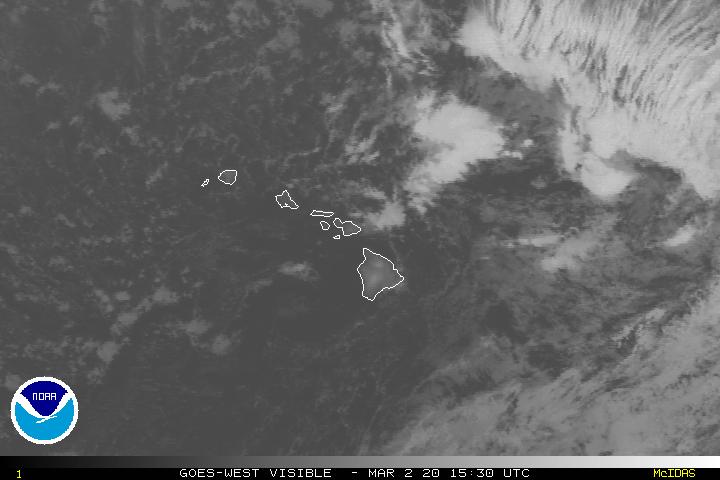


Ann Says:
thanks for your Aloha Friday post!!~~~You’re welcome Ann, Aloha, Glenn
rudy Says:
hey, you got the photo of Waianapanapa on and we’re going there tomorrow!! cool!! and we’re expecting some light and building trades 🙂
da man~~~Hey Rudy, have fun out there on the windward side, should be some good weather for you folks…have fun! Aloha, Glenn
Glenn Says:
Aloha Glenn ~
Any chance that the ENSO prediction for El Nino/La Nina is a bit off with their timing?
Jack W and I were discussing that along with Guy Hagi’s weather prediction said the other evening was ‘dry in Nov, with more than usual rains Dec-May’.
Curious minds would love your input.
Happy Friday ~~~Hi, I have no reason to disagree with the NOAA forecast of drier than normal through the autumn, and then somewhat wetter than normal during the winter season. There’s always that chance that any forecast can be a bit off, especially considering that it is for many months in the future. I prefer to stick closer to the moment in my prognosticating…keeping expectations to a minimum. I can understand your curiosity of course, perhaps I should ask for your and Guy’s ideas? Aloha, Glenn