October 7-8, 2010
Air Temperatures – The following maximum temperatures were recorded across the state of Hawaii Thursday afternoon:
Lihue airport, Kauai – 85
Honolulu airport, Oahu – 88
Kaneohe MCAS, Oahu – 84
Molokai airport – 84
Kahului airport, Maui – 88
Ke-ahole airport (Kona) – 84
Hilo airport, Hawaii – 84
Air Temperatures ranged between these warmest and coolest spots near sea level – and on the highest mountain tops…as of 5pm Thursday evening:
Barking Sands, Kauai – 84
Hilo, Hawaii – 78
Haleakala Crater – 54 (near 10,000 feet on Maui)
Mauna Kea summit – 43 (near 14,000 feet on the Big Island)
Precipitation Totals – The following numbers represent the largest precipitation totals (inches) during the last 24 hours on each of the major islands, as of Thursday afternoon:
0.01 Mount Waialeale, Kauai
0.01 Mililani, Oahu
0.00 Molokai
0.00 Lanai
0.00 Kahoolawe
0.01 Puu Kukui, Maui
0.09 Kealakekua, Big Island
Marine Winds – Here’s the latest (automatically updated) weather map showing a 1023 millibar high pressure system far to the east-northeast of our islands, moving eastward…away from the islands. Our local trade winds will remain light Friday, picking up Saturday.
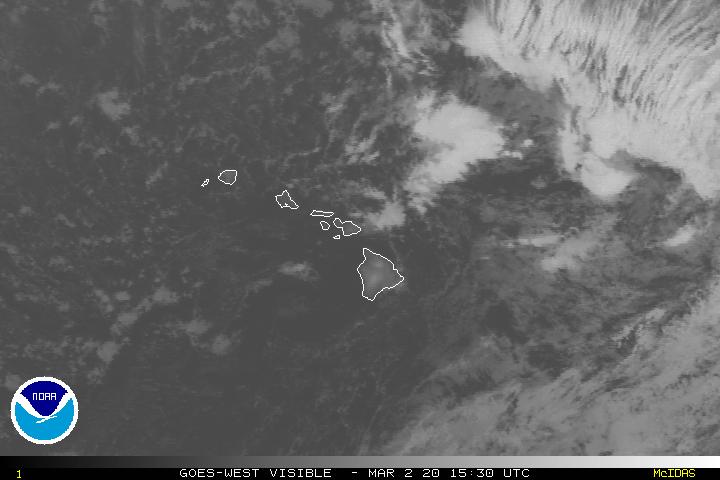
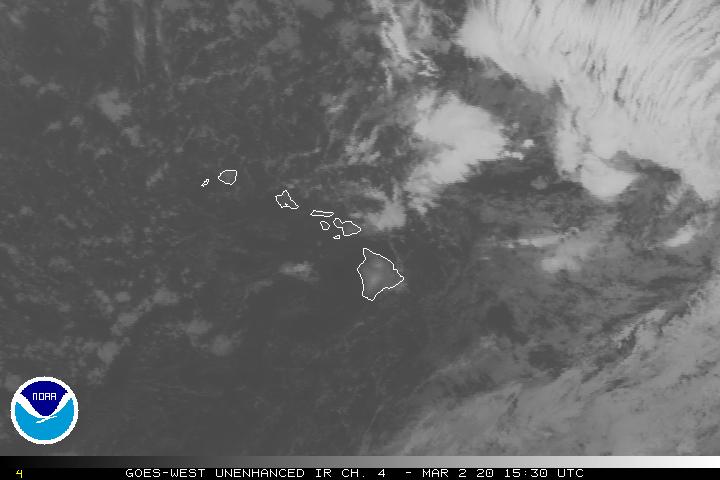
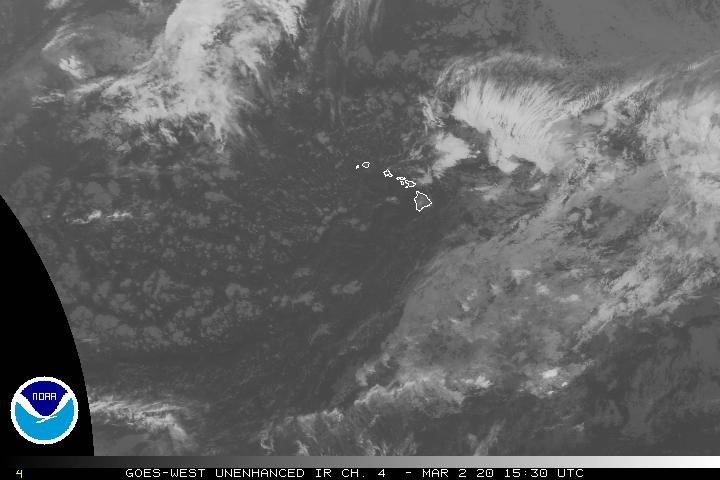
Satellite and Radar Images: To view the cloud conditions we have here in Hawaii, please use the following satellite links, starting off with this Infrared Satellite Image of the islands to see all the clouds around during the day and night. This next image is one that gives close images of the islands only during the daytime hours, and is referred to as a Close-up visible image. This next image shows a larger view of the Pacific…giving perspective to the wider ranging cloud patterns in the Pacific Ocean. Finally, here’s a Looping IR satellite image, making viewable the clouds around the islands 24 hours a day. To help you keep track of where any showers may be around the islands, here’s the latest animated radar image.
Hawaii’s Mountains – Here’s a link to the live webcam on the summit of near 14,000 foot Mauna Kea on the Big Island of Hawaii. The tallest peak on the island of Maui is the Haleakala Crater, which is near 10,000 feet in elevation. These two webcams are available during the daylight hours here in the islands…and when there’s a big moon rising just after sunset for an hour or two! Plus, during the nights and early mornings you will be able to see stars, and the sunrise too…depending upon weather conditions.
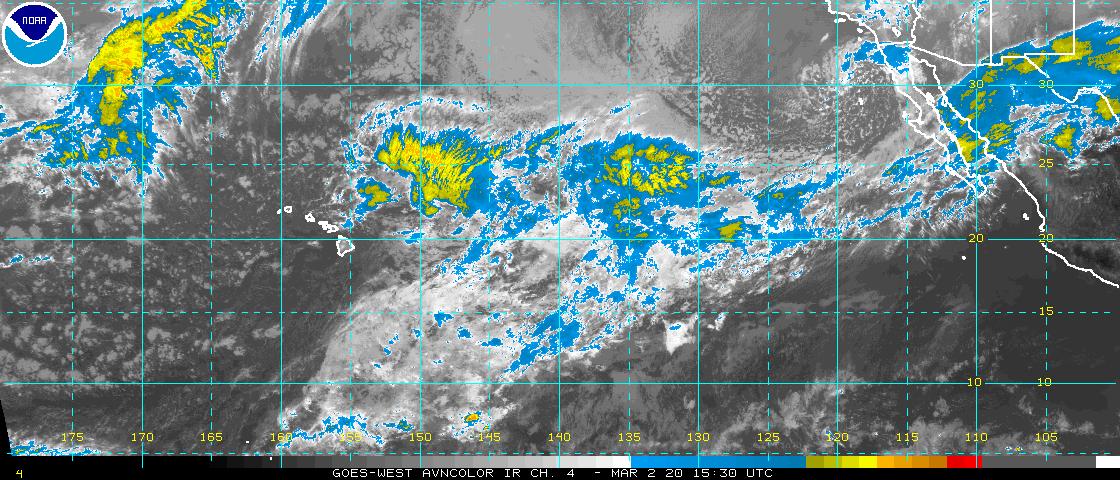
Tropical Cyclone activity in the eastern and central Pacific – Here’s the latest weather information coming out of the National Hurricane Center, covering the eastern north Pacific. You can find the latest tropical cyclone information for the central north Pacific (where Hawaii is located) by clicking on this link to the Central Pacific Hurricane Center. Here’s a tracking map covering both the eastern and central Pacific Ocean. A satellite image, which shows the entire ocean area between Hawaii and the Mexican coast…can be found here. Of course, as we know, our hurricane season won’t end until November 31st here in the central Pacific.
Aloha Paragraphs

Chinaman’s hat…windward Oahu
The trade winds will remain on the light side Friday…then increase again this weekend into early in the new week. These trade winds are lighter now as the ridge of high pressure to our north, is being weakened by low pressure systems…and their associated cold fronts in the mid-latitudes of the north Pacific. This weather map shows 1023 millibar high pressure system far to our east-northeast, moving away towards the east…supporting this lighter trade wind flow. This weather chart also shows numerous low pressure systems in the mid-latitudes of the north Pacific Ocean. As the ridge gets pumped-up again into the weekend, our trade winds will build back into the moderately strong realms, into at least the middle of the new week.
Whatever few light showers that fall, will be focused over the leeward slopes during the afternoons…at least for the most part through Friday. This means that our beaches will have favorable weather conditions through Friday. As we can see from checking this IR satellite image, there are a few clouds in our vicinity Thursday night, located over the ocean…and to some degree over the islands. As the trade winds pick up again this weekend, into early next week, we’ll see at least some increase in our windward biased showers. The computer models are suggesting that we could see an upper level low pressure system, with its cold air aloft…enhancing those showers then.
It’s Thursday evening as I begin writing this last section of today’s narrative update. The weather here in the islands will remain nice, with clear nights and early mornings. Air temperatures will likely be a little cooler than normal Friday before sunrise. Those temperatures will rebound nicely during the day Friday, with high temperatures well up into the 80F’s near sea level by the afternoon hours. As noted above, rainfall will be at a bare minimum, with most gauges remaining completely dry overnight. Looking at this large satellite view, we see some pretty dense looking high cirrus clouds heading our way from the west, which may arrive into our area sooner than later. We might even see it on our western horizon as early as Friday morning. If this high stuff does travel our way, it will cause some sun dimming, although bring colorful sunrise and sunset colors at the same time. ~~~ Here in Kihei, just before I leave for the drive back upcountry to Kula, Maui, it’s clear to partly cloudy. The winds have calmed down quite a bit now, and will remain on the light side through Friday. I’ll be back early Friday morning with your next new weather narrative, I hope you have a great Thursday night until then! Aloha for now…Glenn.
Extra: great aerial tour of the D.T. Fleming Arboretum
Interesting: The 2010 Atlantic hurricane season has been very active in the number of storms but is likely to go down as a non-event for most people in the United States, which has so far dodged a major landfall, the top official U.S. hurricane forecaster said on Tuesday. Before the June 1-Nov. 30 season got under way, residents of hurricane danger zones were warned by many forecasters they faced a very high probability of a major hurricane making landfall along the U.S. coastline.
That has not happened and with the most active part of the season winding down in the next two weeks or so, the chances of a major impact on the U.S. mainland or on energy interests in the Gulf of Mexico are ebbing. "If you just use (U.S.) landfall as a criteria and did not pay attention to the numbers, you’d think this was a really quiet year," U.S. National Hurricane Center director Bill Read told Reuters.
"A couple of relatively minor impacts and some flooding and that’s what we’d have to show for it," he said. Read said 2010 was still likely to go down in the record books as another in a string of exceptionally busy seasons, however. The United States had just been very lucky in not getting hit by a major hurricane. Hurricane Earl, which became a Category 4 hurricane on the five-step Saffir-Simpson scale of storm intensity, came the closest by approaching to about 100 miles off North Carolina and southern New England last month, Read said.
"That’s a relatively narrow escape if you look at it from the global perspective," he said. Read also noted that the 2010 Atlantic season had taken a high toll in flood and mudslide deaths in Central America and Mexico, meanwhile. An average season produces about 10 storms, of which six become hurricanes. This year has seen 15 named storms so far, with Otto forming as a subtropical storm over the Western Atlantic on Wednesday, but posing no immediate threat to land.
U.S. oil and gas installations in the Gulf of Mexico have been virtually unscathed by this year’s hurricane season, which posed an early threat to efforts to control and clean up oil spewing from the ruptured Gulf of Mexico well owned by BP, which was the worst oil spill in U.S. history. Read said the eastern portion of the Gulf and the Caribbean, along with southern Florida, were not totally out of the woods yet, however. With sea surface temperatures still very high, conditions for storm or hurricane formation, especially over the Caribbean, remain favorable, Read said.
Tropical cyclones draw energy from warm sea water. Read expressed particular concern for impoverished and nearly treeless Haiti, saying it had just been "an amazing stroke of good fortune" that the earthquake-ravaged nation had not been hit by a major storm so far this year. "They’re so vulnerable, it wouldn’t take much to cause a crisis," he said.
LANDFALLS TOUGH TO PREDICT
Though forecasters have cut their errors in predicting the track of a hurricane, Read said there were still problems in terms of their long-term "skill" in pointing to landfalls. In June, for instance, leading U.S. forecasters at Colorado State University had said the chance a major hurricane would make a landfall on the U.S. coastline this year was 76 percent compared with the last-century average of 52 percent.
But Read said it was not surprising no major hurricanes had hit the U.S. coast directly, given global oceanic and atmospheric conditions. "It’s highly dependent on where they form and the steering currents at the time," Read said, when asked about the ability to predict landfalls. "With the weather pattern that was in place and the fact that these (storms) formed so far out to the east, it’s not surprising that they turned off to the north," he said.
"As soon as you find a weakness in the big high, the Bermuda-Azores high, you’ll get that effect. That’s why Igor and Danielle and Julia among others went straight north pretty much." The weather pattern known as La Nina was also a factor behind this year’s hurricane season, since it brought wind conditions that foster Atlantic hurricanes.
La Nina is a cooling of the sea surface in the tropical Pacific and has had an impact on global weather. It tends to reduce the shearing winds that can disrupt nascent storms in the Atlantic. "In the eastern Pacific this will be one of the quietest seasons on record," Read said. "That’s what you see in a La Nina pattern, a lessening of storms in the Pacific and a greater chance of storms in the Atlantic."
Interesting2: New research suggests that climate change following massive volcanic eruptions drove Neanderthals to extinction and cleared the way for modern humans to thrive in Europe and Asia. The research, led by Liubov Vitaliena Golovanova and Vladimir Borisovich Doronichev of the ANO Laboratory of Prehistory in St. Petersburg, Russia, is reported in the October issue of Current Anthropology. "[W]e offer the hypothesis that the Neanderthal demise occurred abruptly (on a geological time-scale) … after the most powerful volcanic activity in western Eurasia during the period of Neanderthal evolutionary history," the researchers write.
"[T]his catastrophe not only drastically destroyed the ecological niches of Neanderthal populations but also caused their mass physical depopulation." Evidence for the catastrophe comes from Mezmaiskaya cave in the Caucasus Mountains of southern Russia, a site rich in Neanderthal bones and artifacts. Recent excavations of the cave revealed two distinct layers of volcanic ash that coincide with large-scale volcanic events that occurred around 40,000 years ago, the researchers say.
Geological layers containing the ashes also hold evidence of an abrupt and potentially devastating climate change. Sediment samples from the two layers reveal greatly reduced pollen concentrations compared to surrounding layers. That’s an indication of a dramatic shift to a cooler and dryer climate, the researchers say. Further, the second of the two eruptions seems to mark the end of Neanderthal presence at Mezmaiskaya. Numerous Neanderthal bones, stone tools, and the bones of prey animals have been found in the geological layers below the second ash deposit, but none are found above it.
The ash layers correspond chronologically to what is known as the Campanian Ignimbrite super-eruption which occurred around 40,000 years ago in modern day Italy, and a smaller eruption thought to have occurred around the same time in the Caucasus Mountains. The researchers argue that these eruptions caused a "volcanic winter" as ash clouds obscured the sun’s rays, possibly for years.
The climatic shift devastated the region’s ecosystems, "possibly resulting in the mass death of hominins and prey animals and the severe alteration of foraging zones." Enter Modern Humans Anthropologists have long puzzled over the disappearance of the Neanderthals and the apparently concurrent rise of modern humans. Was there some sort of advantage that helped early modern humans out-compete their doomed cousins? This research suggests that advantage may have been simple geographic location.
"Early moderns initially occupied the more southern parts of western Eurasia and Africa and thus avoided much of the direct impact of the … eruptions," the researchers write. And while advances in hunting techniques and social structure clearly aided the survival of modern humans as they moved north, they "may have further benefited from the Neanderthal population vacuum in Europe, allowing wider colonization and the establishment of strong source populations in northern Eurasia."
While the researchers stress that more data from other areas in Eurasia are needed to fully test the volcanic hypothesis, they believe the Mezmaiskaya cave offers "important supporting evidence" for the idea of a volcanic extinction.
Interesting3: Large-scale crop failures like the one that caused the recent Russian wheat crisis are likely to become more common under climate change due to an increased frequency of extreme weather events, a new study shows. However, the worst effects of these events on agriculture could be mitigated by improved farming and the development of new crops, according to the research by the University of Leeds, the Met Office Hadley Centre and University of Exeter.
The unpredictability of the weather is one of the biggest challenges faced by farmers struggling to adapt to a changing climate. Some areas of the world are becoming hotter and drier, and more intense monsoon rains carry a risk of flooding and crop damage. A summer of drought and wildfires has dramatically hit harvests across Russia this year, leading the government to place a ban on wheat exports.
This led to a dramatic rise prices on the international commodity markets which is likely to have a knock-on effect in higher prices of consumer goods. But the authors of the new study, which appears in Environmental Research Letters, argue that adaptation to climate change be possible through a combination of new crops that are more tolerant to heat and water stress, and socio-economic measures such as greater investment.
Lead author Dr Andy Challinor, from the University of Leeds School of Earth and Environment, said: "Due to the importance of international trade crop failure is an issue that affects everyone on the planet, not just those in crop-growing regions. "More extreme weather events are expected to occur in the coming years due to climate change and we have shown that these events are likely to lead to more crop failures.
What we need to do now is think about the solutions. "It is highly unlikely that we will find a single intervention that is a ‘silver bullet’ for protecting crops from failure. What we need is an approach that combines building up crop tolerance to heath and water stress with socio-economic interventions." The team studied spring wheat crops in North East China. They used a climate model to make weather projections up to the year 2099 and then looked at the effect on crop yields.
In parallel they looked at socioeconomic factors to determine how well farmers were able to adapt to drought. While the study only looked at crops in China, the authors say this methodology can be applied to many of the other major crop-growing regions around the globe. Study co-author Dr Evan Fraser, also of the University of Leeds, said: "It appears that more developed countries with a higher GDP tend to evolve more advanced coping mechanisms for extreme events.
In China this is happening organically as the economy is growing quickly, but poorer regions such as Africa are likely to require more in the way of aid for such development. "What is becoming clear is that we need to adopt a holistic approach: new crops for a changing climate and better farming practices that can only come about under more favorable socio-economic conditions."
The team will now expand their research to look at other crops in different regions and they will look more closely at the reasons why increased GDP appears to protect against drought.
Interesting4: In recent decades documented biological changes in the far Northern Hemisphere have been attributed to global warming, changes from species extinctions to shifting geographic ranges. Such changes were expected because warming has been fastest in the northern temperate zone and the Arctic. But new research published in the Oct. 7 edition of Nature adds to growing evidence that, even though the temperature increase has been smaller in the tropics, the impact of warming on life could be much greater there than in colder climates.
The study focused on ectothermic, or cold-blooded, organisms (those whose body temperature approximates the temperature of their surroundings). Researchers used nearly 500 million temperature readings from more than 3,000 stations around the world to chart temperature increases from 1961 through 2009, then examined the effect of those increases on metabolism.
"The expectation was that physiological changes would also be greatest in the north temperate-Arctic region, but when we ran the numbers that expectation was flipped on its head," said lead author Michael Dillon, an assistant professor of zoology and physiology at the University of Wyoming. Metabolic changes are key to understanding some major impacts of climate warming because a higher metabolic rate requires more food and more oxygen, said co-author Raymond Huey, a University of Washington biology professor.
If, for example, an organism has to spend more time eating or conserving energy, it might have less time and energy for reproduction. "Metabolic rate tells you how fast the animal is living and thus its intensity of life," Huey said. Using a well-documented, century-old understanding that metabolic rates for cold-blooded animals increase faster the warmer the temperature, the researchers determined that the effects on metabolism will be greatest in the tropics, even though that region has the smallest actual warming.
Metabolic impacts will be less in the Arctic, even though it has shown the most warming. In essence, organisms in the tropics show greater effects because they start at much higher temperatures than animals in the Arctic. Dillon and co-author George Wang of the Max Planck Institute for Developmental Biology in Tübingen, Germany, sifted through temperature data maintained by the National Oceanic and Atmospheric Administration’s National Climatic Data Center.
They came up with readings from 3,186 stations that met their criteria of recording temperature at least every six hours during every season from 1961 through 2009. The stations, though not evenly spaced, represented every region of the globe except Antarctica. The data, the scientists said, reflect temperature changes since 1980 that are consistent with other recent findings that show the Earth is getting warmer.
Temperatures rose fastest in the Arctic, not quite as fast in the northern temperate zone and even more slowly in the tropics. "Just because the temperature change in the tropics is small doesn’t mean the biological impacts will be small," Huey said. "All of the studies we’re doing suggest the opposite is true."
In fact, previous research from the University of Washington has indicated that small temperature changes can push tropical organisms beyond their optimal body temperatures and cause substantial stress, while organisms in temperate and polar regions can tolerate much larger increases because they already are used to large seasonal temperature swings.
The scientists say the effects of warming temperatures in the tropics have largely been ignored because temperature increases have been much greater farther north and because so few researchers work in the tropics. "I think this argues strongly that we need more studies of the impacts of warming on organisms in the tropics," Dillon said.
 Email Glenn James: