











October 5-6, 2010
Air Temperatures – The following maximum temperatures were recorded across the state of Hawaii Tuesday afternoon:
Lihue airport, Kauai – 82
Honolulu airport, Oahu – 89
Kaneohe MCAS, Oahu – 84
Molokai airport – 88
Kahului airport, Maui – 90
Ke-ahole airport (Kona) – 86
Hilo airport, Hawaii – 79
Air Temperatures ranged between these warmest and coolest spots near sea level – and on the highest mountain tops…as of 5pm Tuesday evening:
Kahului, Maui – 84
Hilo, Hawaii – 76
Haleakala Crater – 52 (near 10,000 feet on Maui)
Mauna Kea summit – 43 (near 14,000 feet on the Big Island)
Precipitation Totals – The following numbers represent the largest precipitation totals (inches) during the last 24 hours on each of the major islands, as of Tuesday afternoon:
2.91 Mount Waialeale, Kauai
0.39 Wilson Tunnel, Oahu
0.00 Molokai
0.00 Lanai
0.00 Kahoolawe
2.09 West Wailuaiki, Maui
2.18 Glenwood, Big Island
Marine Winds – Here’s the latest (automatically updated) weather map showing a 1033 millibar high pressure system far to the northeast of our islands. Our local trade winds will begin slowing down Wednesday into Thursday.
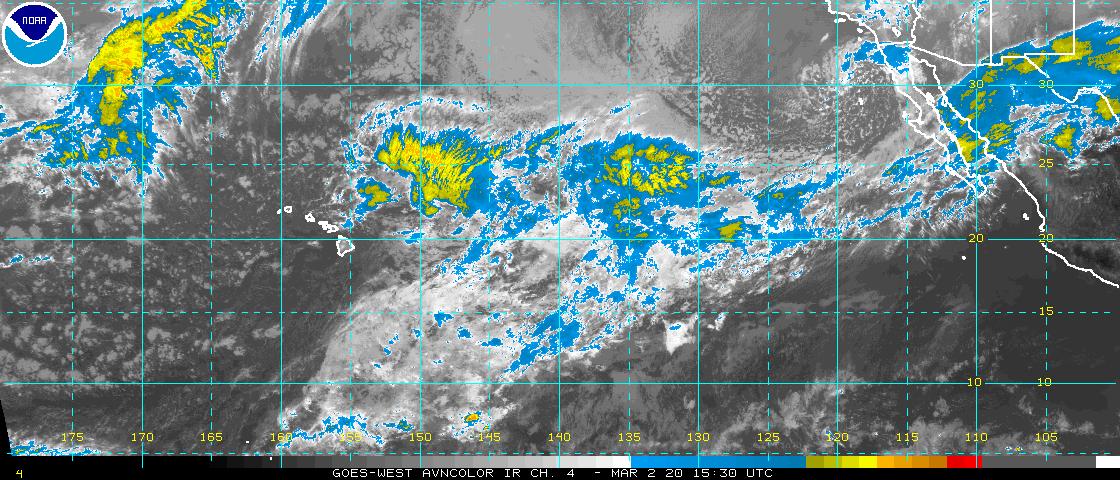
Satellite and Radar Images: To view the cloud conditions we have here in Hawaii, please use the following satellite links, starting off with this Infrared Satellite Image of the islands to see all the clouds around during the day and night. This next image is one that gives close images of the islands only during the daytime hours, and is referred to as a Close-up visible image. This next image shows a larger view of the Pacific…giving perspective to the wider ranging cloud patterns in the Pacific Ocean. Finally, here’s a Looping IR satellite image, making viewable the clouds around the islands 24 hours a day. To help you keep track of where any showers may be around the islands, here’s the latest animated radar image.
Hawaii’s Mountains – Here’s a link to the live webcam on the summit of near 14,000 foot Mauna Kea on the Big Island of Hawaii. The tallest peak on the island of Maui is the Haleakala Crater, which is near 10,000 feet in elevation. These two webcams are available during the daylight hours here in the islands…and when there’s a big moon rising just after sunset for an hour or two! Plus, during the nights and early mornings you will be able to see stars, and the sunrise too…depending upon weather conditions.
Tropical Cyclone activity in the eastern and central Pacific – Here’s the latest weather information coming out of the National Hurricane Center, covering the eastern north Pacific. You can find the latest tropical cyclone information for the central north Pacific (where Hawaii is located) by clicking on this link to the Central Pacific Hurricane Center. Here’s a tracking map covering both the eastern and central Pacific Ocean. A satellite image, which shows the entire ocean area between Hawaii and the Mexican coast…can be found here. Of course, as we know, our hurricane season won’t end until November 31st here in the central Pacific.
Aloha Paragraphs

The bright colors and food of old Hawaii
The trade winds will slip into the light to moderately strong range Wednesday into Friday…then rebound this weekend. The winds are still strong enough Tuesday night, that small craft wind advisories remain active across those windiest areas on Maui and the Big Island. The computer models continue to suggest that we we’ll see the trade winds becoming lighter, as our trade wind producing ridge of high pressure…gets pushed down closer to the islands by mid-week. This will happen as low pressure systems, and their associated cold fronts further to the north, extend their influence southward.
The trades will continue to carry clouds our way, which will bring off and on showers to our windward sides, although as the trade winds ease up around mid-week…so will the showers. The leeward sides will remain quite dry, with lots of daytime sunshine beaming down. There will be those occasional windward biased showers, although they won’t bring very much rainfall to our islands in general. All things considered, everything looks pretty good through the rest of this week in terms of any precipitation.
It’s Tuesday evening as I begin writing this last section of today’s narrative update. The weather here in Kihei, Maui looks nice outside, with partly cloudy conditions in most directions. I’m about ready to take the 40 minute or so drive back upcountry to Kula now. I know that may sound like quite a ways to many of you, although the upcountry area is very special, at least in my humble opinion. I’ve always enjoyed driving anyway, and look forward to listening to National Public Radio on the way to and from work. I’ll be back early Wednesday morning with your next new weather narrative, I hope you have a great Tuesday night until then! Aloha for now…Glenn.
Interesting: Researchers have uncovered the largest geothermal hot spot in the eastern United States. According to a unique collaboration between Google and academic geologists, West Virginia sits atop several hot patches of Earth, some as warm as 200?C and as shallow as 5 kilometers.
If engineers are able to tap the heat, the state could become a producer of green energy for the region. In 2004, researchers at Southern Methodist University (SMU) in Dallas, Texas, and colleagues created the Geothermal Map of North America. The map charted the potential for geothermal energy nationwide. Two years ago Google.org, the philanthropic arm of the search engine giant, hired the SMU scientists to update the map.
The group analyzed temperature data from oil and gas firms that no one had bothered to map. Those data were collected via single thermometer readings on the end of drilling equipment, but the readings were artificially low because of water used to cool and wash the equipment. So the SMU team corrected the readings according to the rock type that was being drilled.
Then the researchers estimated the temperatures of adjacent rock layers according to their geologic properties. The work revealed surprising results for West Virginia, a state that had only four data points in the 2004 map. The Google.org-funded effort added measurements from more than 1450 wells in the state. The warm spots were found at depths of 3 to 8 kilometers over an 18,700-square-kilometer area.
By comparison, geothermal hot spots in Nevada reach 200?C at 2 kilometers below the surface, and steam produced from them runs turbines to create electricity. Iceland, meanwhile, has 200?C temperatures just below the surface and uses warm water to heat buildings and showers throughout Reykjavik and elsewhere.
Interesting2: A new review article explores natural crustal earthquakes associated with the elements of the hydrologic cycle, which describes the continuous movement of water on, above and below the surface of the Earth, including hurricanes and typhoons. The theory of hydro-seismicity, first articulated in 1987, attributes most intra-plate and near-intra-plate earthquakes, to the dynamics of the hydrological cycle.
The Hydro-seismicity hypothesis suggests variations in rainfall affect pore-fluid pressure at depth and can trigger earthquakes in areas already under stress and near failure. This report cites documentation of metrological events — rainfall, stream flow, hurricanes — and observed seismic activity by more than 20 research teams across five continents, providing thorough testing and support of the Hydro-seismicity hypothesis.
The authors suggest that the reported correlations between meteorological events and seismicity indicate the need for more local and regional earthquake monitoring networks as well as additional stream gauging stations. In the future it should be possible to discover and quantify causal relationships between earthquakes and meteorological parameters when better focal depths and more stream gauging stations become available. Groundwater hydrology measurements and earthquake monitoring and forecasting might eventually complement each other.
Interesting3: After a decade of joint work and scientific adventure, marine explorers from more than 80 countries delivered a historic first global Census of Marine Life. In one of the largest scientific collaborations ever conducted, more than 2,700 Census scientists spent over 9,000 days at sea on more than 540 expeditions, plus countless days in labs and archives. Released Oct. 4 are maps, three landmark books, and a highlights summary that crown a decade of discovery.
The now-completed documentation in books and journals, plus the accumulating databases and established websites, videos, and photo galleries report and conclude the first Census. Over the decade more than 2,600 academic papers were published — one, on average, every 1.5 days. Presented is an unprecedented picture of the diversity, distribution, and abundance of all kinds of marine life in Planet Ocean — from microbes to whales, from the icy poles to the warm tropics, from tidal near shores to the deepest dark depths.
Oceanic diversity is demonstrated by nearly 30 million observations of 120,000 species organized in the global marine life database of the Census, the Ocean Bio-geographic Information System (OBIS). The migrations tracked across seas and up and down in the water column, plus the revealed ubiquities of many species, demonstrate connections among oceans. Comparisons of the present ocean with the bountiful ocean life portrayed in old archives document changes.
The Census established declines — and some recoveries — of marine abundance. The OBIS directory of names and addresses of known ocean species establishes a reference against which humanity can monitor 21st century change. It also delineates the vast areas of ocean that have never been explored. "We prevailed over early doubts that a Census was possible, as well as daunting extremes of nature," says Australian Ian Poiner, chair of the Census Steering Committee.
"The Age of Discovery continues." "This cooperative international 21st century voyage has systematically defined for the first time both the known and the vast unknown, unexplored ocean." According to Dr. Poiner, the beauty, wonder, and importance of marine life are hard to overstate. "All surface life depends on life inside and beneath the oceans.
Sea life provides half of our oxygen and a lot of our food and regulates climate. We are all citizens of the sea. And while much remains unknown, including at least 750,000 undiscovered species and their roles, we are better acquainted now with our fellow travelers and their vast habitat on this globe."
Interesting4: US President Barack Obama’s science advisor, John Holdren, took on climate change deniers in a comprehensive, data-heavy speech last month at the Kavli Science Forum in Oslo, Norway. Proclaiming that "the earth is getting hotter", Holden went on to enumerate on the causes of climate change (human impacts) and its overall effect (not good), discussing at length the science that underpins the theory of climate change.
For environmentalists and international officials frustrated with the US’s slow pace on combating climate change—which is decades behind Europe’s and many other nations’—Holdren touted that the Obama Administration had made progress on the issue and stated that the administration plans to pursue legislation again after a new congress is elected.
However, given current predictions that Republicans will pick up seats in November, comprehensive climate and energy legislation seems unlikely since historically the majority of the GOP has been against tackling climate change.
Yet, Holdren argued that "most people are perhaps not sufficiently aware of the number of ways in which climate affects our well being," citing how climate impacts not just weather patterns, but availability of water; the productivity of agriculture, forests, and fisheries; the spread of disease; the need for funds to be spent on adaptation; and the survival of the world’s species.
Much of Holdren’s speech addressed what he called the "five myths" of climate change, including that argument that warming is natural, that climate change impacts are far on the horizon, and that climate change won’t be bad for society. Systematically taking on each of these ‘myths’, often touted by climate change deniers,
Holdren argued that for most of the world unmitigated climate change would mean massive disruptions to society and exponential increases in human suffering. "[Current climate change] is rapid compared to the capacities for adjustment, the capacities of ecosystems, and the capacity of social and economic systems to adjust, and it is going to be harmful for most places and most times," Holdren said. "Some places for some time will get some benefits from climate change, but most places for most times and increasingly so going forward will suffer harm."
 Email Glenn James: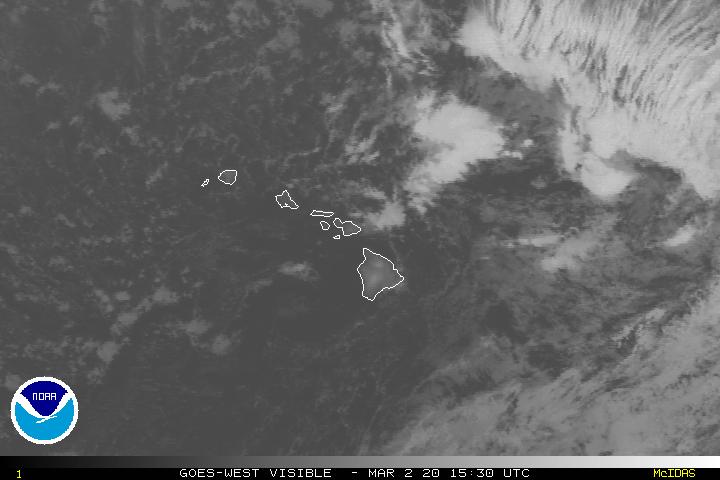

Alwyn Clarke Says:
Interesting 2— Hi glen im from Christchurch New Zealand,have been to your paradise many times over the years windsurfing and just getting in to island life,anyway we have had a earthquake here a few weeks back 7.2, this winter has been the wettest on record and relates to what you put up on your site,our ground has been sodden for months.
first hand news ,the quake forced us to cancel our trip to Maui this year but re-booked for next July ye ha
thanks Al~~~Hi Al, wow, all the way down in NZ, coming to Maui…that must be a trip! Sorry to hear of your canceled trip this time around, but I’m sure you have a fabulous time this coming summer. I’ll bet you are ready for this spring season down there, as we head further into our autumn season towards winter. Thanks for checking in! Aloha, Glenn