October 4-5, 2010
Air Temperatures – The following maximum temperatures were recorded across the state of Hawaii Monday afternoon:
Lihue airport, Kauai – 86
Honolulu airport, Oahu – 87
Kaneohe MCAS, Oahu – 81
Molokai airport – 87
Kahului airport, Maui – 87
Ke-ahole airport (Kona) – 86
Hilo airport, Hawaii – 82
Air Temperatures ranged between these warmest and coolest spots near sea level – and on the highest mountain tops…as of 5pm Monday evening:
Port Allen, Kauai – 84
Hilo, Hawaii – 79
Haleakala Crater – 48 (near 10,000 feet on Maui)
Mauna Kea summit – 41 (near 14,000 feet on the Big Island)
Precipitation Totals – The following numbers represent the largest precipitation totals (inches) during the last 24 hours on each of the major islands, as of Monday afternoon:
0.86 Mount Waialeale, Kauai
0.62 Oahu Forest NWR, Oahu
0.06 Molokai
0.00 Lanai
0.01 Kahoolawe
0.96 West Wailuaiki, Maui
0.76 Glenwood, Big Island
Marine Winds – Here’s the latest (automatically updated) weather map showing a 1028 millibar high pressure system far to the northeast of our islands…moving eastward. Our local trade winds will be moderately strong Monday…slowing down Tuesday.
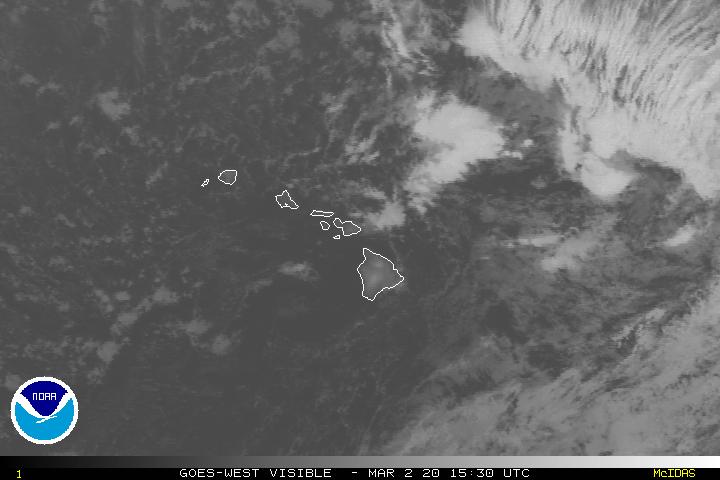
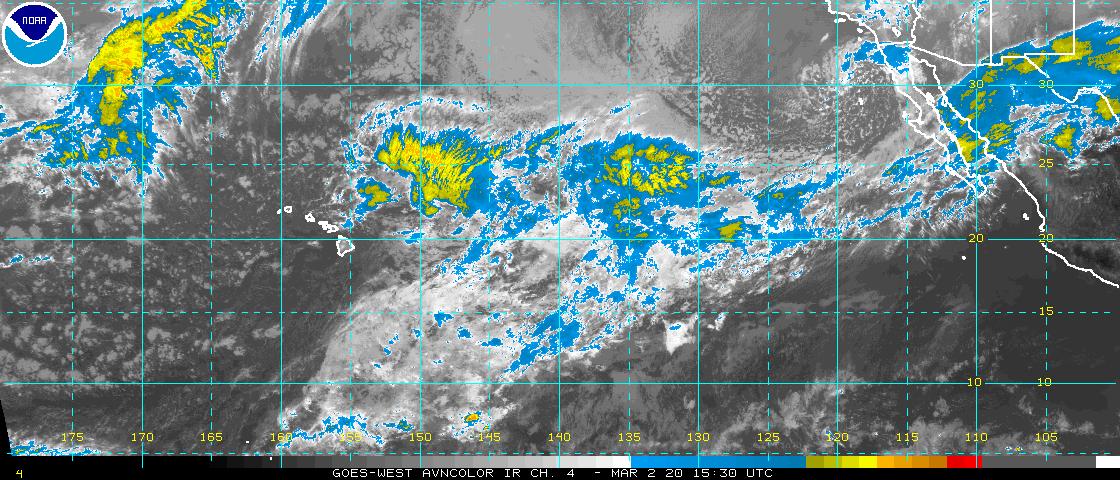
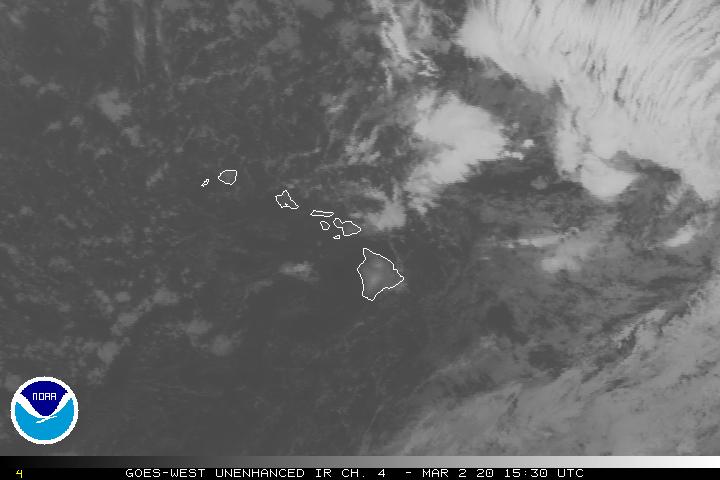
Satellite and Radar Images: To view the cloud conditions we have here in Hawaii, please use the following satellite links, starting off with this Infrared Satellite Image of the islands to see all the clouds around during the day and night. This next image is one that gives close images of the islands only during the daytime hours, and is referred to as a Close-up visible image. This next image shows a larger view of the Pacific…giving perspective to the wider ranging cloud patterns in the Pacific Ocean. Finally, here’s a Looping IR satellite image, making viewable the clouds around the islands 24 hours a day. To help you keep track of where any showers may be around the islands, here’s the latest animated radar image.
Hawaii’s Mountains – Here’s a link to the live webcam on the summit of near 14,000 foot Mauna Kea on the Big Island of Hawaii. The tallest peak on the island of Maui is the Haleakala Crater, which is near 10,000 feet in elevation. These two webcams are available during the daylight hours here in the islands…and when there’s a big moon rising just after sunset for an hour or two! Plus, during the nights and early mornings you will be able to see stars, and the sunrise too…depending upon weather conditions.
Tropical Cyclone activity in the eastern and central Pacific – Here’s the latest weather information coming out of the National Hurricane Center, covering the eastern north Pacific. You can find the latest tropical cyclone information for the central north Pacific (where Hawaii is located) by clicking on this link to the Central Pacific Hurricane Center. Here’s a tracking map covering both the eastern and central Pacific Ocean. A satellite image, which shows the entire ocean area between Hawaii and the Mexican coast…can be found here. Of course, as we know, our hurricane season won’t end until November 31st here in the central Pacific.
Aloha Paragraphs

We love our Hula Dancers!
The trade winds will remain moderately strong, or a little more than that locally, then gradually lose strength beginning Tuesday…on into the rest of week. The winds are still strong enough Monday night, that small craft wind advisories remain active across those windiest areas on Maui and the Big Island. The computer models continue to suggest that we we’ll see the trade winds becoming lighter, as our trade wind producing ridge of high pressure…gets pushed down closer to the islands. This will happen as low pressure systems further to the north, extend their influence southward.
The trades will continue to carry clouds our way, which will bring off and on showers to our windward sides, although as the trade winds ease up…so will the showers. These incoming clouds will be most shower prone at night, and likely around the Big Island beginning tonight into Tuesday. The leeward sides will in contrast remain quite dry, with lots of daytime sunshine beaming down. The sun will be shining from a somewhat lower angle, given that we’re into the autumn season…although it will still feel nice and warm both during the days and at night near sea level.
It’s Monday evening as I begin writing this last section of today’s narrative update. The trade winds are still the dominate weather feature, as they often are pretty much year round. These winds have been pretty fresh the last several days, and will remain that way for the time being. Gale and storm low pressure systems far to the north, will keep our trade wind producing high pressure ridge pressed southward enough though, that our winds will ease up some over the next couple of days. They won’t stop altogether by any means, although will slip down into somewhat lighter realms. The winds have veered slightly to the southeast or east-southeast, as noted on this weather map. This may help to carry some extra showers towards the south and east sides of the Big Island…and to perhaps Maui and Molokai at times into Tuesday too. Here’s a satellite image showing those showery looking clouds just to the southeast of the Big Island. Otherwise, precipitation won’t play a big part in our Hawaiian Island weather picture this week ~~~ Here in Kihei, Maui, before I head back upcountry, its mostly clear and sunny, except for those clouds over the Haleakala Crater, and the West Maui Mountains. The trade winds are still pretty gusty, with the strongest gust of 42 mph being reported on the small island of Kahoolawe. As far as temperatures go at 5pm, the warmest report was the 84F degree reading at Port Allen, Kauai. I’ll be back early Tuesday morning with your next new weather narrative from paradise…I hope you have a great Monday night until then! Aloha for now…Glenn.
Interesting: Geologists have found evidence that some 55 million years ago a river as big as the modern Colorado River flowed through Arizona into Utah in the opposite direction from the present-day river. Writing in the October issue of the journal Geology, they have named this ancient northeastward-flowing river the California River, after its inferred source in the Mojave region of southern California.
Though the Rocky Mountains seem tall and unchanging, they were not always there. Similarly there have been many climatic variations in the area. At one time (merely 14,000 years ago) there was a huge lake in Utah called Lake Bonneville to which local rivers led. Lead author Steven Davis, a post-doctoral researcher in the Department of Global Ecology at the Carnegie Institution, and his colleagues* discovered the ancient river system by comparing sedimentary deposits in Utah and southwest Arizona.
By analyzing the uranium and lead isotopes in sand grains made of the mineral zircon, the researchers were able to determine that the sand at both localities came from the same source — igneous bedrock in the Mojave region of southern California. The river deposits in Utah, called the Colton Formation by geologists, formed a delta where the ancient river emptied into a large lake. The formation is 1400 feet thick.
They are more than 400 miles to the northeast of their source in California and about 140 miles south east of present day Salt Lake City in a region now more desert than river. "The river was on a very similar scale to the modern Colorado-Green River system," says Davis, "but it flowed in the opposite direction."
The modern Colorado River’s headwaters are in the Rocky Mountains, flowing southeast to the river’s mouth in the Gulf of California. The deposits of the Colton Formation are approximately 55 million years old. Recently, other researchers have speculated that rivers older than the Colorado River may have carved an ancestral or "proto" Grand Canyon around this time, long before the present Colorado began eroding the canyon less than 20 million years ago. Davis sees no evidence of this.
"The Grand Canyon would have been on the river’s route as it flowed from the Mojave to Utah, he says. "It stands to reason that if there was major erosion of a canyon going on we would see lots of zircon grains from that area, but we don’t." The mighty California River likely met its end as the Rocky Mountains rose and the northern Colorado Plateau tilted, reversing the slope of the land surface and the direction of the river’s flow to create the present Colorado-Green River system.
Davis and his colleagues have not determined precisely when the change occurred, however. "The river could have persisted for as long as 20 million years before the topography shifted enough to reverse its flow." The Rocky Mountains rose over a period of time ranging from 80 to 35 million years ago.
Interesting2: A planned study of possible new wilderness protections for the Arctic National Wildlife Refuge has sparked a furor in Alaska, where energy companies have long dreamed of tapping oil reserves beneath its vast coastal plain home to herds of migrating animals. The U.S. Fish and Wildlife Service effort announced this week is part of a sweeping review of a land-management plan for what is the second-largest national wildlife refuge in the United States.
The agency stresses that its work is just starting and that a formal draft is not expected until next year. But the oil industry and its political allies regard it as a prelude to an attempt to keep the refuge off-limits to energy production for good by formally declaring its remote coastal tundra as wilderness. "Alaska will not allow the federal government to lock up more land without a fight," Governor Sean Parnell said this week.
The Alaska Wilderness League, for its part, accuses oil companies of trying to destroy a refuge that represents the only place on Alaska’s North Slope that is legislatively closed to development. "The Arctic Refuge is one of the last true wilderness areas left in the United States — some places are just too special to sacrifice to oil and gas development," said Cindy Shogan, the league’s executive director.
Interesting3: Scientists have identified a way that the United States could immediately save the energy equivalent of about 350 million barrels of oil a year — without spending a penny or putting a ding in the quality of life: Just stop wasting food. Their study, reported in ACS’ semi-monthly journal Environmental Science & Technology, found that it takes the equivalent of about 1.4 billion barrels of oil to produce, package, prepare, preserve and distribute a year’s worth of food in the United States.
Michael Webber and Amanda Cuéllar note that food contains energy and requires energy to produce, process, and transport. Estimates indicate that between 8 and 16 percent of energy consumption in the United States went toward food production in 2007. Despite this large energy investment, the U.S. Department of Agriculture estimates that people in the U.S. waste about 27 percent of their food.
The scientists realized that the waste might represent a largely unrecognized opportunity to conserve energy and help control global warming. Their analysis of wasted food and the energy needed to ready it for consumption concluded that the U.S. wasted about 2030 trillion BTU of energy in 2007, or the equivalent of about 350 million barrels of oil. That represents about 2 percent of annual energy consumption in the U.S.
"Consequently, the energy embedded in wasted food represents a substantial target for decreasing energy consumption in the U.S.," the article notes. "The wasted energy calculated here is a conservative estimate both because the food waste data are incomplete and outdated and the energy consumption data for food service and sales are incomplete."
Interesting4: Research by a Kingston University MA student has led her to design a door which could be used as a shelter after an earthquake. Younghwa Lee has been working on the project which, she hopes, could save hundreds of lives in countries where there is a risk of earthquakes. The MA Design: Product and Space student was motivated by the terrible loss of life in Haiti earlier this year to design a door, which can collapse so that it becomes a protective shelter.
"My starting point was the inherent strength of a door frame within a wall — they often remain standing when many of the supporting walls fall down. Also there are more doors inside most homes than there are people so everyone in the house should be able to find a door," Younghwa, who is studying on the MA Design: Product and Space course, said. Initially, Younghwa’s door looks unremarkable but, in an emergency, it can swivel horizontally on a central pivot a little less than a meter above the ground.
At the same time, the door folds horizontally so the bottom half of it remains on the ground, anchoring it to the floor and providing additional protection. There is a small cabinet built into the door frame in which Younghwa has housed a wind-up torch, sachets of drinking water and medical supplies. "There should be enough room for two people to huddle under each door," she said.
The student, who came to Kingston from the South Korean capital Seoul in 2009, says it should take only five seconds to convert the door into a makeshift protective capsule. Younghwa decided to tackle the impact of a natural disaster while she was sitting, frustrated, at Seoul airport when her flight back to the United Kingdom was delayed by the cloud of volcanic ash earlier this year. With the catastrophe in Haiti occurring only a few months earlier, she decided to focus on earthquakes.
"Once an earthquake starts there are usually up to 15 seconds of relatively ‘safe’ vertical vibration before the destructive horizontal vibration starts," Younghwa explained. "The guidance for building occupants during an earthquake is to remain inside the building and take shelter under a strong table. My door is designed to be stronger and more stable than a table and — as it isn’t a flat surface — most debris will slide off it."
Younghwa, 31, based her research on Istanbul as the US Geological Survey has estimated there is a 70 per cent chance the city will be hit by an earthquake measuring 7.6 on the richter scale before 2030, potentially killing as many as 150,000 people. She believes her doors could be inexpensively incorporated in many of the city’s homes.
Kingston University’s Design: Product and Space course leader Colin Holden said "Younghwa was brave to take on this kind of project because it would soon be very obvious if it didn’t work. The principle of her final product is so simple and credible it makes you wonder why it doesn’t already exist, and that’s a rare achievement. I hope she pursues it further."
Interesting5: After a major review of scientific information, six leading tobacco research and policy experts have concluded that a nicotine reduction strategy should be an urgent research priority because of its potential to profoundly reduce the death and disease from tobacco use. Their findings were published in the journal Tobacco Control. According to this new report, reducing the amount of nicotine in cigarettes to non-addictive levels could have a significant public health impact on prevention and smoking cessation.
Over time, the move could dramatically reduce the number of annual deaths related to cigarette smoking by decreasing adolescent experimentation with cigarettes preventing a progression to addiction, and by reducing dependence on tobacco among currently addicted smokers of all ages. Dorothy Hatsukami, Ph.D., University of Minnesota Medical School, and Mitch Zeller, J.D., Pinney Associates in Bethesda, MD, led the overall effort as co-chairs of the National Cancer Institute’s Tobacco Harm Reduction Network.
They convened several meetings of researchers, policy makers, tobacco control advocates and government representatives that explored the science base for a nicotine reduction strategy. Currently, about 44 million (or 20 percent) of adults in the United States smoke cigarettes. Other research cited by the authors had found that reducing nicotine to non-addictive levels could potentially reduce smoking prevalence to about 5 percent. "Nicotine addiction sustains tobacco use.
Quitting tobacco can be as difficult to overcome as heroin or cocaine addiction," said Hatsukami, director of the University of Minnesota’s Tobacco Use Research Center and the Masonic Cancer Center’s Cancer Control and Prevention Research Program "Reducing the nicotine in cigarettes to a level that is non-addicting could have a profound impact on reducing death and disability related to cigarettes and improving overall public health."
Hatsukami adds that studies to date have found that substantial reduction in nicotine in cigarettes does not lead to smokers smoking more lower-nicotine cigarettes because it is harder to compensate for very low nicotine intake. "In addition, studies have shown a significantly lower number of cigarettes are smoked when low-nicotine cigarettes are used, resulting in eventual abstinence in a considerable number of smokers," she said.
"Imagine a world where the only cigarettes that kids could experiment with would neither create nor sustain addiction," Zeller said. "The public health impact of this would be enormous if we can prevent youthful experimentation from progressing to regular smoking, addiction, and the resulting premature disease and death later.
Reducing the nicotine content in cigarettes may be a very effective way to accomplish this major impact," he added. Hatsukami, Zeller, and their colleagues recommend engaging scientific, research and government agencies to conduct the necessary research and set priorities and goals as the next step toward determining the feasibility of a nicotine reduction approach.
 Email Glenn James: