October 2-3, 2010
Air Temperatures – The following maximum temperatures were recorded across the state of Hawaii Saturday afternoon:
Lihue airport, Kauai – 86
Honolulu airport, Oahu – 87
Kaneohe MCAS, Oahu – 83
Molokai airport – 83
Kahului airport, Maui – 85
Ke-ahole airport (Kona) – 82
Hilo airport, Hawaii – 82
Air Temperatures ranged between these warmest and coolest spots near sea level – and on the highest mountain tops…as of 4pm Saturday afternoon:
Port Allen, Kauai – 86
Hilo, Hawaii – 79
Haleakala Crater – 48 (near 10,000 feet on Maui)
Mauna Kea summit – 41 (near 14,000 feet on the Big Island)
Precipitation Totals – The following numbers represent the largest precipitation totals (inches) during the last 24 hours on each of the major islands, as of Saturday afternoon:
0.80 Mount Waialeale, Kauai
1.75 Oahu Forest NWR, Oahu
0.24 Molokai
0.00 Lanai
0.09 Kahoolawe
2.99 Puu Kukui, Maui
1.26 Pohakuloa Keamuku, Big Island
Marine Winds – Here’s the latest (automatically updated) weather map showing high pressure systems to the north of our islands. Our local trade winds will be moderately strong Sunday and Monday.
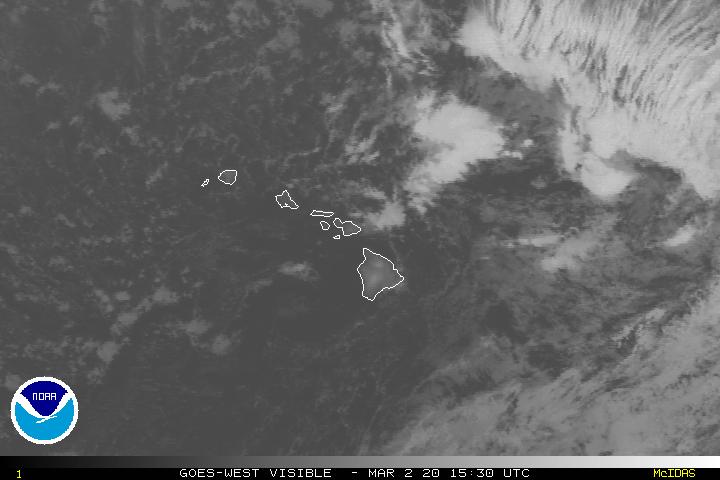
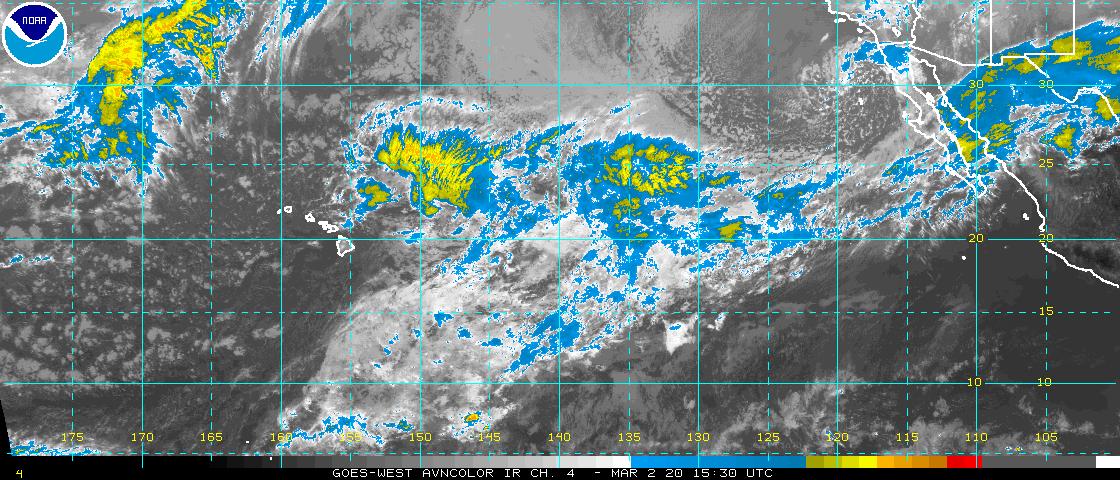
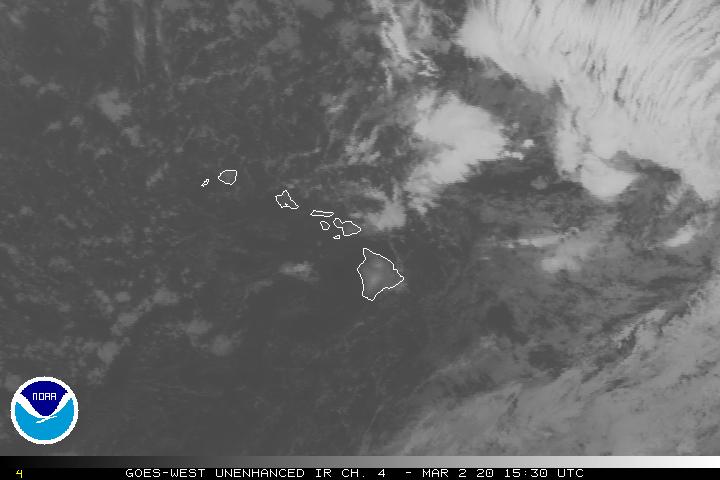
Satellite and Radar Images: To view the cloud conditions we have here in Hawaii, please use the following satellite links, starting off with this Infrared Satellite Image of the islands to see all the clouds around during the day and night. This next image is one that gives close images of the islands only during the daytime hours, and is referred to as a Close-up visible image. This next image shows a larger view of the Pacific…giving perspective to the wider ranging cloud patterns in the Pacific Ocean. Finally, here’s a Looping IR satellite image, making viewable the clouds around the islands 24 hours a day. To help you keep track of where any showers may be around the islands, here’s the latest animated radar image.
Hawaii’s Mountains – Here’s a link to the live webcam on the summit of near 14,000 foot Mauna Kea on the Big Island of Hawaii. The tallest peak on the island of Maui is the Haleakala Crater, which is near 10,000 feet in elevation. These two webcams are available during the daylight hours here in the islands…and when there’s a big moon rising just after sunset for an hour or two! Plus, during the nights and early mornings you will be able to see stars, and the sunrise too…depending upon weather conditions.
Tropical Cyclone activity in the eastern and central Pacific – Here’s the latest weather information coming out of the National Hurricane Center, covering the eastern north Pacific. You can find the latest tropical cyclone information for the central north Pacific (where Hawaii is located) by clicking on this link to the Central Pacific Hurricane Center. Here’s a tracking map covering both the eastern and central Pacific Ocean. A satellite image, which shows the entire ocean area between Hawaii and the Mexican coast…can be found here. Of course, as we know, our hurricane season won’t end until November 31st here in the central Pacific.
Aloha Paragraphs

Hammock on Kauai
The trade winds will remain moderately strong Sunday…continuing on into at least the middle of the new week ahead. The winds have become strong enough now, that small craft wind advisories have become active across those windiest areas on Maui and the Big Island. The latest computer model output continues to suggest that we could see the trade winds becoming lighter again during the second half of the upcoming new work week.
The atmosphere has become much less shower prone, with drier weather on tap through the rest of this early autumn weekend. There’s still the chance that a few showers will stick around, although generally restricted to the windward sides…especially on the Big Island. Fair weather conditions will carry forth into the new work week, with a nice trade wind weather pattern prevailing.
It’s Saturday as I begin writing this last section of today’s narrative update. The weather here in the islands had been quite cloudy the last few days, although those clouds have cleared away nicely now. I expect that the windward sides will see a few showers this weekend. Here’s a satellite image showing the clouds around the islands. There’s still a few wisps of high cirrus clouds around, especially for the islands from Kauai down through Oahu…which wil likely provide a nice sunset…Maui County too!
~~~ I went to see a new film after work Friday evening, called Wall Street: Money never Sleeps 2010, starring Michael Douglas and Shia LaBeouf, Carey Mulligan…among others. The synopsis: Gordon Gecko emerges from a lengthy prison stint, into a much harsher financial world than the one he left. The critics have given this film a B- grade, while the viewers have upped that to a solid B grade. Here’s a trailer in case you’re interested in seeing it. I went to see this film with a friend, who gave this film a C+, while I enjoyed it somewhat more than that, gracing it with a solid B grade. I thought the cinematography of New York City was great, I really like the music track, and enjoyed the film quite a bit overall. I enjoyed the characters, and all the wall street money stuff too.
~~~ Here in Kula Maui this evening, we find lots of clear skies, in contrast to how the day began. The trade winds are back with us now, with the strongest gust at the moment 35 mph, at this windy Maalaea Bay. The air temperature here on the west slope of the Haleakala Crater, at 5pm was a nice warm 75.2F degrees. I still see those few wisps of high clouds on the western horizon, which if they stick around long enough, could give us a nice colorful sunset. I might be worthwhile to grab a cool tropical drink, and saunter down to the beach for a stroll. The ocean is very warm now, and remains inviting to stick your feet in, if not a total dive into! I’ll be out on my weather deck for sunset, and perhaps be nursing a nice little drink myself, just to take the edge off after a long week of work. I hope you have a great Saturday night, whatever you end up doing! I’ll be back Sunday morning with your next new weather narrative from paradise! Aloha for now…Glenn.
Extra: The Beach Boys…don’t worry baby
Interesting: Traces of crude oil that linger on the shores of Alaska’s Prince William Sound after the Exxon Valdez oil spill remain highly biodegradable, despite almost 20 years of weathering and decomposition, scientists are reporting in a new study. Their findings, which appear in ACS’ semi-monthly journal Environmental Science & Technology, suggest a simple approach for further cleaning up remaining traces of the Exxon Valdez spill — the largest in U.S. waters until the 2010 Deepwater Horizon episode.
Albert D. Venosa and colleagues note that bacteria, evaporation, sunlight, and other items in Mother’s Nature’s clean-up kit work together to break down the oil and make it disappear. Scientists have known for years that adding nitrogen and phosphorus fertilizer to oil-contaminated soil can speed the growth of bacteria that decompose, or biodegrade, oil.
But it has been uncertain whether oil that has lingered in the environment for almost 20 years still is biodegradable, leaving questions on whether further clean-up efforts might be worthwhile. The scientists collected oil-contaminated soil from different beaches in Prince William Sound and treated the samples with phosphorus and nitrogen fertilizer in the presence of excess oxygen from the air.
Oil in the fertilized samples biodegraded up to twice as fast as oil in the unfertilized control samples, but significant biodegradation occurred even in the unfertilized controls. The results showed that oxygen supply was the major bottleneck, or limiting factor, in the field that prevented further decomposition of the oil.
The scientists used data from the research to postulate a simple treatment scheme that would involve applying simple nitrate salts to possibly break down the natural organic matter in the sediment. That would cause an increase in sediment porosity that would allow dissolved oxygen in seawater to penetrate to the oiled zone and create oxygen-rich conditions that might stimulate more rapid biodegradation.
Interesting2: With over 23 million children and adolescents in the US overweight or obese, the risks for many chronic diseases continue to increase. An article in the October issue of the Journal of the American Dietetic Association examines the diets of American youth and finds some disturbing results. "The epidemic of obesity among children and adolescents is now widely regarded as one of the most important public health problems in the US," commented Jill Reedy, PhD, MPH, RD, and Susan M. Krebs-Smith, PhD, MPH, RD, both of the Division of Cancer Control and Population Sciences, National Cancer Institute, Bethesda, MD.
"Most experts agree that the solution will involve changes in both diet and physical activity, in order to affect energy balance. For diet, this means a reduction in energy from current consumption levels…This paper identifies the major sources of overall energy and empty calories, providing context for dietary guidance that could specifically focus on limiting calories from these sources and for changes in the food environment.
Product reformulation alone is not sufficient — the flow of empty calories into the food supply must be reduced." For 2-18 year olds, the top sources of energy were grain desserts, pizza, and soda. Sugar-sweetened beverages (soda and fruit drinks combined) provided almost 10% of total calories consumed.
Nearly 40% of total calories consumed by 2-18 year olds were in the form of empty calories from solid fat and from added sugars. Half of empty calories came from six foods: soda, fruit drinks, dairy desserts, grain desserts, pizza, and whole milk. Researchers examined data from the National Health and Nutrition Examination Survey (NHANES), a nationally representative survey with a complex multistage, stratified probability sample.
Trained interviewers conducted in-person 24-hour dietary recalls with all eligible persons, using automated data collection systems that included multiple passes. Calories from solid fats and added sugars were calculated from the USDA MyPyramid Equivalents Database (MPED). Empty calories were defined as the sum of energy from solid fats and added sugars.
Children of different ages get their energy from different sources. For example, the top five sources of energy for 2-3 year olds included whole milk, fruit juice, reduced-fat milk, and pasta and pasta dishes. Pasta and reduced-fat milk were also among the top five sources of energy for 4-8 year olds.
Top contributors of energy also varied by race/ethnicity. For example, major contributors for 2- to 18-year-old non-Hispanic blacks included fruit drinks and pasta and pasta dishes, while Mexican Americans’ top sources included Mexican mixed dishes and whole milk. Non-Hispanic blacks and whites consumed more energy from sugar-sweetened beverages (combining soda and fruit drinks) than from milk (combining all milks), whereas Mexican Americans consumed more energy from milk than from sugar-sweetened beverages.
In an accompanying commentary, Rae-Ellen W. Kavey, MD, MPH, University of Rochester Medical Center, Department of Pediatrics, Division of Cardiology, Rochester, NY, discusses the role of sugar-sweetened beverages in the development of obesity in childhood. Dr. Kavey writes, "High added sugar consumption which occurs most commonly in the form of sugar-sweetened beverages is associated with a constellation of cardiovascular risk factors, both independently, and through the development of obesity.
Multiple studies have shown that presence of these risk factors in childhood is associated with accelerated atherosclerosis and early cardiovascular disease. Randomized trials of nutritionist-guided interventions show us that diet change can be accomplished and is associated with important cardiovascular benefits. This combined body of evidence suggests that reducing consumption of sugar-sweetened beverages should be considered a critical dietary approach to reducing cardiovascular risk in childhood."
A study of how school vending machines can influence the dietary choices of students is presented in the same issue. Researchers from the CDC and the Florida Department of Health found that the availability of vending machines in middle schools was associated with buying snacks or beverages from vending machines instead of buying school lunches. They also found that although healthier choices were available in school vending machines, the most common choices by students were less healthy snacks and beverages.
Interesting3: University researchers said on Thursday they recently found alarming levels of cancer-causing toxins in an area of the Gulf of Mexico affected by BP’s oil spill, raising the specter of long-lasting health concerns. Oregon State University (OSU) researchers found sharply heightened levels of chemicals including carcinogens in the waters off the coast of Louisiana in August, the last sampling date, even after BP successfully capped its runaway Gulf well in mid-July.
Near Grand Isle, Louisiana, the team discovered that polycyclic aromatic hydrocarbons (PAHs) — which include carcinogens and chemicals that pose various risks to human health — remained at levels 40 times higher than before the area was affected by the oil spill. The compounds may enter the food chain through organisms like plankton or fish, a researcher said.
"In a natural environment a 40-fold increase is huge," said Oregon State toxicologist Kim Anderson, who led the research. "We don’t usually see that at other contamination sites." The PAH chemicals, which are often linked to oil spills, are most concentrated in the area near the Louisiana Coast, but levels have also jumped 2 to 3 fold in other spill-affected areas off Alabama, Mississippi and Florida, Anderson said.
Interesting4: Accidents happen. Unfortunately, for BP, they have been in the news often for some major incidents. Besides the Gulf of Mexico spill this year, there was the March 23, 2005 incident. This was a fire and explosion that occurred at BP’s Texas City Refinery in Texas City, Texas, killing 15 workers and injuring more than 170 others. BP was charged with criminal violations of federal environmental laws and has been subject to lawsuits from the victim’s families.
The Occupational safety and Health Administration slapped BP with a then-record fine for hundreds of safety violations, and subsequently imposed an even larger fine after claiming that BP had failed to implement safety improvements following the disaster. BP has now been agreed to pay a $15 million penalty that resolves federal civil claims stemming from the two fires, leak, and reporting violations at the refinery that occurred in the same time frame.
The Texas City Refinery is a large oil refinery in the state and is the third largest in the United States. BP acquired the Texas City refinery as part of its merger with Amoco in 1998. The U.S. Environmental Protection Agency (EPA) and the U.S. Justice Department announced recently that BP Products North America Inc. has agreed to pay a $15 million penalty to resolve federal Clean Air Act violations at its Texas City, Texas petroleum refinery.
The penalty is both the largest ever assessed for civil violations of the Clean Air Act’s chemical accident prevention regulations, also known as the risk management program regulations, and the largest civil penalty recovered for Clean Air Act violations at an individual facility. The settlement, which is subject to court approval, addresses violations stemming from two fires that occurred at the refinery on March 30, 2004 and July 28, 2005, and a leak that occurred on August 10, 2005.
During the three incidents, each of which resulted in the surrounding Texas City community to shelter-in-place, thousands of pounds of flammable and toxic air pollutants were released. EPA identified the Clean Air Act violations addressed in today’s settlement during a series of inspections of the Texas City refinery initiated after a catastrophic explosion and fire on March 23, 2005.
In addition to the Clean Air Act General Duty Clause and risk management program violations resolved by today’s settlement, EPA also identified violations of other Clean Air Act requirements at the refinery relating to the control of benzene, ozone-depleting substances, and asbestos.
These other violations were resolved in a February 2009 settlement that required BP to spend more than $161 million on pollution controls, enhanced maintenance and monitoring, and improved internal management practices at the refinery, as well as pay a $12 million civil penalty and spend another $6 million on a supplemental project to reduce air pollution in Texas City and the surrounding area.
With today’s settlement, the federal government will have recovered approximately $137 million in criminal, civil, and administrative fines related to process safety violations at the Texas City refinery. In addition, BP Products has performed approximately $1.4 billion in corrective actions and the company will spend an estimated additional $500 million, to improve safety at the refinery as required by settlements entered into with the Occupational Safety and Health Administration (OSHA) and the criminal Clean Air Act plea agreement following the fatal March 23, 2005 explosion.
That explosion killed 15 workers and injured more than 170 others. BP was charged with criminal violations of federal environmental laws and has been subject to lawsuits from the victim’s families. OSHA slapped BP with a then-record fine for hundreds of safety violations, and subsequently imposed an even larger fine after claiming that BP had failed to implement safety improvements following the disaster. BP has been quoted as saying that they had paid out $1.6 billion in compensation claims as of early 2008. Money is not everything but is one way to assess blame and incur punishment. It can only be hoped that this was enough.
 Email Glenn James: