October 15-16, 2010
Air Temperatures – The following maximum temperatures were recorded across the state of Hawaii Friday afternoon:
Lihue airport, Kauai – 85
Honolulu airport, Oahu – 88
Kaneohe MCAS, Oahu – 85
Molokai airport – 85
Kahului airport, Maui – 87
Ke-ahole airport (Kona) – 86
Hilo airport, Hawaii – 83
Air Temperatures ranged between these warmest and coolest spots near sea level – and on the highest mountain tops…as of 5pm Friday evening:
Honolulu, Hawaii – 83F
Kapalua, Maui – 79
Haleakala Crater – 50 (near 10,000 feet on Maui)
Mauna Kea summit – 34 (near 14,000 feet on the Big Island)
Precipitation Totals – The following numbers represent the largest precipitation totals (inches) during the last 24 hours on each of the major islands, as of Friday afternoon:
0.08 Mount Waialeale, Kauai
0.07 Kaneohe, Oahu
0.00 Molokai
0.00 Lanai
0.00 Kahoolawe
0.39 West Wailuaiki, Maui
1.40 Honaunau, Big Island
Marine Winds – Here’s the latest (automatically updated) weather map showing high pressure systems merging to the northeast of our islands. Our local winds will remain light to moderately strong from the trade wind direction Saturday into Sunday.
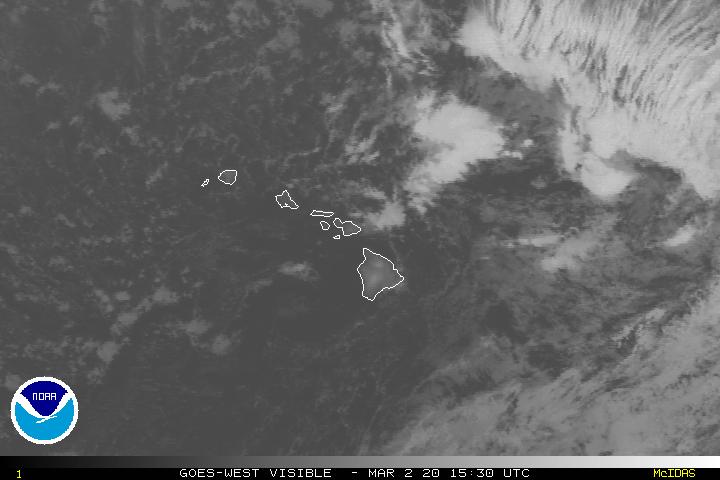
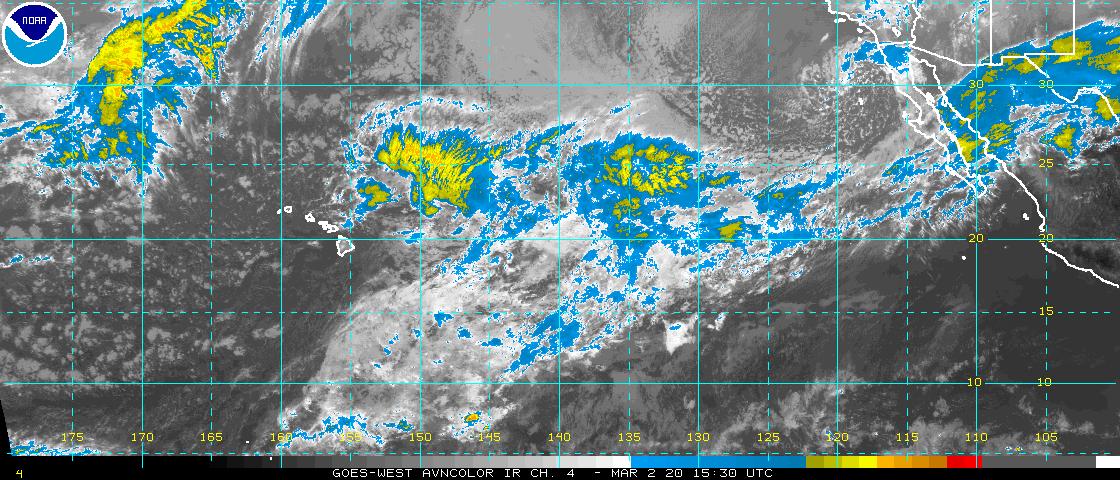
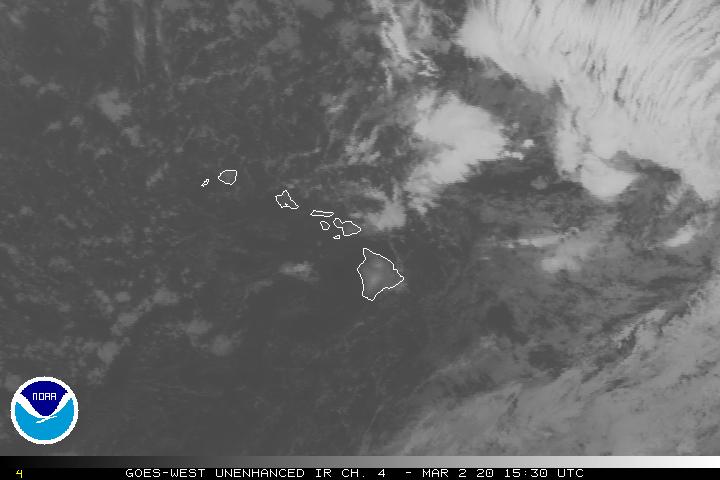
Satellite and Radar Images: To view the cloud conditions we have here in Hawaii, please use the following satellite links, starting off with this Infrared Satellite Image of the islands to see all the clouds around during the day and night. This next image is one that gives close images of the islands only during the daytime hours, and is referred to as a Close-up visible image. This next image shows a larger view of the Pacific…giving perspective to the wider ranging cloud patterns in the Pacific Ocean. Finally, here's a Looping IR satellite image, making viewable the clouds around the islands 24 hours a day. To help you keep track of where any showers may be around the islands, here’s the latest animated radar image.
Hawaii’s Mountains – Here’s a link to the live webcam on the summit of near 14,000 foot Mauna Kea on the Big Island of Hawaii. The tallest peak on the island of Maui is the Haleakala Crater, which is near 10,000 feet in elevation. These two webcams are available during the daylight hours here in the islands…and when there’s a big moon rising just after sunset for an hour or two! Plus, during the nights and early mornings you will be able to see stars, and the sunrise too…depending upon weather conditions.
Tropical Cyclone activity in the eastern and central Pacific – Here’s the latest weather information coming out of the National Hurricane Center, covering the eastern north Pacific. You can find the latest tropical cyclone information for the central north Pacific (where Hawaii is located) by clicking on this link to the Central Pacific Hurricane Center. Here’s a tracking map covering both the eastern and central Pacific Ocean. A satellite image, which shows the entire ocean area between Hawaii and the Mexican coast…can be found here. Of course, as we know, our hurricane season won't end until November 31st here in the central Pacific.
Aloha Paragraphs

Aloha Friday
The trade winds will remain active through the rest of the week…lighter winds are expected to arrive early in the new week ahead. Our trade winds remain light to moderately strong Friday night, thanks to the positioning of high pressure systems to our north at the moment. This weather map shows two trade wind producing high pressure systems, one located to the north, and far to the northeast, about to merge. At the same time, we find a dissipating cold front extending southwest from off the northern California coast, between the high pressure cells to our north and NE…and Hawaii. It will take until Monday for our local trade winds to quiet down into the lighter realms, which will last through Tuesday…before the trade winds start to fill back into our area by the middle of the week onwards.
What few showers that are around now will continue to be most active along the windward coasts and slopes…generally during the cooler night and early morning hours. As we can see from glancing at this satellite image, there are very few patches of low clouds in our vicinity Friday night. Looking to the west-southwest of the islands, over the offshore waters, we see a few towering cumulus over the ocean. Looking to the east, southeast, south and finally southwest…we find high cirrus clouds. As the trade winds drop down in strength after this coming weekend, we’ll see a decrease in our windward biased showers…with a modest increase in upcountry showers during the afternoon hours.
It's Friday evening as I begin writing this last section of today's narrative update. This weekend will be just fine, with the chance of one or two heavier showers here and there. Then during the first couple of days of the new week ahead, our trade winds will falter, moving us into more of a convective weather pattern. At that point, we'll start our days with clear cool mornings, and cloudy periods during the afternoons, especially in those upcountry leeward slopes. There won't be many showers however, as there likely won't be much available moisture in our overlying atmosphere. The main thing will be the lighter winds for those short couple of days. Meanwhile, we'll find a cold front trying to push down into the tropics, although it won't likely have much luck in reaching as far as Kauai. It will provide some clouds though, and as the trade winds return by Wednesday through next Friday, we'll see some remnant showers from the frontal boundary…arriving over our windward sides.
~~~ A friend and I are going to see a film this evening, this time in Kihei rather than Kahului. It's called Red (2010), starring a whole host of well known folks…including Bruce Willis, Morgan Freeman, John Malkovich, Mary-Louise Parker, Helen Mirren, Richard Dreyfus, Ernest Borgnine among others. Synopsis: Bruce Willis, Morgan Freeman, and Helen Mirren play former CIA operatives, who have just become the Agency's top targets. The Yahoo critics are giving this film a B- grade, while the users have upped the score to a more respectable A- score. The trailers make it look pretty good, if not just a fairly typical action film…what else is new? You folks who are regular visitors of this website, know that this type of film is nothing unusual for this Maui weatherman! At any rate, I'll be back Saturday morning with your next new weather narrative, and likely packing positive feedback about this film too. You'd think the film producers were paying me off or something. I hope you have a great Friday night until then! Aloha for now…Glenn.
Interesting: A new system for desalination has been designed by researchers at the Massachusetts Institute of Technology (MIT). The system uses solar power to push ocean water through a permeable membrane which is capable of removing salt and other minerals. Such a portable system would be ideal for disaster-torn regions of the world which have lost access to clean water.
The MIT Field and Space Robotics Laboratory designed the system that can be deployed quickly in a crisis such as the devastating earthquake that befell Haiti. After the quake, many people lost their access to fresh drinking water, and many still suffer from dehydration. Haiti, being an island nation, is surrounded by the ocean, a resource that could prevent such a fate.
The concept of desalination is nothing new. Most desalination plants are huge plants capable of producing massive amounts of water, but also use massive amounts of energy to do so. The difference is that MIT's design is portable and self-contained. It has no need for an external power source thanks to its solar panels.
Their prototype is able to produce 80 gallons of water per day, and they estimate that a larger version could provide up to 1,000 gallons per day. Steven Dubowsky, professor at the Department of Mechanical Engineering, and his students estimate that one of the military's C-130 cargo planes can transport 24 of the larger desalination units in one trip.
That number of units could provide about 24,000 gallons of water per day, enough to sustain 10,000 people. The system is designed to be cost effective. It is made from standard parts such as PVC pipe and basic electronic components. It can be assembled and operated by local people who do not need advanced technical training. The units can also operate efficiently in a wide range of weather conditions.
They have built in computers with sensors that can change certain variables if it gets cloudy. For example, the computer can adjust power going to the pump or the position of the valves to ensure the system will always produce water. The system relies on reverse osmosis, a filtration method that removes particles such as salt by applying hydraulic pressure as the ocean water flows over the permeable membrane.
The solar panels provide the electric current to power the pumps which pressurize the vessel that contains the membrane. Because of the high pressure, the water that permeates through the membrane has had the salt and other minerals removed, making the water safe for consumption.
As population grows in the world's poorest regions, access to fresh water will become more and more difficult. And if these regions are hit with a natural disaster, access can be downright impossible. A simple system that can be operated by anyone, such as the one designed by MIT, could be crucial in providing water from the planet's most abundant resource, the ocean.
Interesting2: Scientists are outfitting elephant seals and self-propelled water gliders with monitoring equipment to unlock the oceans' secrets and boost understanding of the impacts of climate change. Oceans regulate the world's climate by soaking up heat and shifting it around the globe. They also absorb huge amounts of planet-warming carbon dioxide, acting as a brake on the pace of climate change.
But scientists say they need to ramp up a global monitoring network, with the Southern Ocean between Australia and Antarctica playing a key role. The Southern Ocean is a major "sink" of mankind's carbon emissions and an engine of the world's climate.
"To understand the rate of climate change, we need to understand these ocean processes, like how fast it can sequester heat and carbon," said oceanographer Susan Wijffels, a group leader for Australia's Integrated Marine Observing System, or IMOS.
"So what the ocean does affects how fast the system can move and the regional patterns of climate change," she told Reuters on Friday by telephone from a climate conference in Hobart, Tasmania. Scientists also need to better understand natural ocean cycles that affect weather on land to improve long-term forecasts for crops and water management for cities.
IMOS groups researchers across Australian universities and research bodies and also links scientists in the United States, Asia and Europe. A recent funding boost means the team can outfit about 100 elephant seals to collect data from the depths around Antarctica. A small device with an antenna is attached to the heads of the seals to measure temperature, salinity and pressure as the animals dive for food.
Interesting3: Low pressure on the verge of becoming a tropical storm is pushing onshore in northeastern India. Rainfall has only been an inch or two so far. However, portions of Orissa, West Bengal, and northern Andhra Pradesh could have 5-10 inches of rain in the next 24 hours. Further east, a tropical low moved across Vietnam Friday. It too was on the verge of becoming a tropical storm. Heavy rain has soaked the country.
In Vinh, 10 inches has fallen over the past few days, 5 inches of which on Friday. Thanh Hoa had 6 inches of rain in just 12 hours early Friday. Even with a weakened low, tropical moisture will continue to feed downpours across Vietnam through the weekend.
Another 5-10 inches of rain is possible across northern portion of the country through Sunday, with locally higher amounts. This rainfall could trigger widespread flooding. Heavy rain could also trigger flooding across Laos and northern Thailand.
 Email Glenn James: