











October 14-15, 2010
Air Temperatures – The following maximum temperatures were recorded across the state of Hawaii Thursday afternoon:
Lihue airport, Kauai – 85
Honolulu airport, Oahu – 88
Kaneohe MCAS, Oahu – 84
Molokai airport – 86
Kahului airport, Maui – 88
Ke-ahole airport (Kona) – 85
Hilo airport, Hawaii – 83
Air Temperatures ranged between these warmest and coolest spots near sea level – and on the highest mountain tops…as of 5pm Thursday evening:
Port Allen, Kauai – 84F
Hilo, Hawaii – 78
Haleakala Crater – 50 (near 10,000 feet on Maui)
Mauna Kea summit – 32 (near 14,000 feet on the Big Island)
Precipitation Totals – The following numbers represent the largest precipitation totals (inches) during the last 24 hours on each of the major islands, as of Thursday afternoon:
0.23 Mount Waialeale, Kauai
0.18 Oahu Forest NWR, Oahu
0.00 Molokai
0.00 Lanai
0.00 Kahoolawe
0.05 Puu Kukui, Maui
0.08 Glenwood, Big Island
Marine Winds – Here’s the latest (automatically updated) weather map showing high pressure systems far to the north and east-northeast of our islands. Our local winds will remain light to moderately strong from the trade wind direction Friday into Saturday.
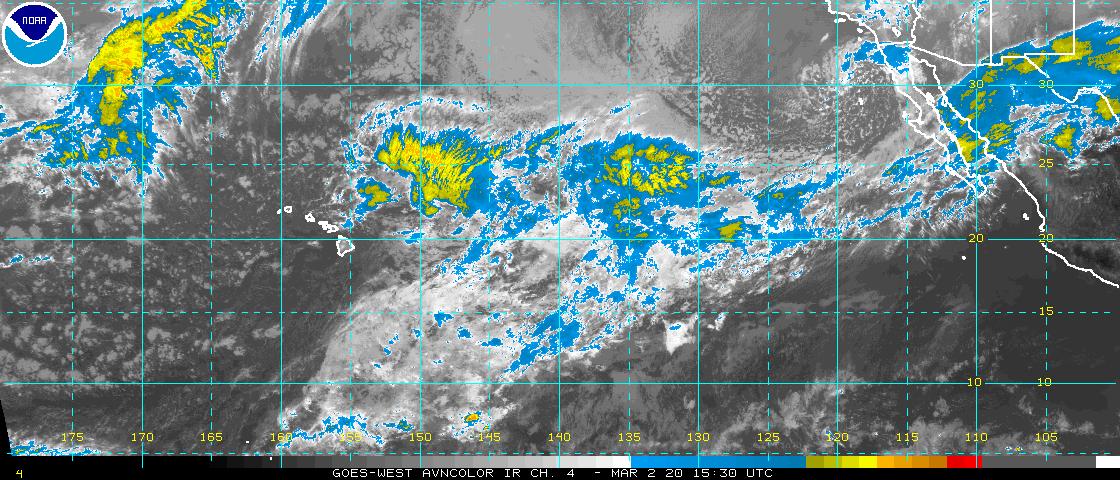
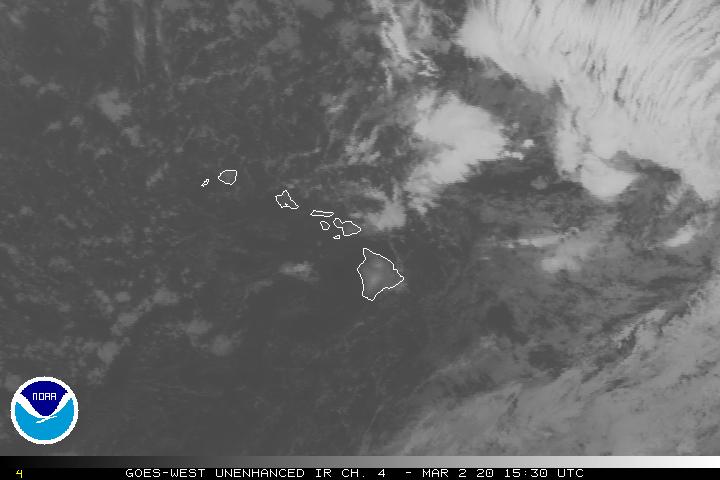
Satellite and Radar Images: To view the cloud conditions we have here in Hawaii, please use the following satellite links, starting off with this Infrared Satellite Image of the islands to see all the clouds around during the day and night. This next image is one that gives close images of the islands only during the daytime hours, and is referred to as a Close-up visible image. This next image shows a larger view of the Pacific…giving perspective to the wider ranging cloud patterns in the Pacific Ocean. Finally, here's a Looping IR satellite image, making viewable the clouds around the islands 24 hours a day. To help you keep track of where any showers may be around the islands, here’s the latest animated radar image.
Hawaii’s Mountains – Here’s a link to the live webcam on the summit of near 14,000 foot Mauna Kea on the Big Island of Hawaii. The tallest peak on the island of Maui is the Haleakala Crater, which is near 10,000 feet in elevation. These two webcams are available during the daylight hours here in the islands…and when there’s a big moon rising just after sunset for an hour or two! Plus, during the nights and early mornings you will be able to see stars, and the sunrise too…depending upon weather conditions.
Tropical Cyclone activity in the eastern and central Pacific – Here’s the latest weather information coming out of the National Hurricane Center, covering the eastern north Pacific. You can find the latest tropical cyclone information for the central north Pacific (where Hawaii is located) by clicking on this link to the Central Pacific Hurricane Center. Here’s a tracking map covering both the eastern and central Pacific Ocean. A satellite image, which shows the entire ocean area between Hawaii and the Mexican coast…can be found here. Of course, as we know, our hurricane season won't end until November 31st here in the central Pacific.
Aloha Paragraphs

Nice weather through the rest of the week
The trade winds will remain active through the rest of this week, although the trend will be for lighter into early next week. Our trade winds remain light to moderately strong Thursday night, thanks to the positioning of a 1032 millibar high pressure system to our north at the moment. This weather map shows this trade wind producing high pressure system, with its associated ridges running more or less east and west. At the same time, we find a cold front extending southwest from off the Washington state coast, between the high pressure cell to our north…and Hawaii. It now looks like it will take until next Monday or so for our local trade winds to quiet down into the lighter realms, which will last through about Tuesday…before the trade winds fill back in more thoroughly by the middle of the week onwards.
What few showers that are around now will continue to be most active along the windward coasts and slopes…generally during the cooler night and early morning hours. As we can see from glancing at this satellite image, there are a few patches of clouds in our vicinity Thursday night, heading towards the windward sides generally. Looking to the southwest of the islands, over the offshore waters, we see at least one towering cumulus cloud. Looking southward, we see lots of high cirrus clouds coming up towards the Big Island. We may continue to see a few streaks of high clouds around the state going forward. The trade winds will drop down in strength early next week. At that time we’ll see a decrease in our windward biased showers…with a modest increase in upcountry showers during the afternoon hours.
It's Thursday evening as I begin writing this last section of today's narrative update. The weather here in the islands will remain nice, with light to moderately strong trade winds prevailing into the weekend. We'll finally see that drop in our trade wind speeds around Monday. This will shift us into a convective weather pattern, with showers along the windward sides, during the night and early morning hours…migrating over to the upcountry leeward slopes during the afternoons. At that time, we'll also find slightly cooler than normal night and early mornings, along with a slight increase in haze perhaps too. The long and short of all this suggests that our weather will remain just fine, with no major shifts one way or the other through at least the rest of this week. ~~~ Looking out the window here in Kihei, Maui before I take the drive back upcountry, its mostly clear to partly cloudy. There's just enough high cirrus clouds around too, that we should see some color in our local skies at sunset, or again at sunrise on Friday. I'll be back early Friday morning with your next new weather narrative, I hope you have a great Thursday night until then! Aloha for now…Glenn.
Extra: Seeing the world's cities through individual video's…very cool!
Interesting: New analysis shows populations of tropical species are plummeting and humanity's demands on natural resources are sky-rocketing to 50 per cent more than the earth can sustain, reveals the 2010 edition of WWF’s Living Planet Report — the leading survey of the planet’s health. The biennial report, produced in collaboration with the Zoological Society of London and the Global Footprint Network, uses the global Living Planet Index as a measure of the health of almost 8,000 populations of more than 2,500 species. The global Index shows a decrease by 30 per cent since 1970, with the tropics hardest hit showing a 60 per cent decline in less than 40 years.
"There is an alarming rate of biodiversity loss in low-income, often tropical countries while the developed world is living in a false paradise, fuelled by excessive consumption and high carbon emissions," said Jim Leape, Director General of WWF International.
While the report shows some promising recovery by species’ populations in temperate areas, thanks in part to greater conservation efforts and improvements in pollution and waste control, tracked populations of freshwater tropical species have fallen by nearly 70 per cent — greater than any species’ decline measured on land or in our oceans.
"Species are the foundation of ecosystems," said Jonathan Baillie, Conservation Programme Director with the Zoological Society of London. "Healthy ecosystems form the basis of all we have — lose them and we destroy our life support system." The Ecological Footprint, one of the indicators used in the report, shows that our demand on natural resources has doubled since 1966 and we’re using the equivalent of 1.5 planets to support our activities.
If we continue living beyond the Earth’s limits, by 2030 we'll need the equivalent of two planets' productive capacity to meet our annual demands. "The report shows that continuing of the current consumption trends would lead us to the point of no return," added Leape. "4.5 Earths would be required to support a global population living like an average resident of the US."
Interesting2: Rivers and streams supply the lifeblood of ecosystems across the globe, providing water for drinking and irrigation for humans as well as a wide array of life forms in rivers and streams from single-celled organisms all the way up to the fish humans eat. But humans and nature itself are making it tough on rivers to continue in their central role to support fish species, according to new research by a team of scientists including one from Arizona State University.
Globally, rivers and streams are being drained due to human use and climate change. These and other human impacts alter the natural variability of river flows. Some impacted rivers have dried and no longer run, while still others have actually seen increases in the variability of flows due to storm floods. The end result is that these two forces are conspiring to shorten food chains, particularly by eliminating top predators like many large-bodied fish.
"Floods and droughts shorten the food chain but they accomplish this in different ways," said John Sabo, an Arizona State University associate professor in the School of Life Sciences. Sabo is the lead author of the paper, "The Role of Discharge Variation in Scaling of Drainage Area and Food Chain Length in Rivers," which appeared Oct. 15, 2010, in Science Express, the online, early publication venue for the journal Science.
"High flows take out the middle men in the food web making fish (the top predator) feed lower in the food chain; droughts completely knock out the top predator. The end result in either case is a simpler food web, but the effects we see for low flows are more catastrophic for fish, and much more long lasting," said Sabo, who studies ecology, evolution and environmental sciences.
Sabo and his co-authors — Jacques Finlay, University of Minnesota, St. Paul; Theodore Kennedy, U.S. Geological Survey, Southwest Biological Science Center, Flagstaff, Ariz.; and David Post, Yale University, New Haven, Conn. — suggest that the fate of large bodied fishes should be more carefully factored into the management of water use, especially as growing human populations and climate change increasingly affect water availability.
The researchers studied the food webs that live in and depend on rivers for their survival. They studied 36 rivers and streams in the U.S. ranging in size from the Mississippi and Colorado Rivers, down to and their small tributaries. The rivers included in the study provide water for drinking to large cities like New York City, Minneapolis, Phoenix, Las Vegas and Los Angeles.
At the top of these food webs were large bodied fish, which appear the most vulnerable to variations in river flows. The researchers found that even though the mechanics were different, the end result of floods and droughts on the food webs were similar and the effects appear to be long lasting. The study employed naturally occurring stable isotopes of the element nitrogen to measure how high top-predators were in the food chain.
Nitrogen provides an indicator for how high a consumer is in the food chain because it bio-accumulates increasing by 3.4 parts per million with each link in the chain. "Floods simplify the food web by taking out some of the intermediate players in it so that the big fish begin to eat lower on the food chain than they would if the food web were not exposed to high flows," Sabo said.
"That makes them lower on the food chain themselves. Predators that eat lower on the food chain are having a dinner that has essentially missed a meal in itself. Imagine a lion eating grass, instead of eating gazelles that eat grass." "With droughts, it's completely different, they just eliminate the top predator altogether because many fish just can't tolerate the low oxygen and high temperatures that follow when a str
eam starts drying out," said Sabo, who specializes in river and riparian ecosystems. "Even if it doesn't go completely dry, the conditions get so bad that the fish just can't handle it, and it takes them much longer to come back." Sabo added that climate change is going to have a hand in frequency and intensity of the floods and droughts of coming years. "Climate is giving us a new set of operating terms to work with," Sabo said.
"We will experience overall drying and great weather variability, both of which will further shorten river food chains. "There will be drying in some regions, particularly along the equators and increased flow in some rivers, primarily at higher latitudes," Sabo explained. "We will see more variability because there will be change in the seasonality of storms, ocean currents are changing and the way the ocean blows storms to us is going to be different. Drying and more variable flows are coming." "In some places, like the Southwest U.S., we will get a double punch," he added. "As the streams dry, they also will become more variable in that as rain falls it will race over the parched ground, causing flooding"
Human toll
The human effect on rivers and streams and the food chain they support are closely tied to land use change, such as water diversion and regulation of flows due to dams. Sabo outlined a classic scenario that humans face during drought years. As drought takes hold, the need for water for irrigation and other agricultural purposes increases and leads to a draw down of natural river flow.
The effects downstream can be devastating. Natural drying through drought is not a human effect, but withdrawal of river water during a drought is, and it can have long-term consequences. "We would not have guessed that infrequent drought would have had a big effect on the stream, but our results shows that it does," Sabo said. "River and stream water draw-down has a lasting effect."
"We found that some streams affected by drying 5 to 10 years ago, are still missing large-bodied fishes compared to same sized streams that never dried. That is the major difference," Sabo explained. "Our data show that food webs can recover sooner after a flood, in roughly a year, but it takes far longer to recover in the case of drying or drought."
The study hints that competing users of the river water — agricultural production and recreational uses like fishing — need to work out amenable use of rivers and streams that not only look to the immediate future, but also project long term effects of their use. "The question becomes can you have fish and tomatoes on the same table," Sabo said. "They compete for the same resource and society depends on both — agriculture for grain, fruits, vegetables and river-caught fish for protein, particularly in the developing world."
"Humans may need to make some really hard decisions about how to allocate water so that we grow the right food but still leave enough in the rivers to sustain fish populations," he said. "Some river fish, like salmon in the U.S., are very important commercially." Sabo added that scientists appear to be on the cusp of major advances in understanding how climate and human use of rivers affects biodiversity and global water security.
This paper fits into this bigger picture because it suggests that some aspects of climate and human effects on biodiversity are mediated by the variability in freshwater supplies and thus, could have feedbacks on food security in regions of the world where freshwater fisheries are a significant source of protein for growing populations.
 Email Glenn James: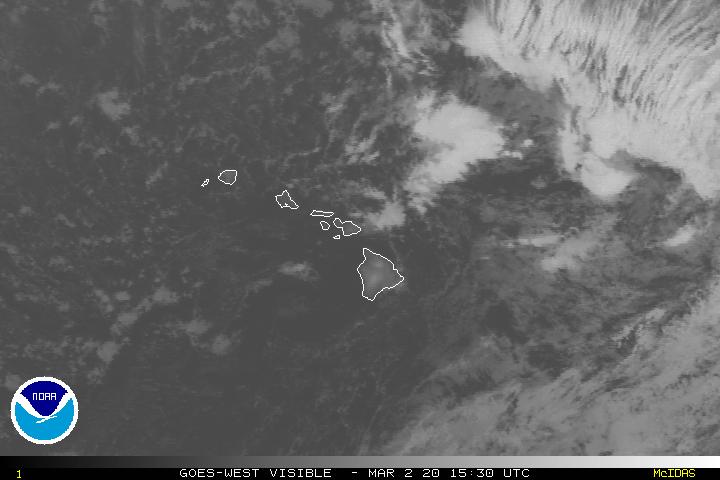


Cynthia Quisenberry Says:
Hi,
We’ve been away from the computer for awhile and have missed reading your commentaries. Do I understand that we’re going into a La Nina winter and so might have more rain? That would certainly be great. We’ve noticed such a drying tread here in Haiku since we moved here in 1975. Less trade winds and definitely less rain than 35 years ago.
Hoping for a “normal” Haiku winter this year.
Aloha,
Cynthia & Terry Quisenberry~~~Hi folks, it’s not a sure thing, we may or may not have a wetter than normal winter season this year…into the months. Sometimes La Nina brings drought breaking rainfall to the islands, and then again, sometimes it doesn’t. I moved here in 1975 myself, and remember a much drier spell of weather one year…with lots of wetter periods too. Lets hope that La Nina works in our favor this winter! By the way, good hearing from you two! Aloha, Glenn