October 12-13, 2010
Air Temperatures – The following maximum temperatures were recorded across the state of Hawaii Tuesday afternoon:
Lihue airport, Kauai – 85
Honolulu airport, Oahu – 87
Kaneohe MCAS, Oahu – 83
Molokai airport – 84
Kahului airport, Maui – 87
Ke-ahole airport (Kona) – 85
Hilo airport, Hawaii – 83
Air Temperatures ranged between these warmest and coolest spots near sea level – and on the highest mountain tops…as of 4pm Tuesday afternoon:
Port Allen, Kauai – 88
Hilo, Hawaii – 80
Haleakala Crater – 52 (near 10,000 feet on Maui)
Mauna Kea summit – 43 (near 14,000 feet on the Big Island)
Precipitation Totals – The following numbers represent the largest precipitation totals (inches) during the last 24 hours on each of the major islands, as of Tuesday afternoon:
0.45 Mount Waialeale, Kauai
0.21 South Fork Kaukonahua, Oahu
0.00 Molokai
0.00 Lanai
0.00 Kahoolawe
0.12 West Wailuaiki, Maui
0.36 Honaunau, Big Island
Marine Winds – Here’s the latest (automatically updated) weather map showing high pressure systems far to the northeast and northwest of our islands. Our local winds will remain moderate from the trade wind direction…although gradually losing strength Wednesday into Thursday.
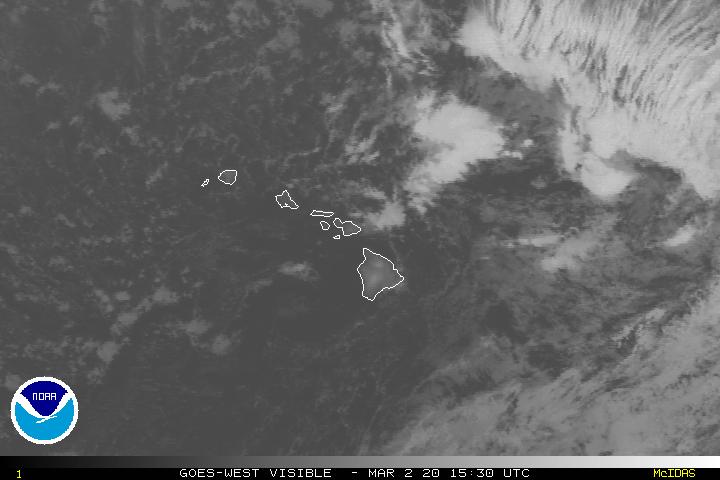
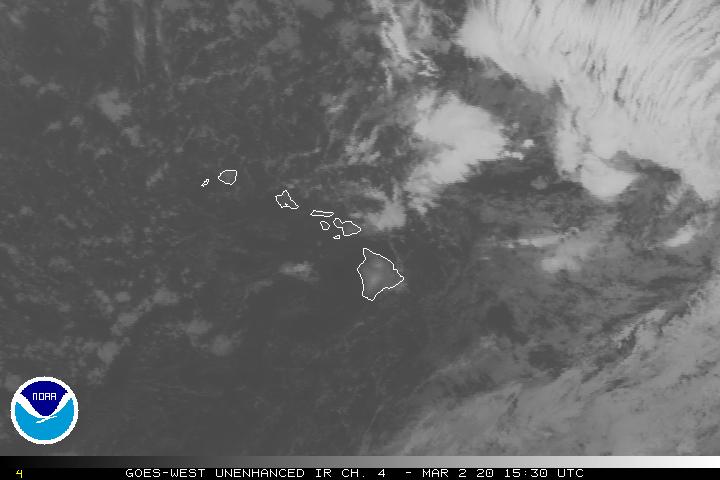
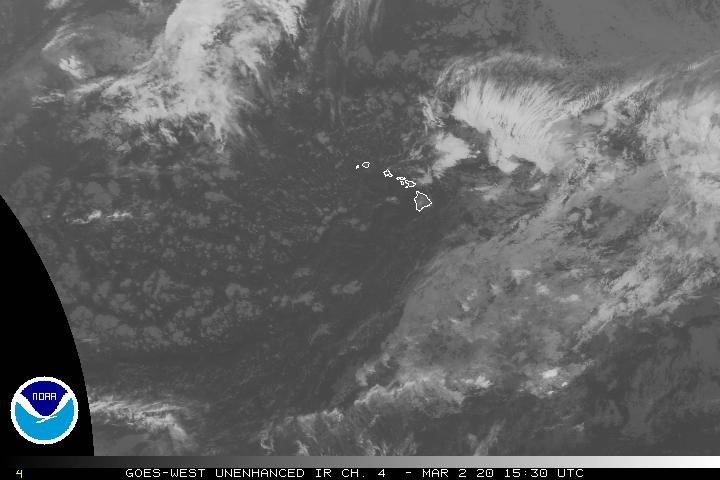
Satellite and Radar Images: To view the cloud conditions we have here in Hawaii, please use the following satellite links, starting off with this Infrared Satellite Image of the islands to see all the clouds around during the day and night. This next image is one that gives close images of the islands only during the daytime hours, and is referred to as a Close-up visible image. This next image shows a larger view of the Pacific…giving perspective to the wider ranging cloud patterns in the Pacific Ocean. Finally, here’s a Looping IR satellite image, making viewable the clouds around the islands 24 hours a day. To help you keep track of where any showers may be around the islands, here’s the latest animated radar image.
Hawaii’s Mountains – Here’s a link to the live webcam on the summit of near 14,000 foot Mauna Kea on the Big Island of Hawaii. The tallest peak on the island of Maui is the Haleakala Crater, which is near 10,000 feet in elevation. These two webcams are available during the daylight hours here in the islands…and when there’s a big moon rising just after sunset for an hour or two! Plus, during the nights and early mornings you will be able to see stars, and the sunrise too…depending upon weather conditions.
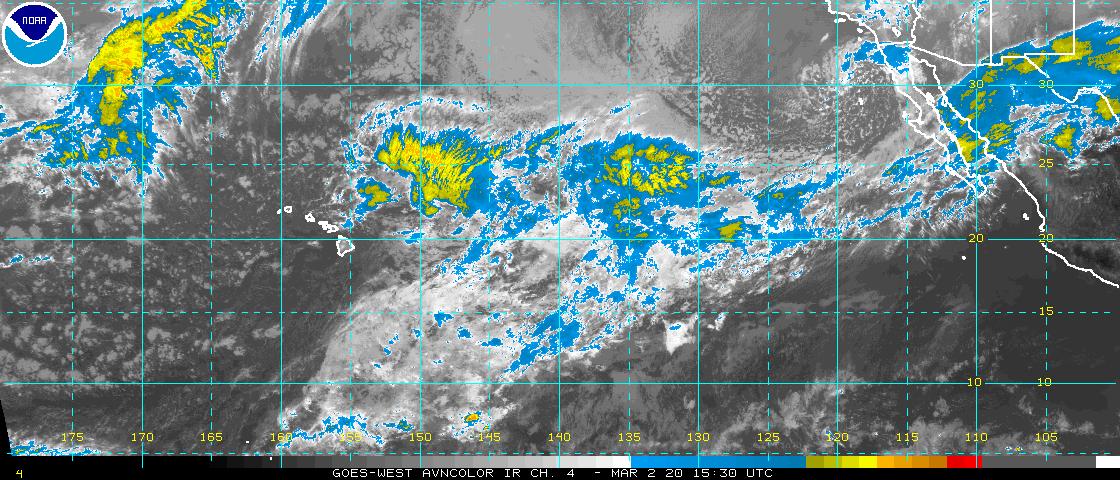
Tropical Cyclone activity in the eastern and central Pacific – Here’s the latest weather information coming out of the National Hurricane Center, covering the eastern north Pacific. You can find the latest tropical cyclone information for the central north Pacific (where Hawaii is located) by clicking on this link to the Central Pacific Hurricane Center. Here’s a tracking map covering both the eastern and central Pacific Ocean. A satellite image, which shows the entire ocean area between Hawaii and the Mexican coast…can be found here. Of course, as we know, our hurricane season won’t end until November 31st here in the central Pacific.
Aloha Paragraphs

Lounging Monk Seals…Hawaii
The trade winds remain rather blustery Tuesday…although the trend will be for softer winds through the rest of this week. These trade winds remain somewhat stronger than normal thanks to the positioning of a weakening 1027 millibar high pressure system far to our northeast Tuesday night. This weather map shows this weather feature not too far offshore from Mendocino County, on the coast of northern California. A developing storm to the north-northeast of Hawaii, with its associated cold front, will press down on our high pressure ridge, currently about 500 or so miles northeast of Kauai. As this happens, our winds will ease up, eventually leading to potentially lighter winds by the weekend.
Showers will continue to be most active along the windward coasts and slopes…increasing at times locally into Wednesday. As we can see from checking this satellite image, there are patches of clouds in our vicinity Tuesday night, especially heading towards the area from Maui up to Kauai. The atmosphere remains fairly dry and stable however, so that not many downpours are likely. As the trade winds drop down in strength this weekend, into early next week, we’ll see at least some decrease in our windward biased showers…with a possible modest increase in upcountry showers during the afternoon hours then. The computer models are hinting that we may see a cold front dropping southward towards the state early next week.
Looking to the southeast through southwest of the islands, in the deeper tropics…we see an impressive array of high topped cirrus clouds. There are embedded thunderstorms located in this mass of elongated clouds. Glancing at this IR satellite image, we see the closest thunderstorm cells not too far southeast of the Big Island. Our area is free of high cirrus clouds for the time being. Although, looking a bit closer at that satellite picture above, we can see a tad bit of the high icy clouds just to the northwest and north of Kauai, which may swing through the northwest islands…although remain thin and rather non-influential for the time being. This looping satellite image shows how these high clouds, and with that developing thunderstorm, seem to be edging closer to the Big Island.
It’s Tuesday evening as I begin writing this last section of today’s narrative update. The weather here in the islands will remain breezy for the time being. This fairly long trade wind episode will wind down however, as the winds gradually weaken through the remainder of the work week. This lighter wind flow may have some bearing on our local weather, with a modified convective weather pattern potential by Saturday or Sunday into next Monday. This means clear and cool night and early morning hours, leading to some upcountry clouds during the afternoons…with a few showers. As we move into early next week, the models continue to show an early season cold front approaching the islands. The question this week will continue to be whether it will reach the state with some showers then…or not. ~~~ Here in Kihei, Maui this evening, before I take the drive back upcountry, there are quite a few low clouds hugging the western slopes of the Haleakala Crater. As many of you know, this is where I live, up at the 3,100 foot elevation. I expect to get into low clouds, or even some fog by the time I reach home. I enjoy that, and look forward to getting out for my evening walk before dinner. I’ll be back early Wednesday morning with your next new weather narrative, I hope you have a great Tuesday night until then! Aloha for now…Glenn.
Extra: Converting plastic trash into oil…video – 5 minutes watching time
Interesting: A massive 30-mile logjam has blocked the Rajang river in Sarawak, Malaysian Borneo, bringing river traffic to a standstill and posing a threat to riverbank communities, reports Malaysian state media. The Rajang, Malaysia’s longest river, is presently unnavigable, according to Bernama. "The river was like a conveyor belt in a sawmill but instead of transporting uniformly cut wood, it carried an endless flow of uprooted trees, discarded logs and all manner of vegetative debris from Kapit, some 176km away," stated Bernama.
The source of the logs and debris is believed to be the Baleh River and upper tributaries of the Rajang. Heavy rain reportedly triggered a landslide or landslides at log ponds at a "major" timber camp. State Minister of Environment and Public Health Datuk Seri Wong Soon Koh told Bermara the cause of the "calamity of gigantic proportion" is under investigation.
Interesting2: Food safety advocates may shudder at the thought, but a team of scientists in Canada have come up with a new breed of pig that is intended to make meat a greener, more sustainable food. The Enviropig is engineered to have the same meat quality as your typically breeded Yorkshire pig, with all the ideal protein and fat content developed for the market.
But in addition, it is also engineered to produce less toxic manure that releases fewer pollutants into the atmosphere, thereby making it a more environmentally sustainable option for large scale pig farmers. Meat production, and more specifically, factory scale meat production exemplified by the ever present concentrated animal feedlot operation model, takes a toll on the environment.
The huge amount of waste produced by a huge number of livestock adds up to lots of methane and other gases that are released into the atmosphere and contribute to global climate change. While there are much more sustainable ways to raise livestock, most of the meat on the market today comes from these giant factory farms that are really damaging their immediate and not so immediate environments.
Although Enviropig sounds like a good thing for the environment, it brings up all kinds of controversial issues that we find ourselves increasingly bumping into. Agricultural and food scientists are pushing further and further into the realm of genetically modified plants and animals to meet our immediate and future food demands and grapple with environmental concerns.
But advocates for organic, sustainable agriculture and food safety folks alike remain very skeptical in the face of all these new ground-breaking developments, and rightfully so. While the first Enivropig was developed way back in 1999, the pork from the pigs still hasn’t been tasted because it hasn’t been made legal for consumption.
But the pig is under review by the FDA to determine whether or not its deemed fit to eat. And although the Center for Food Safety still sides vehemently with organic, sustainable agriculture, and change of practice over change of genetics, the FDA’s recent indecision on genetically-modified salmon is somewhat foreshadowing.
The fact that the FDA is putting genetically modified meats on hold is a good thing, and buys more time for food safety organizations and organic farmers to garner support and public backing.
Interesting3: IEA calculations based on preliminary data show that China has now overtaken the United States to become the world’s largest energy user. China’s rise to the top ranking was faster than expected as it was much less affected by the global financial crisis than the United States. For those who have been following energy consumption trends closely, this does not come as a surprise.
What is more important is the phenomenal growth in demand that has taken place in China over the last decade; also prospects for future growth still remain incredibly strong. Since 2000, China’s energy demand has doubled, yet on a per capita basis it is still only around one-third of the OECD average.
Prospects for further growth are very strong considering the country’s low per-capita consumption level and the fact that China is the most populous nation on the planet, with more than 1.3 billion people. China’s demand today would be even higher still if the government had not made such progress in reducing the energy intensity (the energy input per dollar of output) of its economy.
It has also very quickly become one of the world’s leaders in renewable energy, particularly wind power and solar energy, and paved the way for a big expansion of nuclear power. The worldwide implications of these new trends will be assessed in the upcoming World Energy Outlook 2010 to be released on 9 November 2010.
Interesting4: Energy companies are rushing to develop unconventional sources of oil and gas trapped in carbon-rich shales and sands throughout the western United States and Canada. So far, government officials have shown little concern for the environmental consequences of this new fossil-fuel development boom. The most direct path to America’s newest big oil and gas fields is U.S. Highway 12, two lanes of blacktop that unfold from Grays Harbor in Washington State and head east across the top of the country to Detroit.
The 2,500-mile route has quickly become an essential supply line for the energy industry. With astonishing speed, U.S. oil companies, Canadian pipeline builders, and investors from all over the globe are spending huge sums in an economically promising and ecologically risky race to open the next era of hydrocarbon development.
As domestic U.S. pools of conventional oil and gas dwindle, energy companies are increasingly turning to "unconventional" fossil fuel reserves contained in the carbon rich-sands and deep shales of Canada, the Great Plains, and the Rocky Mountain West. Colorado, Utah, and Wyoming hold oil shale reserves estimated to contain 1.2 trillion to 1.8 trillion barrels of oil, according to the U.S. Department of Energy, half of which the department says is recoverable.
Eastern Utah alone holds tar sands oil reserves estimated at 12 billion to 19 billion barrels. The tar sands region of northern Alberta, Canada contains recoverable oil reserves conservatively estimated at 175 billion barrels, and with new technology could reach 400 billion barrels.
Deep gas-bearing shales of the Great Plains, Rocky Mountain West, Great Lakes, Northeast, and Gulf Coast contain countless trillions of feet of natural gas. If current projections turn out to be accurate, there would be enough oil and gas to power the United States for at least another century.
Interesting5: Use of artificial lighting at night can change human and insect behaviors, increasing the risk of insect-borne disease. Consider that before gas street lamps and electric light bulbs were invented in the 1800s, the world settled into darkness after sunset, relying only on the moon and stars for light. That is still the case in more remote regions of the world.
But, as artificial lighting spreads through these mostly tropical areas, research is showing how night-time light can alter human and insect behavior and bring about some unexpected results — an increase in the transmission of insect-borne diseases. Altering human and insect interactions is one example of how light pollution may be changing disease risk patterns.
The evidence suggests researchers should consider this when conducting future studies of how diseases spread. Many potentially fatal or disfiguring tropical diseases are caused by parasites that are transmitted to humans by the bite of a specific insect carrier. For example, kissing bugs carry Chagas’ disease, mosquitoes bring malaria and sand flies transmit leishmaniasis.
Biting often occurs at night. Insects are generally attracted to artificial lights. The lights interrupt and confuse the insects’ normal night-time navigational cues, such as moonlight. Insects may also have adapted their routine, using lights as signs that humans are near. Researchers from Brazil combed the published scientific literature for studies that examined if artificial light is changing the way night-time biting insects convey disease to humans.
Their efforts turned up three case studies with kissing bugs, mosquitoes and sand flies that support a link, although in some unexpected ways. Better housing and insecticides have reduced the ability of kissing bugs to directly bite humans. Yet, Chagas’ disease perpetuates.
Kissing bugs — attracted to homes by artificial lights — pass the disease on to people by defecating on food grown close to houses and later eaten by people. Kissing bugs also bite animals such as opossums or pets, which maintain the parasite’s life cycle in areas where people live.
Interesting6: A Humpback whale has broken the world record for travel by any mammal, swimming at least 9800km from the Atlantic to the Indian Ocean in search of a mate, marine biologists reported on Wednesday. The female humpback was first photographed among a group of whales at a breeding ground on Abrolhos Bank, off Brazil’s southeastern coast, on August 7, 1999.
By sheer chance, it was photographed more than two years later, on September 21, 2001, by a commercial whale-watching tour at a breeding ground near the Ile Sainte Marie off the eastern coast of Madagascar. The whale was identified thanks to the distinctive shape of its tail and a pattern of spots on it.
"It is the longest documented movement by a mammal, about 250 miles (400 km) longer than the longest seasonal migration that has been reported," according to the research, headed by Peter Stevick of the College of the Atlantic in Bar Harbor, Maine.
The trip is not just remarkable for the distance the whale covered, Mr Stevick said. It also raises exciting questions about the breeding habits of humpbacks (Megaptera novaeangliae), a species of which relatively little is known.
Until now, it was thought that only males, rather than females, would be likely to wander such extreme distances in quest of a partner. Humpbacks are known to be long-distance swimmers, but until now their migration patterns were thought to be between northern and southerly latitudes. For instance, a whale might head to feeding area in a far southern latitude in the Atlantic, then return to a tropical latitude in the Atlantic in order to breed.
But this discovery suggests that humpbacks may also have a migratory pattern that straddles longitudes, not latitudes. In other words, they could swim east-west to breed. Further work is needed to investigate such theories, as this is just a solitary sighting. But if more marathon humpbacks are found, it could lead to a rethink of the species’ genetic profile, which in turn has an impact on conservation.
So far scientists have been able to identify seven distinct breeding stocks and several sub-stocks of humpbacks in the Southern Hemisphere. Their perceived isolation and entrenched breeding habits raised fears of a restricted gene pool, which is bad news for a species. Humpbacks were driven close to extinction through over-hunting but are now staging a comeback.
In 2008, the International Union for the Conservation of Nature (IUCN) moved humpbacks from the category of Vulnerable to that of Least Concern, meaning the species is at low risk of extinction. Two subpopulations remained classified as Endangered, however. The study appears in Biology Letters, published by Britain’s Royal Society.
 Email Glenn James: