October 11-12, 2010
Air Temperatures – The following maximum temperatures were recorded across the state of Hawaii Monday afternoon:
Lihue airport, Kauai – 86
Honolulu airport, Oahu – 86
Kaneohe MCAS, Oahu – 82
Molokai airport – 85
Kahului airport, Maui – 86
Ke-ahole airport (Kona) – 82
Hilo airport, Hawaii – 82
Air Temperatures ranged between these warmest and coolest spots near sea level – and on the highest mountain tops…as of 4pm Monday afternoon:
Port Allen, Kauai – 86
Hilo, Hawaii – 80
Haleakala Crater – 54 (near 10,000 feet on Maui)
Mauna Kea summit – 41 (near 14,000 feet on the Big Island)
Precipitation Totals – The following numbers represent the largest precipitation totals (inches) during the last 24 hours on each of the major islands, as of Monday afternoon:
0.75 Mount Waialeale, Kauai
0.44 Oahu Forest NWR, Oahu
0.06 Molokai
0.00 Lanai
0.00 Kahoolawe
0.95 Puu Kukui, Maui
0.56 Piihonua, Big Island
Marine Winds – Here’s the latest (automatically updated) weather map showing a 1031 millibar high pressure system far to the northeast of our islands. Our local winds will remain moderate to locally strong and gusty from the trade wind direction…gradually losing some strength into Wednesday.
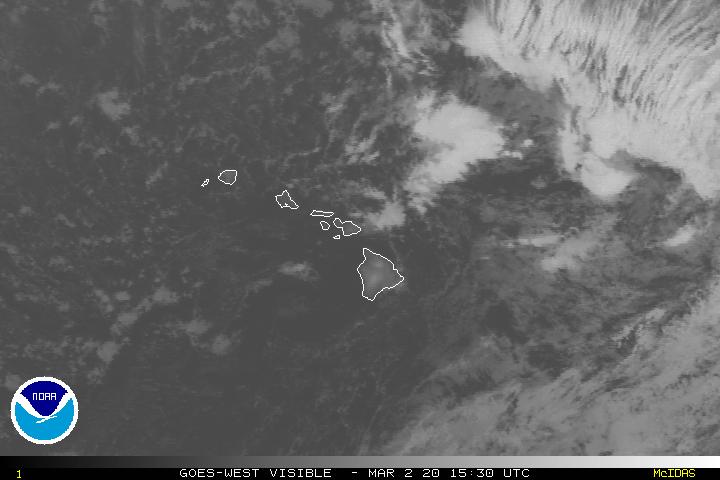
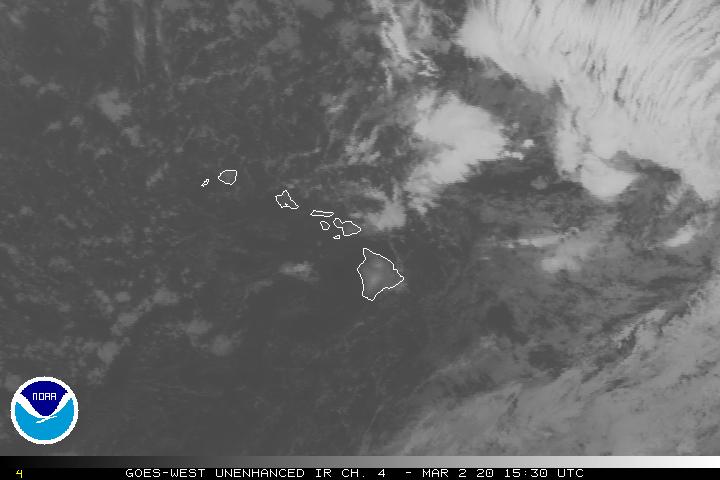
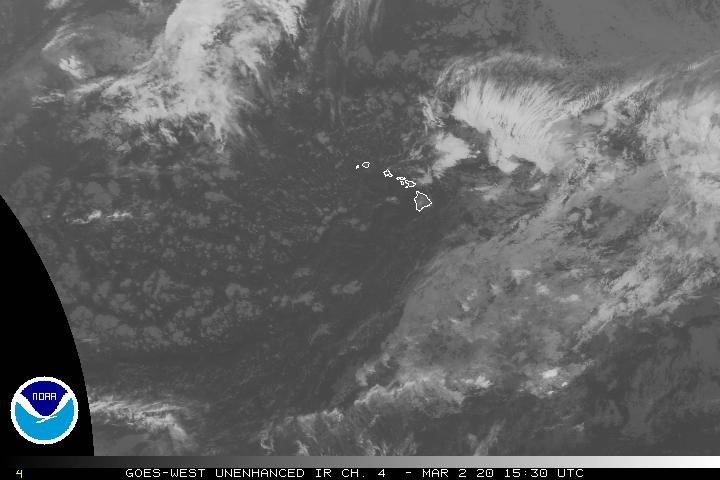
Satellite and Radar Images: To view the cloud conditions we have here in Hawaii, please use the following satellite links, starting off with this Infrared Satellite Image of the islands to see all the clouds around during the day and night. This next image is one that gives close images of the islands only during the daytime hours, and is referred to as a Close-up visible image. This next image shows a larger view of the Pacific…giving perspective to the wider ranging cloud patterns in the Pacific Ocean. Finally, here’s a Looping IR satellite image, making viewable the clouds around the islands 24 hours a day. To help you keep track of where any showers may be around the islands, here’s the latest animated radar image.
Hawaii’s Mountains – Here’s a link to the live webcam on the summit of near 14,000 foot Mauna Kea on the Big Island of Hawaii. The tallest peak on the island of Maui is the Haleakala Crater, which is near 10,000 feet in elevation. These two webcams are available during the daylight hours here in the islands…and when there’s a big moon rising just after sunset for an hour or two! Plus, during the nights and early mornings you will be able to see stars, and the sunrise too…depending upon weather conditions.
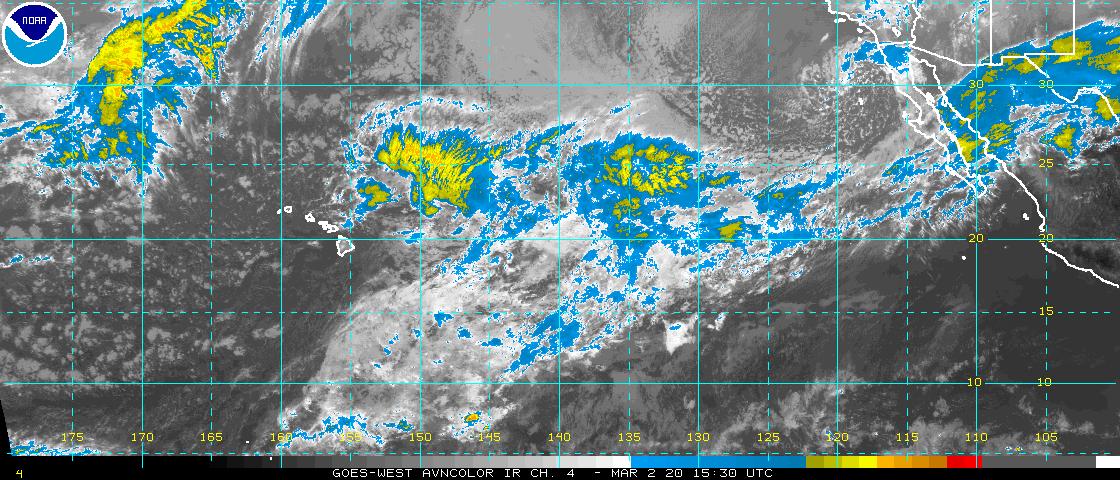
Tropical Cyclone activity in the eastern and central Pacific – Here’s the latest weather information coming out of the National Hurricane Center, covering the eastern north Pacific. You can find the latest tropical cyclone information for the central north Pacific (where Hawaii is located) by clicking on this link to the Central Pacific Hurricane Center. Here’s a tracking map covering both the eastern and central Pacific Ocean. A satellite image, which shows the entire ocean area between Hawaii and the Mexican coast…can be found here. Of course, as we know, our hurricane season won’t end until November 31st here in the central Pacific.
Aloha Paragraphs

The trade winds will remain rather blustery throughTuesday…although the trend will be for them to gradually weaken through the rest of this work week. These trade winds remain somewhat stronger than normal thanks to the positioning of a 1031 millibar high pressure system far to our northeast. This weather map shows this weather feature not too far offshore from Point Arena, on the northwest coast of California. A developing storm to the north of Hawaii, with its associated cold front, will press down on our high pressure ridge, currently about 600 or so miles north of Kauai. As this happens, our winds will ease up, eventually leading to much lighter winds by this weekend.
Showers will continue to be most active along the windward coasts and slopes…increasing at times into mid-week. As we can see from checking this satellite image, there are patches of clouds in our vicinity Monday night, with each of the islands sharing in their presence. The atmosphere remains fairly dry and stable now, so that not many heavy downpours are likely. As the trade winds drop down again by this weekend, into early next week, we’ll see at least some decrease in our windward biased showers…with a possible increase in upcountry showers during the afternoon hours then. The computer models are hinting that we may see a weak cold front dropping into the state around next Monday…we’ll discuss that prospect more throughly over the next couple of days.
Looking to the southeast through southwest of the islands, in the deeper tropics…we see an impressive array of high topped cirrus clouds. There are embedded thunderstorms located in this U shaped mass of clouds. Glancing at this IR satellite image, we see lots of these high cirrus clouds out to the west too. If the upper winds shift some, in our direction, we could see these icy clouds extending over far enough east, for us to see them in our local skies. There were a few streaks of high cirrus clouds over the islands this past weekend. Depending upon how close they come, or if they swing right over our islands, we could see some form of sun dimming…or at least some nice sunrise or sunset colors with time. At this point it doesn’t seem imminent…although they could sweep in with time.
It’s Monday evening as I begin writing this last section of today’s narrative update. The weather here in the islands will remain more or less fine. The trade winds will remain uppity Tuesday, although thereafter will slowly be losing steam into the second half of the week. There will be those periodic decreases and increases in windward showers, although nothing that looks like any drought breakers heading our way at this point.
~~~ I want to remind you that I will be leaving for my annual vacation on the 21st of this month. I’m going to both southern and northern California, to visit with family and friends. I’ll be gone for three weeks. I’ll bring this up several more times during the next 10 days, and fill you in on the details more thoroughly as well. By the way, the forecasts on this site will remain available for all the Hawaiian Islands in my absence. I’ll be back early Tuesday morning with your next new weather narrative, I hope you have a great Monday night until then! Aloha for now…Glenn.
Extra: Times flies…and lots of things happen along the way!
Extra2: Synopsis: Precipitation/Temperature Outlook for Hawaii – NOAA:
The long-lead Hawaiian Islands Outlook issued on September 16 by the NOAA Climate Prediction Center indicated probabilities favoring below normal precipitation through fall 2010. Below normal rainfall along the windward slopes will likely continue to manifest itself as a decrease in rainfall per day while the number of rain-days per month remains near normal.
Farther out in time…
The expectation of La Nina-related impacts prompted the Climate Prediction Center to forecast above normal rainfall during the winter months. Please note that there is a high level of uncertainty regarding the likelihood of above normal rainfall in Hawaii attributed to La Nina. There have been cases with below normal rainfall during moderate-to-strong La Nina events…most notably in 1999 and 2000.
Hydrologic Summary and Outlook…
U.S. Geological Survey monthly stream flow averages indicated that about half of the monitored streams in the Hawaiian Islands were at near normal flow levels, while remaining sites were at below normal flow levels. No significant changes to these conditions are expected over the next month.
Interesting: Concerns regarding the stability of the dam holding back toxic sludge in Hungary has led to more than 8,000 people being evacuated. Estimates suggest that a second spill would be about half the size of the spill that occurred one week ago, killing seven and injuring hundreds. AccuWeather reported last week that heavy rainfall in the region may have weakened walls holding back the toxic metallurgic waste.
Specialists attempting to bolster the dam may have a narrow window to reinforce the walls that currently threaten to rupture. AccuWeather said they believes any rainfall could exacerbate the situation and possibly hasten the dam’s collapse. In the short term, however, Paquette said rainfall will not be an issue.
Those working on the wall will have about five days to work on improving the wall or to work on contingency plans for a secondary collapse. Paquette said that later in the week there will be a change in the weather pattern, which could produce several opportunities for rainfall beginning this weekend and continuing into next week.
At the end of the month, Paquette said the weather pattern supports some heavier, more widespread rainfall. Volunteers, wearing protective gear, walk across a street covered by toxic red sludge in Devecser, Hungary, Monday, Oct. 11, 2010. The population of the neighboring town of Kolontar was evacuated Saturday and Devecser with a population of 5,300 is also in the likely path of a possible new sludge deluge.
Late last week, the sludge from the initial spill reached the Danube River. Though there were concerns that the contamination would flow downstream to countries such as Bulgaria and the Ukraine, early tests suggest that acid levels in the river were elevated slightly, but not dangerous.
The aluminum company, MAL Co., said it is working to minimize the damage such as building dams that may slow or stop the progression of the spill. Among the chemicals in the sludge are believed to be cyanide, cadmium and chromium.
Interesting2: The soils in large areas of the Southern Hemisphere, including major portions of Australia, Africa and South America, have been drying up in the past decade, a group of researchers conclude in the first major study to ever examine "evapotranspiration" on a global basis. Most climate models have suggested that evapotranspiration, which is the movement of water from the land to the atmosphere, would increase with global warming.
The new research, published online this week in the journal Nature, found that’s exactly what was happening from 1982 to the late 1990s. But in 1998, this significant increase in evapotranspiration — which had been seven millimeters per year — slowed dramatically or stopped. In large portions of the world, soils are now becoming drier than they used to be, releasing less water and offsetting some moisture increases elsewhere.
Due to the limited number of decades for which data are available, scientists say they can’t be sure whether this is a natural variability or part of a longer-lasting global change. But one possibility is that on a global level, a limit to the acceleration of the hydrological cycle on land has already been reached. If that’s the case, the consequences could be serious.
They could include reduced terrestrial vegetation growth, less carbon absorption, a loss of the natural cooling mechanism provided by evapotranspiration, more heating of the land surface, more intense heat waves and a "feedback loop" that could intensify global warming. "This is the first time we’ve ever been able to compile observations such as this for a global analysis," said Beverly Law, a professor of global change forest science at Oregon State University.
Law is co-author of the study and science director of the AmeriFlux network of 100 research sites, which is one major part of the FLUXNET synthesis that incorporates data from around the world. "We didn’t expect to see this shift in evapotranspiration over such a large area of the Southern Hemisphere," Law said. "It is critical to continue such long-term observations, because until we monitor this for a longer period of time, we can’t be sure why this is occurring."
Some of the areas with the most severe drying include southeast Africa, much of Australia, central India, large parts of South America, and some of Indonesia. Most of these regions are historically dry, but some are actually tropical rain forests. The rather abrupt change from increased global evapotranspiration to a near halt in this process coincided with a major El Nino event in 1998, the researchers note in their report, but they are not suggesting that is a causative mechanism for a phenomenon that has been going on for more than a decade now.
Greater evapotranspiration was expected with global warming, because of increased evaporation of water from the ocean and more precipitation overall. And data indeed show that some areas are wetter than they used to be. However, other huge areas are now drying out, the study showed. This could lead to increased drought stress on vegetation and less overall productivity, Law said, and as a result less carbon absorbed, less cooling through evapotranspiration, and more frequent or extreme heat waves.
Some of the sites used in this study are operated by Law’s research group in the central Oregon Cascade Range in the Metolius River watershed, and they are consistent with some of these concerns. In the last decade there have been multiple years of drought, vegetative stress, and some significant forest fires in that area.
Evapotranspiration returns about 60 percent of annual precipitation back to the atmosphere, in the process using more than half of the solar energy absorbed by land surfaces. This is a key component of the global climate system, linking the cycling of water with energy and carbon cycles. Longer term observations will be needed to determine if these changes are part of decadal-scale variability or a longer-term shift in global climate, the researchers said.
Interesting3: Changes in population, including aging and urbanization, could significantly affect global emissions of carbon dioxide over the next 40 years, according to a new study. The study, published in the Proceedings of the National Academy of Sciences (PNAS), was conducted by researchers from the National Center for Atmospheric Research (NCAR), the International Institute for Applied Systems Analysis (IIASA), and the National Oceanographic and Atmospheric Administration. It was funded by a European Young Investigator’s Award, the Hewlett Foundation, and the US National Science Foundation.
By mid-century it is estimated that global population could rise by more than three billion people, with most of that increase occurring in urban areas. The study showed that a slowing of that population growth could contribute to significantly reducing greenhouse gas emissions. By 2050, the researchers found that if population followed one of the slower growth paths foreseen as plausible by demographers at the United Nations, it could provide 16 to 29 percent of the emission reductions thought necessary to keep global temperatures from causing serious impacts.
The effect of slower population growth on greenhouse gas emissions would be even larger by the end of the century. "If global population growth slows down, it is not going to solve the climate problem, but it can make a contribution, especially in the long term," says the study’s lead author and NCAR scientist Brian O’Neill. Study co-author and IIASA scientist Shonali Pachauri says that slower population growth will have different influences, depending on where it occurs. "A slowing of population growth in developing countries today will have a large impact on future global population size.
However, slower population growth in developed countries will matter to emissions too because of higher per capita energy use," says Dr Pachauri. Scientists have long known that changes in population will have some effect on greenhouse gas emissions, but there has been debate on how large that effect might be. Urbanization and aging The researchers sought to quantify how demographic changes influence emissions over time, and in which regions of the world.
They also went beyond changes in population size to examine the links between aging, urbanization, and emissions. The team found that growth in urban populations could lead to as much as a 25 percent rise in projected carbon dioxide emissions in some developing countries. The increased economic growth associated with city dwellers was directly correlated with increased emissions, largely due to the higher productivity and consumption preferences of an urban labor force.
In contrast, aging can reduce emission levels by up to 20 percent in some industrialized countries. This is because older populations are associated with lower labor force participation, and the resulting lower productivity leads to lower economic growth. "Demography will matter to greenhouse gas emissions over the next 40 years," says O’Neill. "Urbanization will be particularly important in many developing countries, especially China and India, and aging will be important in industrialized countries."
The researchers worked with projections showing that population aging will occur in all regions of the world, a result of people living longer and declines in fertility. Future scenarios of human behavior The authors developed a set of economic growth, energy use, and emissions scenarios, using a new computer model (the Population-Environment-Technology model, or PET).
To capture the effects of future demographic change they distinguished between household types, looking at age, size, and urban vs. rural location. In addition, they drew on data from national surveys covering 34 countries and representative of 61 percent of the global population to estimate key economic character
"Households can affect emissions either directly, through their consumption patterns, or indirectly, through their effects on economic growth," O’Neill explains. The authors also suggest that developers of future emissions scenarios give greater consideration to the implications of urbanization and aging, particularly in the U.S., European Union, China, and India.
"Further analysis of these trends would improve our understanding of the potential range of future energy demand and emissions," says O’Neill. The researchers caution that their findings do not imply that policies affecting aging or urbanization should be implemented as a response to climate change, but rather that better understanding of these trends would help anticipate future changes.
Interesting4: Geologists studying the Jan. 12 Haiti earthquake say the risk of destructive tsunamis is higher than expected in places such as Kingston, Istanbul, and Los Angeles. Like Haiti’s capital, these cities all lie near the coast and near an active geologic feature called a strike-slip fault where two tectonic plates slide past each other like two hands rubbing against each other.
Until now, geologists did not consider the tsunami risk to be very high in these places because when these faults rupture, they usually do not vertically displace the seafloor much, which is how most tsunamis are generated. This latest research suggests even a moderate earthquake on a strike-slip fault can generate tsunamis through submarine landslides, raising the overall tsunami risk in these places.
"The scary part about that is you do not need a large earthquake to trigger a large tsunami," said Matt Hornbach, research associate at The University of Texas at Austin’s Institute for Geophysics and lead author on a paper describing the research in the Oct. 10 online edition of the journal Nature Geoscience. "Organizations that issue tsunami warnings usually look for large earthquakes on thrust faults," said Hornbach.
"Now we see you don’t necessarily need those things. A moderate earthquake on a strike-slip fault can still be cause for alarm." Within minutes after the magnitude 7 Haiti earthquake, a series of tsunami waves, some as high as 9 feet, crashed into parts of the shoreline. A few weeks later, a team of scientists from the U.S. and Haiti conducted geological field surveys of sites on and offshore near the quake’s epicenter.
The scientists determined the tsunamis were generated primarily by weak sediment at the shore that collapsed and slid along the seafloor, displacing the overlying water. Combined with newly discovered evidence of historic tsunamis, the survey revealed a third of all tsunamis in the area are generated in this way.
Geologists had previously estimated only about 3 percent of tsunamis globally are generated through submarine landslides. "We found that tsunamis around Haiti are about 10 times more likely to be generated in this way than we would have expected," said Hornbach.
Interesting5: Ship sewage will no longer be allowed to foul the Baltic Sea. The International Maritime Organization (IMO) agreed to ban the discharge of sewage from passenger ships and ferries in the Baltic Sea. The decision comes after a three year WWF campaign to stop the dumping of waste water in the Baltic Sea. WWF has since 2007 worked hard to convince governments and the shipping industry to ban the discharge of waste water straight into the Baltic Sea.
The organization had already succeeded in receiving voluntary commitments from many passenger ferry lines and cruise companies that traffic the Baltic Sea. Friday’s decision will make the dumping of waste water illegal starting in 2013 for all new ships, and from 2018 for all ships, when sufficient port reception facilities are available. A special IMO working group will develop criteria for "adequate port reception facilities".
"This is an important milestone for the Baltic Sea", says Mattias Rust, WWF’s representative at the IMO meeting. "The responsibility now lies heavy on the Baltic Sea countries and their ports to provide the necessary port facilities." Last week, the worlds shipping nations met at the IMO in London to discuss environmental issues.
In a joint submission from all the Baltic Sea states, the IMO was asked to "ban discharge of sewage from passenger ships and ferries in the Baltic Sea unless it has been sufficiently treated to remove nutrients or delivered to port reception facilities". The resolution was finally passed today. In total, the Baltic Sea receives more than 350 cruise ship visits with over 2,100 port calls each year and the numbers are rapidly growing.
The waste-water produced in these vessels is estimated to contain 113 tons of nitrogen and 38 tons of phosphorus, Most of this sewage is today discharged into the Baltic Sea, adding to the eutrophication of the sea. In addition to excess nutrients, the waste water also contains bacteria, viruses and other pathogens, as well as heavy metals.
Interesting6: Gavin Conway, a writer for the UK’s Sunday times, recently set out for a country drive. Quite the drive, in fact: his drive ended up lasting three days, on a three-day trip that took him from Maidstone, Kent, to the south of France, and almost all of the way back, on one tank of diesel.
The car: the BlueMotion edition of the Volkswagen Passat. The car Conway powered was the standard model, a 1.6-liter common rail TDI four-cylinder engine, which holds a 20.4 gallon tank for diesel.
Now Conway can brag that he’s in the Guinness World Book of Records for his 1,526.63 mile drive, apparently now the longest distance ever driven by a production passenger car on one tank of fuel.
Much of the Passat BlueMotion’s fuel efficiency is due to its design. Rocker panel extensions, a deep front air-dam, and alloy wheels all contribute to decelerate fuel consumption, handily reducing CO2 emissions at the same time.
A low ride height, specially programmed battery charging system, low rolling resistance tires, and longer gearing all helped a tad with Conway’s record, too.
 Email Glenn James: