September 8-9, 2010
Air Temperatures – The following maximum temperatures were recorded across the state of Hawaii Wednesday afternoon:
Lihue airport, Kauai – 84
Honolulu airport, Oahu – 87
Kaneohe MCAS, Oahu – 85
Molokai airport – 83
Kahului airport, Maui – 87
Hilo airport, Hawaii – 85
Ke-ahoe airport (Kona) – 84
Air Temperatures ranged between these warmest and coolest spots near sea level – and on the highest mountain tops…as of 5pm Wednesday evening:
Port Allen, Kauai – 86
Lihue, Kauai – 80
Haleakala Crater – missing (near 10,000 feet on Maui)
Mauna Kea summit – 46 (near 14,000 feet on the Big Island)
Precipitation Totals – The following numbers represent the largest precipitation totals (inches) during the last 24 hours on each of the major islands, as of Wednesday afternoon:
0.32 Mount Waialeale, Kauai
0.48 Oahu Forest NWR, Oahu
0.00 Molokai
0.00 Lanai
0.00 Kahoolawe
0.09 Puu Kukui, Maui
0.18 Honaunau, Big Island
Marine Winds – Here’s the latest (automatically updated) weather map showing high pressure systems located to the north of the islands. Our local trade winds will remain light to moderately strong Thursday and Friday…locally a bit stronger.
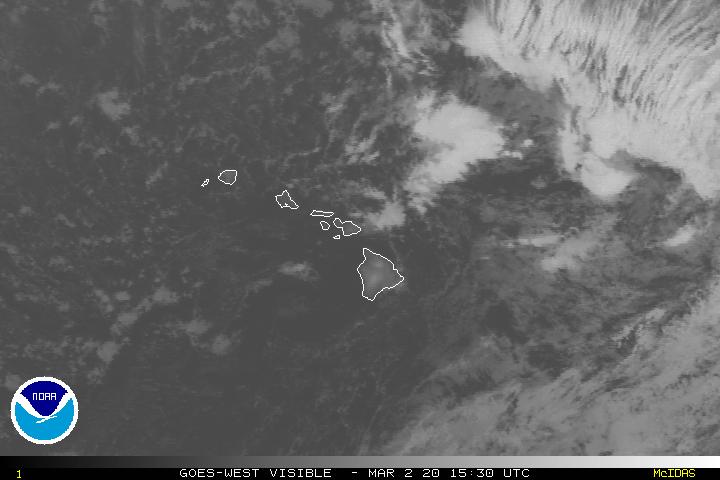
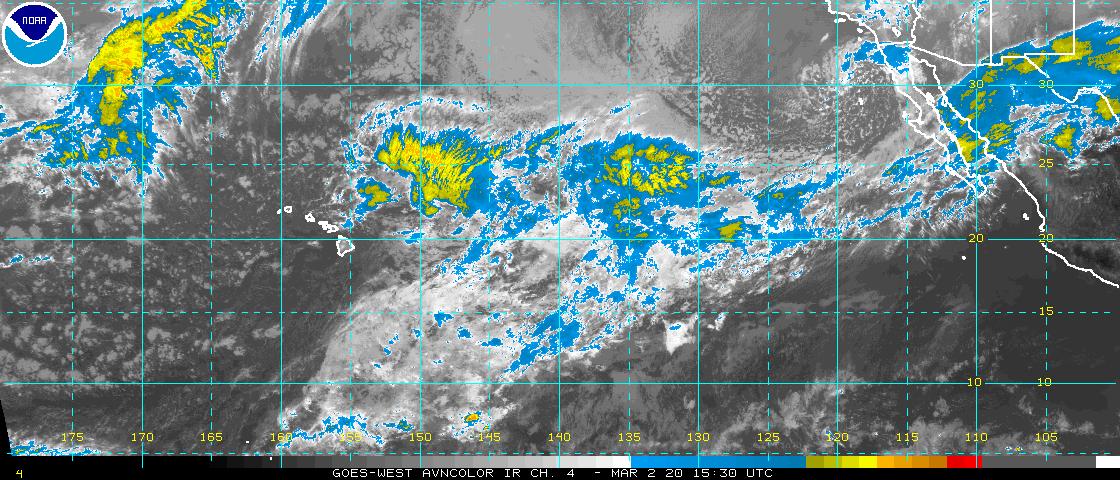
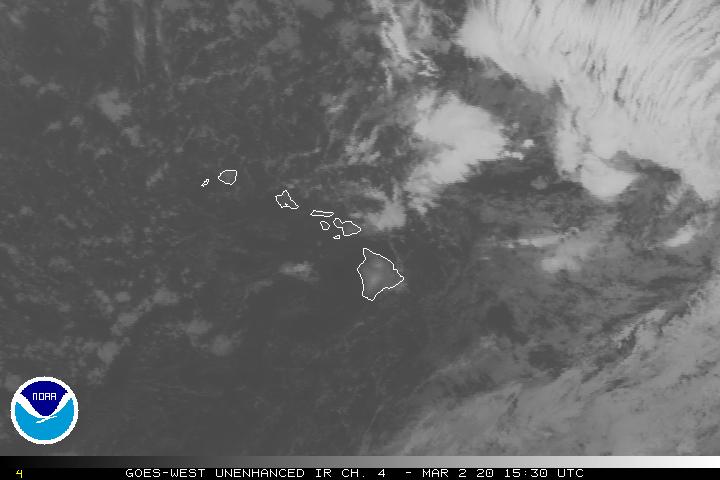
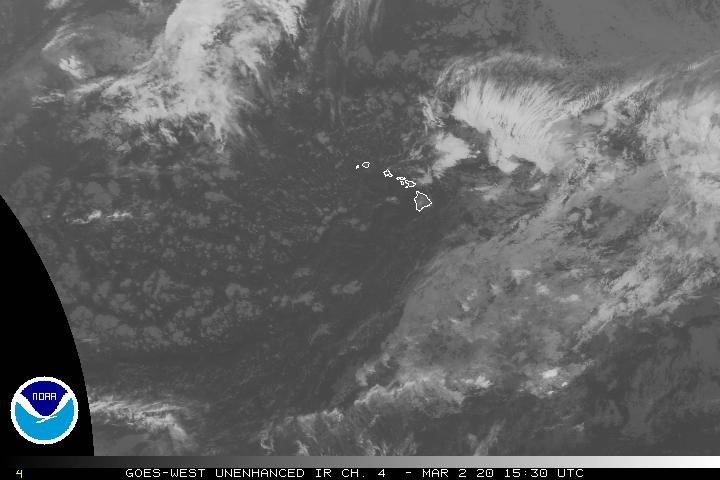
Satellite and Radar Images: To view the cloud conditions we have here in Hawaii, please use the following satellite links, starting off with this Infrared Satellite Image of the islands to see all the clouds around during the day and night. This next image is one that gives close images of the islands only during the daytime hours, and is referred to as a Close-up visible image. This next image shows a larger view of the Pacific…giving perspective to the wider ranging cloud patterns in the Pacific Ocean. Finally, here’s a Looping IR satellite image, making viewable the clouds around the islands 24 hours a day. To help you keep track of where any showers may be around the islands, here’s the latest animated radar image.
Hawaii’s Mountains – Here’s a link to the live webcam on the summit of near 14,000 foot Mauna Kea on the Big Island of Hawaii. The tallest peak on the island of Maui is the Haleakala Crater, which is near 10,000 feet in elevation. These two webcams are available during the daylight hours here in the islands…and when there’s a big moon rising just after sunset for an hour or two! Plus, during the nights and early mornings you will be able to see stars, and the sunrise too…depending upon weather conditions.
Tropical Cyclone activity in the eastern and central Pacific – Here’s the latest weather information coming out of the National Hurricane Center, covering the eastern north Pacific. You can find the latest tropical cyclone information for the central north Pacific (where Hawaii is located) by clicking on this link to the Central Pacific Hurricane Center. Here’s a tracking map covering both the eastern and central Pacific Ocean. A satellite image, which shows the entire ocean area between Hawaii and the Mexican coast…can be found here. Of course, as we know, our hurricane season won’t begin again until June 1st here in the central Pacific.
Aloha Paragraphs

We’ll flip a coin…to see who gets this!
Our local trade winds are expected to remain light to moderate through the rest of this week. This weather map shows two high pressure systems located to our north…the source of our trade breezes Wednesday night. There will be those places, those typically windier locations, that will be somewhat stronger and gusty.
As the light to moderately strong trade winds continue to blow, most of the incoming showers will be focused along the windward sides. This satellite image shows just the usual patchy clouds upstream of the islands…which will bring those occasional showers…mostly at night. Glancing down to the south of the islands, using this satellite picture, we see an area of thunderstorms to the south. The NWS is giving this area a modest 10% chance of developing into a tropical cyclone…along with another smaller area to the southeast. Meanwhile, we see some thickening high cirrus clouds to the west of our islands.
It’s Wednesday evening as I begin writing this last section of this morning’s narrative update. The weather remained nice at mid-week, although the winds got a bit a uppity here and there around the state. There’s still no small craft wind advisories going, let me check on that real quick…yeah that’s right. Meanwhile, the computer models, and satellite imagery still suggest that we’ll see some sort of increase in windward biased showers Thursday evening into Friday morning. Then, there’s those high cirrus clouds just to our west, which are stretching over Kauai and maybe Oahu about now. I’m not sure we’ll be able to see them on Maui and the Big Island for Wednesday’s sunset, but maybe more likely by Thursday’s sunrise. Finally, I’m eyeballing that area of thunderstorms down to the south of the Big Island, a little more closely now. There’s a satellite image above, which shows this area. ~~~ I’ll be leaving soon for the drive back upcountry to Kula, and looking forward to being there. I know, I know, I always say this: I’m looking forward to getting out on the road for my evening walk! I’m such a creature of habit, and during the work week, a slave to my schedule…which I love. So, I’ll be back very early Thursday morning with your next new weather narrative. I hope you have a great Wednesday night until then! Aloha for now…Glenn.
Interesting: Outbursts of heavy rain spread over the last several weeks have left areas of southern Mexico under water. Tens of thousands of people have been driven from their homes. The hardest hit states include Tabasco, Veracruz, Chiapas and Oaxaca. In Tabasco alone, the homes of more than 100,000 people have been infiltrated by floodwaters, according to reports. At least 460,000 acres of cropland has been lost.
The latest outbursts of flooding rain coincided with those that triggered the deadly landslides in the highlands of neighboring Guatemala earlier this week. Tapachula, Chiapas, had 15 inches of rain during the first full week of September, and more than 30 inches since early August. People stand in flooded streets in the Juchitan municipality of Oaxaca state in Mexico, Sunday, Sept. 5, 2010.
Heavy rains have affected at least four states in Mexico causing rivers and dams to overflow. The Grijalva River, which heads up in Chiapas and western Guatemala, has risen quickly to alarming levels in the Tabasco state capital, Villahermosa. Reports have told of workers erecting emergency barriers against the flood surge as some outlying neighborhoods went under water.
Farther north, Veracruz has had about 30 inches of precipitation, or nearly twice the normal rainfall, since the start of August. According to meteorologists, rainfall in the southern half of Mexico normally peaks in August and, even more so, September. Flooding is essentially a yearly occurrence in many flood-prone areas, although its severity varies with seasonal rainfall.
Interesting2: Modeling for climate change is an extremely complex process because Earth’s climate is so complex. It is an interrelated system that involves the atmosphere, biosphere, land, and oceans. A change in one can cause a chain reaction in all the others. By studying ancient climate change patterns, scientists are better able to predict what might happen in future events. However, one factor that remains far from understanding is the role of clouds — how they will react to and influence a changing climate.
On the one hand, clouds provide shade for the surface of the planet and effectively reflect incoming solar radiation back into space. Therefore, a rise in cloudiness will result in a cooler planet. On the other hand, clouds are made up of water vapor which is in itself, a powerful greenhouse gas. This would mean that more clouds would trap more heat than would be reflected. The question is not just how much cloud cover there is, but where it is and what type of cloud.
Would a warming world create more dark, storm clouds (stratus)? More great, big, puffy clouds (cumulus)? More high, wispy clouds (cirrus)? How each type would influence, and be influenced by, higher temperatures remains unknown. However, according to Dave Randall, cloud modeler at Colorado State University, "We do know a lot about clouds. We just don’t know enough. We’re not in the infant stages of understanding any more; we’re in first or second grade, and on the way to adolescence."
The consensus among climate modelers is that global warming would lead to more evaporation of the oceans, which would create more water vapor in the air and more clouds. Yet, more water in the atmosphere may not necessarily lead to more clouds, because higher temperatures would require more water vapor to become saturated. This means that more water vapor would be needed to form clouds, leading to the same amount of cloudiness that there would be otherwise.
The study of clouds is ongoing, and there are many projects in the works to better understand them. MIT scientist, Richard Lindzen has proposed the Iris Hypothesis, which states that increasing humidity as the Earth warms will create a shift from cirrus to cumulus clouds which better reflect sunlight. This would create a counterweight to global warming. There is also a real-world experiment called the GEWEX (Global Energy and Water Cycle Experiment) Cloud System Study conducted by multiple government agencies.
The GEWEX team observes clouds from aircraft, ships, and remote sensing instruments, and then compares them to models that simulate clouds on those same scales. So far, the preliminary assessment suggests clouds will accelerate warming, but the results are far from definitive.
Yet most scientists say that the case is getting stronger. Some say that even if clouds have a cooling effect, they would not be sufficient to halt rising temperatures. One thing that all scientists will freely admit, like all climate science, is that they do not understand everything. But if they are anywhere close to being right, we are in for a warmer future.
Interesting3: San Rafael Falls, Ecuador’s tallest waterfall, is threatened by a Chinese-funded hydroelectric project, reports Save America’s Forests, an environmental group. The 1,500 megawatt Coca-Codo Sinclair Hydroelectric Project will divert water flow away from the 480-foot San Rafael Falls, leaving it "high and dry." Worse, the project, which is scheduled for completion in 2016, will be pressure on Sumaco Biosphere Reserve, an area so renowned for its biodiversity that "even the oil companies spared this area during prospection and development of pipeline corridors in the Ecuadorian Amazon," according to Save America’s Forests, which says the falls have become the principal attraction of Sumaco.
"It is located in the mega-diverse transition zone between the Andes Mountains and the Amazon," stated the environmental group in a press release. "The falls have become one of the more prominent images and icons for promoting ecotourism in Ecuador, a country that made headlines in 2008 for being the first nation to grant constitutional rights to nature itself." Matt Finer of Save America’s Forests says the dam goes against the spirit of Ecuador’s constitution as well as its recent proposal to protect Yasuni National Park in the Amazon from oil development.
Interesting4: The world should safeguard coral reefs with networks of small no-fishing zones to confront threats such as climate change, and shift from favoring single, big protected areas, a U.N. study showed. "People have been creating marine protected areas for decades. Most of them are totally ineffective," Peter Sale, a leader of the study at the U.N. University’s Institute for Water, Environment and Health, told Reuters. "You need a network of protected areas that functions well," he said.
"It’s important to get away from single protected areas which has been the common approach." Fish and larvae of marine creatures can swim or be carried large distances, even from large protected areas. That means it is often best to set up a network of small no-fishing zones covering the most vulnerable reefs, with catches allowed in between.
Closing big zones can be excessive for conservation and alienate fishermen who then ignore bans. Reefs from the Pacific Ocean to the Caribbean are nurseries for fish and vital for food supplies since about 40 percent of the world’s population lives within 30 miles of the coast.
Climate change, pollution and over-fishing are among threats to reefs. Warmer oceans can damage corals, sometimes irreversibly. The U.N. University study is in a new handbook to help planners cooperate with marine scientists.
Interesting5: Not drying your hands thoroughly after washing them, could increase the spread of bacteria and rubbing your hands whilst using a conventional electric hand dryer could be a contributing factor. Frequently people give up drying their hands and wipe them on their clothes instead, but hand-hygiene is a key part of infection control and drying hands after washing is a very important part of the process.
A study by researchers at the University of Bradford and published in the Journal of Applied Microbiology looked at different methods of hand drying, and their effect on transfer of bacteria from the hands to other surfaces. The different methods included paper towels, traditional hand dryers, which rely on evaporation, and a new model of hand dryer, which rapidly strips water off the hands using high velocity air jets.
Our bodies naturally have bacteria called commensals all over them. However, bacteria from other sources, such as raw meat, can also survive on hands, and can be easily transferred to other surfaces, increasing the risk of cross-contamination. When hands are washed the number of bacteria on the surface of the skin decreases, but they are not necessarily eliminated.
If the hands are still damp then these bacteria are more readily transferred to other surfaces. In this study the researchers quantified the effects of hand drying by measuring the number of bacteria on different parts of the hands before and after different drying methods. Volunteers were asked to wash their hands and place them onto contact plates which were then incubated to measure bacterial growth.
The volunteers were then asked to dry their hands using either hand towels or one of three hand dryers, with or without rubbing their hands together, and levels of bacteria were re-measured. Dr Snelling and her team found that rubbing the hands together whilst using traditional hand dryers could counteract the reduction in bacterial numbers following hand washing.
Furthermore, they found that the relative reduction in the number of bacteria was the same, regardless of the hand dryer used, when hands are kept still. When hands are rubbed together during drying, bacteria that live within the skin can be brought to the surface and transferred to other surfaces, along with surface bacteria that were not removed by hand washing.
The researchers found the most effective way of keeping bacterial counts low, when drying hands, was using paper towels. Amongst the electric dryers, the model that rapidly stripped the moisture off the hands was best for reducing transfer of bacteria to other surfaces. Dr Snelling says: "Good hand hygiene should include drying hands thoroughly and not just washing. The most hygienic method of drying hands is using paper towels or using a hand dryer which doesn’t require rubbing your hands together."
 Email Glenn James: