September 7-8, 2010
Air Temperatures – The following maximum temperatures were recorded across the state of Hawaii Tuesday afternoon:
Lihue airport, Kauai – 84
Honolulu airport, Oahu – 86
Kaneohe MCAS, Oahu – 83
Molokai airport – 84
Kahului airport, Maui – 86
Hilo airport, Hawaii – 84
Ke-ahoe airport (Kona) – 82
Air Temperatures ranged between these warmest and coolest spots near sea level – and on the highest mountain tops…as of 4pm Tuesday afternoon:
Port Allen, Kauai – 86
Kaneohe, Oahu – 79
Haleakala Crater – 57 (near 10,000 feet on Maui)
Mauna Kea summit – 45 (near 14,000 feet on the Big Island)
Precipitation Totals – The following numbers represent the largest precipitation totals (inches) during the last 24 hours on each of the major islands, as of Tuesday afternoon:
2.33 Mount Waialeale, Kauai
1.43 Manoa Valley, Oahu
0.03 Molokai
0.00 Lanai
0.11 Kahoolawe
1.26 Puu Kukui, Maui
0.71 Kawainui Stream, Big Island
Marine Winds – Here’s the latest (automatically updated) weather map showing a large 1033 millibar high pressure system located to the north of the islands. Our local trade winds will remain light to moderately strong Wednesday and Thursday.
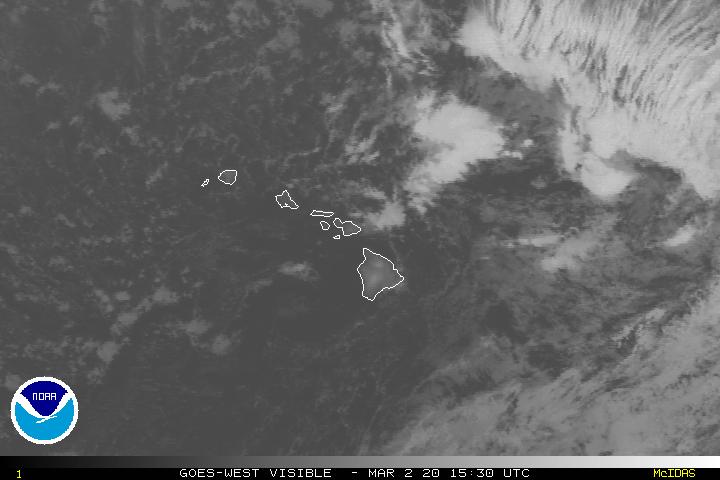
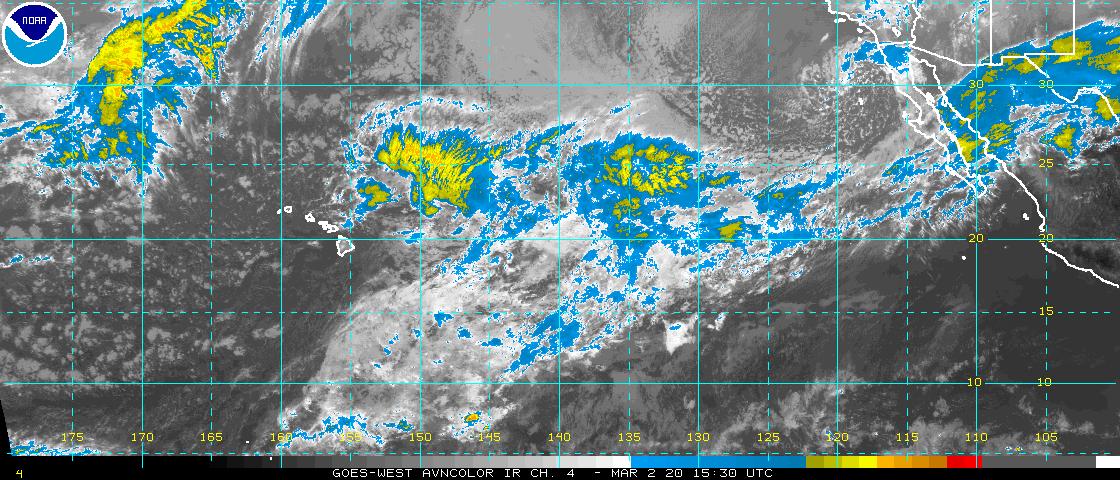
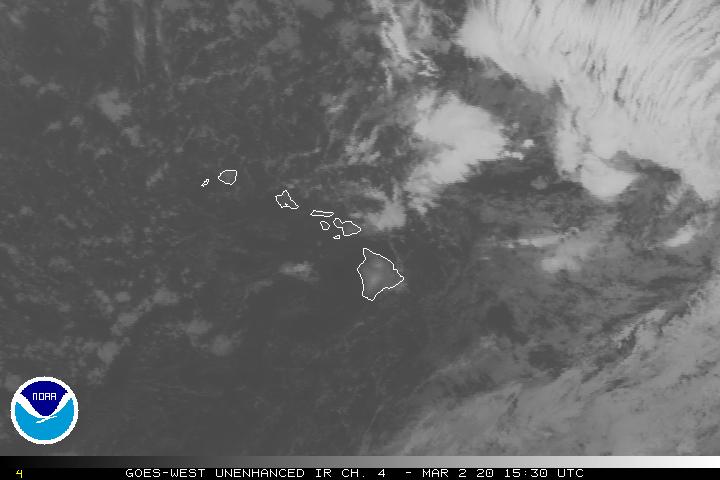
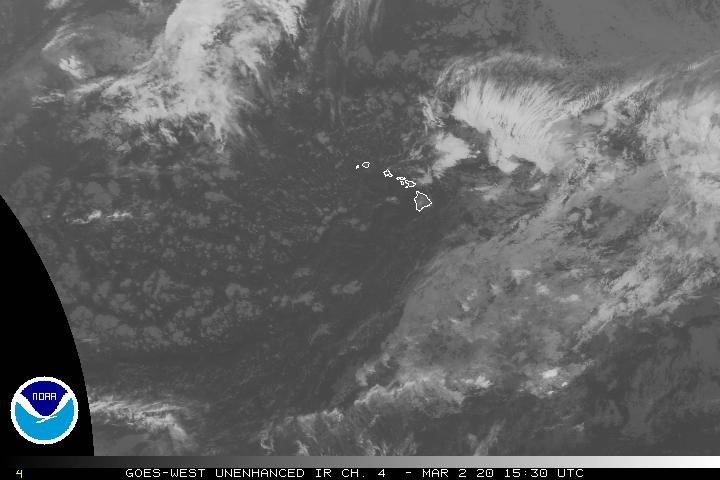
Satellite and Radar Images: To view the cloud conditions we have here in Hawaii, please use the following satellite links, starting off with this Infrared Satellite Image of the islands to see all the clouds around during the day and night. This next image is one that gives close images of the islands only during the daytime hours, and is referred to as a Close-up visible image. This next image shows a larger view of the Pacific…giving perspective to the wider ranging cloud patterns in the Pacific Ocean. Finally, here’s a Looping IR satellite image, making viewable the clouds around the islands 24 hours a day. To help you keep track of where any showers may be around the islands, here’s the latest animated radar image.
Hawaii’s Mountains – Here’s a link to the live webcam on the summit of near 14,000 foot Mauna Kea on the Big Island of Hawaii. The tallest peak on the island of Maui is the Haleakala Crater, which is near 10,000 feet in elevation. These two webcams are available during the daylight hours here in the islands…and when there’s a big moon rising just after sunset for an hour or two! Plus, during the nights and early mornings you will be able to see stars, and the sunrise too…depending upon weather conditions.
Tropical Cyclone activity in the eastern and central Pacific – Here’s the latest weather information coming out of the National Hurricane Center, covering the eastern north Pacific. You can find the latest tropical cyclone information for the central north Pacific (where Hawaii is located) by clicking on this link to the Central Pacific Hurricane Center. Here’s a tracking map covering both the eastern and central Pacific Ocean. A satellite image, which shows the entire ocean area between Hawaii and the Mexican coast…can be found here. Of course, as we know, our hurricane season won’t begin again until June 1st here in the central Pacific.
Aloha Paragraphs

Sunset on Kauai…with cliffs and surf breaking
Our local trade winds are expected to remain light to moderate through the rest of this week. This weather map shows a large 1033 millibar high pressure system located to our north…the source of our trade breezes Tuesday night. Little change is expected, with the strongest winds during the late mornings through early evening…lightest at night through the early mornings.
As the light to moderately strong trade winds continue to blow, most of the incoming showers will be focused along the windward sides. This satellite image shows just the usual patchy clouds upstream of the islands…which will bring those occasional showers…mostly at night. Glancing down to the south of the islands, using this satellite picture, we see that same area of thunderstorms to the southeast. There’s just a little spinning motion in this area, although there has been some off and on activity…so we’ll keep an eye on these two areas for the time being. The NWS is again giving one of them a 0% chance of developing…while the other has a slightly higher 20% chance. Meanwhile, we’re starting to see some high cirrus clouds to the southwest and west of our islands.
It’s Tuesday evening as I begin writing this last section of today’s narrative update. The favorably inclined weather circumstances, during this late summer period…continues. There really isn’t any obvious end in sight, especially while the trade winds are blowing. There will be day to day variations, in terms of how strong the trade winds will be blowing, and how many showers get carried our way on those trades. The air temperatures will remain warm to very warm at sea level, with perhaps 10-20 degrees spread between high and low temperatures…using 70F and 90F as the two extremes in general. ~~~ I’m done working here in Kihei, and am about to take the drive back upcountry to Kula, Maui. I’ll get home and take a walk right away, so to shake myself loose from sitting at my desk all day. Dinner this week consists of organic tortillas, with organic refried beans, organic colby cheese, and a fresh salsa from the health food store. Then it will be probably a quick telepone call, before hitting the bed with something to read. I’ll be up again very early Wednesday morning, so that I can prepare your next new weather narrative, and to get out on my early morning walk before getting ready to come down here to Kihei again then. I hope you have a great Tuesday night until then! Aloha for now…Glenn.
Interesting: How many species of insects exist? Umeå University researcher, Genoveva Rodríguez-Castañeda, found that in tropical mountains there are six times more insects than shown in global calculations. The insects in these areas are also highly specialized in their choice of food. "Our results urge ecologists to account for biogeographical variation when extrapolating in order to obtain global estimates," she says. Up until now researchers have calculated insect global diversity to be highest at tropical latitudes and the estimates for total number of insect species in the world ranges from five to ten million species.
However, these calculations are based from indices derived from plant insect interactions measured in tropical lowlands of Papua New Guinea. Genoveva Rodríguez-Castañeda examined if there was geographical variation in the nature of plant-insect interactions across elevation and if these differences were relevant for global estimates of insect diversity.
Her study shows that plant herbivore associations change across elevation. Herbivore insects have a higher specialization on which host plants they use in tropical montane forests than in tropical lowland forests. These differences occurred not only locally across the Ecuadorean Andes but also across the Barva volcano in Costa Rica. Furthermore, estimates of herbivore diversity increased drastically when geographical variations on herbivore-plant interactions were accounted for the Neotropical zone.
"This shows that what we know of insect diversity still lacks knowledge on tropical mountain diversity. I have worked with one type of herbivore insects, moths. Now we need to test if this pattern also occurs in other types of herbivore," she explains. The researchers incorporated various ecological factors into a model that would explain tropical herbivore diversity. It showed how food sources are not the only predictor of herbivore diversity.
Other factors that increase in tropical montane ecosystems such as stability of climate, protection from predators and evolutionary history may play a more important role. The study highlights a gap in tropical ecology knowledge since there is very little research done with herbivore plant interactions in montane ecosystems. At the same time it demonstrates how tropical montane systems host high diversity of specialized insects.
Interesting2: Russian oil and gas company Rosneft is conducting oil and gas exploration work that may have caused the critically endangered western gray whale to flee its main feeding ground. Tests and offshore installment of equipment by Rosneft for a major seismic survey began in late August, despite repeated calls from 12 governments, NGOs, scientists and the public to postpone the survey because of potential risks to the whales.
Rosneft started preparations for the survey last month near Sakhalin Island even though a small number of western gray whales mothers and calves were feeding in the area. Only an estimated 130 western North Pacific grey whales are left in the world, with around 30 breeding females. Seismic surveys are done by blasting the water with acoustic noise to detect oil and gas deposits under the ocean floor.
Observers from WWF and other NGOs began monitoring Rosneft’s activities and the whales in mid-July. It appears that as of Aug. 20, only weeks after Rosneft’s activities started, whales feeding in the area had already been affected. Before those activities began, observers registered 10 to 15 of the whales feeding in the area. Now whales have only been seen migrating across the area — not feeding.
"This is a critical problem as the whales have only a short time in which to consume enough food to last them through the year when they migrate to their breeding and calving grounds," said Wendy Elliott, WWF’s whale expert. The company also has twice conducted seismic surveys at night, which is in violation of international standards, and even Rosnefts’ own guidelines. On August 23, WWF-Russia issued a letter of concern to Russian environmental authorities, requesting an immediate stop to Rosneft’s testing.
As part of a WWF initiative, more than 10,000 people have sent Rosneft emails requesting that the surveys be postponed. However, Rosneft continues to shut out public opposition to its actions with some WWF members reporting that their emails to Rosneft’s outgoing President Sergei Bogdanchikov had been blocked. Scientists from the Western Gray Whale Advisory Panel (WGWAP), a group of eminent whale scientists, have also repeatedly asked the company to postpone the surveys until the whales have left the area.
A letter sent from 12 governments to the Russian government asking them to make Rosneft postpone the survey also went unheeded. "Rosneft is irresponsibly insisting on conducting this survey when they could easily postpone the survey until next year and hold it before the whales arrive," said Aleksey Knizhnikov, Oil & Gas Environmental Policy officer, WWF Russia.
"Rosneft may be ignoring public outcry but their negligent behavior will not be forgotten, and they will have to be held responsible for any harm that comes to the whales as a result of these surveys." Postponing the surveys would also enable Rosneft to develop the precautionary monitoring and mitigation measures that are essential to minimize the impact of the seismic survey on the whales.
Monitoring and mitigation measures have already been developed by the WGWAP, and are being used by another company in the same area. WWF and other NGOs have dozens of observers and boats on Sakhalin Island this year and will be monitoring the test and how it affects the feeding whales.
Interesting3: Increasingly erratic rainfall patterns related to climate change pose a major threat to food security and economic growth, water experts said on Monday, arguing for greater investment in water storage. In a report by the International Water Management Institute (IWMI), experts said Africa and Asia were likely to be hardest hit by unpredictable rainfall, and urged policymakers and farmers to try to find ways of diversifying sources of water.
The IWMI research estimates that up to 499 million people in Africa and India could benefit from improved agricultural water management. "Just as modern consumers diversify their financial holdings to reduce risk, smallholder farmers need a wide array of ‘water accounts’ to provide a buffer against climate change impacts," Matthew McCartney, a hydrologist at IWMI, said in a statement. "That way, if one water source goes dry, they’ll have others to fall back on."
The U.N. panel of climate experts has projected more extreme weather such as droughts, floods and heat waves this century, caused by global warming. The report said that, despite a great expansion in irrigation in recent decades in Asia, around 66 percent of agriculture there is still dependent on rainfall. In sub-Saharan Africa, the proportion is even greater at 94 percent, it said.
These are the regions where water storage infrastructure is least developed. The report cautioned against over-reliance on single solutions such as big dams, and said an integrated approach combining large- and small-scale storage was a better strategy. It suggested the use of water from natural wetlands, water stored in the soil, groundwater and water collected in ponds, tanks and reservoirs.
Interesting4: The eruption of Mount Sinabung for the first time in 400 years has highlighted the urgent need for Indonesian authorities to boost disaster preparedness, experts warn. "This is a challenge. We should study a volcano’s pattern of activity so that we can draw up guidelines to anticipate such a disaster," said Wisnu Wijaya, director of disaster risk reduction at the National Disaster Management Agency (BNPB). Mount Sinabung volcano in North Sumatra took the country by surprise, bubbling over after 400 dormant years and forcing 30,000 villagers to seek refuge in government-run shelters.
In the early hours of 3 September, Sinabung spewed a column of hot ash 3km into the air in the biggest eruption since 25 and 26 August. Even though it has the largest number – 129 – of active volcanoes on Earth and a history of devastating volcanic disasters, Indonesia has very few scientists watching these potential hazards.
Disaster risk reduction became more of an issue after the 2004 tsunami, but a lack of official awareness of the importance of volcano monitoring and the potential link between eruptions and earthquakes persists, said Wahyu Triyoso, a geophysicist at Indonesia’s Bandung Institute of Technology.
"A major earthquake like in Aceh may have triggered a volcanic surge by waking up dormant volcanoes," Triyoso said, referring to the quake that triggered the 2004 Indian Ocean tsunami, which killed more than 170,000 in Aceh province. Indonesia sits on a belt of intense seismic activity known as the "Pacific Ring of Fire". The Sinabung eruption should serve as a wake-up call for authorities to step up the monitoring of volcanoes around the islands, Wijaya said.
Waiting for warning BNPB chairman Syamsul Maarif said a 2007 law on disaster mitigation required every region to map its vulnerability to disasters, but only a few have complied. "We keep pushing the local governments to do it," Maarif said. "When a disaster happens, they can’t wait for the Jakarta-based BNPB team to arrive there in a short time and they should be able to help themselves before more help comes."
Before the latest eruption, about 10,000 people who had fled the first eruptions had returned to their villages to tend their crops, despite warnings from volcanologists that Mount Sinabung was still dangerous, said BNPB spokesman Priyadi Kardono. "Some villagers return to their fields during the day to harvest crops and go back to the shelters at night," Kardono said.
"As long as they are in the shelters, they are safe." Surono, director of the Centre for Volcanology and Geological Disaster Mitigation, said he had advised local authorities overnight to order villagers who returned to their homes within a 6km radius of Mount Sinabung to go back to the temporary shelters. According to the BNPB, two-thirds of the 30,000 who fled the volcano remain in 20 government shelters in Karo as of 3 September.
 Email Glenn James: