











September 4-5, 2010
Air Temperatures – The following maximum temperatures were recorded across the state of Hawaii Sunday afternoon:
Lihue airport, Kauai – 84
Honolulu airport, Oahu – 87
Kaneohe MCAS, Oahu – 84
Molokai airport – 84
Kahului airport, Maui – 86
Hilo airport, Hawaii – 84
Ke-ahoe airport – 82
Air Temperatures ranged between these warmest and coolest spots near sea level – and on the highest mountain tops…as of 5pm Saturday evening:
Port Allen, Kauai – 86
Hilo, Hawaii – 79
Haleakala Crater – 55 (near 10,000 feet on Maui)
Mauna Kea summit – 45 (near 14,000 feet on the Big Island)
Precipitation Totals – The following numbers represent the largest precipitation totals (inches) during the last 24 hours on each of the major islands, as of Saturday afternoon:
0.28 Mount Waialeale, Kauai
0.38 South Fork Kaukonahua, Oahu
0.03 Molokai
0.00 Lanai
0.03 Kahoolawe
0.45 West Wailuaiki, Maui
0.46 Kawainui Stream, Big Island
Marine Winds – Here’s the latest (automatically updated) weather map showing a large 1036 millibar high pressure system located to the north-northeast of the islands. Our local trade winds will remain active Sunday and Monday.
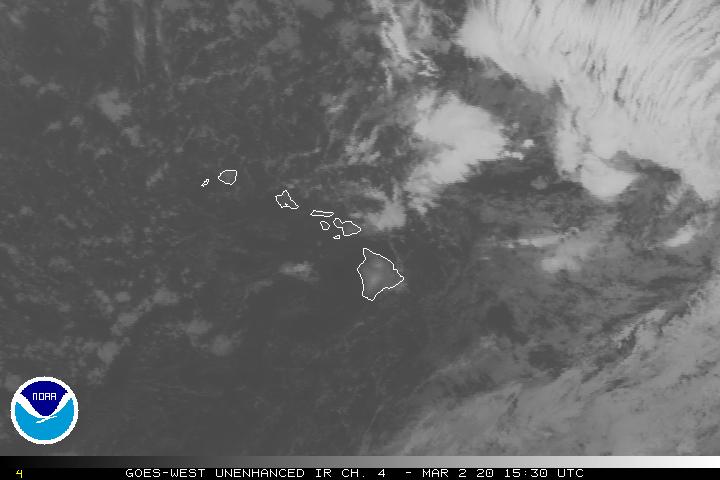
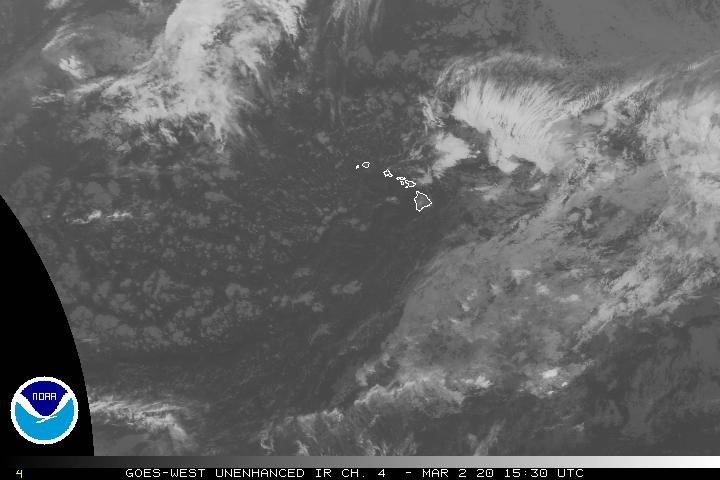
Satellite and Radar Images: To view the cloud conditions we have here in Hawaii, please use the following satellite links, starting off with this Infrared Satellite Image of the islands to see all the clouds around during the day and night. This next image is one that gives close images of the islands only during the daytime hours, and is referred to as a Close-up visible image. This next image shows a larger view of the Pacific…giving perspective to the wider ranging cloud patterns in the Pacific Ocean. Finally, here’s a Looping IR satellite image, making viewable the clouds around the islands 24 hours a day. To help you keep track of where any showers may be around the islands, here’s the latest animated radar image.
Hawaii’s Mountains – Here’s a link to the live webcam on the summit of near 14,000 foot Mauna Kea on the Big Island of Hawaii. The tallest peak on the island of Maui is the Haleakala Crater, which is near 10,000 feet in elevation. These two webcams are available during the daylight hours here in the islands…and when there’s a big moon rising just after sunset for an hour or two! Plus, during the nights and early mornings you will be able to see stars, and the sunrise too…depending upon weather conditions.
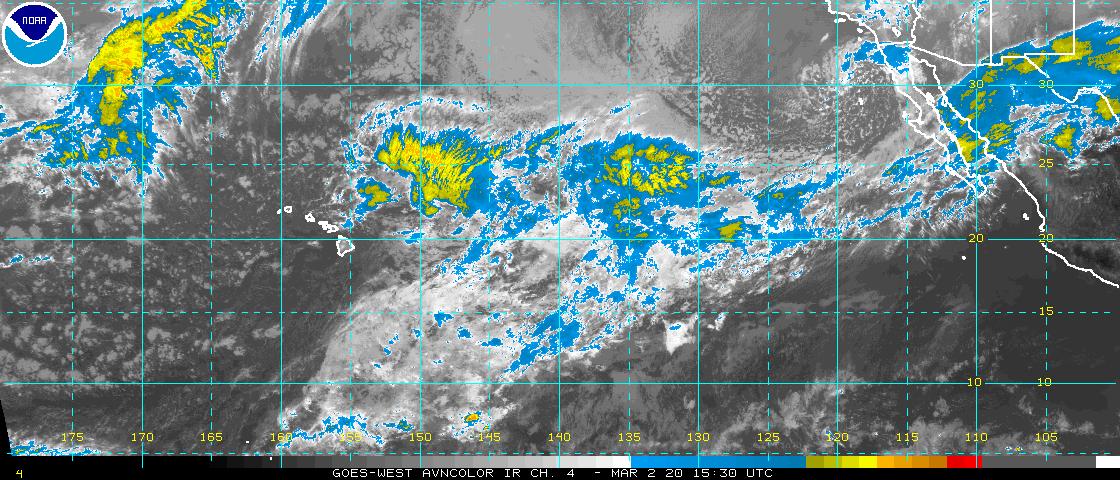
Tropical Cyclone activity in the eastern and central Pacific – Here’s the latest weather information coming out of the National Hurricane Center, covering the eastern north Pacific. You can find the latest tropical cyclone information for the central north Pacific (where Hawaii is located) by clicking on this link to the Central Pacific Hurricane Center. Here’s a tracking map covering both the eastern and central Pacific Ocean. A satellite image, which shows the entire ocean area between Hawaii and the Mexican coast…can be found here. Of course, as we know, our hurricane season won’t begin again until June 1st here in the central Pacific.
Aloha Paragraphs

Great snorkeling spot along the Big Island coast
Our local trade winds remain active during this long holiday weekend, which may become softer beginning around the middle of next week…for several days. This weather map shows a moderately strong 1036 millibar high pressure system located to our north-northeast…the source of our trade breezes Saturday night. Our trade winds did’nt become as strong as the computer models had been suggesting today. Nonetheless, they blew moderately strong, and will continue to do so through the rest of this long holiday weekend…into Monday. As we move into the new week, the winds may become lighter for several days, around the middle of the week
.
As the trade winds continue to blow, most of the incoming showers will be focused along the windward sides. This windward biased shower activity will occur most readily during the night and early morning hours. This satellite image shows most of the incoming clouds heading towards the islands from Oahu down through the Big Island. Glancing down further to the south of the islands, in the deeper tropics, using this satellite picture, we see an area of thunderstorms far to the southeast. There’s no spinning motion down there, although the NWS is giving this area a low 10% chance of developing into a tropical cyclone over the next few days.
It’s Saturday
evening as I begin writing this last section of this morning’s narrative update. This weekend has been a good one so far, with favorably inclined weather conditions prevailing just about everywhere. Moving into the new week, especially towards the middle of the week, we could see a shift into a new weather pattern. This would take the form of lighter winds, and their associated subtle changes.
~~~ Friday evening after work I went to see a new film in Kahului. This film was about as close to an Indie film as we get here in the islands, or at least here on Maui. It’s called Mao’s Last Dancer (2010), starring Amanda Schull and Kyle MacLachlan, Bruce Greenwood, Jack Thompson, Aden Young. The synopsis:
the rags-to-riches story of Chinese ballet dancer Li Cunxin who, at age 11, was chosen to train at Madam Mao’s Beijing Dance Academy, and later went on to become one of the world’s greatest dancers.
The Yahoo viewers are giving it an A grade, and this trailer makes it look very good in my humble opinion. The theatre was not packed by any means, rather there was just a modest sprinkling of folks. I didn’t talk to anyone else, although I enjoyed the film quite a bit. It was a thoughtful film, in contrast to most of the action films that I see. I wouldn’t give it an A grade, although I could give it a strong B, or even B+. You can get a good sense of this film by checking out the trailer, as it centered around dancing, family values, and loving relationships.
~~~ Saturday was a wonderful late summer day, with just a few light showers along our windward sides. The leeward sides had great weather conditions, with lots of sunshine in most areas. There will be some increase in clouds overnight, along the windward sides, although nothing too pronounced. I expect Sunday to be another great day, as will the upcoming holiday on Monday. I’ll be back Sunday morning with your next new weather narrative, I hope you have a great Saturday night until then! Aloha for now…Glenn.
Interesting: The National Oceanic and Atmospheric Administration (NOAA) today reopened to commercial and recreational fishing 5,130 square miles of Gulf waters stretching from the far eastern coast of Louisiana, through Mississippi, Alabama, and the western Florida panhandle. The Mariner Energy oil platform just had an explosion is about 250 miles from today’s reopening. The fire on a Mariner Energy Inc. oil and natural-gas platform in the Gulf of Mexico has been extinguished in an event that may prolong the U.S. drilling moratorium imposed after BP’s record crude spill.
At its closest point, the area to be reopened is about 54 miles north of the Deepwater/BP wellhead. The entire area is heavily fished by fishermen targeting snapper, mackerel, and shrimp. In addition, the area off the Florida panhandle currently open only to fin fish fishing will be opened to all fishing. King mackerel are found Gulf wide in open near shore and coastal waters.
While these fish as adults are seldom found inshore, they are found as near to shore as clear water can be found. While they are generally considered an open-water fish, in the northern Gulf of Mexico they are very commonly encountered near the perimeters of offshore oil and gas platforms. The total area is about four percent of federal waters in the Gulf of Mexico and 21 percent of the current closed area, as last modified on August 27. The closed area now covers 43,000 square miles, or about 18 percent of the federal waters in the Gulf.
The boundary of the fishery closure has changed 26 times after it was first instituted on May 2, at which time it covered about 3 percent (6,817 square miles) of Gulf waters around the wellhead. As oil continued to spill from the wellhead, the area grew in size, peaking at 37 percent (88,522 square miles) of Gulf waters on June 2.
The Mariner fire occurred September 2 and there were no injuries or deaths. However, a mile long, 100-foot-wide sheen of oil was sighted near the burning Vermilion 380 platform, which stands in less than 400 feet of water, the Coast Guard said, citing a report from Houston based Mariner. Mariner operates seven wells in the Vermilion 380 field.
Proved reserves were estimated at 33.2 billion cubic feet of gas equivalent at the end of 2009 and were about 47 percent oil and 53 percent gas and gas liquids. Production last year was equivalent to 1.1 billion cubic feet of gas, Mariner said in a public filing. At this time the Mariner incident is not having any effect on the BP incident. What this foretells for the overall oil drill rig industry is to be determined.
Interesting2: A reinterpretation of the fossil record suggests a new answer to one of evolution’s existential questions: whether global mass extinctions are just short-term diversions in life’s preordained course, or send life careening down wholly new paths. Some scientists have suggested the former. Rates of species diversification — the speed at which groups adapt and fill open ecological niches — seemed to predict what’s flourished in the aftermath of past planetary cataclysms. But according to the calculations of Macquarie University paleobiologist John Alroy, that’s just not the case.
"Mass extinction fundamentally changes the dynamics. It changes the composition of the biosphere forever. You can’t simply predict the winners and losers from what groups have done before," he said. Alroy was once a student of paleontologist Jack Sepkoski, who in the 1980s formalized the notion that Earth has experienced five mass extinctions in the 550 million years since life became durable enough to leave a fossil record.
Graphs of taxonomic abundance depict lines rising steadily as life diversifies, plunging precipitously during each extinction, and rising again as life proliferates anew. As the fossil record is patchy and long-term evolutionary principles still debated, paleobiologists have historically disagreed about what these extinctions mean.
Some held that, in the absence of extinctions, species would diversify endlessly. The Tree of Life could sprout new branches forever. Others argued that each taxonomic group had limits; once it reached a certain size, each branch would stop growing.
Interesting3: Ants are not out of their weight class when defending trees from the appetite of nature’s heavyweight, the African elephant, a new University of Florida study finds. Columns of angered ants will crawl up into elephant trunks to repel the ravenous beasts from devouring tree cover throughout drought-plagued East African savannas, playing a potentially important role in regulating carbon sequestration in these ecosystems, said Todd Palmer, a UF biology professor and co-author of a paper being published in the journal Current Biology.
"It really is a David and Goliath story, where these little ants are up against these huge herbivores, protecting trees and having a major impact on the ecosystems in which they live," Palmer said. "Swarming groups of ants that weigh about 5 milligrams each can and do protect trees from animals that are about a billion times more massive." The mixture of trees and grasses that make up savanna ecosystems are traditionally thought to be regulated by rainfall, soil nutrients, plant-eating herbivores and fire, he said.
"Our results suggest that plant defense should be added to the list," he said. "These ants play a central role in preventing animals that want to eat trees from doing extensive damage to those trees." While conducting research in the central highlands of Kenya, where hungry elephants have destroyed much of the tree cover, Palmer said he and his colleague and former UF post-doctoral student, Jacob Goheen, now a University of Wyoming zoology, physiology and botany professor, noticed that elephants rarely ate a widespread tree species known as Acacia drepanolobium where guardian ants aggressively swarm anything that touches the trees.
But they would feed on other trees that did not harbor these ants. The researchers decided to test whether these tiny ants were repelling the world’s largest land mammal by serving as bodyguards for the tree in exchange for shelter and the food it supplied in the form of a sugary nectar solution. So they offered elephants at a wildlife orphanage a choice between these "ant plant" trees, with and without ants on the branches, and their favorite species of tree, the Acacia mellifera, to which the researchers added ants to some of its otherwise ant less branches.
"We found the elephants like to eat the "ant plant" trees just as much as they like to eat their favorite tree species, and that when either tree species had ants on them, the elephants avoided those trees like a kid avoids broccoli," he Palmer said. Also, the researchers removed ants from "ant trees" out in the field to see if elephants would attack them undefended, and a year later found much more damage than on trees with ants.
Satellite images between 2003 and 2008 confirmed the ants were having a widespread, long-term effect throughout the savanna, he said. The ants did not seem to annoy tree-feeding giraffes, who used their long tongues to swipe away them away from their short snouts, in marked contrast to the long nose or trunk on an elephant, Palmer said. The inside of an elephant’s trunk is tender and highly sensitive to thousands of biting ants swarming up into it, he said.
"An elephant’s trunk is a truly remarkable organ, but also appears to be their Achille’s heel when it comes to squaring off with an angry ant colony," he said. Because it appears that smell alerts elephants to avoid trees that are occupied by ants, it raises the question of whether ant odors might be applied to crops to deter elephants from feeding on them, just as DEET helps repel mosquitoes from people, he said. "A big issue in east Africa is elephants damaging crops, which is one reason elephants have been harassed and sometimes killed," he said.
"There’s been a lot of interest in the conservation world about how to minimize the conflict elephants have with humans and particularly how to keep elephants from raiding agricultural fields." One predicted outcome of global warming is more frequent and intense droughts, which will force desperate elephants to eat everything they can to survive, Palmer said "With more droughts, the extent to which elephants destroy and remove trees may increase and potentially shift the ecosystems back to grasslands," he said.
Ants’ role in saving trees is critical with the interest in slowing the accumulation of greenhouse gasses since trees absorb carbon dioxide from the atmosphere, Palmer said. "These ‘ant plants’ don’t cover just a few hundred acres but are distributed throughout east Africa from southern Sudan all the way over to eastern Zaire and down through the horn of Africa and Tanzania," he said. "So they potentially play a big role in terms of regulating carbon dynamics in these ecosystems."
 Email Glenn James: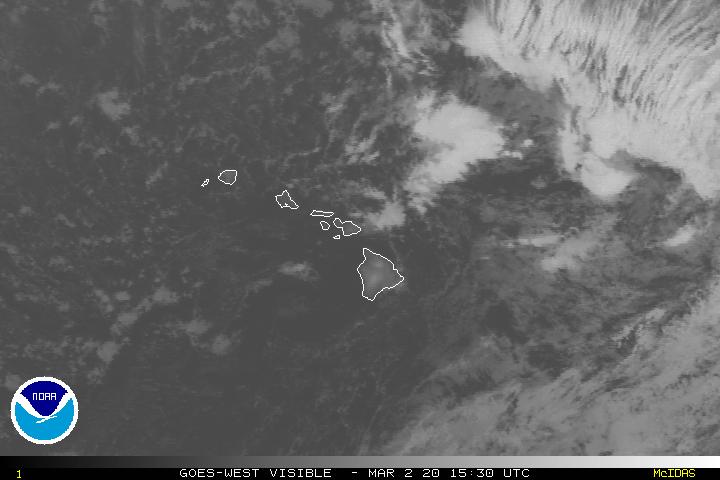


Priscilla Allen Says:
KZN, S Africa.
A few years back an acquaintance showed me a photo taken of the area where I live taken soon after the white man first arrived in Natal, S Africa; about 150 years ago. It showed wide stretches of open veldt covered by long grass and the occasional stunted tree. Today the same countryside is a mixture of gardens (all with trees), plantation forests, and thick wild bush. How could this be the same place he asked? The Zulu name for my home is uMgungunglovu “the place of the elephant”. This is where they could always be found. I don’t know the detail but the elephants didn’t last long after the white man arrived. Now we are called ‘the garden city’. Pity they can’t live together.
Thanks for your great site.
Priscilla~~~Hi Priscilla, this makes me sad. The world seems to be getting smaller, as more and more people populate it. I appreciate your letting us know about what was, and what it has become…there in Africa. My understanding is the elephant is a gentle creature, very large but pretty easy going if not provoked. Let’s hope that we can continue to see them in the wild, rather than in zoo’s. Aloha, Glenn