











Hawaiian Islands weather details & Aloha paragraphs / September 30 – October 1, 2010
Posted by GlennSeptember 30-October 1, 2010
Air Temperatures – The following maximum temperatures were recorded across the state of Hawaii Thursday afternoon:
Lihue airport, Kauai – 86
Honolulu airport, Oahu – 87
Kaneohe MCAS, Oahu – 85
Molokai airport – 84
Kahului airport, Maui – 84
Ke-ahole airport (Kona) – 83
Hilo airport, Hawaii – 86
Air Temperatures ranged between these warmest and coolest spots near sea level – and on the highest mountain tops…as of 5pm Thursday evening:
Port Allen, Kauai – 88
Kahului, Maui -79
Haleakala Crater – 46 (near 10,000 feet on Maui)
Mauna Kea summit – 43 (near 14,000 feet on the Big Island)
Precipitation Totals – The following numbers represent the largest precipitation totals (inches) during the last 24 hours on each of the major islands, as of Thursday afternoon:
1.24 Mount Waialeale, Kauai
1.26 Nuuanu Upper, Oahu
0.30 Molokai
0.00 Lanai
0.05 Kahoolawe
0.82 Kahakuloa, Maui
0.20 Kaupulehu, Big Island
Marine Winds – Here’s the latest (automatically updated) weather map showing a high pressure systems far to the northwest, and northeast of our islands. At the same time, we find a retiring frontal cloud band over the state. Our local winds will remain light Thursday into Friday.
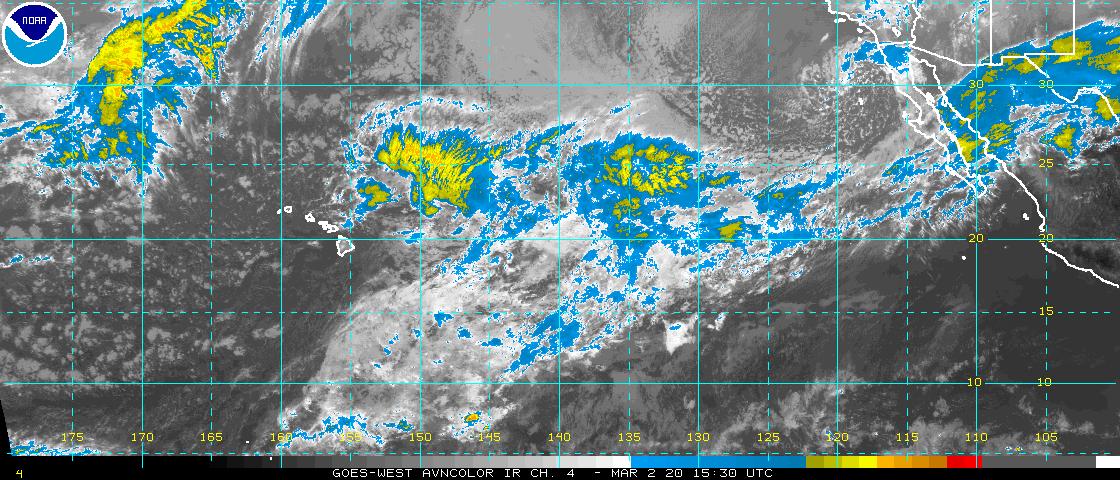
Satellite and Radar Images: To view the cloud conditions we have here in Hawaii, please use the following satellite links, starting off with this Infrared Satellite Image of the islands to see all the clouds around during the day and night. This next image is one that gives close images of the islands only during the daytime hours, and is referred to as a Close-up visible image. This next image shows a larger view of the Pacific…giving perspective to the wider ranging cloud patterns in the Pacific Ocean. Finally, here’s a Looping IR satellite image, making viewable the clouds around the islands 24 hours a day. To help you keep track of where any showers may be around the islands, here’s the latest animated radar image.
Hawaii’s Mountains – Here’s a link to the live webcam on the summit of near 14,000 foot Mauna Kea on the Big Island of Hawaii. The tallest peak on the island of Maui is the Haleakala Crater, which is near 10,000 feet in elevation. These two webcams are available during the daylight hours here in the islands…and when there’s a big moon rising just after sunset for an hour or two! Plus, during the nights and early mornings you will be able to see stars, and the sunrise too…depending upon weather conditions.
Tropical Cyclone activity in the eastern and central Pacific – Here’s the latest weather information coming out of the National Hurricane Center, covering the eastern north Pacific. You can find the latest tropical cyclone information for the central north Pacific (where Hawaii is located) by clicking on this link to the Central Pacific Hurricane Center. Here’s a tracking map covering both the eastern and central Pacific Ocean. A satellite image, which shows the entire ocean area between Hawaii and the Mexican coast…can be found here. Of course, as we know, our hurricane season won’t end until November 31st here in the central Pacific.
Aloha Paragraphs

Dolphins…in Hawaiian waters
Our local winds will remain light and variable in direction, becoming trade winds as we move into the weekend…and beyond. The reason our trade winds are on vacation now, at least in some parts of the Hawaiian Islands…is due to the presence of two cold fronts, one dissipating over Maui County, and another to the north of our islands. These early season cold fronts, in combination with no trade wind producing high pressure systems in our area…are keeping our trade winds tamped-down. Thus, there will continue to be a convective weather pattern over us, with generally light winds prevailing. It should be noted that over Kauai and Oahu, there are some trade winds blowing. As we move into the weekend, we should see the trade winds strengthening statewide, continuing on into early next week…at least.
The dissipating cold front over Maui and some of Oahu, is bringing clouds and showers to this area, while the rest of the state…remained in generally fine weather Thursday. Maui County, and especially Oahu will continue to see scattered showers into Friday associated with the dying cold front. The low pressure associated with this old cold front may trigger a few heavier showers locally. As the weekend rolls around, and as the trade winds return then later Friday, we could see more showers keeping the windward sides off and on wet…as an upper level low pressure system moves by to our south.
It’s Thursday evening as I begin writing this last section of today’s narrative update. The early season cold front brought moisture into the central islands overnight, which hung around over Oahu and Maui County during the day. The islands of Kauai and the Big Island had better luck, with less clouds and showers…and actually a fair amount of sunshine. Meanwhile, a small low pressure system will keep parts of Oahu and Maui County off and on showery Thursday night into Friday. The islands of Kauai and the Big Island will find somewhat less of these wetter clouds around. As we get into the weekend, and the trade winds crank up statewide, there will be off and on passing showers along the windward sides of all the islands. ~~~ Here on Maui, during much of the day, we saw low clouds and light showers falling over the Kahului and Wailuku areas. This is pretty amazing, considering most all of the summer we’ve had dry weather there, and just when the Maui County Fair rolls around, we have showers! Today the Maui News called me, and asked about what I thought would be happening Friday into the weekend, in terms of the weather over the fair grounds. This was a loaded question surrounded by pressure, as no weatherman wants to rain on anyone’s parade. I told the newspaper that I thought we’d see off and on passing showers, and that they would help to keep the dust down. I’m hoping that there won’t be too many showers, and that the fair will come off nicely! ~~~ I’ll be back early Friday morning with your next new weather narrative. I hope you have a great Thursday night until then! Aloha for now…Glenn.
Interesting: Astronomers say they have for the first time spotted a planet beyond our own in what is sometimes called the Goldilocks zone for life: Not too hot, not too cold. Juuuust right. Not too far from its star, not too close. So it could contain liquid water. The planet itself is neither too big nor too small for the proper surface, gravity and atmosphere. It’s just right. Just like Earth. "This really is the first Goldilocks planet," said co-discoverer R. Paul Butler of the Carnegie Institution of Washington.
The new planet sits smack in the middle of what astronomers refer to as the habitable zone, unlike any of the nearly 500 other planets astronomers have found outside our solar system. And it is in our galactic neighborhood, suggesting that plenty of Earth-like planets circle other stars. Finding a planet that could potentially support life is a major step toward answering the timeless question: Are we alone?
Scientists have jumped the gun before on proclaiming that planets outside our solar system were habitable only to have them turn out to be not quite so conducive to life. But this one is so clearly in the right zone that five outside astronomers told The Associated Press it seems to be the real thing. "This is the first one I’m truly excited about," said Penn State University’s Jim Kasting. He said this planet is a "pretty prime candidate" for harboring life. Life on other planets doesn’t mean E.T.
Even a simple single-cell bacteria or the equivalent of shower mold would shake perceptions about the uniqueness of life on Earth. But there are still many unanswered questions about this strange planet. It is about three times the mass of Earth, slightly larger in width and much closer to its star — 14 million miles away versus 93 million. It’s so close to its version of the sun that it orbits every 37 days.
And it doesn’t rotate much, so one side is almost always bright, the other dark. Temperatures can be as hot as 160 degrees or as frigid as 25 degrees below zero, but in between — in the land of constant sunrise — it would be "shirt-sleeve weather," said co-discoverer Steven Vogt of the University of California at Santa Cruz. It’s unknown whether water actually exists on the planet, and what kind of atmosphere it has.
But because conditions are ideal for liquid water, and because there always seems to be life on Earth where there is water, Vogt believes "that chances for life on this planet are 100 percent." The astronomers’ findings are being published in Astrophysical Journal and were announced by the National Science Foundation on Wednesday. The planet circles a star called Gliese 581.
It’s about 120 trillion miles away, so it would take several generations for a spaceship to get there. It may seem like a long distance, but in the scheme of the vast universe, this planet is "like right in our face, right next door to us," Vogt said in an interview. That close proximity and the way it was found so early in astronomers’ search for habitable planets hints to scientists that planets like Earth are probably not that rare.
Vogt and Butler ran some calculations, with giant fudge factors built in, and figured that as much as one out of five to 10 stars in the universe have planets that are Earth-sized and in the habitable zone. With an estimated 200 billion stars in the Milky Way galaxy, that means maybe 40 billion planets that have the potential for life, Vogt said.
However, Ohio State University’s Scott Gaudi cautioned that is too speculative about how common these planets are. Vogt and Butler used ground-based telescopes to track the star’s precise movements over 11 years and watch for wobbles that indicate planets are circling it. The newly discovered planet is actually the sixth found circling Gliese 581. Two looked promising for habitability for a while, another turned out to be too hot and the fifth is likely too cold.
This sixth one bracketed right in the sweet spot in between, Vogt said. With the star designated "a," its sixth planet is called Gliese 581g. "It’s not a very interesting name and it’s a beautiful planet," Vogt said. Unofficially, he’s named it after his wife: "I call it Zarmina’s World." The star Gliese 581 is a dwarf, about one-third the strength of our sun. Because of that, it can’t be seen without a telescope from Earth, although it is in the Libra constellation, Vogt said.
But if you were standing on this new planet, you could easily see our sun, Butler said. The low-energy dwarf star will live on for billions of years, much longer than our sun, he said. And that just increases the likelihood of life developing on the planet, the discoverers said. "It’s pretty hard to stop life once you give it the right conditions," Vogt said.
Interesting2: Astronomers said life is likely to exist on the newfound world named Gliese 581g. The planet is in the habitable zone around its star, a setup just 20 light-years from us. One of the discovery team went so far as to say: "Personally, given the ubiquity and propensity of life to flourish wherever it can, I would say, my own personal feeling is that the chances of life on this planet are 100 percent," said Steven Vogt, a professor of astronomy and astrophysics at the University of California, Santa Cruz, during a press briefing today. "I have almost no doubt about it."
This discovery, announced today, was the result of more than a decade of observations using the W. M. Keck Observatory in Hawaii. The research, sponsored by NASA and the National Science Foundation, placed the planet in an area where liquid water could exist on the planet’s surface. If further observations confirm everything, "this would be the most Earth-like exoplanet yet discovered and the first strong case for a potentially habitable one," NASA said in a statement.
Interesting3: Dams, agricultural runoff, pesticides, sewage, mercury pollution from coal plants, invasive species, overconsumption, irrigation, erosion from deforestation, wetland destruction, overfishing, aquaculture: it’s clear that the world’s rivers are facing a barrage of unprecedented impacts from humans, but just how bad is the situation? A new global analysis of the world’s rivers is not comforting: the comprehensive report, published in Nature, finds that our waterways are in a deep crisis which bridges the gap between developing nations and the wealthy west.
According to the study, while societies spend billions treating the symptoms of widespread river degradation, they are still failing to address the causes, imperiling both human populations and freshwater biodiversity. "Flowing rivers represent the largest single renewable water resource for humans," says Charles J. Vörösmarty of the City University of New York, an expert on global water resources and co-leader of the international team examining the world’s rivers.
"What we’ve discovered is that when you map out these many sources of threat, you see a fully global syndrome of river degradation." The study found that 80 percent of the world’s population (nearly 5.5 billion people) lives in an area where their rivers are gravely threatened, putting the issue of water security at front and center.
In addition, the study found that freshwater organisms, on which people depend, are also in crisis, echoing a study last year that reported that the world’s freshwater species are more threatened than both land and marine. But researchers were especially surprised to find that wealthy nations were no better at safeguarding their rivers than developing nations.
The Colorado River winding through America’s Grand Canyon. A new study in river health found that rivers worldwide, regardless of a nation’s economic status, are in grave trouble. "What made our jaws drop is that some of the highest threat levels in the world are in the United States and Europe," says Peter B. McIntyre, co-leader of the study and a professor of zoology at the University of Wisconsin-Madison’s Center for Limnology. "Americans tend to think water pollution problems are pretty well under control, but we still face enormous challenges."
Interesting4: A shortage of berries and other foods that hungry bears normally rely on to bulk up before hibernation has sent conflicts with humans spiraling to unprecedented levels in the Rocky Mountain West. Wildlife officials in parts of Idaho, Montana and Wyoming say they are experiencing a record year for so-called problem bears, which wander from the wilds into civilization — and into trouble. State and federal bear biologists say they are overrun this season with reports about errant grizzly and black bears foraging in everything from garbage cans to garages, in every place from golf courses to city centers.
"I’ve had as many as 20 calls a day," said Tim Manley, a grizzly bear management specialist with the Montana Fish, Wildlife and Parks Department. Scientists say bears this year are wrestling with challenging conditions. For starters, the mild winter meant bears emerging from their dens in the spring encountered fewer weakened or winter-killed wildlife like elk to prey on.
And late spring snows, which blanketed the high country and pushed bears to lower elevations earlier, delayed or even destroyed the crop of fruit-producing shrubs bears favor, such as huckleberries and hawthorns. Conflicts between wildlife and humans almost always center on food, and when supplies of nourishment are low in the mountains, bears congregate closer to the valleys, where people live and livestock is conveniently located.
Interesting5: The leaves resemble brown lasagna noodles when they wash ashore on coasts around the world. Like many other seaweeds, sugar kelp has all sorts of uses. The leaves of Saccharina latissima provide a sweetener, mannitol, as well as thickening and gelling agents that are added to food, textiles and cosmetics. But some believe its most important potential is largely untapped: as an addition to the American diet.
Seaweed is widely cultivated and consumed in Asia. However, in North America, where it sometimes is rebranded as a "sea vegetable," it is cultivated rarely and eaten infrequently. To proponents, this is the unfortunate oversight, considering it is a crop that can clean the water in which it grows, needs no arable land, and provide a nutritious food with traditional roots.
There is, of course, a matter of perception.
"You have to remember in Western countries, people say ‘seaweed,’ what do they think of? The glop that’s on the beach. They don’t realize there are resources sitting right in front of them," said Charles Yarish, a biologist at the University of Connecticut.
Yarish, a seaweed expert, is collaborating with a Maine company that sells seaweed cut as noodles, salads and slaw. He hopes to plant the seeds of an industry off the coast of New England, starting with the long brown fronds of sugar kelp.
Big business elsewhere
As a source of food for humans, the oceans have reached a tipping point, according to a 2006 report from the U.N.’s Food and Agriculture Organization. Fishermen have harvested the ocean essentially like hunter-gatherers for millennia, but traditional fisheries no longer can produce enough fish to keep up with the rising demand for seafood.
Meanwhile, aquaculture has increased and may have the potential to dramatically increase food production, in what has been called the Blue Revolution.
Seaweed is a part of this revolution. The cultivation and harvest of plants made up almost a quarter of the quantity of global aquaculture’s output in 2004, according to the Food and Agriculture Organization. Increasingly, seaweeds and shellfish are being grown alongside fish or shrimp pens, where they can feed off the excess nutrients, becoming part of a system that produces an additional crop instead of a pollution problem.
Most seaweed, both harvested and cultivated, is eaten, according to a 2003 FAO report. For more than a millennium, it has been part of the diet in China and Japan, which are among the largest consumers and producers of seaweed. In the last 50 years, global hunger for seaweed has grown beyond what wild plants could provide, and now cultivation meets 90 percent of this demand, according to the FAO.
Americans were introduced to seaweed as food when sushi began gaining popularity in the 1970s, and consumption has been growing ever since, said David Myslabodski, sole proprietor of Great SeaVegetables, a consulting business in Maine.
Although North Americans are eating more seaweed, most of it is imported. Seaweed farming is "almost painfully nonexistent. There are very few cases, very small-scale," Myslabodski said. "You always see people trying and trying, but it is probably less successful than opening a restaurant.
Promoting seaweed as a source of nutrition – added to livestock feed, in fertilizer, or as human food – is more than a job to Myslabodski. "I am going to do whatever I can, until I kick the bucket, to have sea vegetables on the plate," he said.
Success stories do exist. Near New Brunswick, Canada, Cooke Aquaculture raises seaweed and mussels alongside its salmon pens to suck up the excess nutrients produced by the fish. The seaweed goes to local restaurants and a spa.
In Hawaii, the native tradition of eating seaweed, called limu, has melded with the diets of Asian immigrants. Together, edible seaweed and tiny algae, grown as feed additives and nutritional supplements, are Hawaii’s most valuable aquaculture crops, according to the state government.
The United States needs to catch up with Asia’s seaweed production, said Kevin Fitzsimmons, a professor at the University of Arizona and a former president of the World Aquaculture Society.
It provides a balance to a lot of the damage we are doing to our environment in that it’s taking wastes we put in the ocean and converting those into a good product," Fitzsimmons said. Seaweeds use carbon dioxide, nitrogen, phosphates, some heavy metals and a lot of micronutrients. They also provide a base for other organisms, like sponges, bacteria and barnacles, which break down organic compounds and other pollutants, he explained.
The complex life of seaweed
In Maine, Paul Dobbins and Tollef Olson are poised to shift their seafood business, Ocean Approved, solely over to seaweed. They are selling their mussel farming operation to focus entirely on a line of kelp products, including sugar kelp packaged as noodles, and two other species cut for salads and slaw. Unlike the seaweed products more familiar to Americans, theirs are cooked, then stored frozen, rather than dehydrated.
But their operation is limited. Ocean Approved takes young, wild plants from beds in the sea from which they have collected for more than 10 years, and raises them on a rig that rests just above the ocean floor. For a farmer on land, this would be like collecting seedlings from the forest and transplanting them into a garden, rather than simply planting seeds. But the millennia-old innovation of sowing one’s own crop is not yet available in this field.
"We have no Burpee seed company," said Yarish. "No companies provide the seed stock for any seaweeds."
Yarish and his colleagues are working on a solution using small-business innovation funds from the National Atmospheric and Oceanic Administration, as well as a Connecticut Sea Grant.
The word "seed" is convenient but misleading. Seaweed does not have seeds. However, like land plants, seaweeds have two distinct life phases — a tiny one and the familiar large one. The microscopic stage is the key, and Yarish and Sarah Redmond, a graduate student and former Ocean Approved employee, are figuring out how best to control it, starting with sugar kelp.
A mature brown kelp plant releases male and female spores into the water. These eventually settle, then germinate into tiny plants, which produce eggs and sperm. The sperm locate the eggs and they unite to form a zygote, which grows into the recognizable, mature plant.
Remond and Yarish have just received a string of the tiny plants, sent from Korea, which they wrap around PVC pipes before allowing the spores to settle onto it. Under ideal conditions — light and temperature are very important — tiny kelp plants will be clinging to the string after 14 days. Once the plants reach .04 to .08 inches (1 to 2 millimeters), the young kelp are placed in open water.
This effort is not unprecedented in the United States.
In Hawaii, cultivation of edible seaweed began in the early 1980s, after wild species were depleted by harvesting. In the mid-1990s, Fitzsimmons helped to set up a "hatchery" for the edible red seaweed Gracilaria on Molokai island. Once planted, the Graciliaria is self-replenishing, and Hawaiian aquaculturists now grow it alongside fish and shrimp.
The newest vegetable
Without the capacity to cultivate seaweed, Ocean Approved hasn’t focused much on sales, according to Dobbins, the company’s president. But he doesn’t sound worried about demand.
"We still have a long way to grow before we have to move over into the mainstream, and at the same time kelp is becoming more mainstream," he said.
In the meantime, they are laying the groundwork. Ocean Approved has trademarked the phrase "Kelp, the virtuous vegetable."
Seaweed is high in fiber, and one study found evidence that seaweed fiber can dramatically reduce the body’s fat uptake, so some have suggested adding it to food as a way to address obesity, heart disease, diabetes, cancer and other problems associated with poor, modern diets. Seaweed powder has been proposed as a healthier alternative to salt and monosodium glutamate. Research has also shown that some species or compounds derived from seaweed have antibacterial, antitumor, antiviral and antioxidant effects. They are high in iodine, essential for thyroid function.
Of course, there are also cautions. Seaweeds can absorb heavy metals, most notably arsenic. But the risks, overall, are very low, according to Myslabodski. (There is evidence that carrageenan, a thickener and stabilizer derived from seaweed, can damage the digestive tract.)
As food, seaweed also faces a more mundane challenge in the English-speaking world its name.
Myslabodski finds the "weed" in seaweed problematic.
"Some people tell me it doesn’t have bad connotations," he said. "I don’t like it."
Seaweeds, or sea vegetables, were once common foods for coastal dwellers. They have been baked into bread in Wales, mixed with raw fish in Hawaii, as well as eaten raw, pickled, dried and prepared in many other ways. Myslabodski prefers to tap into that aspect.
If you show people the end product, it is a very different story," he said.
 Email Glenn James: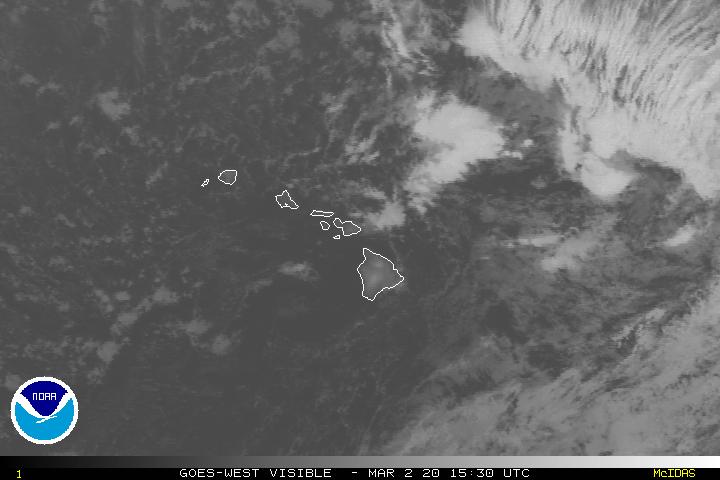

Burton Marc Lubitz Says:
Just a few thoughts on Gliese581g:
Even though I’m just a back yard star gazer, I love
astronomy news! I’ve been following since 581a came to our attention. From PHDs down to folks like me with a 90mm Mak-Cassegrain…we want to find life…and we know it’s out there!
Keep up the most excellent commentary Glenn!
Burton
m51.com/Astronomy
m51.com/Lightspeed
m51.com/Cinema~~~Hi Burton, yes I agree…very interesting new discoveries! Aloha, Glenn