











September 21-22, 2010
Air Temperatures – The following maximum temperatures were recorded across the state of Hawaii Tuesday afternoon:
Lihue airport, Kauai – 85
Honolulu airport, Oahu – 89
Kaneohe MCAS, Oahu – 83
Molokai airport – 85
Kahului airport, Maui – 80
Ke-ahole airport (Kona) – 86
Hilo airport, Hawaii – 83
Air Temperatures ranged between these warmest and coolest spots near sea level – and on the highest mountain tops…as of 5pm Tuesday evening:
Honolulu, Oahu – 85
Hilo, Hawaii – 77
Haleakala Crater – 54 (near 10,000 feet on Maui)
Mauna Kea summit – 41 (near 14,000 feet on the Big Island)
Precipitation Totals – The following numbers represent the largest precipitation totals (inches) during the last 24 hours on each of the major islands, as of Tuesday afternoon:
0.06 Mount Waialeale, Kauai
0.20 Luluku, Oahu
0.00 Molokai
0.00 Lanai
0.00 Kahoolawe
0.03 Puu Kukui, Maui
0.31 Honaunau, Big Island
Marine Winds – Here’s the latest (automatically updated) weather map showing high pressure systems stretched out from the northeast through northwest of our islands. Our local trade winds will remain light to moderately strong through Thursday…locally stronger and gusty.
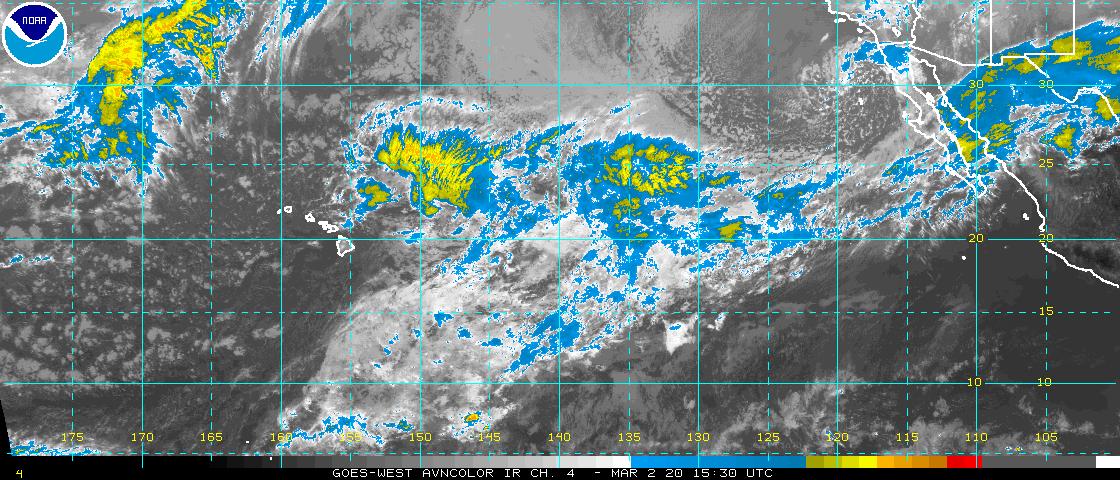
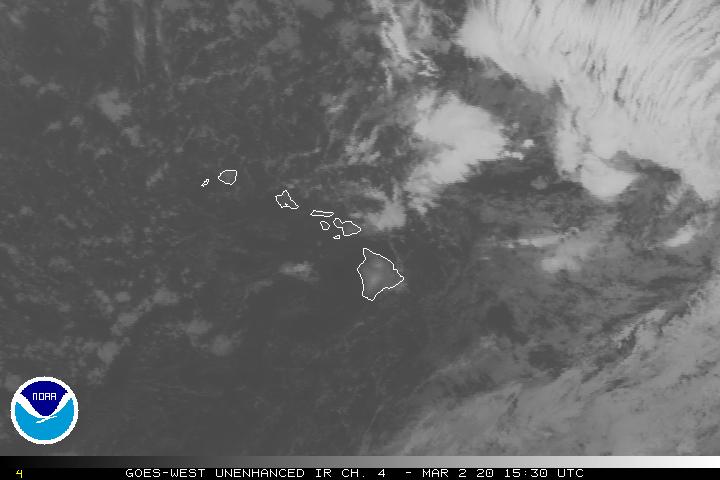
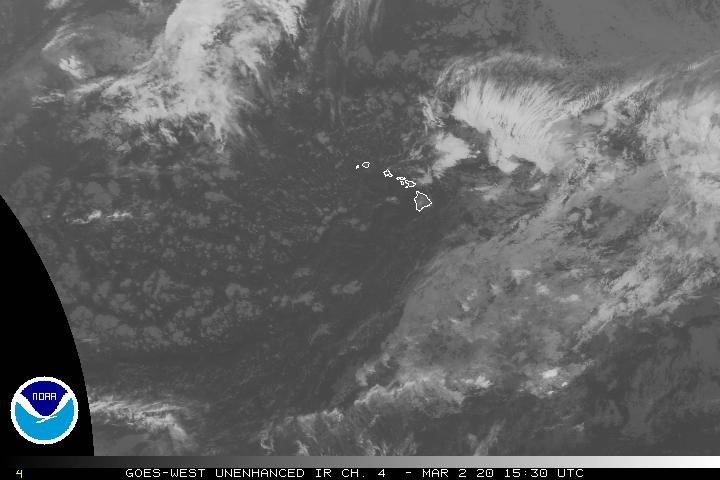
Satellite and Radar Images: To view the cloud conditions we have here in Hawaii, please use the following satellite links, starting off with this Infrared Satellite Image of the islands to see all the clouds around during the day and night. This next image is one that gives close images of the islands only during the daytime hours, and is referred to as a Close-up visible image. This next image shows a larger view of the Pacific…giving perspective to the wider ranging cloud patterns in the Pacific Ocean. Finally, here’s a Looping IR satellite image, making viewable the clouds around the islands 24 hours a day. To help you keep track of where any showers may be around the islands, here’s the latest animated radar image.
Hawaii’s Mountains – Here’s a link to the live webcam on the summit of near 14,000 foot Mauna Kea on the Big Island of Hawaii. The tallest peak on the island of Maui is the Haleakala Crater, which is near 10,000 feet in elevation. These two webcams are available during the daylight hours here in the islands…and when there’s a big moon rising just after sunset for an hour or two! Plus, during the nights and early mornings you will be able to see stars, and the sunrise too…depending upon weather conditions.
Tropical Cyclone activity in the eastern and central Pacific – Here’s the latest weather information coming out of the National Hurricane Center, covering the eastern north Pacific. You can find the latest tropical cyclone information for the central north Pacific (where Hawaii is located) by clicking on this link to the Central Pacific Hurricane Center. Here’s a tracking map covering both the eastern and central Pacific Ocean. A satellite image, which shows the entire ocean area between Hawaii and the Mexican coast…can be found here. Of course, as we know, our hurricane season won’t end until November 31st here in the central Pacific.
Aloha Paragraphs

Almost full September moon tonight
This last full day of summer, on into the first several days of the new autumn season ahead, will be filled with light to moderately strong trade winds. The computer models keep suggesting that as we move into the weekend, especially by Sunday…that our trade wind speeds would tumble a notch. This weather map shows high pressure systems strung out to the northwest through north and northeast of our islands. These high pressure cells are mostly connected by their associated high pressure ridges.
Our trade winds remain light enough Tuesday, that our small craft wind advisories remain down. Winds during the day Tuesday reached just a little above the 30 mph mark on only one of the islands…with the rest below that. The computer models are suggesting that our winds could fade away even more so a bit later this week, coming down into the lighter realms. If this happens as expected, we would shift into a modified convective weather pattern…with daytime sea breezes, along with rather hot and muggy conditions at sea level locations too.
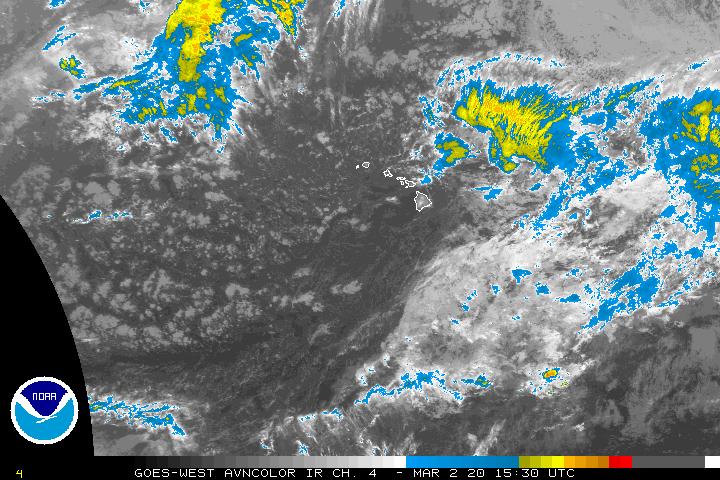
The old cold front, which brought showers to us this past weekend, looks like it will get carried back over our windward sides this evening into Wednesday. This remnant cold frontal feature brought localized good precipitation to some parts of the state…over 4.00” in the mountains on Maui Sunday! This satellite image shows what’s left of this cloud band, to the northeast and southwest of the Big Island Tuesday night. The trade winds look as if they will carry this feature back in our direction. If this cloud band does manage to travel eastwards over us, we’d see the windward sides of the islands get a second dose of showers tonight…which would be a good thing considering the long dry spell we’ve had this year.
Meanwhile, glancing south of the islands, using this satellite picture, we see those typical areas of thunderstorms to the southwest, south and southeast. The area of disturbed weather, which has been pulsing to the south-southeast and southeast for the last several weeks, remains active. As this satellite image shows, the area circled in red has a 60% chance of spinning up into a tropical depression. Tonight this area seems to be looking like it has increased its chances of developing into a tropical depression! As this picture points out, there is some spin to this area…and it may actually become a tropical depression within the next day or two. Here’s what the computer models are showing of its movements, if it were to develop further.
It’s Tuesday evening as I begin writing this last section of today’s narrative update. As I mentioned above, we’re into our last 24 hours of summer, are we sad to see it go? Well, perhaps on the mainland, as the autumn season is cooler heading towards a cold winter, that might be the case. However, here in the tropics the weather never gets cold, and remains warm year round. Now, if you live in the upcountry areas, it does get cooler during the later autumn and winter, although down at sea level, with that warm ocean nearby…it’s never that cool for very long! ~~~ At any rate, and also as I mentioned above, we have an old frontal cloud band that will drop some showers over us tonight into Wednesday. We can keep an eye on this weather feature, by checking out this looping radar image, which will help us keep track of any showers that begin to slide back over our islands. ~~~ Here in Kihei, Maui, before I leave for the drive back upcountry to Kula, it’s breezy and partly cloudy. I’d say that in general, it was a nice last day of summer, at least last full day of summer. Many of our local beaches were on the breezy side, although high temperatures today reached 80F degrees everywhere near the ocean, with the warmest of them being 89 at the Honolulu airport. I’ll be back very early Wednesday morning with your next new weather narrative. I hope to see you again then, here’s wishing you well until then! Aloha for now…Glenn.
Interesting: Unlike Vegas, what happens in China doesn’t stay in China. The country’s environmental challenges have worldwide implications, so more developed nations, such as the United States, need to help China adopt integrated solutions for the sake of global sustainability, a Michigan State University environmental scientist argues. "What happens in China affects the rest of the world," said Jianguo "Jack" Liu, University Distinguished Professor of fisheries and wildlife.
Liu is known around the world for his work on environmental sustainability and coupled human and natural systems and is the lead investigator of the International Network of Research on Coupled Human and Natural Systems, funded by the National Science Foundation. "China is growing very quickly and as its economy has grown, so have its environmental challenges. The first thing everyone needs to do is recognize the relationship between humans and the environment.
Environmental problems are an indicator of human problems. By protecting the environment, people protect their health and their livelihoods," he said. "Every country needs to recognize the important link between human and natural systems," said Peter Raven, president of the Missouri Botanical Garden and noted China scholar. "We focus on China because the country is developing so fast. In 2002, the Chinese government compared the growth in gross domestic product to environmental destruction and both were about 10 percent.
Those numbers aren’t compared anymore because it makes the economic statistics look bleak. China’s biodiversity, one of the richest sets of organisms in the world, is seriously threatened by extinction in the decades to come, but if preserved, offers great opportunities to us all for the future." Liu and Raven’s paper, "China’s Environmental Challenges and Implications for the World," is published in the September issue of Critical Reviews in Environmental Science and Technology.
The paper examines long-term and recent socioeconomic and environmental trends in China and outlines a systems approach to tackling China’s environmental issues. Those include using economic stimulus money to invest in low-emission industries such as solar and bio-energy; better coordination of environmental and economic activities at all organization levels; and working together with developed countries, such as the United States, and developing countries, such as India, to develop a global climate agreement and reduce carbon dioxide emissions.
"In the past, China’s motto was ‘conquer nature.’ People thought that development should come first and pollution could be cleaned up later," explained Liu. "It is encouraging that this attitude has begun to change. Investment in green technologies is increasing dramatically. However, fundamental changes in the development model and in the administrative system are urgently needed. Through institutional, scientific and technological innovations, China can help achieve global sustainability."
Interesting2: Super sized electromagnetic coils are helping explain how aquatic life might be affected by renewable energy devices being considered for placement along America’s coastal waters and in the nation’s rivers. An electromagnetic field is a physical field produced by electrically charged objects. It affects the behavior of charged objects in the vicinity of the field. The effect on marine life is not known one way or the other.
Scientists with the Department of Energy’s Pacific Northwest National Laboratory are examining whether a variety of fish and invertebrates change their behavior during and after exposure to an electromagnetic field similar to those produced by marine and hydrokinetic power devices that capture energy from ocean waves, tides, currents and rivers.
Energy companies and utilities are looking at using several different technologies to harness energy from oceans and rivers. Marine power could come from devices that move with rolling waves on the ocean’s surface or from underwater turbines that spin with the tides and currents. Hydrokinetic devices would be similar to marine power devices, but generate power from free-flowing water in rivers and streams.
Whatever the design, each device generates electricity that travels through cables that connect the device with a land power line. Researchers want to know how the devices and their cables affect marine life. Researchers want to know if the electromagnetic field will also affect marine and estuarine animal behavior, including migration, finding food and avoiding predators.
Several aquatic animals – such as sharks, skates, salmon, sea turtles and lobsters – may use the Earth’s natural magnetic fields like a compass to navigate and detect their prey. To test the field’s potential effects, aquarium tanks filled with marine species are being placed near the two coils. Then researchers will activate the electromagnetic field – at various strengths and time periods – to see if the animals’ actions change.
For example, researchers will observe whether the electromagnetic field interferes with the ability of juvenile Coho salmon to recognize and avoid predators. Young salmon normally stop swimming, go low and stay still when they detect a predator. Researchers will document whether the animals are attracted or repelled by the fields. The effect of electromagnetic fields on life forms is not well studied. Some birds and marine life migrate apparently reacting to the Earth’s magnetic field for orientation.
The best understood biological effect of electromagnetic fields is to cause heating. For example, touching or standing around an antenna while a high-power transmitter is in operation may cause burns. Many subtle, and at times, not-so-subtle effects on behavior have been reported from exposure to electromagnetic fields while other effects have been disproved. The current study will help focus attention on this poorly understood area of science and biology.
Interesting3: This week, from September 19-25, marks the 20th anniversary of the Pollution Prevention Act of 1990. The old way of doing things was to let companies pollute, and then pay a fortune to try to clean it up. This act states that it is a national policy of the United States to prevent pollution at the source whenever feasible. To honor this anniversary, the EPA is urging the public to recommit to the ideal of preventing pollution in their day-to-day lives.
At the time when the bill had passed in 1990, environmental degradation was a major problem (not like it isn’t now). Congress found that the US produced millions of tons of pollution and spent tens of billions of dollars to control it. Environmental compliance laws focused too much on treatment and disposal rather than pollution reduction at the source. Cost-effective solutions were available for pollution prevention, but were not implemented on a large-enough scale.
A new policy was necessary to shift the business model to more pollution prevention. The new policy made source reduction the law of the land. If the pollution could not be prevented, then recycling efforts should be made. If neither prevention nor recycling were possible, then pollution should be treated in an environmentally safe manner. Release of pollution to the environment should only be an option of last resort.
The Pollution Prevention Act authorized the EPA to collect and disseminate information on how businesses can prevent pollution, as well as provide financial assistance to the States. It also authorized the EPA to establish standard methods to measure source reduction. This includes monitoring systems that can detect criteria air pollutants like NOx and CO as well as water discharge pollutants.
Pollution prevention has become one of the EPA’s primary functions. "Protecting public health and the environment begins with pollution prevention. We’re taking proactive steps that minimize pollution at the source and keep environmental threats from reaching our communities," said EPA Administrator Lisa P. Jackson.
"The Pollution Prevention Act of 1990 gave our nation a strong start in this direction. Twenty years later, we must work with our government and industry partners to foster clean innovations and sustainable strategies that expand and enhance pollution prevention across the country."
 Email Glenn James: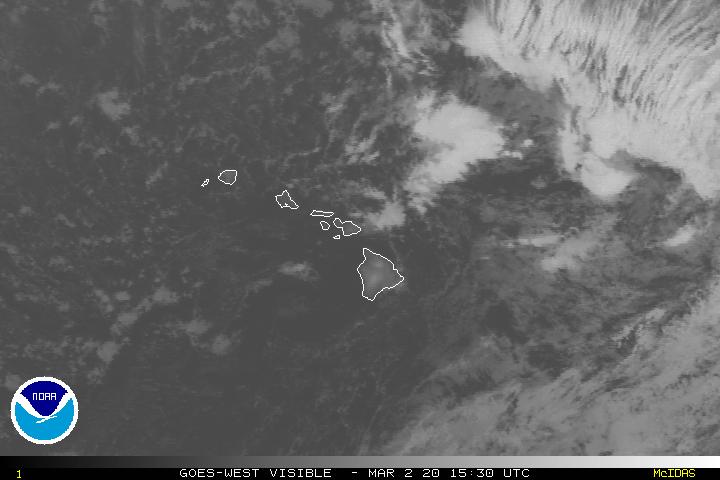




Cathy Says:
Aloha Glenn,
Love todays picture of casual dinning…any idea where it
was taken??
Cathy,~~~Hi Cathy, me too…as for the caption, it actually says Hawaii, although I sure don’t recognize it for here in the islands. It would be fun to have a meal in such a place, although that sunshine would be beaming down! Thanks for saying hi, Aloha, Glenn
Blair Thorndike Says:
I notice the full moon, this Thursday, coincides with the first day of Autumn. Does this happen very often? Is there a name for it?~~~Hi Blair, actually it’s on Wednesday I believe, I don’t know of an official name for this combined event, although I’m enjoying the occurrence. Good observation! Aloha, Glenn