











September 2-3, 2010
Air Temperatures – The following maximum temperatures were recorded across the state of Hawaii Thursday afternoon:
Lihue airport, Kauai – 84
Honolulu airport, Oahu – 87
Kaneohe MCAS, Oahu – 85
Molokai airport – 85
Kahului airport, Maui – 86
Hilo airport, Hawaii – 85
Ke-ahoe airport – 83
Air Temperatures ranged between these warmest and coolest spots near sea level – and on the highest mountain tops…as of 5pm Thursday evening:
Barking Sands, Kauai – 84
Molokai airport – 77
Haleakala Crater – 55 (near 10,000 feet on Maui)
Mauna Kea summit – 46 (near 14,000 feet on the Big Island)
Precipitation Totals – The following numbers represent the largest precipitation totals (inches) during the last 24 hours on each of the major islands, as of Thursday afternoon:
0.22 Mount Waialeale, Kauai
0.51 Maunawili, Oahu
0.10 Molokai
0.00 Lanai
0.00 Kahoolawe
0.57 Ulupalakua, Maui
0.29 Honaunau, Big Island
Marine Winds – Here’s the latest (automatically updated) weather map showing three near 1028 millibar high pressure systems located to the north-northwest through northeast of the islands. Our local trade winds will remain active Friday and Saturday…although fairly light into Saturday.
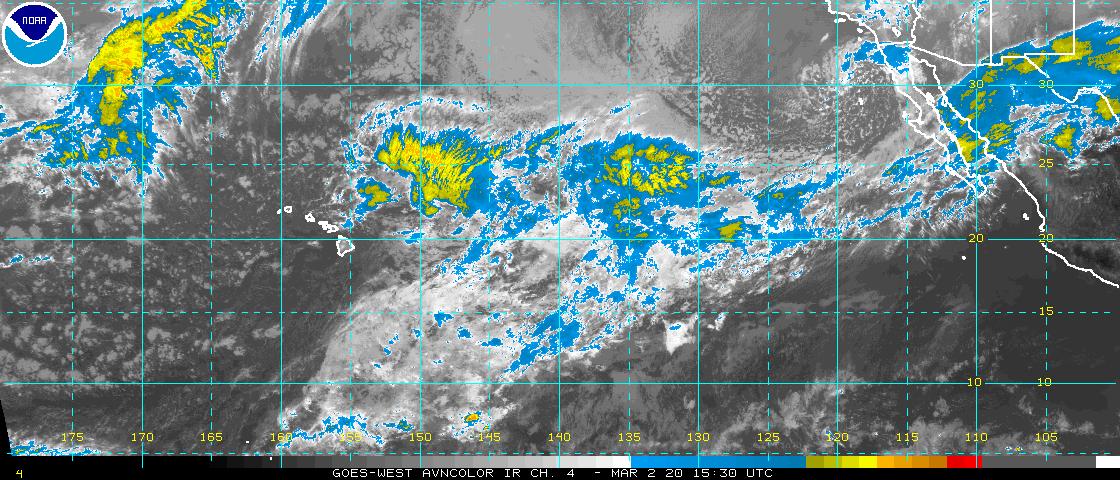
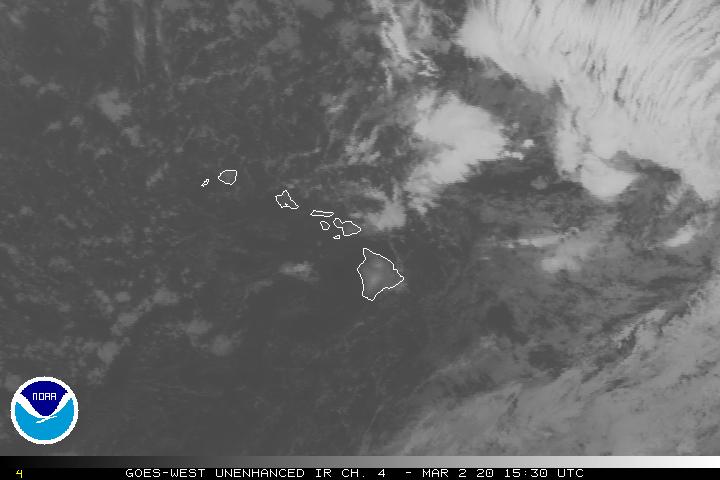
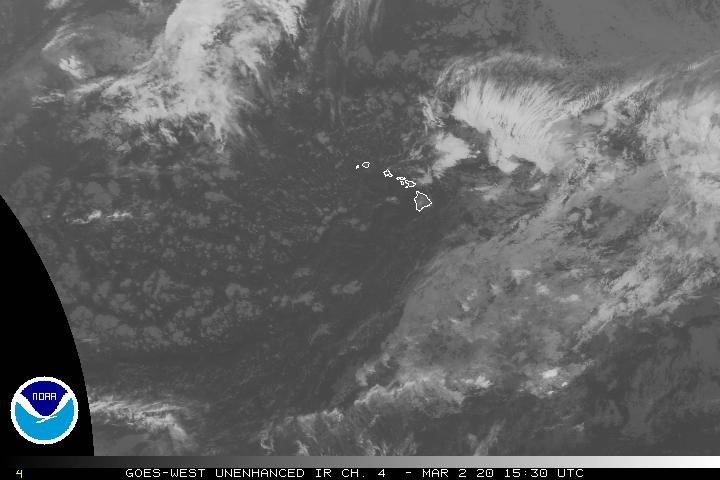
Satellite and Radar Images: To view the cloud conditions we have here in Hawaii, please use the following satellite links, starting off with this Infrared Satellite Image of the islands to see all the clouds around during the day and night. This next image is one that gives close images of the islands only during the daytime hours, and is referred to as a Close-up visible image. This next image shows a larger view of the Pacific…giving perspective to the wider ranging cloud patterns in the Pacific Ocean. Finally, here’s a Looping IR satellite image, making viewable the clouds around the islands 24 hours a day. To help you keep track of where any showers may be around the islands, here’s the latest animated radar image.
Hawaii’s Mountains – Here’s a link to the live webcam on the summit of near 14,000 foot Mauna Kea on the Big Island of Hawaii. The tallest peak on the island of Maui is the Haleakala Crater, which is near 10,000 feet in elevation. These two webcams are available during the daylight hours here in the islands…and when there’s a big moon rising just after sunset for an hour or two! Plus, during the nights and early mornings you will be able to see stars, and the sunrise too…depending upon weather conditions.
Tropical Cyclone activity in the eastern and central Pacific – Here’s the latest weather information coming out of the National Hurricane Center, covering the eastern north Pacific. You can find the latest tropical cyclone information for the central north Pacific (where Hawaii is located) by clicking on this link to the Central Pacific Hurricane Center. Here’s a tracking map covering both the eastern and central Pacific Ocean. A satellite image, which shows the entire ocean area between Hawaii and the Mexican coast…can be found here. Of course, as we know, our hurricane season won’t begin again until June 1st here in the central Pacific.
Aloha Paragraphs

We all love our Hula Dancers…those hands say so much!
The trade winds have eased up as expected, and should remain that way through the rest of the week…with slightly more strength over the upcoming holiday weekend. This weather map shows two high pressure systems located to our north through the northeast…the source of our trade breezes Thursday night. This area of high pressure has a cold front inhibiting their full strength. Our trade winds will remain softened Friday, although should bounce back some into the weekend. A trough of low pressure edging in our direction by Monday or so, will have some bearing on whether our trade winds speed up another notch, or remain on the lighter side of the wind spectrum then.
As the trade winds have come down some now, we’ll find a modified convective weather pattern…with some of our localized showers ending up over the leeward slopes during the afternoon Friday. It will depend upon just how light our trade winds remain, on where these few showers end up. The overlying atmosphere remains still quite a bit on the dry and stable side, although there have been some generous showers in some leeward areas. This satellite image shows just the normal amount of cloud patches heading towards the windward sides. Glancing down further to the south of the islands, in the deeper tropics, using this satellite picture, we see an increasing amount of thunderstorms to the southeast and southwest. These are very normal for that area of converging trade winds…from the southern and northern hemispheres. There’s no spinning motion down there, despite all the tropical cyclone activity around the rest of the world!
It’s Thursday
evening as I begin writing this last section of this morning’s narrative update. As we find lighter trade winds blowing now, we saw afternoon showers break out along the leeward slopes of the Big Island…and Maui too. Other than that, our weather will remain nice to very nice, just the way we like it. There’s still some uncertainty about what the winds will do as we move into next week. This situation remains somewhat up in the air in regards to the shower department early next week too, we’ll have to give ourselves another day or two before this becomes more clear. ~~~ Meanwhile, the tropical waters of the world remain active with storms. I won’t provide any information on these here, as they are such big news now, in the Atlantic…that there is no lack of information online and on TV. ~~~ Here in Kihei, Maui a large area of afternoon clouds hung over the leeward sides of the Haleakala Crater, and out to sea from there. At lunch I could see all kinds of showers falling up there, and then over the ocean too. Looking out the windows here, I can see showers still falling over that way this evening. Up towards Kula, where I’ll be driving to soon, it looks foggy, which I love. At any rate, those clouds will be disappearing after dark, and we should see a great start to our Friday in the morning. Speaking of which, I’ll be back here well before sunrise, with your next new weather narrative. I hope you have a great Thursday night until then! Aloha for now…Glenn.
Interesting: The Amazon, the world’s biggest river, is at its lowest level in more than 40 years near its source in northeastern Peru, causing havoc in a region where it is used as the only form of travel, authorities said. According to officials in Loreto province, the Amazon yesterday in the northeast city of Iquitos fell to 105.97 meters above sea level, 50cm lower than it was in 2005, so far the lowest reference point in four decades.
Low levels have brought economic havoc in areas of Peru that depend on the Amazon for shipping, by denying boats a navigable river as well as usable ports and harbors. At least six boats became stranded for lack of river flow over the past three weeks and several shipping companies have been forced to suspend service, said regional civil defence chief Roberto Falcon.
River trips between Iquitos and other Amazon towns that normally take around 12 to 15 days now last twice as long, officials said. According to the national meteorological service, the level drop – which is forecast to slide another 20cm until mid-September – has been caused by a lack of rain and high temperatures in the region.
The Amazon is the second-longest river in the world, after the Nile, but discharges far more water at its mouth than any other. It also drains more territory than any other, from Colombia, Bolivia, Ecuador, Peru, Paraguay and Venezuela before running across Brazil and into the Atlantic.
Interesting2: Forest and brush fires have flared up again in southern Russia, killing one person and burning down more than a hundred houses, the emergencies ministry said today. Strong winds stoked fires that burnt 113 houses in different towns, according to a local branch of the ministry cited by the RIA Novosti news agency.
Although temperatures have come down in Moscow since an unprecedented heat wave this summer, at times they topped 104F in the southern region of Volgograd, sources quoted by the agency said. Forest fires ravaged about a million hectares in Russia in recent months, destroying whole villages and leaving more than 50 people dead, according to official tallies.
Fires also threatened several nuclear plants. The emergency alert was lifted on August 23 in the last of the seven regions affected by the fires.
Interesting3: An undersea earthquake measuring 4.3 points on the Richter scale rattled Athens early on Thursday, the Greek geodynamic institute said. The quake in the Corinthian Gulf struck at 6:53am local time, with an epicenter 37 miles west of the capital, near to the town of Lefktra, it said. No damage was reported. Greece accounts for half the earthquakes on the European continent.
Interesting4: A fuel tanker carrying supplies for Arctic communities has run aground in the Northwest Passage but no diesel is leaking, the Canadian Coast Guard said today. Larry Trigatti, the Canadian Coast Guard’s superintendent of environmental response in the central and Arctic region, said the vessel wasn’t leaking and there was no reported damage. "It has been verified.
There is no leaking product and no reported damage but it is aground," Mr Trigatti said. Mr Trigatti said the ship was stuck, but it was not taking on any water. He said the coast guard ship Henry Larsen was nearby. The tanker, which is owned by Woodward’s Oil, was resupplying northern Inuit communities.
It ran aground southwest of the Canadian territory of Nunavut. A cruise ship exploring the Northwest Passage in the Arctic also ran aground last week when it hit a rock that wasn’t on the map.
Interesting5: An Indonesian volcano sent a new, powerful burst of hot ash and debris two miles into the air early Friday (local time), sending villagers fleeing back to emergency shelters. The tremor could be felt five miles away, said Surono, who heads the nation’s volcano alert center. Mount Sinabung erupted for the first time in 400 years on Sunday and Monday, catching many scientists off guard and forcing at least 30,000 people living along its fertile slopes in North Sumatra province to be evacuated.
Many had already returned to areas within the "safety zone" — well away from the crater’s mouth — despite warnings by vulcanologists that the alert level was still high. Pasi Ginting, a resident, told MetroTv that Friday’s blast, which occurred around 4:45 a.m., as many people were sleeping, appeared to be the strongest yet.
Indonesia, prone to seismic activity because of its location in the so-called "Ring of Fire," is home to 129 active volcanoes. It has recorded some of the largest eruptions in history.
 Email Glenn James: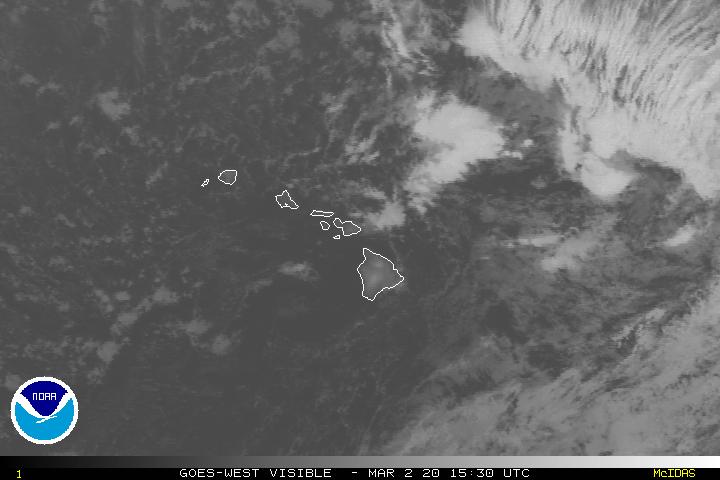


Myrtle Says:
Hi Glenn — We’re getting heavy rainfall here in Paukukalo, at 7:50 p.m. The plants love it! –myrtle~~~Hi Myrtle, good to hear from you, especially as those native plants down near the ocean in Kahului get watered to the roots. Up here in Kula at 815pm, its totally foggy and with drizzle, so this is a good thing for both places. Thanks for your on the spot weather report. Aloha, Glenn