











September 15-16, 2010
Air Temperatures – The following maximum temperatures were recorded across the state of Hawaii Wednesday afternoon:
Lihue airport, Kauai – 84
Honolulu airport, Oahu – 87
Kaneohe MCAS, Oahu – 83
Molokai airport – 85
Kahului airport, Maui – 88
Ke-ahole airport (Kona) – 84
Hilo airport, Hawaii – 83
Air Temperatures ranged between these warmest and coolest spots near sea level – and on the highest mountain tops…as of 5pm Wednesday evening:
Kahului, Maui – 84
Hilo, Hawaii – 77
Haleakala Crater – 57 (near 10,000 feet on Maui)
Mauna Kea summit – 41 (near 14,000 feet on the Big Island)
Precipitation Totals – The following numbers represent the largest precipitation totals (inches) during the last 24 hours on each of the major islands, as of Wednesday afternoon:
0.41 Mount Waialeale, Kauai
0.13 Manoa Lyon Arboretum, Oahu
0.02 Molokai
0.00 Lanai
0.00 Kahoolawe
0.71 Puu Kukui, Maui
0.38 Kealakekua, Big Island
Marine Winds – Here’s the latest (automatically updated) weather map showing a 1023 millibar high pressure system located just to the northeast of the islands. Our local trade winds will remain light to almost moderately strong through Friday…locally stronger and gusty.
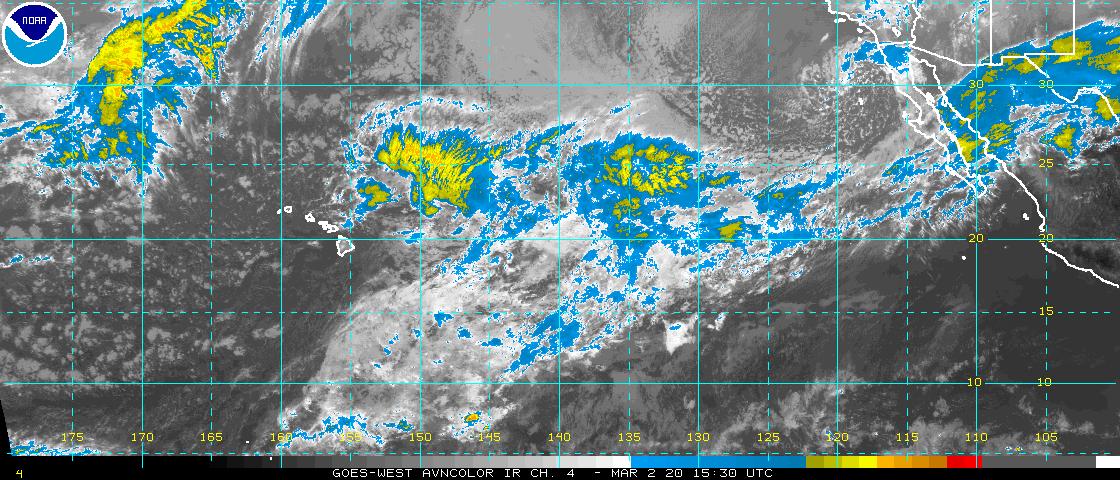
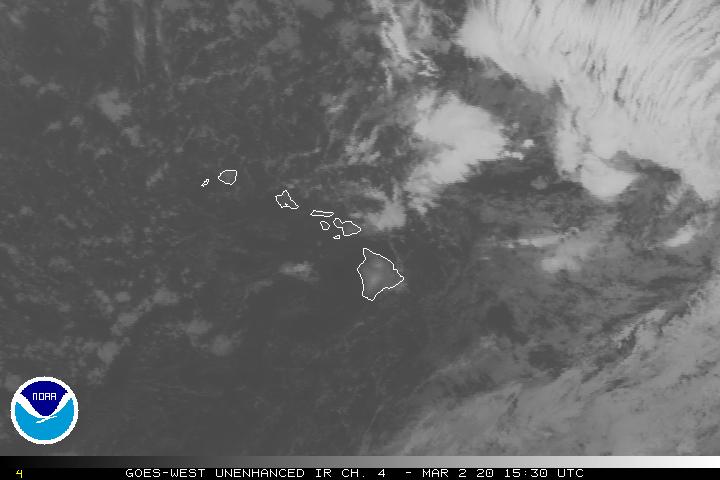
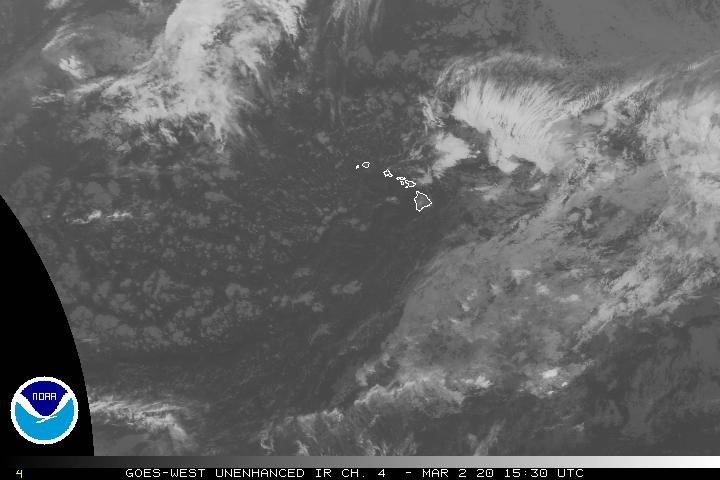
Satellite and Radar Images: To view the cloud conditions we have here in Hawaii, please use the following satellite links, starting off with this Infrared Satellite Image of the islands to see all the clouds around during the day and night. This next image is one that gives close images of the islands only during the daytime hours, and is referred to as a Close-up visible image. This next image shows a larger view of the Pacific…giving perspective to the wider ranging cloud patterns in the Pacific Ocean. Finally, here’s a Looping IR satellite image, making viewable the clouds around the islands 24 hours a day. To help you keep track of where any showers may be around the islands, here’s the latest animated radar image.
Hawaii’s Mountains – Here’s a link to the live webcam on the summit of near 14,000 foot Mauna Kea on the Big Island of Hawaii. The tallest peak on the island of Maui is the Haleakala Crater, which is near 10,000 feet in elevation. These two webcams are available during the daylight hours here in the islands…and when there’s a big moon rising just after sunset for an hour or two! Plus, during the nights and early mornings you will be able to see stars, and the sunrise too…depending upon weather conditions.
Tropical Cyclone activity in the eastern and central Pacific – Here’s the latest weather information coming out of the National Hurricane Center, covering the eastern north Pacific. You can find the latest tropical cyclone information for the central north Pacific (where Hawaii is located) by clicking on this link to the Central Pacific Hurricane Center. Here’s a tracking map covering both the eastern and central Pacific Ocean. A satellite image, which shows the entire ocean area between Hawaii and the Mexican coast…can be found here. Of course, as we know, our hurricane season won’t begin again until June 1st here in the central Pacific.
Aloha Paragraphs

The world famous Waikiki Beach…leeward Oahu
Our trade winds are expected to remain light to moderate through this work week, through the weekend…into early next week. This weather map shows a 1023 millibar high pressure system located just to the northeast of our islands…the source of our trade breezes Wednesday night. This high pressure cell’s ridges extend both westward and eastward. The close proximity of this high are what’s keeping our local trade winds from gaining too much strength. However, it should be pointed out that yesterday there was a 40 mph gust on the Big Island, and Wednesday’s 39 mph gusts on Maui and Kahoolawe, confirm that there will be those occasional…and localized stronger gusts. The computer models are suggest that the winds will become stronger atop the summits on the Big Island and Maui over the next day or two as well.
As the trade winds continue to blow, most of the incoming showers will be focused along the windward sides. Most of the showers will be on the light side, and generally falling during the night and early morning hours. This satellite image shows minor patches of clouds being carried our way…especially towards the central islands at the time of this writing. Meanwhile, most of the high cirrus clouds to the north through the west of our islands have faded away to the west and northwest. Glancing south of the islands, using this satellite picture, we see those typical areas of thunderstorms to the south and west. There certainly isn’t any lack of high clouds in just about all directions at the moment…although none are taking aim on our islands for the time being.
It’s Wednesday evening as I begin writing this last section of today’s narrative update. The weather here in the islands remains nice, which means lots of sunshine during the days, and seasonably very warm temperatures too. Looking at the satellite image above, we see very few clouds around the islands, which likely means a rather dry night into Thursday. There’s almost always a few showers around, along the windward sides, so they will likely arrive at times. ~~~ Here in Kihei, just before I leave for the drive back upcountry to Kula, it’s mostly clear in all directions. As the high clouds are gone now, it will be a nice sunset, although not filled with all of the pink and orange colors now. I’ll look forward to catching up with you again very early Thursday morning, using our Hawaiian time as a reference…usually a little before 6am HST. I hope you have a great Wednesday night until then! Aloha for now…Glenn.
Interesting: Tigers, like most big cats of the world, are in retreat. In the past, tigers were found all throughout Asia, from the Caspian Sea to Siberia and Indonesia. Now they occupy only six percent of their former range. In the last decade alone, tiger-occupied area has decreased by 41 percent. Despite decades of conservation initiatives, the number of tigers in the wild is at an all-time low.
According to a new study from an international team of researchers, efforts should be concentrated on a few key sites in order to save the species from extinction. The report was produced by a team including the University of Cambridge, Wildlife Conservation Society, and others, and is published in the journal PLoS Biology. Co-author, John Robinson, said,
"The tiger is facing its last stand as a species…we are confident that the world community will come together to bring these iconic big cats back from the brink of extinction." The report encourages conservationists to focus on 42 "source sites" as the top priority for the tiger’s recovery. The price tag of doing so would be an estimated $35 million more than what is currently being spent on tiger conservation per year. Unfortunately, the situation for the tiger is dire.
Their global population is less than 3,500, of which a mere 1,000 are breeding females. Certain tiger populations have completely disappeared such as those in Cambodia, China, Vietnam, and North Korea. The remaining populations are pressured by habitat loss, killing or capture for human use, and from overhunting of their own prey. A huge factor in the recent decline of tigers is the demand for tiger body parts to be used as medicine.
The 42 source sites are defined as sites that have breeding populations and have the best chance to seed the tiger’s recovery over a larger area in the future. It is akin to establishing no-fishing zones in the oceans in order to increase overall fish numbers. These sites would be safe havens for a predicted 70 percent of the global tiger population. However, they must be coupled with effective law enforcement and scientific monitoring. The result may be a rapid increase in tigers over a short span of time.
India has been singled out as the most important country for tiger conservation, with 18 source sites. Sumatra (largest island of Indonesia) also has eight, and the Russian Far East has six. The cost of this new conservation attempt would be borne mostly by the host countries but with contributions from international donors and NGOs.
This fall, Russia will be hosting an international "Tiger Summit" with the hope of jump-starting this new coordinated effort. A resurgence of the tiger population would be heartening to see. A poll conducted by the channel, Animal Planet, labeled the Tiger as the world’s favorite animal, even beating out the dog. If this is the case, then people will recognize their importance and the need to ensure their survival.
Interesting2: Decades of overfishing have deprived the food industry of billions of dollars in revenue and the world of fish that could have helped feed undernourished countries, according to a series of studies released on Tuesday. The Canadian, U.S. and British researchers behind the studies also said that overfishing is often the result of government subsidies that would have been better spent conserving fish stocks.
Fisheries contribute $225 billion to $240 billion to the world economy annually, but if fishing practices were more sustainable, that amount would be up to $36 billion higher, according to the four papers published in the Journal of Bio-economics.
The researchers said the data demonstrate that the reasons for protecting world’s ocean fish stocks from unsustainable fishing are more than just biological. "Maintaining healthy fisheries makes good economic sense, while overfishing is clearly bad business," said Rashid Sumaila, an economist at the University of British Columbia in Vancouver, who led the research.
The researchers estimated that from 1950 to 2004, 36 to 53 percent of the fish stocks in more than half the exclusive economic zones in the world’s oceans were overfished, with up to 10 million tons of fish catch now lost. They said many governments underestimate the financial impact of overfishing, such as the affect on related industries, and, as a result, they have less incentive to protect fish stocks.
Interesting3: On any given day, most U.S. adults report performing predominantly sedentary and light activities, according to a new study published in the October issue of the American Journal of Preventive Medicine. Overall only 5.07% report any vigorous intensity activity. The most frequently reported moderate activity was food and drink preparation.
In order to determine the 10 most frequently reported non-work and non-sleep activities by intensity reported by U.S. individuals, researchers from the Pennington Biomedical Research Center, Baton Rouge, Louisiana, used data collected between 2003-2008 from close to 80,000 respondents to the American Time Use Survey (ATUS).
This nationally representative telephone-based survey captures activities that people recall doing during the preceding 24 hours. These data were coupled with published Metabolic Equivalent (MET) intensity values in order to group activities into sedentary, light, moderate, and vigorous categories.
While most Americans engage in sedentary activities such as eating and drinking (95.6%), followed by watching television/movies (80.1%), and light activities such as washing, dressing, and grooming oneself (78.9%), and driving a car, truck, or motorcycle (71.4%), most did not engage in moderate or vigorous activities.
The most frequently reported moderate activities were food and drink preparation (25.7%), followed by lawn, garden, and houseplant care (10.6%). The most frequently reported vigorous activities were using cardiovascular equipment (2.2%) and running (1.1%).
According to lead investigator Catrine Tudor-Locke, PhD, Director of the Walking Behavior Laboratory, Pennington Biomedical Research Center, "Knowing the most-frequently reported intensity-defined behaviors can inform intervention strategies aimed at improving energy balance or enhance questionnaire design by targeting queries related to time spent in such behaviors.
As a single more-detailed example of utility, data can be collected using objective monitors under controlled conditions on these most-frequently reported sedentary behaviors and provide valuable calibration data useful for identifying and tracking sedentary behaviors in objectively monitored surveillance and intervention studies."
Interesting4: Hurricane Igor, currently churning across the Atlantic as a major Category 4 storm, has been followed by NASA satellites, and dubbed a "monstrous hurricane," in a NASA statement. Igor is so large that it is the same distance from one end of the storm to the other as it is from Boston, Mass., to Richmond, Va., some 550 miles. That’s a 10-hour drive. Astronauts aboard the International Space Station were so impressed by Igor’s immensity that they nicknamed it, "Igor the Terrible."
Igor’s winds have weakened slightly, hitting a maximum of 145 mph, but it remains a major Category 4 hurricane. While it’s projected path is somewhat uncertain, it could make a direct hit on Bermuda in the next three or four days. But even if it doesn’t make a direct hit, Igor is so large that the National Hurricane Center noted that Bermuda can be buffeted by winds of hurricane-force or tropical storm-force on its current track.
Hurricane-force winds extend outward from the center of the storm up to 45 miles, while tropical-storm-force winds extend as far as 225 miles from the storm’s center. Igor is accompanied by Hurricane Julia, also a Category 4 hurricane, in the Atlantic, and Tropical Storm Karl in the Gulf of Mexico, which made landfall at Mexico’s Yucatan Peninsula earlier today (Sept. 15). Julia is not expected to be a threat to land, but Karl is expected to move over the Yucatan and back out over the Gulf before hitting the coast of mainland Mexico.
 Email Glenn James: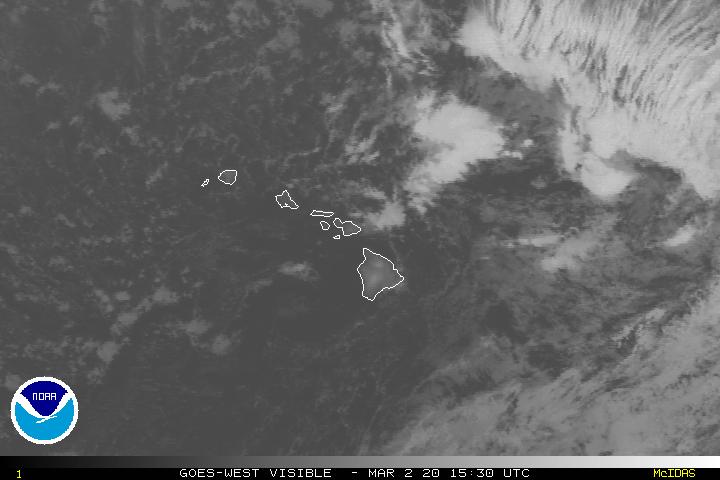


jeff mcconnel Says:
Hi Glenn,
I have been off the islands for a few months, headed back today. I was looking at the picture of world famous Waikiki Beach….is it backwards or have I lost my bearings? aloha jeff~~~Hi Jeff, that picture is backwards, although I couldn’t resist showing it anyway…as the ocean is such a great color! Aloha, Glenn
AmandaonMaui Says:
Yes, I too have been wondering when this drought will end. I’m beginning to get concerned about fires upcountry.~~~It is of great concern, the vegetation on the leeward side of Maui, all the way up from the coasts, into upper Kula and Ulupalakua is dry. Gusty trade winds, low humidities, and continuing dry conditions pose a great fire danger. It will likely take until we begin to see some cold frontal precipitation this autumn, or wet Kona winds…before we can find relief. Aloha, Glenn
Jeff Says:
Hi Glenn,
As a Maui visitor from Seattle, I’ve enjoyed using your website to help plan activities, etc.. A quick weather question for you (if you have time to answer it). We were thinking about doing a Molokini snorkel trip on Friday, but wondering if the increase in trade winds that you’ve mentioned increases the chance that the boats won’t go to Molokini, or do the Trade’s usually remain light in the morning and pick up in the afternoon? Thanks!
Jeff~~~Hi Jeff, another good question here. Trips to Molokini go regardless of the trade wind speeds, at least generally. Almost always the morning hours are much less windy, and then during the afternoons they pick up…as you thought. I’d go as early as possible, and enjoy the trip. It may become more windy, although not enough to really worry about. It will be great out there, what fun! Aloha, Glenn
Eliza Says:
Aloha Glenn –
Perhaps I’ve missed any posts about this, so sorry to ask you to repeat the answer: Any long term forecasting out there to suggest when the droughts on BI and Maui will end?
Mahalo ~
Eliza~~~Hi Eliza, sometimes when we have a La Nina winter rainy season, like we’ll have coming up, we can get wetter than normal rainfall…although not always. It’s tough to know, although as I find out more about this subject, about on ongoing droughts, I’ll write about it on my narrative page. Good question by the way, Aloha, Glenn