











September 11-12, 2010
Air Temperatures – The following maximum temperatures were recorded across the state of Hawaii Saturday afternoon:
Lihue airport, Kauai – 85
Honolulu airport, Oahu – 88
Kaneohe MCAS, Oahu – 85
Molokai airport – 87
Kahului airport, Maui – 90
Hilo airport, Hawaii – 86
Ke-ahoe airport (Kona) – 85
Air Temperatures ranged between these warmest and coolest spots near sea level – and on the highest mountain tops…as of 5pm Saturday evening:
Kahului, Maui – 85
Lihue, Hawaii – 80
Haleakala Crater – 46 (near 10,000 feet on Maui)
Mauna Kea summit – 46 (near 14,000 feet on the Big Island)
Precipitation Totals – The following numbers represent the largest precipitation totals (inches) during the last 24 hours on each of the major islands, as of Saturday afternoon:
0.58 Mount Waialeale, Kauai
0.07 Oahu Forest NWR, Oahu
0.00 Molokai
0.00 Lanai
0.00 Kahoolawe
0.02 West Wailuaiki, Maui
0.09 Kawainui Stream, Big Island
Marine Winds – Here’s the latest (automatically updated) weather map showing two high pressure systems located to the north through northeast of the islands. Our local trade winds will remain light to moderately strong this weekend into Monday…locally stronger and gusty.
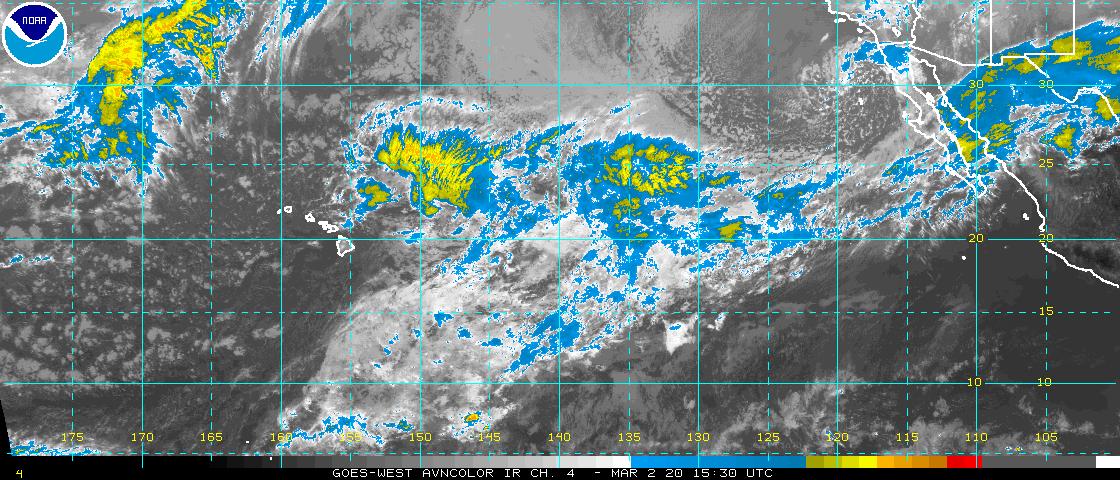
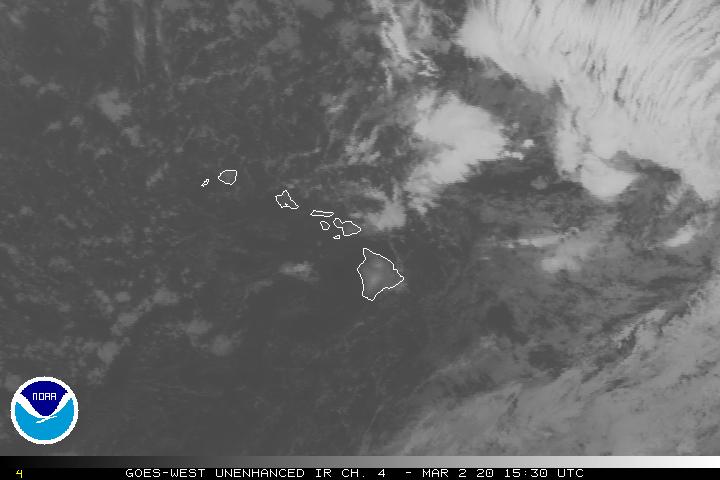
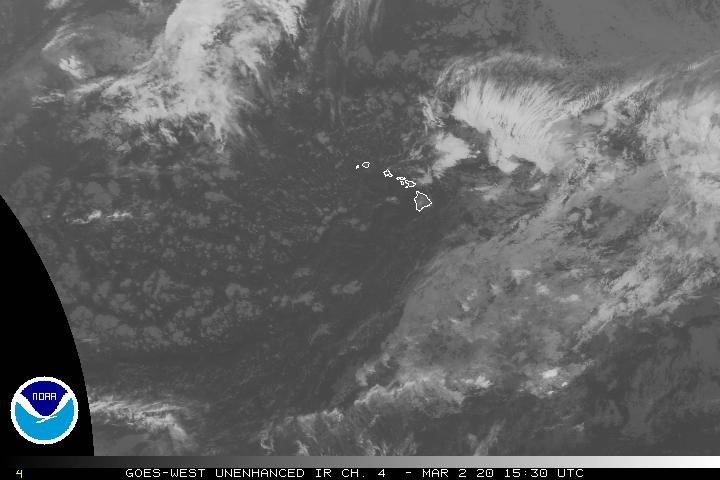
Satellite and Radar Images: To view the cloud conditions we have here in Hawaii, please use the following satellite links, starting off with this Infrared Satellite Image of the islands to see all the clouds around during the day and night. This next image is one that gives close images of the islands only during the daytime hours, and is referred to as a Close-up visible image. This next image shows a larger view of the Pacific…giving perspective to the wider ranging cloud patterns in the Pacific Ocean. Finally, here’s a Looping IR satellite image, making viewable the clouds around the islands 24 hours a day. To help you keep track of where any showers may be around the islands, here’s the latest animated radar image.
Hawaii’s Mountains – Here’s a link to the live webcam on the summit of near 14,000 foot Mauna Kea on the Big Island of Hawaii. The tallest peak on the island of Maui is the Haleakala Crater, which is near 10,000 feet in elevation. These two webcams are available during the daylight hours here in the islands…and when there’s a big moon rising just after sunset for an hour or two! Plus, during the nights and early mornings you will be able to see stars, and the sunrise too…depending upon weather conditions.
Tropical Cyclone activity in the eastern and central Pacific – Here’s the latest weather information coming out of the National Hurricane Center, covering the eastern north Pacific. You can find the latest tropical cyclone information for the central north Pacific (where Hawaii is located) by clicking on this link to the Central Pacific Hurricane Center. Here’s a tracking map covering both the eastern and central Pacific Ocean. A satellite image, which shows the entire ocean area between Hawaii and the Mexican coast…can be found here. Of course, as we know, our hurricane season won’t begin again until June 1st here in the central Pacific.
Aloha Paragraphs

Our trade winds are expected to remain light to moderate through the weekend…locally a bit stronger in those typically windiest areas. This weather map shows two high pressure systems located to our north and northeast…the source of our trade breezes Saturday night. Little change is expected in our local wind conditions as we move into the new work week ahead.
As the trade winds continue to blow, most of the few incoming showers will be focused along the windward sides. This satellite image shows just the usual patches of rather stable looking clouds being carried our way…meaning pretty dry weather. We also find that same area of high cirrus clouds to the west of our islands now…which are now stretching over the state. Glancing south of the islands, using this satellite picture, we see that same area of thunderstorms south-southwest of the Big Island. This area is holding its chances of becoming a tropical cyclone…to 10% at the moment. This satellite image shows the current shot of this area of disturbed weather.
It’s Saturday evening as I begin writing this last section of today’s narrative update. The trade winds continue to be the primary driving force in our local Hawaiian Island weather picture, as it has been, and will continue to be through most of the rest of this summer season. These trade winds will bring a few scattered clouds our way, from the upstream area, over the ocean to our east and east-northeast. The overlying atmosphere remains quite dry and stable, which will limit the amount of precipitation falling anywhere in the Aloha state through the weekend.
~~~ After work last evening I went to see a new film. This film is not for everyone, and actually, for perhaps just a few. It was one of the more violent ones that I’ve see this year. It’s called Machete (2010), starring Robert De Niro, Michelle Rodriquez, Jessica Alba, Steven Seagal, Lindsay Lohan, Don Johnson…among others. The critics are giving this film a B- grade, while the viewers are rising that a little to B. Here’s the synopsis: After a violent shakedown from a notorious drug lord nearly kills him, Machete, a renegade Mexican Federale and tough-as-nails vigilante for justice, roams the streets of Texas, working as a day laborer. When Machete is hired by a crooked US Senator to execute a covert hit, Machete is double-crossed and forced to run from the cops and an endless stream of assassins. I’m sure you can imagine the kinds of action and adventure that this type of setup could produce! This was an over the top kind of film, full of things that the general public would avoid at all costs! I must say, that I enjoyed it quite a bit, although couldn’t in good conscious recommend it to 90% of the average human race. At any rate, here is the trailer, careful now, no young kids or innocent bystanders should click on that trailer link!
~~~ It’s Saturday evening, and it feels so good to be the weekend! I drove down to Keokea, for my normal long Saturday morning walk, which was as usual, a delight. I then went down to Paia for a haircut and shopping, and then came back to Kula. I just got back from a quick trip, with my neighbor, to get our propane tanks filled up. I can see lots of high cirrus clouds sweeping in overhead, which will present us with a wonderful sunset…keep an eye out for it. I’ll be out on my weather deck for the show in a little while. I’ll meet you here Sunday morning again, when I’ll have your new weather narrative ready for the reading. I hope you have a great Saturday night until then!
If you have a chance, check out the alignment of the crescent moon, with that large planet to the lower right this evening here in the islands…its awe inspiring!
Before I finish, I’d like to join in the rememberance of the men and women who died in the tragic 9/11 disaster in New York. I continue to feel empathy for them, and their family and loved ones. May they rest in peace, and may the world, one day…come around to its senses.
Aloha for now…Glenn.
Extra: Saturday night music – I like the beat
Extra2: Saturday night music = I like the story and movement
Interesting: Yellowstone Park is a somewhat dormant super volcano site full of fuming vents and hot geysers. A plume of molten rock rising from deep beneath Yellowstone National Park is probably what is fueling the region’s volcanic activity, as well as tectonic plate oddities across the Pacific Northwest, new research suggests.
Yellowstone, like Hawaii, is believed to lie on top of an area called a hotspot where light, hot, molten mantle rock rises towards the surface. While the Yellowstone hotspot is now under the Yellowstone Plateau, it previously helped create the eastern Snake River Plain (to the west of Yellowstone) through a series of huge volcanic eruptions. Although the hotspot’s apparent motion is to the east-northeast, the North American Plate is really moving west-southwest over the stationary hotspot deep underneath.
Building on a growing body of evidence, Mathias Obrebski of the University of California, Berkeley, and his colleagues created the most convincing picture to date of a Yellowstone mantle plume — one that extends from about 621 miles below the surface of the Earth.
Debates have long been waged over whether erupting and shaking in the area over the last few millions of years — and a track marked out by a chain of volcanic calderas along the Yellowstone Snake River Plain in Idaho — could be the work of a column of hot rock rising up from deep within the Earth’s mantle. The mantle is the layer of hot, viscous rock beneath the planet’s crust.
Obrebski’s team used data from a new, dense deployment of seismometers, called the Earthscope USArray, to get a high-resolution image of the elusive mantle, along with information on the unusual structure of the subducting Juan de Fuca slab to its west. The Juan de Fuca plate is a small tectonic plate jammed in between the much larger Pacific and North American plates.
The plume is thought to be more or less stationary, with the North American plate — and the Juan de Fuca subducting beneath it — slowly sliding southwesterly over the plume. So what is now Oregon probably sat where Yellowstone is today about 17 million years ago, baking and breaking over a hot plume of rock. The findings were detailed in the July 22 edition of the journal Geophysical Research Letters.
The source of the Yellowstone hotspot is controversial. Some geoscientists hypothesize that the Yellowstone hotspot is the effect of an interaction between local conditions in the lithosphere and upper mantle convection. Others prefer a deep mantle origin (or mantle plume). Part of the controversy is due to the relatively sudden appearance of the hotspot in the geologic record. Additionally, the Columbia Basalt flows appeared at the same approximate time, causing speculation about their origin.
Interesting2: There is widespread knowledge of airborne creatures taking to the water. Everybody knows about ducks and geese, penguins, and seabirds that dive for their prey. But, there is scant attention for the seaborne creatures that take to the air. Flying fish really do fly. A new study published in the Journal of Experimental Biology takes a look at how these amazing animals do what they do.
Flying fish, from the family of marine fish, Exocoetidae, can remain in the air for over forty seconds and cover distances of 400 meters at speeds of 43 mph. There are about 64 species which all live in oceans at the tropical and subtropical latitudes. There pectoral fins are enlarged, allowing the fish to take flight to escape predators by leaping out of the water. Their "wings" have an aerodynamic shape that can be compared to those of birds.
The study by Haecheon Choi and Hyungmin Park of the Seoul National University in Korea went about to find out how fish can stay aloft. First, they had to catch the fish for his experiments, which proved to be quite difficult. After selecting five similar-sized fish, Park had them dried and stuffed, some with their wings extended as if in flight. These were then taken to the wind tunnel to test their aerodynamics.
Like any aircraft, the fish have a lift-to-drag ratio that is essential to flight. The researchers found that it actually quite good, gliding better than insects and as well as some waterfowl. The fish are not as good at turning, however. They fly best when their wings are parallel to the surface of the water. When the wings were swept back, the flight became more unstable, but that is what is necessary for aquatic aerodynamics.
This makes the flying fish well adapted in both environments. The researchers realized that flying fish always glide just above the surface of the sea, never at a high elevation. Therefore, they tailored some of their wind-tunnel experiments so that the fish was set up near the floor.
They found that the lift-to-drag ratio rose as the elevation became less and less. The fish can go farther by staying closer to the water. The next step for these intrepid researchers is to construct an airplane inspired by the design of the flying fish. Now that would be a sight to see.
Interesting3: From farmers to government officials in charge of efficiently managing Earth’s precious water and energy resources, people all over the world rely on accurate short-term climate forecasts on timescales ranging from a few weeks to a few years to make more informed decisions. But today’s climate forecast systems have limited ability to operate on such timescales. That’s because it’s difficult to realistically represent the complex interactions between Earth’s ocean, atmosphere and land surface in the climate models from which forecasts are developed.
A new report by the National Academy of Sciences looks at the current state of these climate predictions and recommends strategies and best practices for improving them. Duane Waliser, chief Earth scientist at NASA’s Jet Propulsion Laboratory, Pasadena, Calif., was on the 12-member panel that conducted the NOAA-requested study.
Among the report’s key recommendations:
• Continue research to better understand and use information from key sources of climate predictability, and interactions between the ocean and atmosphere, atmosphere and land, as well as volcanic eruptions, greenhouse gases and land use changes.
• Improve the basic building blocks of climate forecasts through better physical climate models, making more sustained physical observations, better incorporating observations into forecast systems, and increasing collaboration between forecast agencies and stakeholders in developing and implementing forecast strategies.
• Adopt best practices such as working more closely with research communities, particularly universities; making data that feed into and come out of forecasts publicly available; minimizing subjective forecast components; and using forecast metrics that better convey to the public the probability aspects of forecasts.
Waliser contributed his expertise in a phenomenon called the Madden-Julian Oscillation that exerts a powerful influence on short-term climate predictions. During this type of climate pattern, unusual variations of clouds, rainfall and large-scale atmospheric circulation move slowly eastward from the tropical Indian Ocean into the Pacific Ocean over the course of weeks, ebbing and flowing like waves in cycles lasting about 40 to 50 days.
This climate pattern typically spans more than half the distance around Earth’s equator. In the disturbed portion of the "wave," air rises, triggering showers and thunderstorms; in the sinking portion, air subsides, inhibiting clouds and rainfall.
Madden-Julian Oscillation events can strongly influence long-term weather patterns and have widespread impacts around the globe. They can help trigger the beginning and end of the Asian and Indian monsoons and influence the development and evolution of El Niño, hurricanes and weather in Earth’s mid-latitudes. Scientists want to incorporate information about the oscillation more accurately into the climate models that agencies around the world use to predict weather and climate.
"Ten years ago, our ability to forecast Madden-Julian Oscillation events was very limited," said Waliser. "Today, numerous operational forecast centers around the world are recognizing the importance of forecasting the MJO and are beginning to provide useful forecast information about it. This information, in turn, can be used to make better forecasts of other weather and climate phenomena.
 Email Glenn James: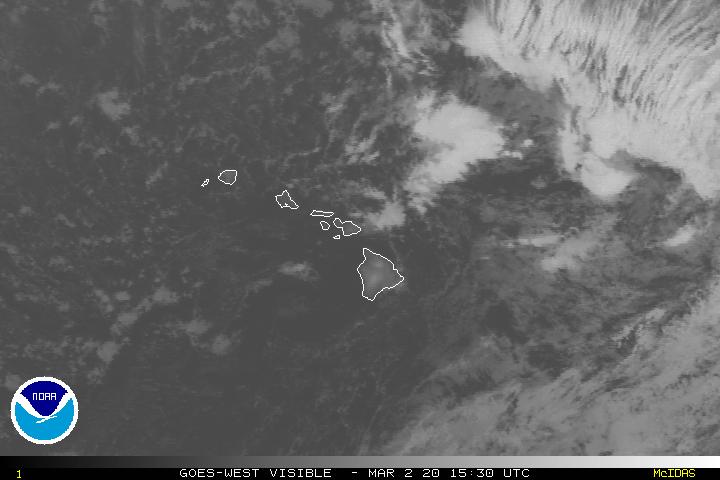



jack weber Says:
Pretty rainy rainy here al morning for a nice “dry and stable” air mass…looks pretty wet on the radar too for the other islands as well!…good for the orchard, anyway, but not my home…happy rainy day…J*~~~You’re right Jack, the Big Island has some showers, although the rest of the state looks quite dry. Have a good day, and thanks for your personal weather update…and correction. Aloha, Glenn
Brian Ward Says:
Glen:
A month or so ago you posted that a flag pole would not cast a shadow on two days a year here in Hawaii. Does that also mean that at sunrise and sunset on those days the sun will be due east and west?
Brian~~~Hi Brian, good question…when the sunrise and sunset are due east and west, is during the spring and autumn equinox. This is the time when there is equal day and night around the planet. Aloha, Glenn