











September 20-21, 2010
Air Temperatures – The following maximum temperatures were recorded across the state of Hawaii Monday afternoon:
Lihue airport, Kauai – 85
Honolulu airport, Oahu – 88
Kaneohe MCAS, Oahu – 85
Molokai airport – 85
Kahului airport, Maui – 85
Ke-ahole airport (Kona) – 84
Hilo airport, Hawaii – 81
Air Temperatures ranged between these warmest and coolest spots near sea level – and on the highest mountain tops…as of 4pm Monday afternoon:
Port Allen, Kauai – 88
Hilo, Hawaii – 80
Haleakala Crater – 54 (near 10,000 feet on Maui)
Mauna Kea summit – 45 (near 14,000 feet on the Big Island)
Precipitation Totals – The following numbers represent the largest precipitation totals (inches) during the last 24 hours on each of the major islands, as of Monday afternoon:
o.52 Mount Waialeale, Kauai
0.51 Oahu Forest NWR, Oahu
0.10 Molokai
0.00 Lanai
0.06 Kahoolawe
3.70 Puu Kukui, Maui
2.13 Kawainui Stream, Big Island
Marine Winds – Here’s the latest (automatically updated) weather map showing a 1024 millibar high pressure system located just to the north-northwest, and a 1022 millibar cell to the northwest of the islands. Our local trade winds will remain light to moderately strong through Wednesday…locally stronger and gusty.
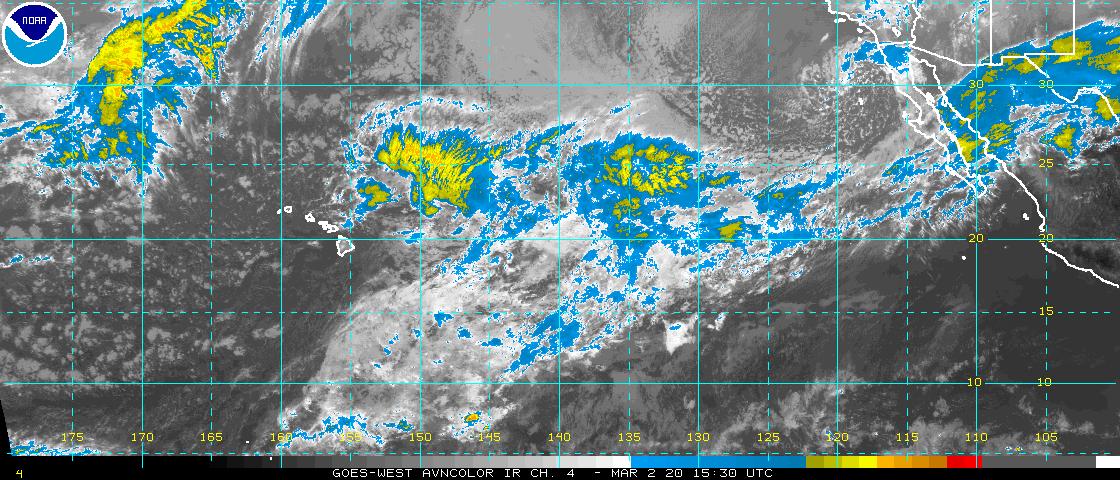
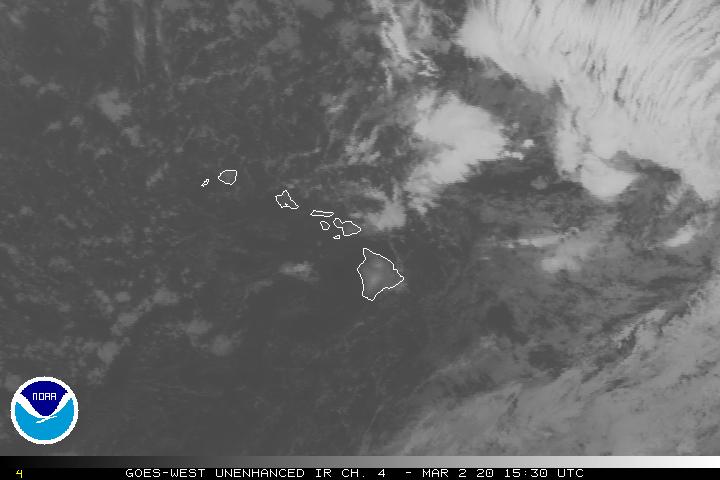
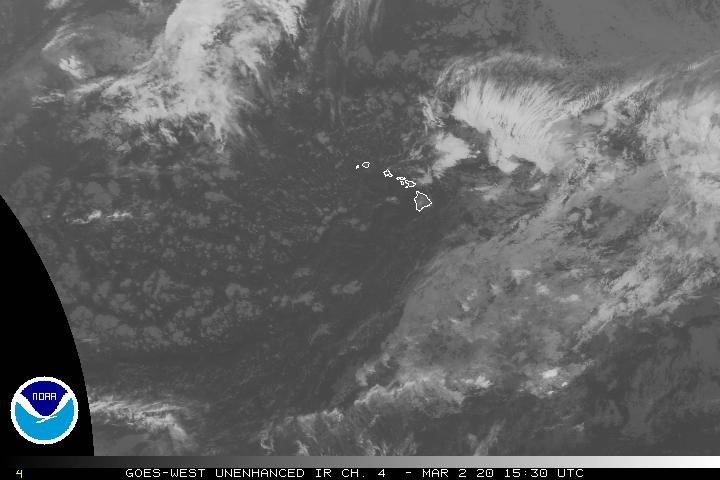
Satellite and Radar Images: To view the cloud conditions we have here in Hawaii, please use the following satellite links, starting off with this Infrared Satellite Image of the islands to see all the clouds around during the day and night. This next image is one that gives close images of the islands only during the daytime hours, and is referred to as a Close-up visible image. This next image shows a larger view of the Pacific…giving perspective to the wider ranging cloud patterns in the Pacific Ocean. Finally, here’s a Looping IR satellite image, making viewable the clouds around the islands 24 hours a day. To help you keep track of where any showers may be around the islands, here’s the latest animated radar image.
Hawaii’s Mountains – Here’s a link to the live webcam on the summit of near 14,000 foot Mauna Kea on the Big Island of Hawaii. The tallest peak on the island of Maui is the Haleakala Crater, which is near 10,000 feet in elevation. These two webcams are available during the daylight hours here in the islands…and when there’s a big moon rising just after sunset for an hour or two! Plus, during the nights and early mornings you will be able to see stars, and the sunrise too…depending upon weather conditions.
Tropical Cyclone activity in the eastern and central Pacific – Here’s the latest weather information coming out of the National Hurricane Center, covering the eastern north Pacific. You can find the latest tropical cyclone information for the central north Pacific (where Hawaii is located) by clicking on this link to the Central Pacific Hurricane Center. Here’s a tracking map covering both the eastern and central Pacific Ocean. A satellite image, which shows the entire ocean area between Hawaii and the Mexican coast…can be found here. Of course, as we know, our hurricane season won’t end until November 31st here in the central Pacific.
Aloha Paragraphs
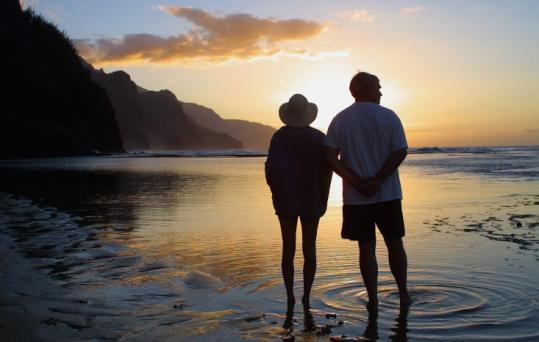
A nice time of day here in the islands
As we move through these last two days of late summer, or moderately strong trade winds will continue..right on into the beginning our autumn season. This weather map shows a 1024 millibar high pressure system located just to the north-northwest of our islands…along with another weaker 1018 millibar high pressure cell far to our northeast. These high’s are split in two by a weak low pressure system to the north-northeast. Our trade winds have become just light enough now, that our small craft wind advisories have been discontinued over those windiest areas around Maui and the Big Island. The computer models are suggesting that our winds could fade away more so, a bit later this week…coming down into the lighter realms then.
An old cold front brought some decent showers to some parts of the state yesterday into the Sunday night. Most of these showers were generally focused along the windward sides of the islands…although not all of them. It’s true that the largest amounts fell over the windward mountains…with over 4.00” atop the West Maui Mountains. There were light showers reported in the leeward sides too, although considerably less so. This cold front, despite it coming in from the northeast, rather than the northwest, like they usually do during the autumn and winter seasons…brought localized good precipitation. This satellite image shows what’s left of this early season frontal boundary, as diffuse as it has become…just to the south of the Big Island early Monday night.
Glancing south of the islands, using this satellite picture, we see those typical areas of thunderstorms to the southwest, south and southeast. The area of disturbed weather, which has been pulsing to the south-southeast and southeast for the last several weeks, has been taken off the NWS radar screens for the time being. Although, looking down into that area, we can still see evidence that something is trying to look interesting Monday night. The last time this area was circled in yellow, earlier this morning, it had taken on a 0% chance of developing…so I guess we could call it minus that at this point.
It’s Monday evening as I begin writing this last section of today’s narrative update. The weather remains generally nice now, and should hold up well through the rest of this week. This isn’t unusual, as we move through the rest of summer, and push on into the early autumn season on Wednesday. The trade winds will stick around, blowing showers our way at times, arriving along the windward sides for the most part. The early season cold front may get blown back our way over the next couple of days. We can keep an eye on this weather feature, by checking out this IR satellite image. This looping radar image too, will help us keep track of any showers that begin to slide back over our islands. ~~~ Looking out the windows here in Kihei, Maui, before I take the drive back upcountry to Kula, I see very few clouds in any direction. The trade winds are still blowing quite well, especially since they are coming in from the northeast direction now. This makes Kihei often have stronger winds than the Paia side of the island. One last thing, have you noticed that big almost full September moon out there, check it out! I’ll be back with your next new weather narrative very early Tuesday morning, I hope you have a great Monday night until then! Aloha for now…Glenn.
Interesting: The equatorial waters of the Pacific Ocean have made the transition from the warming flow, known as El Niño, 10 months ago to its cooler cousin, La Niña, NASA scientists report. The widespread cooling of the ocean surface, revealed by satellite data, is expected to intensify and could worsen dry spells and forest-fire-friendly conditions in the western United States, the scientists warn.
"This La Niña has strengthened for the past four months, is strong now and is still building," said climatologist Bill Patzert of NASA’s Jet Propulsion Laboratory in Pasadena, Calif. "It will surely impact this coming winter’s weather and climate." Researchers uncovered the change in sea surface temperatures by examining data from the U.S-French oceanography satellite, Ocean Surface Topography Mission/Jason-2, which looks at sea surface heights.
Because the height of the surface is an indicator of how much of the sun’s heat is being stored in the upper ocean (warmer waters tend to expand, increasing sea surface heights), scientists were able to calculate the change in ocean temperature from satellite data collected over a 10-day period in early September. La Niña ocean conditions often follow an El Niño episode, and the two systems are essentially two sides of the same coin — El Niño the warm side, La Niña the cool side.
During a La Niña episode, trade winds are stronger than normal, and the cold water found along the west coast of South America extends to the central equatorial Pacific. La Niña episodes change global weather patterns. They are associated with less moisture in the air, resulting in less rain along the coasts of North and South America and the equator, and more rain in the far western Pacific. Lower rain amounts can have a significant impact on already water-starved areas.
"After more than a decade of mostly dry years on the Colorado River watershed and in the American Southwest, and only one normal rain year in the past five years in Southern California, water supplies are dangerously low," Patzert said. Patzert said that this La Niña could deepen the drought in the already parched Southwest "and could also worsen conditions that have fueled Southern California’s recent deadly wildfires."
Interesting2: Warming waters in the deepest parts of the ocean surrounding Antarctica have contributed to sea-level rise over the past two decades, scientists report today (Sept. 20). In an attempt to pinpoint all culprits for the rising oceans, scientists analyzed warming trends in the abyssal ocean — below about 3,300 feet (1,000 meters), said study team member and oceanographer Sarah Purkey of the University of Washington in Seattle.
The scientists found that the strongest deep warming occurred in the water around Antarctica, and the warming lessens as it spreads around the globe. The temperature increases are small — about 0.05 degrees Fahrenheit per decade in the deep Southern Ocean, and less elsewhere. But the large volume of the ocean over which they are found and the high capacity of water to absorb heat means that this warming accounts for a huge amount of energy storage.
If this deep ocean heating were going into the atmosphere instead — a physical impossibility — it would be warming at a rate of just over 5 degrees F per decade. This amount of energy would be the equivalent of giving every person on Earth five 1400-Watt hair dryers, and running them constantly during the 20-year study period, said study team member and oceanographer Gregory Johnson of the National Oceanic and Atmospheric Administration (NOAA).
Sea level has been rising at around one-eighth of an inch per year on average since 1993, with about half of that caused by the ocean expanding as it’s heated, and the other half due to additional water added to the ocean, mostly from melting continental ice. The oceanographers note that deep warming of the Southern Ocean accounts for about one-twentieth of an inch per year of the sea-level rise around Antarctica in the past two decades.
The authors note that there are several possible causes for this deep warming: a shift in Southern Ocean winds; a change in the density of what is called Antarctic Bottom Water (which would change how much gets mixed with surface waters); or how quickly that bottom water is formed near the Antarctic, where it sinks to fill the deepest, coldest portions of the ocean around much of the globe. The study draws on temperature trends between the 1990s and 2000s in the deep Southern Ocean.
Though there are no continental boundaries there, and all oceans contribute water to the Southern Ocean, its distinct circulation makes the area a separate water body. This study shows that the deep ocean is taking up about 16 percent of the energy that the upper ocean is absorbing. To study how much heat was building up in the Southern Oceans, the researchers divided the ocean into 28 sections, or basins, for which they computed warming rates.
As a part of a large international research mission, researchers sailed across the ocean, stopping every 30 miles to lower their instruments into the deep ocean to take measurements for four hours. "It was like crossing the ocean at a jogging pace," Johnson said.
The three southernmost basins showed a strong statistically significant abyssal warming trend, with that warming signal weakening to the north in the central Pacific, western Atlantic and eastern Indian Oceans, the researchers said. Eastern Atlantic and western Indian Ocean basins showed slight cooling trends, though the results weren’t statistically significant, meaning they could be due to measurement or other errors.
Interesting3: There are mountains on land and there are mountains under the sea. The vast ocean seems flat but under that water are mountains, valleys and plains. These mountain chains rival the Alps, the Andes and the Himalayas in size and little is known about seamounts, the vast mountains hidden under the world’s oceans. Now in a special issue of Marine Ecology scientists uncover the mystery of life on these submerged mountain ranges and reveal why these under studied ecosystems are under threat.
A seamount is a mountain rising from the ocean seafloor that does not reach to the water’s surface (sea level), and thus is not an island. These are typically formed from extinct volcanoes. They are defined by oceanographers as independent features that rise to at least 3,281 feet) above the seafloor. The peaks are often found hundreds to thousands of feet below the surface, and are therefore considered to be within the deep sea. There are an estimated 100,000 seamounts across the globe, with only a few having been studied.
Most seamounts are volcanic in origin, and thus tend to be found on oceanic crust near mid-ocean ridges, mantle plumes, and island arcs. Nearly half of the world’s seamounts are found in the Pacific Ocean, and the rest are distributed mostly across the Atlantic and Indian oceans. Because of their abundance, seamounts are one of the most common oceanic ecosystems in the world. Interactions between seamounts and underwater currents, as well as their elevated position in the water, attract plankton, corals, fish, and marine mammals alike.
The shape and size of our ocean depths are now resolved at a scale and detail unimaginable by early pioneers. Yet only about 300 have been well studied. This scarcity of knowledge provided the primary motivation for CenSeam, a seamount-focused field within the Census of Marine Life which commenced in 2005. "The field of seamount ecology is rife with ecological paradigms, many of which have already become cemented in the scientific literature and in the minds of advocates for seamount protection," said Dr Ashley Rowden, one of the principal investigators of CenSeam.
"Together, these paradigms have created a widely held view of seamounts as unique environments, hot spots of biodiversity with fragile ecosystems of exceptional ecological worth." Researchers challenged the theory that seamounts act as hot spots of species richness, the weight of evidence now suggests that seamounts may have comparable levels of diversity to continental margins.
However, it appears that their ecological communities are distinct in structure, and of higher biomass than neighboring continental margins. Seamounts often project upwards into shallower water thus providing habitats for marine species that are not found on or around the surrounding deeper ocean bottom. Because seamounts are isolated from each other they form "undersea islands". As they are formed from volcanic rock, the substrate is much harder than the surrounding sedimentary deep sea floor.
This causes a different type of fauna to exist than on the seafloor, and leads to a theoretically higher degree of endemic marine life. However, recent research especially centered at Davidson Seamount suggests that seamounts may not be especially endemic, and discussions are ongoing on the effect of seamounts on endemicity. Much seamount research has been born out of the need to better manage these potentially vulnerable ecosystems.
Globally, seamount ecosystems are under pressure from bottom-contact fishing and other human`related impacts. Researchers detail the footprint of trawling and conduct a risk assessment that confirms what has long been suspected: seamount communities are highly vulnerable to disturbance by bottom trawling and recovery from fishing impacts is a lengthy process, likely requiring decades at a minimum.
Interesting4: The Prius has been the top selling hybrid automobile of all time. Toyota is taking the success of the Prius and expanding their clout in the green vehicles market. By the end of 2012, the Japan-based automaker is set to introduce six new hybrid models, two of which will be in the Lexus luxury brand, and four as Toyota models. The four Toyota models include the Rav4 Hybrid, Sienna Hybrid, Yaris Hybrid, and Corolla Hybrid.
The new hybrid Lexus vehicles are harder to predict because there are already four Lexus hybrids on the market. The host of vehicles will run on both gasoline and electricity. They will be new, not next-generation versions of existing models. The company is jockeying for top position in the ever-more competitive green vehicle market.
One of their challengers is Nissan which is introducing the all-electric Leaf to the marketplace later this year. Nissan is promoting the Leaf as the world’s first mass-produced zero-emissions electric vehicles. Also in the hunt is GM with the all-electric Chevrolet Volt, which is set for release later this year as well. Other green vehicle competitors include Mitsubishi’s i-MiEV, the Subaru Plug-in Stella, and the Ford electric Focus.
Toyota is still pumping out hybrid vehicles, as opposed to PHEVs (plug-in hybrid electric) or fully electric vehicles. Their success and technical expertise with this particular technology creates a competitive advantage for them in the market place. However, they will be attempting their first foray into the all-electric market with the Rav4. The Rav4 is a compact sport utility vehicle that may be considered a crossover. This would actually be the second generation electric Rav4.
The first was actually in 1997, when a small number were built specifically for fleet lease purposes. Then in 2002, the vehicle was made available to the public, but only 328 of them sold. The second generation Rav4 has been designed and built in partnership with California-based Tesla Motors, which has a long history of developing electric vehicles. The electric version will be unveiled at the Los Angeles Auto Show this November.
Toyota is hoping that their new generation of hybrids will put the spotlight back on their environmentally friendly cars, and off of their recent problems. The company desperately wants to overcome the drop in sales that followed a series of recalls earlier this year related to safety problems. These problems included unintended acceleration, engine, steering, and brake problems. About ten million total vehicles were affected.
Interesting5: Hima, practiced for over 14,000 years in the Arabian Peninsula, is believed to be the most widespread system of traditional conservation in the Middle East, and perhaps the entire earth. In these modern times, it’s easy to think of environmental protection as a new concept which has emerged in response to modern problems linked to industrialization and globalization. In reality, the need to protect the environment from abuse has been a constant concern for humans since the beginning of time- especially for people who were living directly of the earth’s resources.
Even the Middle East, which many assume is new to environmental concerns, had a system to help protect nature called "Hima". Hima which roughly translates as "protected or preserved place" has been practiced for over 14,000 years in the Arabian Peninsula and is believed to be the most widespread system of traditional conservation in the Middle East, and perhaps the entire earth. Hima is a system of resource protection in which pastures, trees or grazing lands are declared as forbidden and access to them and their use is denied by the owner.
Types of Himas included reserves for bee-keeping, forest trees, reserving woodland to stop desertification as well as the seasonal regeneration of fields. Hima pre-dates the emergence of Islam in Arabia, and according to Lutfallah Gari who has charted the rise and fall of the Hima system, Hima was sometimes placed under the protection of tribal deity. He notes that; "Fauna and flora were protected; and [Hima areas] enjoyed the right of asylum”
The animals consecrated to them grazed there safely, and no one dared to kill or steal them. The straying animals that crossed over the boundary were lost to their owner. Despite this, the system was subject to some abuse. The rich took advantage of it to protect their interests by pastures for their flocks and protecting themselves against the effects of future droughts.
Interesting6: The rocks of Colombia’s Sierra Nevada de Santa Marta — the highest coastal mountain on Earth — tell a fascinating tale: The mountain collides and then separates from former super-continents. Volcanoes are born and die. The mountain travels from Peru to northern Colombia and finally rotates in a clockwise direction to open up an entirely new geological basin. Smithsonian scientists were part of a four-year project to study Santa Marta’s geological evolution. Their findings are published in the October 2010 special issue of the Journal of South American Earth Sciences.
The study involved state-of-the-art geological, structural, paleomagnetic, geochemical and geochronological techniques applied by collaborators from universities and research institutions in several European countries and the Americas. "This integrated study represents a long-awaited contribution — particularly to the international scientific community who work in the circum-Caribbean — and fills a notorious gap in the picture of the region’s geology," said Agustin Cardona, post doctoral fellow at the Smithsonian Tropical Research Institute.
The diverse rock record exposed in Santa Marta rests on an ancient foundation that is more than 1 billion years old. One of the studies links the foundation to other old massifs in the Americas. Using the ancient magnetic field recorded in these rocks, the Smithsonian research group revealed Santa Marta’s 2,200-kilometer journey from northern Peru to its modern position on the Caribbean coast of Colombia during the past 170 million years. Sophisticated laboratory analyses of Santa Marta rock samples also offered scientists an explanation of their origin as remnants of extinct volcanoes and mountains that once existed but were later obliterated by powerful geologic forces.
Other studies revealed observations pertaining to recent dislocations along the Sierra’s bounding faults — evidence of historic earthquakes and a large submarine canyon carved in the floor of the Caribbean Sea. "We hope that this contribution will serve as a catalyst to accelerate the pace of geological research along this margin of South America," said German Ojeda, co-leader of the research team and geologist at Colombia’s Ecopetrol energy company. Sponsoring agencies included the geological and marine science research institutes of the Colombian government.
 Email Glenn James:


Denis Says:
Hi Glenn,
That sounds absolutely fantastic. Far better than our strong southwesterlies with cold squalls, hail, thunder and lightening. May see you in a month. Denis~~~Come ahead Denis, actually, in a month from now I’ll be in northern California on vacation…but you will find great weather! Aloha, Glenn
Denis Says:
Hello Glenn,
My wife and I are coming to hawaii from the 21st October until about the 8th November. I am sick and tired of the rainy and windy weather in New Zealand. Can you give me a forecast for the weather in Hawaii when there. Don’t be afraid to make it sound really good 🙂
Thanks
Denis~~~Hi Denis, understand your desire for warm sunny weather…and I don’t see any reason why you shouldn’t have lots of that. During your visit temperatures at sea level will be in the 80Fs with low temperatures in the 60’s and low 70’s…that sounds good to me, and I’m sure good to you! Have fun, Aloha, Glenn
Eliza Says:
Aloha Glenn – Wheee! What a nice morning – seeing the puddles in the street from last night’s long rain. Wow, what a nice change from this summer’s dry spell. So, we’re in for quite a bit of precip this winter? A friend said it sprinkled in Wailea for 20 minutes yesterday. Happy fall equinox on Wed afternoon at 509pm. ~ Eliza~~~Hi Eliza, yes Kula got some light showers, and glad to know that Wailea even got a little wet too. Happy autumn equinox to you too! Aloha, Glenn