September 13-14, 2010
Air Temperatures – The following maximum temperatures were recorded across the state of Hawaii Monday afternoon:
Lihue airport, Kauai – 85
Honolulu airport, Oahu – 88
Kaneohe MCAS, Oahu – 84
Molokai airport – 87
Kahului airport, Maui – 90
Ke-ahole airport (Kona) – 85
Hilo airport, Hawaii – 83
Air Temperatures ranged between these warmest and coolest spots near sea level – and on the highest mountain tops…as of 5pm Monday evening:
Honolulu, Oahu – 84
Hilo, Hawaii – 74
Haleakala Crater – 54 (near 10,000 feet on Maui)
Mauna Kea summit – 43 (near 14,000 feet on the Big Island)
Precipitation Totals – The following numbers represent the largest precipitation totals (inches) during the last 24 hours on each of the major islands, as of Monday afternoon:
0.31 Mount Waialeale, Kauai
0.09 Punaluu Stream, Oahu
0.01 Molokai
0.00 Lanai
0.00 Kahoolawe
0.49 Puu Kukui, Maui
0.09 Mountain View, Big Island
Marine Winds – Here’s the latest (automatically updated) weather map showing high pressure systems located to the north through northeast of the islands. Our local trade winds will remain light to moderately strong through Wednesday.
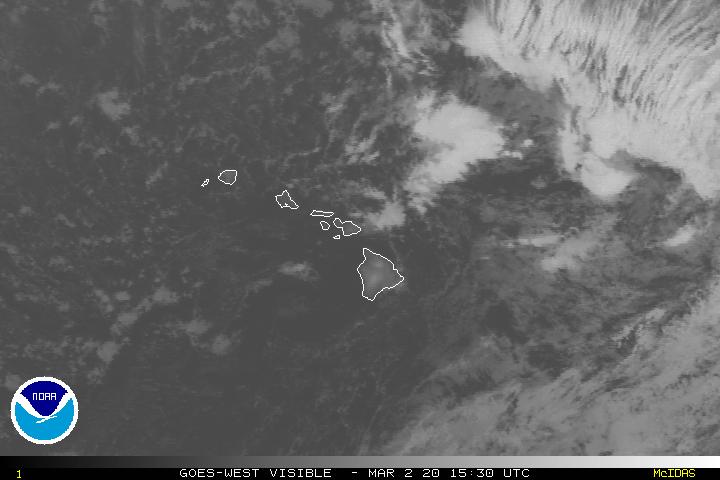
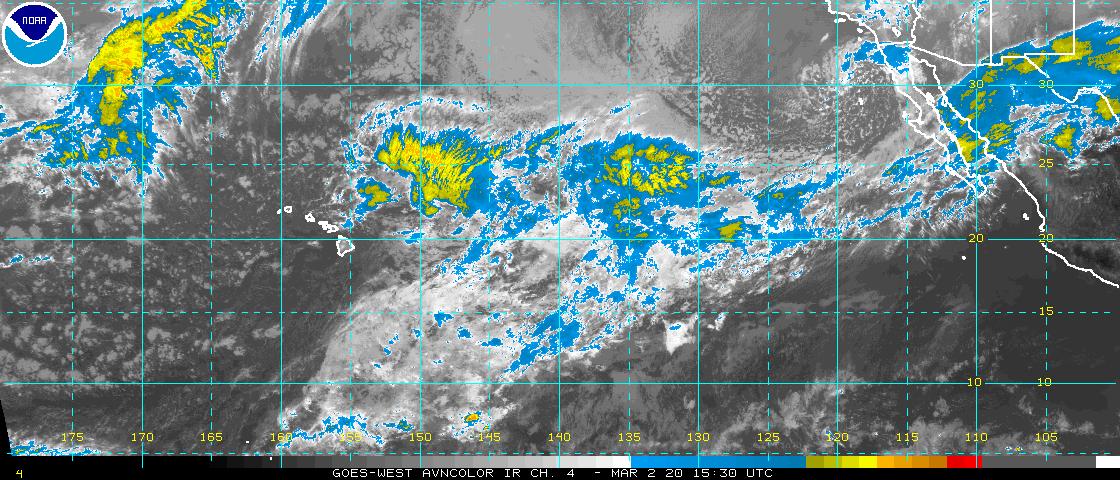
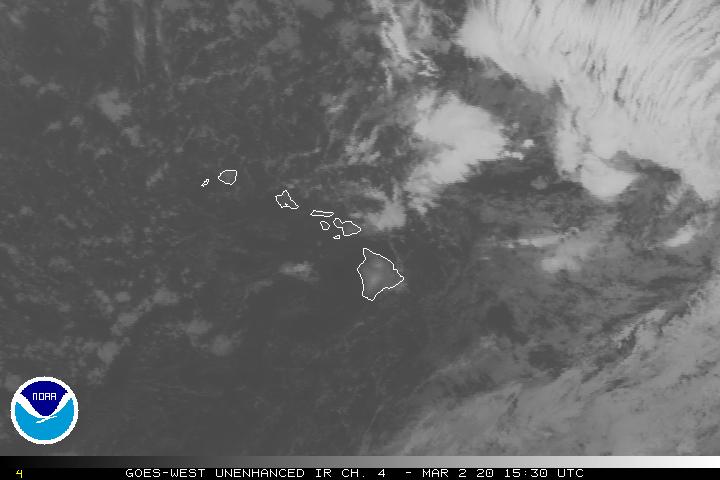
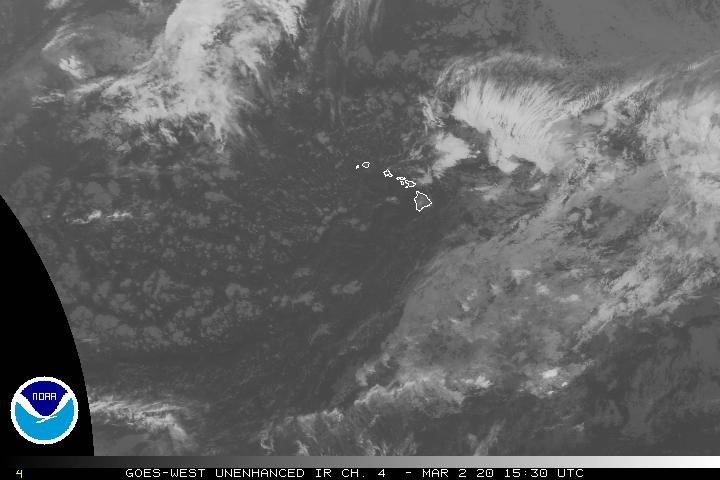
Satellite and Radar Images: To view the cloud conditions we have here in Hawaii, please use the following satellite links, starting off with this Infrared Satellite Image of the islands to see all the clouds around during the day and night. This next image is one that gives close images of the islands only during the daytime hours, and is referred to as a Close-up visible image. This next image shows a larger view of the Pacific…giving perspective to the wider ranging cloud patterns in the Pacific Ocean. Finally, here’s a Looping IR satellite image, making viewable the clouds around the islands 24 hours a day. To help you keep track of where any showers may be around the islands, here’s the latest animated radar image.
Hawaii’s Mountains – Here’s a link to the live webcam on the summit of near 14,000 foot Mauna Kea on the Big Island of Hawaii. The tallest peak on the island of Maui is the Haleakala Crater, which is near 10,000 feet in elevation. These two webcams are available during the daylight hours here in the islands…and when there’s a big moon rising just after sunset for an hour or two! Plus, during the nights and early mornings you will be able to see stars, and the sunrise too…depending upon weather conditions.
Tropical Cyclone activity in the eastern and central Pacific – Here’s the latest weather information coming out of the National Hurricane Center, covering the eastern north Pacific. You can find the latest tropical cyclone information for the central north Pacific (where Hawaii is located) by clicking on this link to the Central Pacific Hurricane Center. Here’s a tracking map covering both the eastern and central Pacific Ocean. A satellite image, which shows the entire ocean area between Hawaii and the Mexican coast…can be found here. Of course, as we know, our hurricane season won’t begin again until June 1st here in the central Pacific.
Aloha Paragraphs

Artwork: Gary Schira
Our trade winds are expected to remain light to moderate through the next week…and beyond. This weather map shows high pressure systems located to our north through northeast, the source of our trade breezes Monday night. There will be subtle day to day variations in wind speeds and direction…although nothing pronounced for the time being.
As the trade winds continue to blow, most of the incoming showers will be focused along the windward sides. Most of the showers will be on the light side, and generally falling during the night and early morning. There will be the chance however, of periods of more numerous showers…which could be more generous in coverage locally into Tuesday. This satellite image shows patches of clouds being carried our way. We also find areas of high cirrus clouds to the south of our islands now…which will stretch over the state at times. Glancing southwest through southeast of the islands, using this satellite picture, we see those typical areas of thunderstorms.
It’s Monday evening as I begin writing this last section of today’s narrative update. The weather today, on this first day of the work week, went very well. There were some clouds, although lots of sunshine too…especially along our very warm leeward beaches. Looking at that satellite image just above, we see lots of high cirrus clouds in just about all directions…except the east. We may see some of this stuff flying overhead, on the upper level winds over the next few days. Meanwhile, the surf will be gradually coming up along our south and west shores, over the next few days as well. I’d say by Thursday or so, we might even see high surf advisory flags going up in some of our leeward shores. ~~~ I’m just about ready to head upcountry again, driving up to Kula, Maui. I suppose most folks consider the first day of the new work week to be the most difficult, although for me, I must say…I enjoy them all! I’m fortunate in that regard, and am already looking forward to getting back to work in Kihei in the mornin’. I’ll have your next new weather narrative ready for the reading, early Tuesday. I hope you have a great Monday night until then! Aloha for now…Glenn.
Interesting: A toxin produced by a type of cyano-bacteria, also known as blue-green algae, has been devastating a colony of sea otters off the coast of California. In a paper published in the journal, PLoS ONE, by the California Department of Fish and Game (DFG) and the University of California (UC), Santa Cruz, researchers link the deaths of over 21 California sea otters to toxic chemicals from algae flowing into the ocean.
Blue-green algae itself can be detrimental to the natural ecosystem because it can block light from reaching the depths of the water and starve the water of dissolved oxygen. Once the oxygen goes, no marine life can survive and you get "dead zones." Now, according to the researchers, one particular type of algae is also releasing a deadly toxin known as Microcystis.
Warm, nutrient-rich fresh water systems are ideal for large blooms of Microcystis. The toxic algae can resemble slimy green goo as it as it forms a thick green mat over the surface of the water. Eventually the fresh water flows into the ocean, carrying the algae with it. However, the toxin does not break down right away as it reaches the salt water. It can last well over three weeks without any serious degradation.
The Microcystis can cause acute liver failure, damage body tissue, and be fatal, as was witnessed with the sea otters. Melissa Miller, lead author of the study and senior wildlife veterinarian at the DFG, began recovering the dead otters along the shore of Monterey Bay in 2007. This sparked a wider search for the sources of the toxin.
The search lead the scientists to Pinto Lake in Watsonville, a lake with a history of Microcystis blooms. Pinto Lake drains into Corralitos Creek, then into the Pajaro River, one of three main rivers to empty into Monterey Bay. In the ocean, the Microcystis can be eaten or absorbed by creatures such as oysters, mussels, clams, and crabs, which are then consumed by sea otters. Deaths from this toxic bacteria have attributed to the overall decline of the California sea otter population.
According to co-author Tim Tinker, "These findings also show the value in closely monitoring sentinel species like sea otters as a way to detect and understand threats to coastal oceans." Humans can also be at risk from Microcystis poisoning if they eat shellfish harvested near the mouths of rivers, especially during or after periods of heavy rains. Commercially harvested shellfish, however, come from areas that are unlikely to be contaminated.
Pets can also be at risk from drinking the water at places like Pinto Lake, or from getting wet and then licking their fur. Another problem is that there are no state or federal regulations for exposure to the toxin. Even low levels of exposure can promote the development of liver cancer. No surveillance system exists for Microcystis detection in the United States, as well as most other countries. The authors of the study have received funding from the US Environmental Protection Agency to continue their research in order to make recommendations on how the algae blooms might be controlled or prevented.
Interesting2: Paris is a tourist destination of choice for many reasons. Thankfully, a convenient and extensive rail system allows one to navigate around the city to see and experience all those reasons—and it is especially useful if you happen to transit through Charles de Gaulle airport and have a long layover. The Paris Metro also gives rest to weary feet after walking around the Latin Quarter, the Marais, or wandering lost around La Défense for a business appointment.
Of course, like many public transport systems, summer, and even other times of the year, can generate some body heat—almost as much as the eponymous 1981 movie. And when a system like that of Paris Metro hauls 4.5 million people a day, those heat calories have got to go somewhere. Now a public housing project in the city’s center will benefit from all those commuters darting across Paris. Located on rue Beaubourg, close to the Rambuteau station, the building will draw heat from all those passengers, who on average generate about 100 watts of energy per ride.
Based on the principles of geothermal technology, heat will push from the station to heat exchangers, which will then flow through heating pipes. A request for proposal will be issued by the city government before the end of this year, and work will begin in 2011. Should the project progress as planned, 17 flats will receive heat from this method. The new system will also reduce carbon emissions by one-third through the replacement of a boiler currently used in the building.
Interesting3: Last week, more than 100 police officers raided restaurants in Da Lat City, Vietnam. What they found was unappetizing: illegally poached animals of nearly 20 species. The authorities arrested more than a dozen restaurant owners for planning to serve meals of pangolins, porcupines, mouse deer, monitor lizards, bears, snakes, and other rare animals—amounting to more than 850 pounds of meat.
Criminal prosecutions are in store for the wholesaler who was supplying the restaurants with the unlawful wildlife goods. A larger investigation is also underway to determine where the animals were captured and what trading networks were involved in transporting and selling them. "The detection and prosecution of restaurants illegally serving wildlife is a critical step in the battle for wildlife conservation in Vietnam," said Mr. Tran Thanh Binh, head of Lam Dong Forest Protection Department.
"The campaign today is our warning shot to illegal wildlife traders that Lam Dong province will not condone wildlife violators anymore." The raid that swept through Da Lat City and neighboring towns came after recent surveys revealed that 44 restaurants and 33 traditional Chinese medicine shops in the area were selling wildlife. The surveys are part of a campaign that WCS and its partners have developed to help curb the illegal wildlife trade.
"WCS commends the strong and decisive actions of Lam Dong province on tackling wildlife trade in Da Lat City and hopes these seizures will be followed up with investigations to identify and prosecute the illegal traders behind the restaurants," said Scott Roberton of WCS-Vietnam. "The future of wildlife in Vietnam hangs in the balance, but with more agencies showing a strong commitment like Lam Dong Forest Protection Department, things could change for the better very quickly."
Interesting4: A team of U.S. scientists and environmentalists met with Cuban officials this week to discuss a proposed alliance, including Mexico, to protect the Gulf of Mexico’s declining shark population. The meetings were a product of both improved U.S.-Cuba relations and concern that only a joint effort by the three nations that share the gulf can protect sharks, whose numbers are said to be down as much as 50 percent for some species.
"The Gulf of Mexico is one ecosystem, it’s not just the U.S. gulf. The shark is a highly migratory fish that moves between the countries and it is troubled," said Pamela Baker, gulf policy advisor for the New York-based Environmental Defense Fund, which is spearheading the effort along with the Mote Marine Laboratory in Sarasota, Florida.
Shark populations have fallen worldwide, primarily due to overfishing to satisfy China’s demand for shark fin soup, which is rising as China becomes more prosperous, scientists say. An estimated 73 million sharks are being killed annually mostly for their fins, the EDF said in a recent publication. Still unknown, said shark expert Robert Hueter at the Mote Marine Laboratory, is the effect of the massive BP oil spill this summer in the Gulf of Mexico.
 Email Glenn James: