











August 6-7, 2010
Air Temperatures – The following maximum temperatures were recorded across the state of Hawaii Friday afternoon:
Lihue, Kauai – 84
Honolulu, Oahu – 88
Kaneohe, Oahu – 83
Kaunakakai, Molokai – 87
Kahului, Maui – 90
Hilo, Hawaii – 84
Kailua-kona – 83
Air Temperatures ranged between these warmest and coolest spots near sea level – and on the highest mountain tops too…as of 5pm Friday evening:
Port Allen, Kauai – 88
Molokai AP – 80
Haleakala Crater – 52 (near 10,000 feet on Maui)
Mauna Kea summit – 41 (near 14,000 feet on the Big Island)
Precipitation Totals – The following numbers represent the largest precipitation totals (inches) during the last 24 hours on each of the major islands, as of Friday afternoon:
0.42 Mount Waialeale, Kauai
0.33 Manoa Valley, Oahu
0.00 Molokai
0.00 Lanai
0.00 Kahoolawe
0.07 West Wailuaiki, Maui
0.31 Kawainui Stream, Big Island
Marine Winds – Here’s the latest (automatically updated) weather map showing high pressure systems to the north-northeast and north-northwest of the islands. Our local trade winds will remain active Saturday and Sunday.
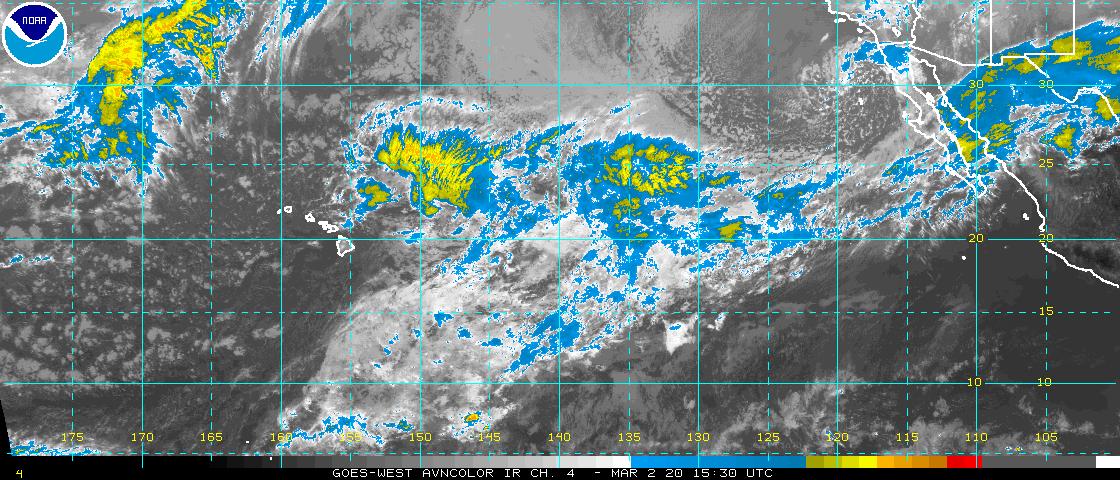
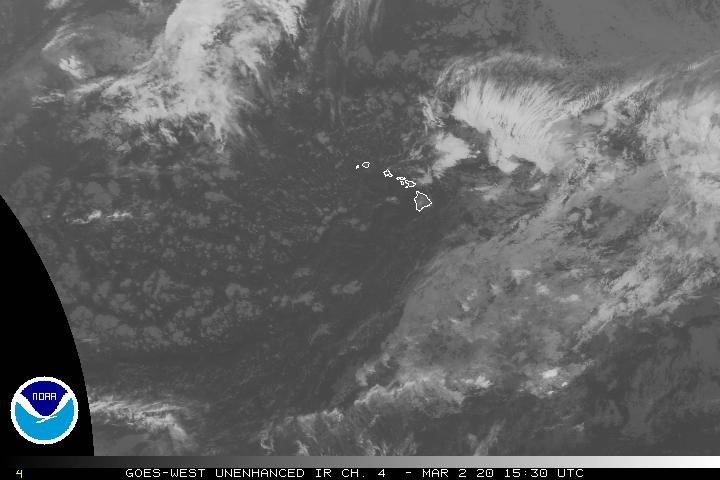
Satellite and Radar Images: To view the cloud conditions we have here in Hawaii, please use the following satellite links, starting off with this Infrared Satellite Image of the islands to see all the clouds around during the day and night. This next image is one that gives close images of the islands only during the daytime hours, and is referred to as a Close-up visible image. This next image shows a larger view of the Pacific…giving perspective to the wider ranging cloud patterns in the Pacific Ocean. Finally, here’s a Looping IR satellite image, making viewable the clouds around the islands 24 hours a day. To help you keep track of where any showers may be around the islands, here’s the latest animated radar image.
Hawaii’s Mountains – Here’s a link to the live webcam on the summit of near 14,000 foot Mauna Kea on the Big Island of Hawaii. The tallest peak on the island of Maui is the Haleakala Crater, which is near 10,000 feet in elevation. These two webcams are available during the daylight hours here in the islands…and when there’s a big moon rising just after sunset for an hour or two! Plus, during the nights and early mornings you will be able to see stars, and the sunrise too…depending upon weather conditions.
Tropical Cyclone activity in the eastern and central Pacific – Here’s the latest weather information coming out of the National Hurricane Center, covering the eastern north Pacific. You can find the latest tropical cyclone information for the central north Pacific (where Hawaii is located) by clicking on this link to the Central Pacific Hurricane Center. Here’s a tracking map covering both the eastern and central Pacific Ocean. A satellite image, which shows the entire ocean area between Hawaii and the Mexican coast…can be found here. Of course, as we know, our hurricane season won’t begin again until June 1st here in the central Pacific.
Aloha Paragraphs

Hanauma Bay…Oahu
Our local trade winds will remain light to moderately strong, picking up a notch during the weekend…then perhaps another into the new week ahead. This weather map shows two high pressure systems located more or less to our north, the source of our breezes now. Otherwise, there’s nothing out of the ordinary expected well into the future, in terms of our winds here in
We’ll find just a few showers falling, almost exclusively along the windward sides, potentially increasing some this weekend...especially at night. This drier than normal trade wind flow is expected to moisten-up a touch this weekend, as a rainfall enhancing upper low pressure system moves by to our south. This satellite image shows nothing unusual to our east through northeast Friday night. Glancing down further to the south of the islands, in the deeper tropics, using this satellite picture…we see minimal thunderstorm activity, with a few streaks of high cirrus clouds to our west and southeast.
It’s Friday evening as I begin writing this last section of today’s narrative update. Our trade winds are still with us, and will remain that way well into the future. However, they remain light enough now that small craft wind advisories around the state remain inactive for the time being. These light to moderately strong winds will keep our atmosphere feeling comfortable, both during the days…and at night this weekend.
~~~ Tropical storm Colin remains active in the western Atlantic Ocean. Here’s the track map for this storm, along with a satellite image. The greatest threat is for Bermuda…as the storm moves very close to that islands Saturday. Meanwhile, in the eastern Pacific, we have the 7th tropical cyclone of the hurricane season. It will stick close to the Mexican coast for the time being. Here’s a track map for tropical storm Estelle. Here’s a satellite image. I have no concern that this system will get anywhere near our Hawaiian Islands during its life cycle.
~~~ The NWS has declared the prospect for a moderate to strong La Nina phase of the ENSO cycle. This, in an overly simplified manner, means that there will be cooler than normal water in the tropical eastern Pacific now into the winter season. This can translate to wetter conditions for our upcoming rainy season here in Hawaii. This would be very good news, as it could finally end, or at least push back greatly…the long lasting drought conditions that many parts of the state have been experiencing. I’ll have more to say about this with time.
~~~ As many of you know, I typically see one of the new films on Friday evenings after work here in Kihei. I couldn’t find anything that looked that interesting though, so I have a change of plans on my hands. I think I’ll head over to Baldwin Beach for a late walk, and likely a jump in the ocean too. Since I’m over on that windward side of the island, I’ll probably have dinner at that little vegetarian Vietnamese restaurant in Paia. Then, well, I guess I’ll just head upcountry to Kula, unless something else catches my eye. I’ll be up early Saturday morning with your next new weather narrative, and then plan on having a nice long walk out at Thompson Ranch Rd after that. I hope you have a great Friday night wherever you happen to be spending it! Aloha for now…Glenn.
Interesting: The way that humanity reacts to climate change may do more damage to many areas of the planet than climate change itself unless we plan properly, an important new study published in Conservation Letters by Conservation International’s Will Turner and a group of other leading scientists has concluded. The paper Climate change: helping nature survive the human response, looks at efforts to both reduce emissions of greenhouse gases and potential action that could be taken by people to adapt to a changed climate and assesses the potential impact that these could have on global ecosystems.
In particular it notes that one fifth of the world’s remaining tropical forests lie within 50km of human populations that could be inundated if sea levels rise by 1m. These forests would make attractive sources of fuel-wood, building materials, food and other key resources and would be likely to attract a population forced to migrate by rising sea levels. About half of all Alliance for Zero Extinction sites — which contain the last surviving members of certain species — are also in these zones.
Dr Turner said: "There are numerous studies looking at the impacts of climate change on biodiversity, but very little time has been taken to consider what our responses to climate change might do to the planet."
The paper notes that efforts to reduce greenhouse gas emissions by constructing dams for hydropower generation can cause substantial damage to key freshwater ecosystems as well as to the flora and fauna in the flooded valleys. It also notes that the generally bogus concept that biofuels reduce carbon emissions is still being used as a justification for the felling of large swathes of biodiverse tropical forests.
The report also reviews studies examining the complex series of outcomes in historical examples of climate change and environmental degradation, and humanity’s efforts to adapt to changing circumstances. Migration caused in part by climatic instability in Burkina Faso in the late 20th century, for example, led to a 13 per cent decline in forest cover as areas were cleared for agriculture, and a decline in fish supplies in Ghana may have led to a significant increase in bush meat hunting.
Dr Turner added: "If we don’t take a look at the whole picture, but instead choose to look only at small parts of it we stand to make poor decisions about how to respond that could do more damage than climate change itself to the planet’s biodiversity and the ecosystem services that help to keep us all alive.
"While the Tsunami in 2004 was not a climate event, many of the responses that it stimulated are comparable with how people will react to extreme weather events — and the damage that the response to the Tsunami did to many of Aceh province’s important ecosystems as a result of extraction of timber and other building materials, and poor choices of locations for building , should be a lesson to us all."
Although the challenge of sustaining biodiversity in the face of climate change seems daunting, the paper notes that we must — and can — rise to the challenge.
Turner adds: "Climate change mitigation and adaptation are essential. We have to ensure that these responses do not compromise the biodiversity and ecosystem services upon which societies ultimately depend. We have to reduce emissions, we have to ensure the stability of food supplies jeopardized by climate change, we have to help people survive severe weather events — but we must plan these things so that we don’t destroy life-sustaining forests, wetlands, and oceans in the process.’
The paper concludes that there are many ways of ensuring that the human response to climate change delivers the best possible outcomes for both society and the environments, and notes that in particular, maintaining and restoring natural habitats are among the cheapest, safest, and easiest solutions at our disposal to reduce greenhouse-gas emissions and help people adapt to unavoidable changes.
Dr Turner said: "Providing a positive environmental outcome is often the best way to ensure the best outcome for people. If we are sensible, we can help people and nature together cope with climate change, if we are not it will cause suffering for people and serious problems for the environment."
Interesting2: In trying to predict how species will respond to climate change caused by global warming, researchers and scientists are turning to comparative physiology, a sub-discipline of physiology that studies how different organisms function and adapt to diverse and changing environments. By comparing different species to each other, as well as to members within a species that live in different environments, researchers are learning which physiologic features establish environmental optima and tolerance limits.
This approach gives the scientific community a "crystal ball" for predicting the effects of global warming, according to George N. Somero, Associate Director of Stanford University’s Hopkins Marine Station.
Dr. Somero will discuss the benefits of the comparative approach at the 2010 American Physiological Society’s Intersociety Meeting in Westminster, Colo., August 4-7. He will deliver the plenary lecture of the conference, entitled Global Change and Global Science: Comparative Physiology in a Changing World. The lecture will focus on work done by his team and others with ectothermic marine species — species whose body temperatures change in response to their environment and are commonly referred to as "cold-blooded."
Heat’s Effect on Adaptation in Porcelain Crabs
According to Dr. Somero, the comparative approach can provide insight into the ways in which past evolution under different climatic conditions determines a species’ likelihood of survival in a warming world. For example, thermal tolerance limits — the highest and lowest temperatures at which an organism can survive — differ among closely related species of porcelain crab: Tropical species are far more heat-tolerant than their counterparts in temperate climates.
One might expect the heat-tolerant tropical crab to have an advantage over their temperate cousins when it comes to adaptability to climate change. Comparative physiology has shown that this is not the case, however.
According to Dr. Somero, "Tropical porcelain crabs, which live at high temperatures, live right near the edge of their thermal tolerance range, and they have little ability to further increase their thermal tolerance by acclimation." Therefore, even though this tropical crab species can handle higher temperatures compared to the temperate crab species, the tropical species is close to reaching the tipping point for coping with additional increases in temperature.
Thus, the tropical crabs have less of a margin for adaptation to warm climates while the temperate counterparts have more room to adapt. "Researchers can predict that tropical species of porcelain crabs will be more vulnerable to climate change than temperate ones," said Dr. Somero. "Furthermore, the lessons we’ve learned from studying these marine crabs appear to apply not only to other marine animals, but also to terrestrial species."
Interesting3: By 2100 only 18% to 45% of the plants and animals making up ecosystems in global, humid tropical forests may remain as we know them today, according to a new study led by Greg Asner at the Carnegie Institution’s Department of Global Ecology. The research combined new deforestation and selective logging data with climate-change projections. It is the first study to consider these combined effects for all humid tropical forest ecosystems and can help conservationists pinpoint where their efforts will be most effective. The study is published in the August 5, 2010, issue of Conservation Letters.
"This is the first global compilation of projected ecosystem impacts for humid tropical forests affected by these combined forces," remarked Asner. "For those areas of the globe projected to suffer most from climate change, land managers could focus their efforts on reducing the pressure from deforestation, thereby helping species adjust to climate change, or enhancing their ability to move in time to keep pace with it. On the flip side, regions of the world where deforestation is projected to have fewer effects from climate change could be targeted for restoration."
Tropical forests hold more then half of all the plants and animal species on Earth. But the combined effect of climate change, forest clear cutting, and logging may force them to adapt, move, or die.
The scientists looked at land use and climate change by integrating global deforestation and logging maps from satellite imagery and high-resolution data with projected future vegetation changes from 16 different global climate models. They then ran scenarios on how different types of species could be geographically reshuffled by 2100.They used the reorganization of plant classes, such as tropical broadleaf evergreen trees, tropical drought deciduous trees, plus different kinds of grasses as surrogates for biodiversity changes.
For Central and South America, climate change could alter about two-thirds of the humid tropical forests biodiversity — the variety and abundance of plants and animals in an ecosystem. Combining that scenario with current patterns of land-use change, and the Amazon Basin alone could see changes in biodiversity over 80% of the region.
Most of the changes in the Congo area likely to come from selective logging and climate change, which could negatively affect between 35% and 74% of that region. At the continental scale, about 70% of Africa’s tropical forest biodiversity would likely be affected if current practices are not curtailed.
In Asia and the central and southern Pacific islands, deforestation and logging are the primary drivers of ecosystem changes. Model projections suggest that climate change might play a lesser role there than in Latin America or Africa. That said, the research showed that between 60% and 77% of the area is susceptible to biodiversity losses via massive ongoing land-use changes in the region.
"This study is the strongest evidence yet that the world’s natural ecosystems will undergo profound changes — including severe alterations in their species composition — through the combined influence of climate change and land use," remarked Daniel Nepstad, senior scientist at the Woods Hole Research Center. "Conservation of the world’s biota, as we know it, will depend upon rapid, steep declines in greenhouse gas emissions."
 Email Glenn James: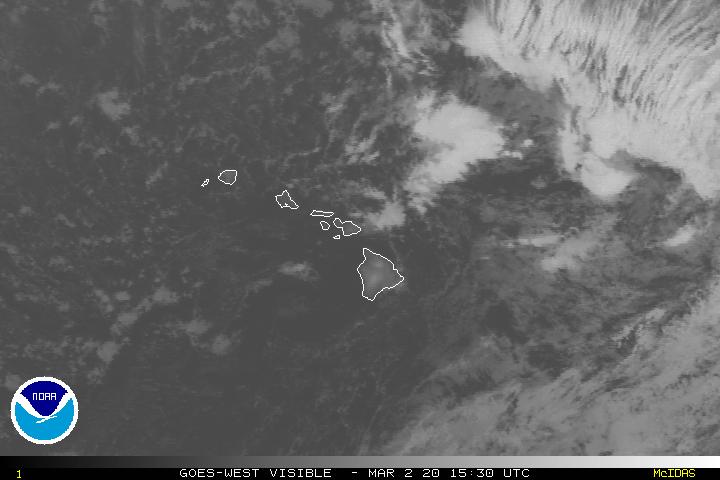




Eliza Says:
Aloha Glenn – feels very minimal trades right now (noonish) in Pukalani. Will head to Ma’alaea later this afternoon to finish the photo project. Happy Aloha Friday to you ~ Eliza~~~Hi Eliza, late Friday morning the winds at Maalaea Bay were blowing sustained 14 mph, with gusts 28 mph. Happy Aloha Friday to you as well…Aloha, Glenn