August 5-6, 2010
Air Temperatures – The following maximum temperatures were recorded across the state of Hawaii Thursday afternoon:
Lihue, Kauai – 84
Honolulu, Oahu – 86
Kaneohe, Oahu – 83
Kaunakakai, Molokai – 85
Kahului, Maui – 88
Hilo, Hawaii – 82
Kailua-kona – 82
Air Temperatures ranged between these warmest and coolest spots near sea level – and on the highest mountain tops too…as of 5pm Thursday evening:
Barking Sands, Kauai – 85
Princeville, Kauai – 73
Haleakala Crater – 55 (near 10,000 feet on Maui)
Mauna Kea summit – 41 (near 14,000 feet on the Big Island)
Precipitation Totals – The following numbers represent the largest precipitation totals (inches) during the last 24 hours on each of the major islands, as of Thursday afternoon:
0.89 Mount Waialeale, Kauai
1.15 Oahu Forest NWR, Oahu
0.08 Molokai
0.00 Lanai
0.15 Kahoolawe
1.46 Puu Kukui, Maui
0.68 Kawainui Stream, Big Island
Marine Winds – Here’s the latest (automatically updated) weather map showing high pressure systems to the north-northwest through northeast of the islands. Our local trade winds will remain active Friday and Saturday.
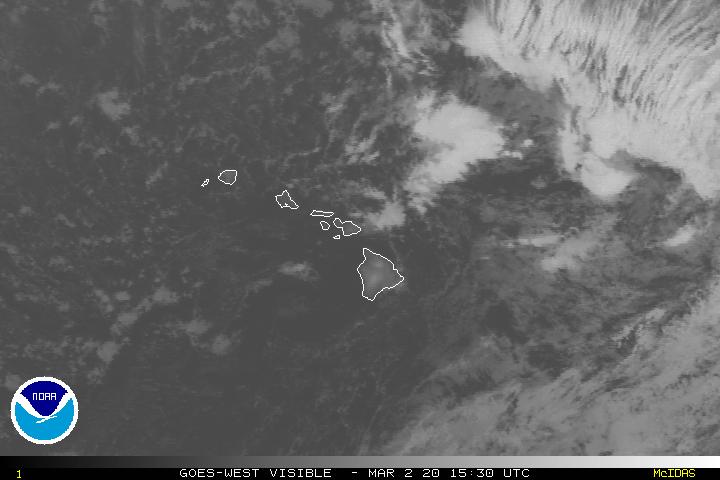
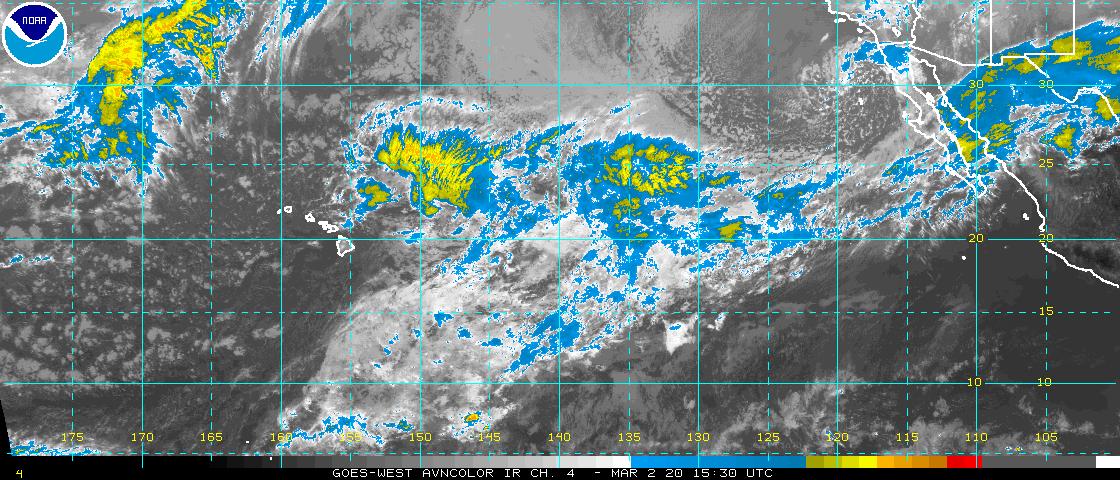
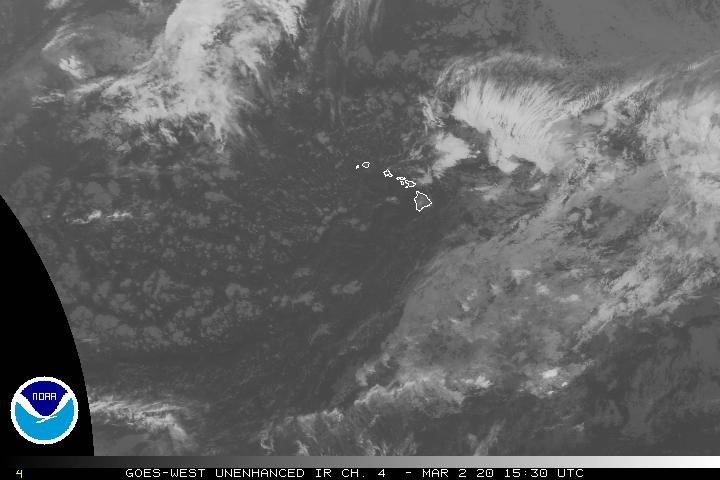
Satellite and Radar Images: To view the cloud conditions we have here in Hawaii, please use the following satellite links, starting off with this Infrared Satellite Image of the islands to see all the clouds around during the day and night. This next image is one that gives close images of the islands only during the daytime hours, and is referred to as a Close-up visible image. This next image shows a larger view of the Pacific…giving perspective to the wider ranging cloud patterns in the Pacific Ocean. Finally, here’s a Looping IR satellite image, making viewable the clouds around the islands 24 hours a day. To help you keep track of where any showers may be around the islands, here’s the latest animated radar image.
Hawaii’s Mountains – Here’s a link to the live webcam on the summit of near 14,000 foot Mauna Kea on the Big Island of Hawaii. The tallest peak on the island of Maui is the Haleakala Crater, which is near 10,000 feet in elevation. These two webcams are available during the daylight hours here in the islands…and when there’s a big moon rising just after sunset for an hour or two! Plus, during the nights and early mornings you will be able to see stars, and the sunrise too…depending upon weather conditions.
Tropical Cyclone activity in the eastern and central Pacific – Here’s the latest weather information coming out of the National Hurricane Center, covering the eastern north Pacific. You can find the latest tropical cyclone information for the central north Pacific (where Hawaii is located) by clicking on this link to the Central Pacific Hurricane Center. Here’s a tracking map covering both the eastern and central Pacific Ocean. A satellite image, which shows the entire ocean area between Hawaii and the Mexican coast…can be found here. Of course, as we know, our hurricane season won’t begin again until June 1st here in the central Pacific.
Aloha Paragraphs

Nice clear water sandy beach…on the Big Island
The strongest winds will blow during the days, becoming lighter at night…with little day to day change through the first several days of next week. These trade winds have eased up enough now, that the small craft wind advisories have been pared back all the way, leaving no advisories anywhere in the state Thursday night. This weather map shows two moderately strong high pressure systems located to our northwest through northeast…the source of our moderately strong breezes now.
The somewhat abundant showers, which have primarily fallen along our windward sides the last few days…have backed off some now. This somewhat drier than normal trade wind flow, is expected to moisten up some later this weekend into early next week. This satellite image shows a fairly cloud free sky upwind of the islands, although a few showers look like they will try to reach the
.
It’s Thursday evening as I begin writing this last section of today’s narrative update. Our trade winds are still alive now, and will remain that way well into the future. However, they have eased up just enough, as noted above, that the small craft wind advisories around the state have finally been taken down. As compared to earlier this week, when we had gusts topping 40-45 mph, today’s were top gusts were in the lower 30’s. These moderately strong winds will keep our atmosphere feeling comfortable, both during the days, and at night.
~~~ By the way, tropical storm Colin, which fell apart in the western Atlantic several days ago, has regenerated, and is active again. Here’s the track map for this storm, along with a satellite image. The greatest threat appears to be Bermuda. Meanwhile, in the eastern Pacific, we have the 7th tropical cyclone of the hurricane season. It will stick close to the Mexican coast for the time being. Here’s a track map for that soon to be tropical storm. Here’s a satellite image.
~~~ I’m just getting ready to leave the beach area of Kihei, Maui, for the drive back upcountry to Kula. Looking out the window before I leave, it’s quite breezy, although mostly sunny down here. Looking up the slope of the Haleakala Crater, there are some clouds up that way. I’m looking forward to getting home and taking my walk, before dinner, some reading, and getting some sleep. After that’s done, I’ll be up at 430am for some meditation, and then back on the computer to prepare your next new weather narrative. I hope you have a great Thursday night until then! Aloha for now…Glenn.
Interesting: The Russian government warned on Thursday that the country’s deadliest wildfires in nearly four decades posed a nuclear threat if they are not contained, as the death toll rose to 50 and the blazes continued to spread. The worst heat wave in more than a century is set to intensify on Friday, with record temperatures of 104 degrees fahrenheit expected and to continue into the next week, weather forecasters said.
Prime Minister Vladimir Putin announced a ban on exports of grain and grain products from Aug. 15 until December, and his spokesman said it would apply also to contracts already signed. Emergencies Minister Sergei Shoigu said heat from fires in the Bryansk region, which already has nuclear contamination from the Chernobyl disaster more than 20 years ago, could release harmful radioactive particles into the atmosphere.
"In the event of a fire there, radionuclides could rise (into the air) together with combustion particles, resulting in a new pollution zone," he said on state television, without going into detail. Shoigu added two fires had already broken out in the Bryansk region, some 250 miles southwest of Moscow, but they were quickly contained.
Interesting2: The National Oceanic and Atmospheric Administration (NOAA) has released a major report by the federal government addresses the fate of the oil released while the well was gushing, and what is likely to happen to the remaining oil in the ocean. The report was prepared by a team of federal agencies and scientists from NOAA, USGS, and NIST, and as well as independent scientists from universities, Environment Canada, Exxon Mobil, and other companies.
The study concludes that the vast majority of the oil from the BP oil spill has either evaporated or been burned, skimmed, recovered from the wellhead or dispersed much of which is in the process of being degraded. A significant amount of this is the direct result of what the report terms the robust federal response efforts.
A third (33 percent) of the total amount of oil released in the Deepwater Horizon/BP spill was captured or mitigated by the Unified Command recovery operations, including burning, skimming, chemical dispersion and direct recovery from the wellhead, according to a federal science report released today.
An additional 25 percent of the total oil naturally evaporated or dissolved, and 16 percent was dispersed naturally into microscopic droplets. The residual amount, just over one quarter (26 percent), is either on or just below the surface as residue and weathered tarballs, has washed ashore or been collected from the shore, or is buried in sand and sediments.
Dispersed and residual oil remain in the system until they degrade through a number of natural processes. Early indications are that the oil is degrading quickly. These estimates were derived by the National Oceanic and Atmospheric Administration (NOAA) and the Department of the Interior (DOI), who jointly developed what’s known as an Oil Budget Calculator, to provide measurements and best estimates of what happened to the spilled oil.
The calculator is based on 4.9 million barrels of oil released into the Gulf, the governments Flow Rate Technical Group estimate from Monday. More than 25 respected government and independent scientists contributed to or reviewed the calculator and its calculation methods.
Teams of scientists and experts have been carefully tracking the oil since the beginning of the spill, and based on the data from those efforts and their collective expertise, they have been able to provide these useful and educated estimates about the fate of the oil, says Jane Lubchenco, under secretary of commerce for oceans and atmosphere and NOAA administrator.
Less oil on the surface does not mean that there isn’t oil still in the water column or that our beaches and marshes aren’t still at risk. Knowing generally what happened to the oil helps us better understand areas of risk and likely impacts. The estimates do not make conclusions about the long-term impacts of oil on the Gulf.
Fully understanding the damages and impacts of the spill on the Gulf of Mexico ecosystem is something that will take time and continued monitoring and research. Dispersion increases the likelihood that the oil will be biodegraded, both in the water column and at the surface.
While there is more analysis to be done to quantify the rate of biodegradation in the Gulf, early observations and preliminary research results from a number of scientists show that the oil from the BP Deepwater Horizon spill is biodegrading quickly.
Scientists from NOAA, EPA, DOE, and academic scientists are working to calculate more precise estimates of this rate. It is well known that bacteria that break down the dispersed and weathered surface oil are abundant in the Gulf of Mexico in large part because of the warm water, the favorable nutrient and oxygen levels, and the fact that oil enters the Gulf of Mexico through natural seeps regularly.
Interesting3: Myanmar has announced that Hukaung Valley Tiger Reserve will be nearly tripled in size, making the protected area the largest tiger reserve in the world. Spanning 6,748 square miles, the newly expanded park is approximately the size of Kuwait and larger than the US state of Connecticut.
After years of illegal hunting and a decline in prey the reserve may hold as few as 50 tigers, yet experts hope with protection the population could bounce back. Although tigers are the star, the park holds many other species including some 370 bird species.
Besides the tiger, which is listed as Endangered by the IUCN Red List, the area contains a number of threatened species , including the Indo-Chinese leopard (Near Threatened), clouded leopard (Vulnerable), Malayan sun bear (Vulnerable), Himalayan black bear (Vulnerable), sambar deer (Vulnerable), a wild bovine known as the gaur (Vulnerable), Asian elephants (Endangered), and the Rufous-necked hornbill (Critically Endangered).
"I have dreamt of this day for many years," said Alan Rabinowitz in a press release. Rabinowitz is the head of the cat-conservation group Panthera and leader of the first biological expedition into Hukaung Valley in 1997. During this expedition Rabinowitz discovered a new mammal: the leaf deer, the second smallest deer in the world.
Interesting4: Earth’s solid inner core may be continually inching eastward relative to its liquid outer core, renewing itself by shedding its front while solidifying its back, a team of French scientists suggests. "Within less than 100 million years, everything that has been crystallized on the west will have melted on the east," said lead researcher Thierry Alboussiere of Université Joseph Fourier in Grenoble.
The idea counters traditional theory that the big ball at the center of the Earth stands still, growing uniformly in all directions as the planet cools. It could shed light on the nature of the core — such as its age, apparent seismic mismatches, and a mysterious coating of dense fluid on its surface.
Seismic clues About a billion years ago, the middle of the Earth began slowly solidifying from the inside out. The planet is hottest at its center, possibly even hotter than the surface of the sun, yet the core’s iron is thought to be solid because of the extreme pressure that has raised its melting temperature. As it freezes, according to theory, the inner core takes in more iron, sending lighter elements up through the liquid outer core.
This movement is thought to drive Earth’s magnetic field. Since scientists can’t journey the roughly 4,000 miles to the center of the Earth to see what’s going on, insight of the 1,600-mile wide innermost layer more or less stops there. But bits and pieces of indirect information come in all the time, through earthquakes. The study is detailed in the Aug. 4 edition of the journal Nature.
Interesting5: The atmospheric setting of the tropical western Pacific Ocean is becoming increasingly favorable for spinning up a tropical storm that could threaten southern Japan early next week. As of Thursday, the makings for an organized tropical system took the form of widespread showers and thunderstorms over the southern Philippines Sea far to the east of the Philippines.
Movement of this broad swath of disturbed weather will be towards the north and northwest and, by later Saturday, a tropical depression, even a named tropical storm, could be under way. Although the piled-up moisture necessary to form the core of a would-be tropical cyclone has already gathered in the area in question, the upper atmosphere has thus far stayed unfavorable for tropical cyclone development.
An expected shift to a more favorable, "less shearing" in the words of tropical storm forecasters, environment is the basis for the tropical cyclone threat for southwestern Japan. In the event that the upper wind flow becomes favorable to the fullest extent, a typhoon, a tropical cyclone of hurricane strength, would wrap up over waters south of southwestern Japan by next Tuesday.
Less-than-optimal atmospheric conditions could still bring a rain-laden tropical storm or depression land falling to southwestern Japan early next week. At this time, the most likely scenario would be the latter, in which torrential, flooding rain would pose the greatest weather threat to life and property.
 Email Glenn James: