











August 31-September 1, 2010
Air Temperatures – The following maximum temperatures were recorded across the state of Hawaii Tuesday afternoon:
Lihue, Kauai – 85
Honolulu, Oahu – 88
Kaneohe, Oahu – 84
Kaunakakai, Molokai – 87
Kahului, Maui – 90
Hilo, Hawaii – 83
Kailua-kona – 86
Air Temperatures ranged between these warmest and coolest spots near sea level – and on the highest mountain tops…as of 4pm Tuesday afternoon:
Honolulu, Oahu – 86
Hilo, Hawaii – 82
Haleakala Crater – 57 (near 10,000 feet on Maui)
Mauna Kea summit – 45 (near 14,000 feet on the Big Island)
Precipitation Totals – The following numbers represent the largest precipitation totals (inches) during the last 24 hours on each of the major islands, as of Tuesday afternoon:
0.53 Mount Waialeale, Kauai
0.20 Manoa Valley, Oahu
0.00 Molokai
0.00 Lanai
0.00 Kahoolawe
0.06 West Wailuaiki, Maui
0.46 Piihonua, Big Island
Marine Winds – Here’s the latest (automatically updated) weather map showing a large 1034 millibar high pressure system located to the north-northeast of the islands. Our local trade winds will remain active Wednesday and Thursday…somewhat lighter.
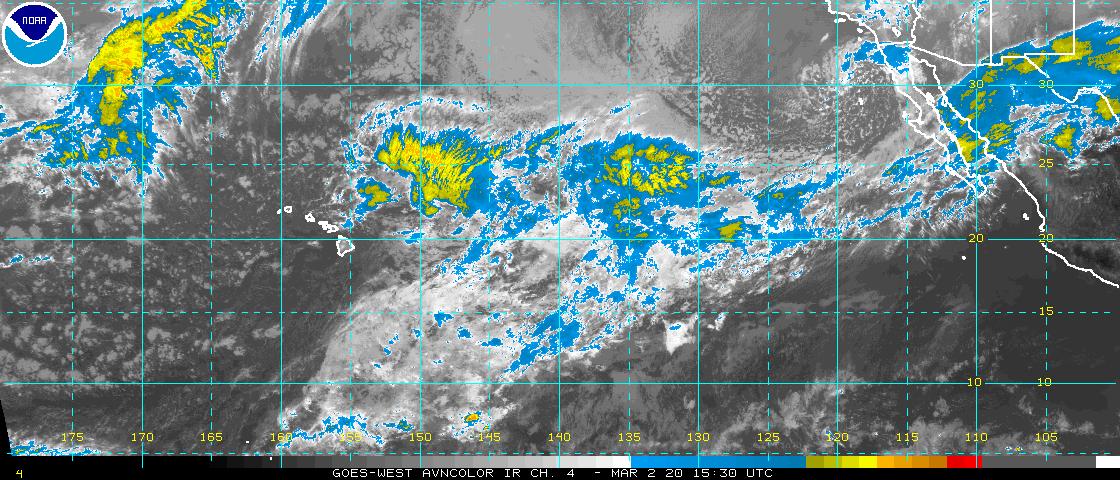
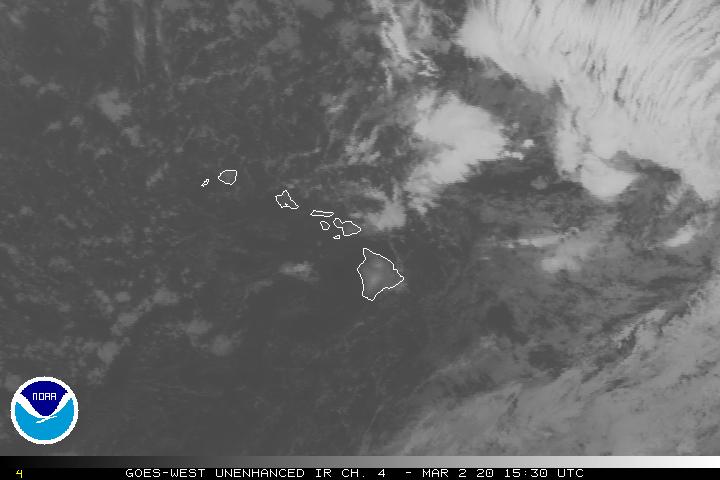
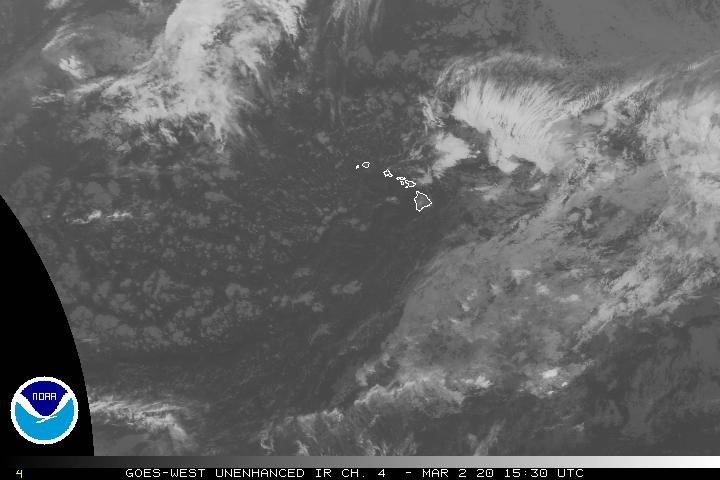
Satellite and Radar Images: To view the cloud conditions we have here in Hawaii, please use the following satellite links, starting off with this Infrared Satellite Image of the islands to see all the clouds around during the day and night. This next image is one that gives close images of the islands only during the daytime hours, and is referred to as a Close-up visible image. This next image shows a larger view of the Pacific…giving perspective to the wider ranging cloud patterns in the Pacific Ocean. Finally, here’s a Looping IR satellite image, making viewable the clouds around the islands 24 hours a day. To help you keep track of where any showers may be around the islands, here’s the latest animated radar image.
Hawaii’s Mountains – Here’s a link to the live webcam on the summit of near 14,000 foot Mauna Kea on the Big Island of Hawaii. The tallest peak on the island of Maui is the Haleakala Crater, which is near 10,000 feet in elevation. These two webcams are available during the daylight hours here in the islands…and when there’s a big moon rising just after sunset for an hour or two! Plus, during the nights and early mornings you will be able to see stars, and the sunrise too…depending upon weather conditions.
Tropical Cyclone activity in the eastern and central Pacific – Here’s the latest weather information coming out of the National Hurricane Center, covering the eastern north Pacific. You can find the latest tropical cyclone information for the central north Pacific (where Hawaii is located) by clicking on this link to the Central Pacific Hurricane Center. Here’s a tracking map covering both the eastern and central Pacific Ocean. A satellite image, which shows the entire ocean area between Hawaii and the Mexican coast…can be found here. Of course, as we know, our hurricane season won’t begin again until June 1st here in the central Pacific.
Aloha Paragraphs

The wild bunch…I have several in my neighborhood
Artist: Marsha Heimbecker
The trade winds will remain moderately strong today, then weaken a bit Wednesday and Thursday…before picking back up some Friday into the weekend. This weather map shows a 1034 millibar high pressure system located to our north-northeast, the source of our trade breezes Tuesday afternoon. This late summer high pressure system will diminish in strength some, and shift to the east a ways. This in turn will prompt somewhat lighter trade winds during the mid-week period…and then increase again towards the end of this work week. The NWS issued small craft wind advisories have been discontinued, in response to the slightly lighter wind speeds.
There don’t appear to be any major changes in regards to our local rainfall…with hardly any minor ones either. As usual, the night and early morning hours will be the favored time for whatever windward biased showers that manage to be carried our way on the trade winds. This satellite image shows hardly any cloud patches heading towards the windward sides this afternoon…a bit more active on
It’s Tuesday
evening as I begin writing this last section of today’s narrative update. The weather remains pleasant on this last day of August, 2010, with the trade winds our primary driving force. The atmosphere remains dry and stable, limiting showers that may be carried our way on the decreasingly strong trade wind flow. Despite all the tropical cyclone activity in the western Pacific, and the Atlantic too, we remain high and dry in regards to storms…just the way we like it here in the north central Pacific! ~~~ Looking out the windows here in Kihei, before I take off for the drive up to Kula, Maui, it’s not totally clear…but almost. The trade winds are blowing out there, which is very common this time of year. This is the time of year when it’s great to visit the islands, especially if you like the heat. Our air temperatures, and sea surface temperatures are nice and warm now. Air temperatures are almost always in the mid to upper 80F’s near the coasts, with an occasional 90 reasonably common in those warmest leeward beaches. Our ocean is ranging between 78 and 80, maybe 81 or even 82 at those warmest beaches as we finish out the summer season, into the early autumn months as well. ~~~ I’ll be back early Wednesday morning with your next new weather narrative, I hope you have a great Tuesday night until then! Aloha for now…Glenn.
Interesting: Scientists at the University of Texas Health Science Center San Antonio are on to something that should bring joy to sunbathers everywhere. Studies show that certain plant substances, administered in combinations, have the ability to suppress skin cancer development in susceptible mice.
"On the basis of our research, supplements and creams or sunscreens may be developed, tested in humans and then used to prevent skin cancer," said Zbigniew Walaszek, Ph.D., research associate professor of pharmacology at the Health Science Center. Natural agents, susceptible mice The plant substances are being tested in SENCAR mice, which because of genetic manipulation are sensitive to skin cancer initiation and promotion/progression.
The natural agents include resveratrol, found in the skin of red grapes, and grape seed extract. Others are calcium D-glucarate, a salt of D-glucaric acid, present in many fruits and vegetables and also the bloodstream, and ellagic acid, found in a host of berries and in walnuts. Because each of these compounds has a unique mechanism of action, giving them in combinations has proven to be the most protective.
The scientists also are combining treatments, administering the agents both topically and in the diet. Study method In one study, the team induced skin cancer by shaving the backs of rodents and applying a chemical that produces a genetic mutation. This was done twice a week for four weeks. At the same time, researchers applied topical resveratrol and fed the mice diets supplemented with various combinations of the plant substances.
The team evaluated several outcomes, including epidermal thickness. An increase in thickness is an indicator of pre-cancerous proliferation of cells in the epidermis, the outer layer of the skin. The researchers also monitored mutations in Ha-ras, an oncogene that is a biomarker of cancer initiation, and inflammation, which is important in tumor promotion.
Promising results even low doses of the plant agent combinations produced protective effects, while the plant substances given individually produced markedly less benefit. "Both the combined agents and the combined treatments work better than single agents or treatments in prevention of skin cancer," Dr. Walaszek said.
Preventing cell transformation His colleague and wife, Margaret Hanausek, Ph.D., research associate professor of pharmacology, said the findings hold great potential for those most at risk for skin cancer and other cancers involving epithelial cells, including lung cancer. "The combined inhibitory effects of different plant chemicals are expected to be particularly beneficial to, for example, smokers, former smokers or individuals whose skin is heavily tanned, who carry thousands of cells already initiated for malignant transformation," Dr. Hanausek said.
"Described combinations may be very useful in the prevention of skin cancer and other epithelial cancers in humans, achieving a high efficacy and potency with reduced side effects," agreed Magdalena Kowalczyk, Ph.D., research scientist. Further directions The team continues to look for the best combinations of the natural agents in suppressing different events during skin cancer development, she said.
The researchers acknowledge that not all information, including effects on organs such as the lungs, can be gleaned from a skin cancer model. But it is an exciting start. "The team’s next step is to go to an ultraviolet B light model of skin cancer initiation and confirm the results," Dr. Walaszek said.
Interesting2: Every year Vancouver resident Stephen Ottridge takes hamburgers or steak to his street’s annual summer block party. This year, against the backdrop of what looks to be the biggest sockeye salmon run in almost a century in the nearby Fraser River, he arrived with a salmon large enough to fill the whole barbecue.
"There is a cornucopia of salmon this year, so we decided to treat the block to some," Ottridge said from the city on Canada’s Pacific Coast, where marine experts are both puzzled and delighted by the unexpected glut of the bright-red, succulent fish.
After years of declining sockeye numbers and a struggling fishing industry, the Pacific Salmon Commission last week said it now expects 25 million sockeye will return to the Fraser River this year — more than double its earlier forecast and the best run since 1913.
Last year, slightly more than a measly 1 million sockeye made their way back to their spawning grounds, prompting the Canadian government to close the river to commercial and recreational sockeye fishing for the third straight year.
The reasons for the salmon bonanza remain a mystery, but what has helped is that it has coincided with a "dominant-run" year, said Carl Walters, a fisheries expert at the University of British Columbia’s zoology department.
"Every fourth year is the dominant year when the biggest run comes in. The year after that is sub-dominant. Then you get two really low runs," Walters told Reuters.
Interesting3: The horseshoe crab is one of the most ancient animals on the planet today. They have survived massive upheavals throughout the Earth’s history and have remained intact and unchanged. Recently their numbers have been in decline, and this is thought to be due to coastal habitat destruction and overharvesting (they are often used as bait or in fertilizer).
However, new research from the US Geological Survey (USGS) indicates that their population size also parallels changes in the climate. With predicted climate change in the future, their numbers may continue to decline. The largest source of horseshoe crab decline remains overharvesting and habitat destruction.
The new research suggests that climate change can play a role in altering the amount of successfully reproducing horseshoe crabs. According to Tim King, scientist with the USGS and lead author of the study, the accompanying sea-level rise and water temperature fluctuations may limit horseshoe crab distribution and interbreeding.
This can lead to localized and regional population declines. This would mirror what occurred after the last ice age as temperatures rose. "Using genetic variation, we determined the trends between past and present population sizes of horseshoe crabs and found that a clear decline in the number of horseshoe crabs has occurred that parallels climate change associated with the end of the last Ice Age," said King.
Significant declines have already been occurring along the entire eastern seaboard of the United States and eastern Gulf of Mexico. Further declines may have a devastating impact on the ecosystems which rely on nutrient-rich horseshoe crab eggs for food each spring. Species that have been affected include migrating seabirds such as the Red Knot, which feeds on the eggs at Delaware Bay during its 10,000 mile annual migration.
Also, the Atlantic loggerhead turtle, which feed on the adult horseshoe crabs of Chesapeake Bay, have been forced to look for less desirable sources of food, affecting their population size. Conservation managers can use the findings from this study to make more well-informed decisions on how to protect horseshoe crabs and other related species. For example, one finding indicated that males moved from one bay to the other, but females remained in one spot.
Since females are more important in order to reproduce, devising local strategies may be more important than regional strategies. "Consequently, harvest limitations on females in populations with low numbers may be a useful management strategy, as well as relocating females from adjacent bays to help restore certain populations," King said.
"Both studies highlight the importance of considering both climatic change and other human-caused factors such as overharvest in understanding the population dynamics of this and other species." The study was published in the journal, Molecular Ecology. It was authored by Tim King, Soren Faurby of Denmark, Matthias Obst of Sweden, and others.
Interesting4: From June 1 through Nov. 30 each year, the coastal United States comes under threat from the ferocious winds and floodwaters of the hurricanes that form in the Atlantic Ocean basin. Five years ago this week, one of the most devastating storms ever to hit U.S. soil, Hurricane Katrina, all but destroyed parts of New Orleans, as the surging ocean waters it pushed to land overtopped the city’s protective levees, inundating a vast region, displacing millions of residents and killing more than 1,800 people.
While Katrina is the most remembered of these swirling storms — its name now infamous — it certainly isn’t alone in causing significant death and destruction to areas of the United States. Following are eight of the most destructive storms in recorded U.S. history from 1900 until present day.
1900: The Galveston Hurricane
This hurricane was the deadliest weather disaster in U.S. history. It occurred before hurricanes and tropical storms were named and so is known instead by the place it hit.
Early on the evening of Sept. 8, 1900, a powerful Category 4 storm, with sustained winds of more than 130 mph, roared ashore at Galveston, Texas.
Storm tides of 8 to 15 feet inundated the whole of Galveston Island, as well as other portions of the nearby Texas coast, according to a National Hurricane Center (NHC) historical account. These tides were largely responsible for the 8,000 deaths (estimates range from 6,000 to 12,000) attributed to the storm. The damage to property was estimated at $30 million.
The lack of weather forecasting and detection technology, such as the satellites and radar now used to track hurricanes, meant that there wasn’t as much warning for Galveston residents as there would be for those in hurricane-prone areas now.
However, warnings were issued by what was then known as the Weather Bureau. The real problem, according to a NOAA analysis: "Many didn’t heed the warnings, preferring instead to watch the huge waves."
1928: San Felipe-Okeechobee Hurricane
This hurricane, the second deadliest in U.S. history, hit near Palm Beach, Fla., on Sept. 16, 1928.
The storm caused extensive destruction. The worst tragedy occurred at inland Lake Okeechobee in Florida, where the hurricane caused a lake surge of 6 to 9 feet that inundated the surrounding area. The lake surge was the main cause of the 1,836 deaths in the area.
No reliable wind readings are available from near the landfall area in Florida. However, Palm Beach reported a minimum barometric pressure of 27.43 inches, making this the fourth strongest hurricane of record to hit the United States. (The lower the barometric pressure at the center of a storm the more intense the winds.)
1935: Florida Keys Labor Day Hurricane
This hurricane, another that preceded the naming of storms, was small but vicious.
The storm formed to the east of the Bahamas on Aug. 29, 1935, became a hurricane on Sept. 1 and then underwent a rapid intensification before it struck the Florida Keys on Sept. 2 as a whopping Category 5 storm, one of only three Category 5 storms to hit the United States in the 20th century.
No wind measurements were made from the core of the storm, but a pressure of 26.35 inches measured at Long Key, Fla., makes this the most intense hurricane of record to hit the United States.
The combination of winds and tides generated by the storm were responsible for 408 deaths in the Florida Keys, primarily among World War I veterans working in the area. Damage in the United States was estimated at $6 million, which would work out to about $95 million in today’s money.
1969: Hurricane Camille
Before the trauma wrought by Katrina, the most memorable hurricane to hit the Gulf coast near Mississippi and Louisiana was probably Hurricane Camille, which struck along the Mississippi coast late on Aug. 17, 1969 as a Category 5 storm.
A minimum pressure of 26.84 inches was reported in Bay St. Louis, Miss., which makes Camille the second most intense hurricane of record to hit the United States. The actual maximum sustained winds will never be known, as the hurricane destroyed all the wind-recording instruments in the landfall area. The estimates at the coast are near 200 mph. Columbia, Miss., located 75 miles inland, reported 120 mph sustained winds.
A storm tide of 24.6 feet occurred at Pass Christian, Miss.
The combination of winds, storm surges and rainfalls caused 256 deaths (143 on the Gulf Coast and 113 died in floods when the storm later passed over Virginia) and $1.421 billion in damage. Until hurricanes Andrew (in 1992) and Katrina, Camille was cited as the largest single act of destruction in U.S. history.
1989: Hurricane Hugo Hurricane
Hugo was one of the worst storms ever to hit the coasts of the Carolinas, making landfall just north of Charleston, S.C., on Sept. 22 as a Category 4 hurricane.
Storm surges from Hugo inundated the South Carolina coast from Charleston to Myrtle Beach, with maximum storm tides of 20 feet observed in the Cape Romain-Bulls Bay area, the highest ever recorded on the East Coast.
A ship moored in the Sampit River in South Carolina measured sustained winds of 120 mph. High winds associated with Hugo extended far inland, with Shaw Air Force Base, South Carolina (about 100 miles or 161 km inland) reporting 67 mph sustained winds with gusts up to 110 mph.
Hugo was responsible for 21 deaths in the mainland United States, five more in Puerto Rico and the U. S. Virgin Islands, and 24 more elsewhere in the Caribbean. Damage estimates are $7 billion in the mainland United States and $1 billion in Puerto Rico and the U.S. Virgin Islands.
1992: Hurricane Andrew
Until Hurricane Katrina, Andrew was the most damaging storm in U.S. history, causing $26.5 billion in damage, 23 deaths in the United States and three more in the Bahamas.
Most of the damage was caused by Andrew’s monstrous winds, which are estimated to have been about 167 mph when it made landfall in Florida on Aug. 24, 1992, making it a Category 5 storm, the highest category on the Saffir-Simpson scale of hurricane strength. (Andrew was initially listed as a Category 4 storm at landfall, but a 2004 paper that re-analyzed the data bumped it up to a 5. Accurate estimates of the storm’s strength were tricky to make, because the storm destroyed so many instruments when it hit.)
In the hardest hit areas of south Florida, Andrew reportedly destroyed 25,524 homes and damaged 101,241 others, according to the NHC. In Homestead, which was virtually obliterated by the storm, more than 99 percent of mobile homes were destroyed.
As bad as Andrew was, the havoc it wreaked could have been much worse if it was not a compact storm and if it had hit slightly higher on Florida’s southeast coast — in this case, Miami and several other more densely populated areas would’ve been hit with unimaginable consequences.
2004: Hurricane Charley
Charley was one of a barrage of hurricanes that hit Florida in 2004.
Charley was headed toward the southwest coast of Florida as a Category 2 storm when it rapidly intensified to a Category 4 storm — winds jumped from 110 mph to 145 mph — in the six hours before it slammed into Florida. Unprepared coastal communities, expecting a mild hurricane, instead experienced widespread destruction.
Charley made landfall with maximum winds near 150 mph on the southwest coast of Florida just north of Captiva Island around 3:45 p.m. ET. An hour later, Charley’s eye passed over Punta Gorda. Both places were devastated by the storm’s ferocious winds. The hurricane then crossed central Florida, passing near Kissimmee and Orlando. Charley was still of hurricane intensity around midnight when its center cleared the northeast coast of Florida near Daytona Beach.
Charley killed 10 people in the United States and caused an estimated $14 billion in damages, making Charley the second costliest hurricane in U.S. history.
Before striking Florida, Charley had already hit Cuba as a Category 3 storm.
2005: Hurricane Katrina
On Aug. 29, 2005, after passing over the Caribbean and Florida, Hurricane Katrina made landfall along the Gulf Coast as a Category 3 hurricane on the Saffir-Simpson scale with winds of 125 mph.
Though it was not as strong as some of the other destructive storms that have hit the coast when it struck, Katrina had been a Category 5 the day before it hit land. That previous strength and its large footprint in the Gulf of Mexico created large swells in the ocean waters, resulting in a huge, unrelenting storm surge when the hurricane finally did hit.
Storm surge flooding of 25 to 28 feet (7.6 to 8.5 m) above normal tide level occurred along portions of the Mississippi coast, with storm surge flooding of 10 to 20 feet (3 to 6.1 m) above normal tide levels along the southeastern Louisiana coast.
Ultimately, this storm surge was responsible for much of the damage as it flooded coastal communities, overwhelmed levees, and left at least 80 percent of New Orleans underwater.
By the time the hurricane subsided, Katrina had claimed more than 1,800 human lives and caused roughly $125 billion in damages. It was the deadliest hurricane to strike the United States since the Palm Beach-Lake Okeechobee hurricane of September 1928.
 Email Glenn James: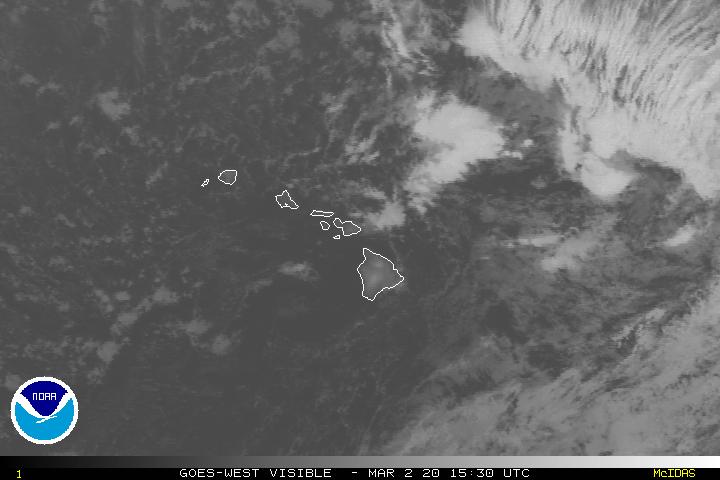


Theodore Bennett Says:
Aloha Glenn!
My friend, Brigitte Cooper, turned me on to your site and I can tell you I will use it regularly. I am growing a farm and there is nothing more interesting than the weather or shall I say rain. I live near South Point; you mention the moisture to the southeast of the islands, but anytime it approaches it seems repelled by the great Mauna Loa. Can you at some future time describe the effect the large mountain has on the moisture systems coming towards it. I bet you have many times; maybe, you could copy/paste!
Mahalo for your fine work! I particularly enjoy the “INTERESTING” and the one on climate change specifically.
Aloha!
Ted~~~Hi Ted, thanks for your positive feedback! Glad to know that I have a new “customer” down there on the Big Island. I’m sure that since you growing plants, the main thing is those few passing showers that happen to come your way, otherwise I’m sure you are irrigating. The good news is that we should be having a wetter than normal winter, and until then, keep your fingers crossed for whatever rainfall you can coax in your direction. Your best bet of course is the windward showers that are deflected your way, thanks to the slope of that big mountain you live near the base of. Aloha, Glenn