











August 30-31, 2010
Air Temperatures – The following maximum temperatures were recorded across the state of Hawaii Monday afternoon:
Lihue, Kauai – 84
Honolulu, Oahu – 89
Kaneohe, Oahu – 84
Kaunakakai, Molokai – 84
Kahului, Maui – 87
Hilo, Hawaii – 83
Kailua-kona – 84
Air Temperatures ranged between these warmest and coolest spots near sea level – and on the highest mountain tops…as of 5pm Monday evening:
Barking Sands, Kauai – 84
Hilo, Hawaii – 77
Haleakala Crater – 55 (near 10,000 feet on Maui)
Mauna Kea summit – 43 (near 14,000 feet on the Big Island)
Precipitation Totals – The following numbers represent the largest precipitation totals (inches) during the last 24 hours on each of the major islands, as of Monday afternoon:
0.31 Mount Waialeale, Kauai
0.05 Kunia Substation, Oahu
0.00 Molokai
0.00 Lanai
0.00 Kahoolawe
0.08 West Wailuaiki, Maui
1.42 Kawainui Stream, Big Island
Marine Winds – Here’s the latest (automatically updated) weather map showing a large 1035 millibar high pressure system located to the north of the islands. Our local trade winds will remain active Tuesday and Wednesday.
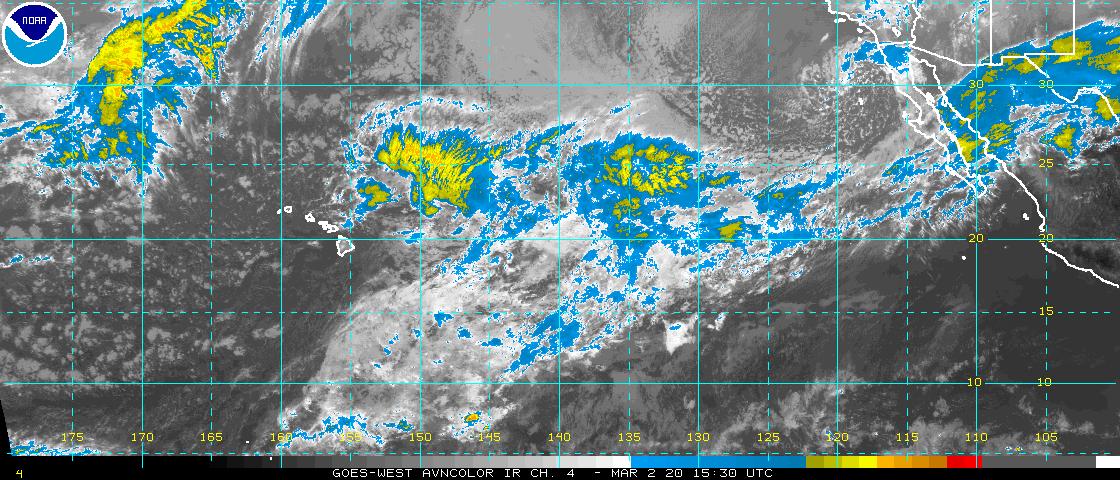
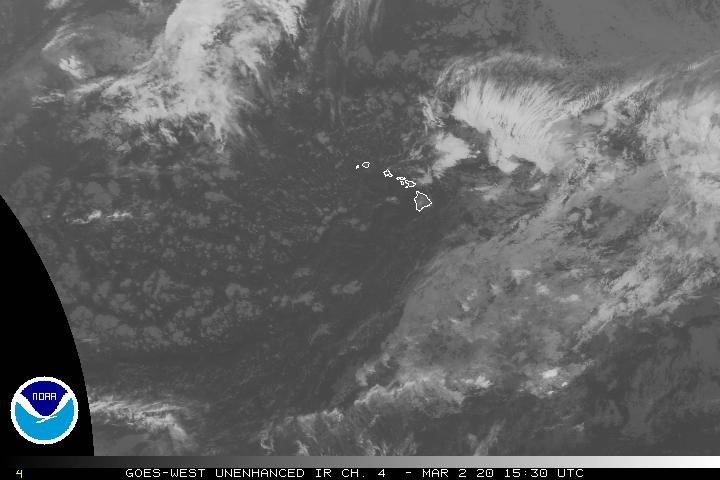
Satellite and Radar Images: To view the cloud conditions we have here in Hawaii, please use the following satellite links, starting off with this Infrared Satellite Image of the islands to see all the clouds around during the day and night. This next image is one that gives close images of the islands only during the daytime hours, and is referred to as a Close-up visible image. This next image shows a larger view of the Pacific…giving perspective to the wider ranging cloud patterns in the Pacific Ocean. Finally, here’s a Looping IR satellite image, making viewable the clouds around the islands 24 hours a day. To help you keep track of where any showers may be around the islands, here’s the latest animated radar image.
Hawaii’s Mountains – Here’s a link to the live webcam on the summit of near 14,000 foot Mauna Kea on the Big Island of Hawaii. The tallest peak on the island of Maui is the Haleakala Crater, which is near 10,000 feet in elevation. These two webcams are available during the daylight hours here in the islands…and when there’s a big moon rising just after sunset for an hour or two! Plus, during the nights and early mornings you will be able to see stars, and the sunrise too…depending upon weather conditions.
Tropical Cyclone activity in the eastern and central Pacific – Here’s the latest weather information coming out of the National Hurricane Center, covering the eastern north Pacific. You can find the latest tropical cyclone information for the central north Pacific (where Hawaii is located) by clicking on this link to the Central Pacific Hurricane Center. Here’s a tracking map covering both the eastern and central Pacific Ocean. A satellite image, which shows the entire ocean area between Hawaii and the Mexican coast…can be found here. Of course, as we know, our hurricane season won’t begin again until June 1st here in the central Pacific.
Aloha Paragraphs

Beautiful east Hilo…on the Big Island
The trade winds will remain moderately strong today, weaken a bit Tuesday into Thursday…then pick back up a little Friday into the weekend. This weather map shows a 1035 millibar high pressure system located to our north, the source of our trade breezes Monday night. This late summer high pressure system will start to diminish in strength soon, prompting lighter trade winds during the Tuesday through Thursday time period…and then increase again towards the end of this new week.
The overlying atmosphere remains fairly stable, limiting showers for the most part…although the windward sides will still end up receiving a few. As usual, the night and early morning hours will be the favored time for these windward biased showers. This satellite image shows hardly any cloud patches heading towards the windward sides tonight…although a few may arrive on the Big Island and Kauai. This looping radar image demonstrates that our air mass is quite dry, and not very shower prone. Glancing down further to the south of the islands, in the deeper tropics, using this satellite picture, we see areas of thunderstorms to the south and southeast. We should probably keep an eye on the area to the southeast…this week.
It’s Monday
evening I begin writing this last section of today’s narrative update. The weather conditions here in the islands remain good, with hardly any showers within striking distance, and a downward trend in trade wind speeds too. I don’t see anything otherwise, that would interrupt this favorably inclined late summer weather pattern. We’ll soon be experiencing the beginning of September, which keeps us still in the heart of summer hurricane season. Speaking of which, we have three active storms in the western part of the Pacific Ocean, one that may soon be starting in the eastern Pacific, and two storms in the Atlantic now. Active everywhere except here in the Central Pacific for the time being. The GFS computer model is trying to get something going far to the southeast of our islands, although this is of no immediate concern. ~~~ Here in Kihei, Maui, as I get ready to head back upcountry to Kula, it’s clear to partly cloudy…and the trade winds are still pretty active. It’s been a good start to the week, and I’ll be back early Tuesday morning with your next new weather narrative from paradise. I hope you have a great Monday night, and can check back in soon! Aloha for now…Glenn.
Interesting: The fear that global temperature can change very quickly and cause dramatic climate changes that may have a disastrous impact on many countries and populations is great around the world. But what causes climate change and is it possible to predict future climate change? New research from the Niels Bohr Institute at the University of Copenhagen shows that it may be due to an accumulation of different chaotic influences and as a result would be difficult to predict.
The results have just been published in Geophysical Research Letters. For millions of years the Earth’s climate has alternated between about 100,000 years of ice age and approximately 10-15,000 years of a warm climate like we have today. The climate change is controlled by the Earth’s orbit in space, that is to say the Earth’s tilt and distance from the sun. But there are also other climatic shifts in the Earth’s history and what caused those?
Dramatic climate change of the past By analyzing the ice cores that are drilled through the more than three kilometer thick ice sheet in Greenland, scientists can obtain information about the temperature and climate going back around 140,000 years. The most pronounced climate shifts besides the end of the ice age is a series of climate changes during the ice age where the temperature suddenly rose 10-15 degrees in less than 10 years.
The climate change lasted perhaps 1000 years, then — bang — the temperature fell drastically and the climate changed again. This happened several times during the ice age and these climate shifts are called the Dansgaard-Oeschger events after the researchers who discovered and described them. Such a sudden, dramatic shift in climate from one state to another is called a tipping point.
However, the cause of the rapid climate change is not known and researchers have been unable to reproduce them in modern climate models. The climate in the balance "We have made a theoretical modeling of two different scenarios that might trigger climate change. We wanted to investigate if it could be determined whether there was an external factor which caused the climate change or whether the shift was due to an accumulation of small, chaotic fluctuations," explains Peter Ditlevsen, a climate researcher at the Niels Bohr Institute.
He explains that in one scenario the climate is like a seesaw that has tipped to one side. If sufficient weight is placed on the other side the seesaw will tip — the climate will change from one state to another. This could be, for example, an increase in the atmospheric content of CO2 triggering a shift in the climate. In the second scenario the climate is like a ball in a trench, which represents one climate state. The ball will be continuously pushed by chaos-dynamical fluctuations such as storms, heat waves,
heavy rainfall and the melting of ice sheets, which affect ocean currents and so on. The turmoil in the climate system may finally push the ball over into the other trench, which represents a different climate state. Peter Ditlevsen’s research shows that you can actually distinguish between the two scenarios and it was the chaos-dynamical fluctuations that were the triggering cause of the dramatic climate changes during the ice age. This means that they are very difficult to predict.
Warm future climate But what about today — what can happen to the climate of the future? "Today we have a different situation than during the ice age. The Earth has not had such a high CO2 content in the atmosphere since more than 15 million years ago, when the climate was very warm and alligators lived in England. So we have already started tilting the seesaw and at the same time the ball is perhaps getting kicked more and could jump over into the other trench.
This could mean that the climate might not just slowly gets warmer over the next 1000 years, but that major climate changes theoretically could happen within a few decades," estimates Peter Ditlevsen, but stresses that his research only deals with investigating the climate of the past and not predictions of the future climate.
Interesting2: There are a lot of things that can go into the ground water. The key is whether what goes in will readily biodegrade and if not can it harm you or the environment. In the first large study to track the fate of a wide range of antibiotics given to dairy cows, University of California (UC) Davis scientists found that the drugs routinely end up on the ground and in manure lagoons, but are mostly broken down before they reach groundwater.
Note that antibiotics are given to sick cows who are isolated from the regular milking herd until the antibiotic is absent from their system. Dairy cows may be found either in herds on dairy farms where dairy farmers own, manage, care for, and collect milk from them, or on commercial farms. Dairy cow herds range in size from small farms of fewer than five cows to large herds of about 20,000 with the average dairy farm having a few hundred.
Cows get sick just like any other animal or human. Sick cows are no good for milk production and it is not right to let them suffer either. So these cows will be treated with antibiotics. Health officials are worried that even if the sick cow is not producing milk for production, that the antibiotic will be released to the environment in urine or feces. When this happens, it may be transferred to the ground water and be ingested by others in their drinking water.
The antibiotic, if ingested in this way, may cause increased antibiotic resistance in disease causing bacteria. “What we found is that antibiotics can frequently be found at the manure affected surfaces of the dairy operation (such as corrals and manure flush lanes) but generally degrade in the top 12 inches of soil," said Thomas Harter, an expert on the effects of agriculture on groundwater quality and the Robert M. Hagan Chair for Water Management and Policy at UC Davis.
"A very small amount of certain antibiotics do travel into shallow groundwater. Our next task is to determine whether these particular antibiotics are further degraded before reaching domestic and public water wells." Antibiotics are commonly used in food animal production to treat illness, promote growth, and ward off disease. These drugs and their metabolites appear in animal wastes and can eventually enter ground and surface waters following the common practice of applying manure to agricultural fields.
Given that low levels of antibiotics can promote the development of microbial drug resistance, their presence in ground and surface waters constitutes an environmental health concern. This study provides the first comprehensive data set to assess and compare potential local impacts to groundwater from the wide variety of antibiotics in use on dairy farms.
The new UC Davis study looked at two large operations in the San Joaquin Valley, in a region with highly vulnerable groundwater due to its shallow depth and sandy soils. The two dairies had a total of more than 2,700 milking cows and 2,500 heifers.
Soil and water samples were collected from the ground surface under the animals; surfaces such as flush lanes, which carry waste; manure lagoons, where feces and urine are collected; farm fields where lagoon contents were spread for fertilizer; the first 12 inches of soil immediately below the surface of various sections in the dairy operation; and from groundwater 10 to 30 feet beneath the animal areas, adjacent to the lagoons, and beneath the manured fields.
Interesting3: An Indonesian volcano, inactive for four centuries, erupted again on Monday, pitching ash 1.5 miles into the air and sending nearby residents scurrying from their homes. Villages were emptying fast near Mount Sinabung on the north of Sumatra island, leaving behind only officials from the bureau of meteorology and the police. Short-haul flights skirting the volcano were delayed. Surono, head of Indonesia’s vulcanology center, told Reuters Monday’s eruption was more powerful than the first a day earlier.
"Earlier today was another eruption at 6.30 a.m., sending out smoke as high as two km, more or less," he told Reuters. A Reuters photographer said he saw plumes of smoke rising from the 2,460-meter volcano after the second eruption. Inactive since 1600, it had been rumbling for several days. "I saw some hot pieces of volcanic rock come out and burn trees in the area," he said. A smell of sulphur pervaded the air as residents moved out of their homes to temporary shelters.
Indonesia is on the so-called Pacific Rim of Fire, an arc of volcanoes and geological fault lines triggering frequent earthquakes around the Pacific Basin. The eruption triggered the highest red volcano alert. About 21,000 people had been evacuated from largely farming areas. Many fled to Medan, 30 miles, Indonesia’s third-largest city, northeast of the volcano. Officials said much of the movement was unnecessary.
"People have been evacuated from areas within a four-mile radius of the volcano," vulcanologist Surono said. "Beyond six km it is safe, but there has still been a lot of panic among people here who don’t understand that." He said it was impossible to know when the eruptions would stop, but it was unlikely volcanic dust would drift to neighboring countries.
"Here, it is 1/8 of an inch thick on the leaves of plants," he said. "It has the potential to damage people’s respiratory tracts, but in my lifetime of studying volcanoes I have never heard of anyone dying from inhaling volcanic ash."
Interesting4: Ever since the banning of the pesticide DDT, which weakened eggshells, bald eagles have been making a comeback in the Great Lakes region. In Michigan, however, that recovery has been lackluster, and researchers have found one potential reason why: flame retardants and pesticides in the blood of eagle nestlings. "(Eagles) have recovered mostly, but not to what was expected," said Marta Venier of Indiana University.
Venier is the lead author of a paper in the August issue of the journal Chemosphere, which describes a "snapshot" of what is in eagle nestlings’ blood in near lakes around Michigan. Venier and her colleagues were able to collect blood samples of bald eagle nestlings in the Great Lakes region by arduously climbing trees, bagging the large nestlings and carrying them carefully to the ground to draw a small sample of blood.
The birds were then returned to their nests angry, but unharmed. Tests on the blood show that the national symbol of the United States is ingesting flame retardants and pesticides via its food. The chemicals are originally from pesticides or foam padding for furniture and mattresses, which contain a variety of flame retardants.
Interesting5: China’s decision to slash export quotas of rare earth elements was a necessary step to protect the country’s environment, commerce minister Chen Deming said following criticism from Japanese officials. "Mass extraction of rare earth will cause great damage to the environment and that’s why China has tightened controls over rare earth production, exploration and trade," Chen was quoted by state news agency Xinhua as saying on Saturday.
China issued export quotas for 30,258 metric tones by the end of July, down 40 percent compared to last year, following a nationwide campaign to consolidate the sector and clamp down on illegal production. China has been steadily reducing export quotas since 2005 for rare earth elements, which consist of 17 metals used in crucial new green technologies like hybrid cars, wind turbines and superconductors, as well as in missile guidance systems and mobile phones.
Overseas buyers have expressed concern about China’s policies to restrict rare earth exports, which have driven up global prices, but Chen said China had no choice and its own market would also suffer as a consequence. Rare earths are in increasingly short supply as world demand surges, with industry officials predicting a global shortfall of 30,000 to 50,000 metric tones by 2012.
 Email Glenn James: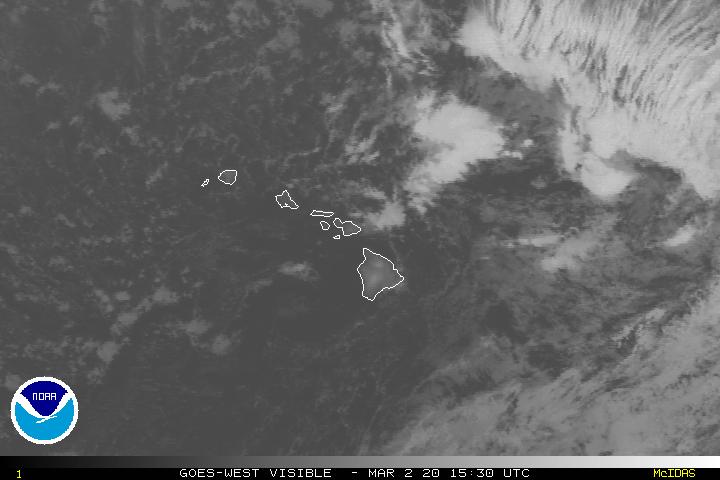



Robert Kay Says:
Aloha Glenn,
As a resident of Maui for the past 30 yrs, I was wondering if the past 4-5 yrs. have been exceptionally dry during the winter seasons? What are the forecasts or predictions, if any, for this coming winter? I am a weather buff myself and very curious why we don’t see the rains that we used to!..Any input would be appreciated. Keep up the great work Glenn, It’s good to know you are out there. Miss your show -by the way. Mahalo!-Rob. ~~~Hi Rob, good to hear from you, being here so long and all. It has been dry to very dry overall, the last several years. We may be in luck this winter, as we move into a La Nina weather phase. This usually manifests as a rainier than normal winter season. If this were to actually happen, it could rid us of the long lasting drought conditions. We would see more than the normal of rainy cold fronts coming our way, so as we move into October and November, through the upcoming winter, that will be what we’re looking for. Thanks for your note, and be well Rob. Aloha, Glenn
Noel Says:
Glenn, regarding the wonderful photographs posted on your site daily, are you a photography buff and are they your shots? If not, what source do you use? They are wonderful either way. Mahalo. Noel~~~Hi Noel, I wish I had the time to be into photography, although I’m not at this stage in my career. It’s all weather, weather, weather…so I just search on the internet for cool photo’s. I’m glad that you like my picks! Aloha, Glenn