August 3-4, 2010
Air Temperatures – The following maximum temperatures were recorded across the state of Hawaii Tuesday afternoon:
Lihue, Kauai – 83
Honolulu, Oahu – 85
Kaneohe, Oahu – 82
Kaunakakai, Molokai – 82
Kahului, Maui – 88
Hilo, Hawaii – 82
Kailua-kona – 85
Air Temperatures ranged between these warmest and coolest spots near sea level – and on the highest mountain tops too…as of 4pm Tuesday afternoon:
Barking Sands, Kauai – 87
Molokai airport – 73
Haleakala Crater – 52 (near 10,000 feet on Maui)
Mauna Kea summit – 46 (near 14,000 feet on the Big Island)
Precipitation Totals – The following numbers represent the largest precipitation totals (inches) during the last 24 hours on each of the major islands, as of Tuesday afternoon:
1.80 Mount Waialeale, Kauai
1.43 Manoa Valley, Oahu
0.25 Molokai
0.00 Lanai
0.09 Kahoolawe
3.84 Puu Kukui, Maui
1.76 Kealakekua, Big Island
Marine Winds – Here’s the latest (automatically updated) weather map showing high pressure systems to the northwest through north-northeast of the islands. Our local trade winds will remain active Wednesday and Thursday.
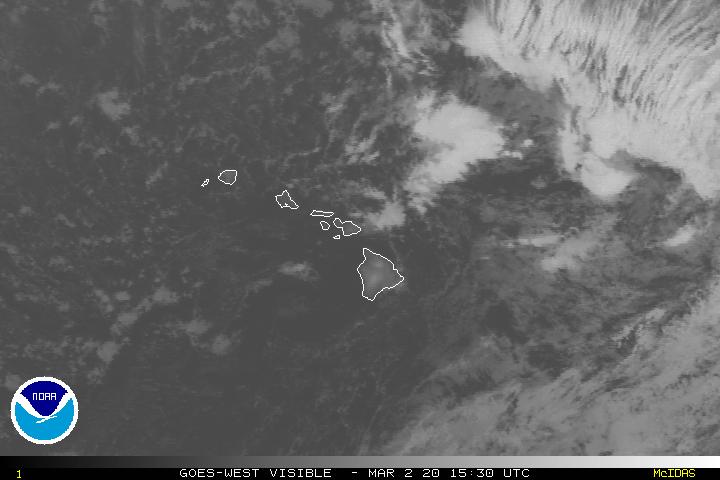
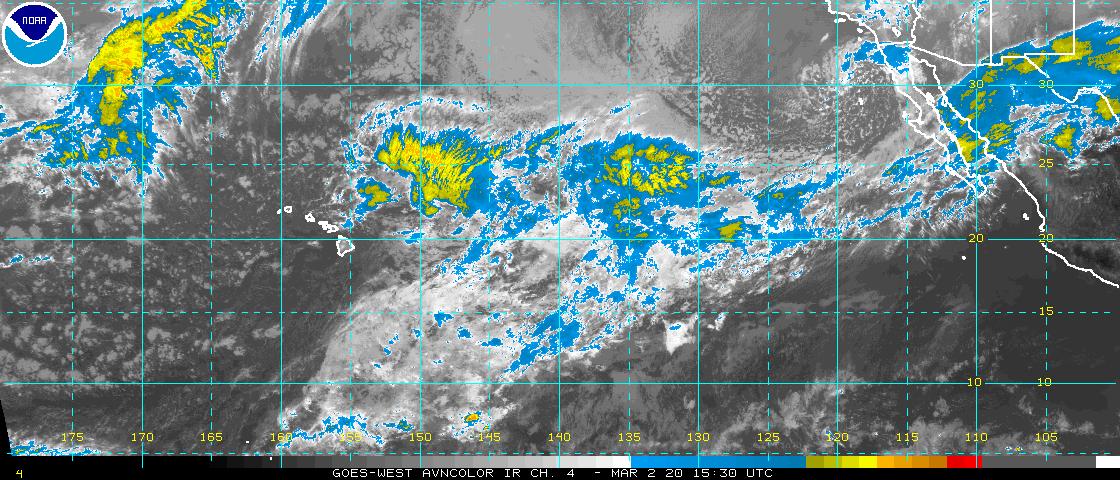
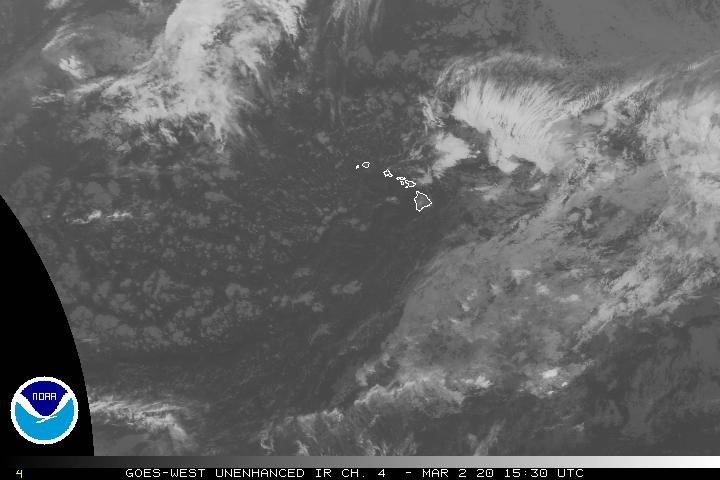
Satellite and Radar Images: To view the cloud conditions we have here in Hawaii, please use the following satellite links, starting off with this Infrared Satellite Image of the islands to see all the clouds around during the day and night. This next image is one that gives close images of the islands only during the daytime hours, and is referred to as a Close-up visible image. This next image shows a larger view of the Pacific…giving perspective to the wider ranging cloud patterns in the Pacific Ocean. Finally, here’s a Looping IR satellite image, making viewable the clouds around the islands 24 hours a day. To help you keep track of where any showers may be around the islands, here’s the latest animated radar image.
Hawaii’s Mountains – Here’s a link to the live webcam on the summit of near 14,000 foot Mauna Kea on the Big Island of Hawaii. The tallest peak on the island of Maui is the Haleakala Crater, which is near 10,000 feet in elevation. These two webcams are available during the daylight hours here in the islands…and when there’s a big moon rising just after sunset for an hour or two! Plus, during the nights and early mornings you will be able to see stars, and the sunrise too…depending upon weather conditions.
Tropical Cyclone activity in the eastern and central Pacific – Here’s the latest weather information coming out of the National Hurricane Center, covering the eastern north Pacific. You can find the latest tropical cyclone information for the central north Pacific (where Hawaii is located) by clicking on this link to the Central Pacific Hurricane Center. Here’s a tracking map covering both the eastern and central Pacific Ocean. A satellite image, which shows the entire ocean area between Hawaii and the Mexican coast…can be found here. Of course, as we know, our hurricane season won’t begin again until June 1st here in the central Pacific.
Aloha Paragraphs

Old Hula dancing postcard
The trade winds continue to blow across our tropical latitudes of the central north Pacific. The winds turned out to be a little lighter today than they were the last couple of days, although strong enough to be keeping the small craft wind advisory flags waving in all the major channels…plus a couple of the windiest spots on Maui and the Big Island. This weather map shows lots of moderately strong high pressure systems positioned to our northwest through northeast. At the same time, referring to that same weather chart, we see the elongated trough of low pressure down in the deeper tropics to our south…that candy cane looking feature. A basic meteorological fact is that high pressure moves towards low pressure, so the pressure gradient force between the blue high’s to our north, and the red low pressure zone to our south…is the driving mechanism for our gusty trade wind flow. The computer forecast models don’t show any significant slow down in our trade wind speeds through the rest of this week, into next week. There will be some variations on a daily basis, but no stopping or overly strong trade winds are expected.
The overlying atmosphere remains a bit on the unstable side, with somewhat more than the ordinary amount of showers arriving along our windward slopes locally. The cold air, at least in terms of summer, aloft over the islands, associated with a trough of low pressure…is prompting these heavier localized showers. A very good example of one of these downpours is the 3.84” of water that has fallen over Puu Kukui, near the summit of the
It’s Tuesday evening as I begin writing this last section of today’s narrative update. As noted above, our trade winds remain quite breezy this week, with no end in sight to our gusty weather. To get an idea how strong the trade winds are near sea level, in gusts…these were the highest as of late-day Tuesday, on each of the islands:
Kauai – 33 mph
Oahu – 38
Molokai – 30
Kahoolawe – 35
Lanai – 17
Maui – 44
Big Island – 42
~~~ The numbers above suggest that our trade winds are definitely still blowing, locally strong in gusts on Maui and the Big Island. Showers will remain somewhat more active than normal too, and will remain that way along our windward sides into Wednesday. We’d like to see some of this precipitation carry over into those dry leeward areas, which could happen on the smaller islands here and there.
~~~ Speaking of the leeward sides, we have larger than normal surf breaking along those south and west facing beaches now. This swell train of waves was generated down in the southern hemisphere, where it is winter now. The responsible storm generated this swell last week, and it has taken that long to travel the distance between here and there. In response, the NWS office in Honolulu is keeping a high surf advisory in force, which means that there will be waves large enough to require caution when entering the ocean. This swell activity will be locally on the large side through Wednesday, and then gradually lower in size thereafter into Friday.
~~~ That same area of disturbed weather is back with again this evening…located about 800 miles southeast of the Big Island. This satellite image shows it well, with those cirrus clouds being blown off the tops of the thunderstorms. This is a good indicator, meaning that the disturbance is in an unfavorable location to develop into something. The NWS office in Honolulu is giving it a 10% chance of developing into a tropical depression. This satellite image, shows this area of thunderstorms circled in yellow.
~~~ Here in Kihei, Maui, before taking the drive back home to Kula, it’s clear to partly cloudy from this vantage point. It’s considerably less cloudy this evening, compared to Monday evening at this time. The trade winds are still blowing, although nothing out of the ordinary at this location. Maui’s an interesting island to live on, considering today for instance…Kahului had a high temperature of 88F degrees, the hottest in the state. At the same time, it had the most rain statewide, 3.84" atop the West Maui Mountains. Then, the strongest wind gust of the day anywhere in the state as well, with a top gust of 44 mph. These outstanding weather features make for an interesting place to live! I’ll be back early Wednesday morning with your next new weather narrative from paradise. I hope you have a great Tuesday night until then! Aloha for now…Glenn.
Interesting: Bad news, Miami. Of all Florida’s major population centers, the city is the most vulnerable to strong hurricane winds, according to Florida State University researchers who developed a new tool to estimate the frequency of extreme hurricane winds at a particular location. Geography doctoral student Jill C. Malmstadt, working with Professor James B. Elsner and research consultant Thomas H. Jagger, created the Hurricane Risk Calculator and used it to estimate the risk to 12 cities in Florida.
The findings are outlined in "Risk of Strong Hurricane Winds to Florida Cities," to be published in the November issue of the American Meteorological Society’s Journal of Applied Meteorology and Climatology. "Not unexpectedly, we found that the extreme wind risk from hurricanes varies across the state," Malmstadt said.
"Areas in the northeast, such as Jacksonville and in the Big Bend between Tampa and Tallahassee, have longer periods between occurrences of a given strong wind speed compared to areas such as Miami and Pensacola. That’s also where we found the highest annual threats of a catastrophic hurricane event."
Using the Hurricane Risk Calculator, the researchers found that Miami can expect to see winds of 112 mph or stronger — that’s a category 3 hurricane — once every 12 years on average. Miami last saw winds of that strength with Hurricane Wilma in 2005. By contrast, Tallahassee, the state’s least vulnerable city, can expect to see winds of that speed only once every 500 years.
The Hurricane Risk Calculator is a statistical model based on extreme value theory — a theory that is used to estimate the occurrence of the rare and extreme events like hurricanes Andrew and Katrina, Malmstadt said. Researchers applied the theory to wind speed data derived from the National Hurricane Center’s Hurricane Database, which is the official record of tropical cyclones for the Atlantic Ocean, Gulf of Mexico and Caribbean Sea dating back to 1851.
"This method is unique because it uses extreme value distributions that allow us to better estimate extreme events," Malmstadt said. "Other approaches use various distributions that work incredibly well when trying to estimate the average event, like category 1 or 2 hurricanes. They may be underestimating or overestimating the extremes even if they are right on with the average."
The Hurricane Risk Calculator can provide important information to emergency planners, the insurance industry and homeowners, Malmstadt said, noting that the state of Florida especially has experienced more than $450 billion in damages from hurricanes since the early 20th century.
"Hurricanes top the list of the most destructive and costly natural disasters in the United States," she said. "For society to better cope with and mitigate these disasters, a more precise estimate of the risk of high winds on the local level is needed. The Hurricane Risk Calculator does that."
Florida is particularly vulnerable to hurricanes because warm seas surround the state, but some locations are even more vulnerable than others. Along with Miami, its South Florida neighbors Port St. Lucie, Key West and Cape Coral are the cities with the highest wind strength and shortest return periods.
Gulf Coast cities Pensacola and Panama City are no strangers to strong hurricane winds, although their locations in the western Panhandle mean they are protected somewhat by the Florida peninsula itself from winds coming from the southeast. Still, Pensacola can expect to see a hurricane with 112 mph winds once every 24 years, according to Malmstadt.
The cities of Orlando, Tampa and Jacksonville join Tallahassee as the cities with the least vulnerability. Still, Malmstadt cautioned that "people who live anywhere in Florida could receive a hurricane threat, so they should always be ready and prepared for one of the extremes."
The researchers also used the data that went into the Hurricane Risk Calculator to determine whether the wind risk from hurricanes is changing over time. Although they found that the frequency of hurricanes and major hurricanes is constant throughout time, there is an upward trend in the intensity of the strongest hurricanes in Florida.
Intensification refers to the amount of increase in maximum wind speeds between hourly observations of a given hurricane. "The strongest hurricanes appear to be getting stronger," Malmstadt said. "This is consistent with the increasing ocean heat content noted over the Gulf of Mexico and the western Caribbean."
However, the greater intensification rates do not necessarily mean that hurricanes are more intense at the point of landfall, she said, adding that additional study is needed to make that determination.
Interesting2: New research from the University of Sheffield has discovered that the deep open ocean, by far the largest habitat for life on Earth, is currently the most under-explored area of the sea, and the one we know least about. The research, published in the journal PLoS ONE, has mapped the distribution of marine species records and found that most of our knowledge of marine biodiversity comes from the shallow waters or the ocean floor, rather than the deep pelagic ocean- the water column deeper than the sunlit surface waters but above the sea bed.
This area is home to uncounted animals which never experience a hard surface, including megamouth sharks, giant squid, and a myriad of smaller species of gelatinous animals and other planktonic organisms. The research was led by Dr Tom Webb, a Royal Society Research Fellow and marine ecologist from the University’s Department of Animal and Plant Sciences, in conjunction with the Ocean Biogeographic Information System (OBIS) secretariat at Rutgers University, and the Consortium for Ocean Leadership in the USA.
The team used data from OBIS, which collates all available information on geographical distributions of marine life, to plot the position in the water of seven million records of marine species. They combined this data with a separate dataset of the bottom surface of the ocean, and then attributed each separate record to a position in the ocean, to enable them to provide a global analysis of the depth distribution of recorded marine biodiversity.
The almost limitless deep waters of the sea have been largely under explored due to a long-held belief, first expressed by Charles Wyville Thomson, leader of the challenger Expedition in the 1870s, which effectively launched the discipline of deep sea biology. He believed that life in the deep water was confined primarily to a belt at the surface and one near the sea bed, and believed the area in the middle to be almost completely without larger animals.
More recent sampling, employing new techniques, has revealed that this is not the case, and the deep pelagic is actually teeming with life. The global picture provided by this new study has led to calls for increased exploration of the Earth’s last frontier of biodiversity research. Dr Tom Webb said: "It’s shocking that in 2010, the International Year of Biodiversity, the largest habitat on Earth remains virtually unexplored.
On a more positive note, being able to highlight gaps in our knowledge is an important step towards filling them, and our analysis — the first at a global scale — was possible because of the commitment in the marine biodiversity research community to sharing data through initiatives like OBIS." Dr Ron O’Dor, Senior Scientist with the Census of Marine Life, said: "The Census of Marine Life has invested more than $650M in exploring all of the global ocean realms in the last decade, but we have barely made a dent in this one.
One project has provided a look at everything that lives in the water column in the Charlie-Gibbs Fracture Zone in the northern Mid-Atlantic Ridge — just a single piece of a giant puzzle. "Another project collected plankton with a giant net and doubled the amount of sampling in a single cruise in the North Atlantic. Now we know how to do this, but just need commitment to continue our exploration for the rest of the planet."
‘Bridging’, an unusual mode of getting around frequently used by vegetation-inhabiting spiders to cross large gaps, may partly explain the tendency for male spiders to be much smaller than females. Researchers writing in the open access journal BMC Evolutionary Biology studied bridging, in which spiders use the wind to carry a strand of web to their destination and then clamber upside down along the resulting bridge, finding that small size was associated with a greater ability to carry out the maneuver.
Guadalupe Corcobado, from the Spanish National Research Council, worked with a team of researchers led by Jordi Moya-Laraño to investigate the spiders’ behavior in a laboratory wind tunnel. She said, "In species where bridging is a very common mode of locomotion, small males, by being more efficient bridgers, will enjoy more mating opportunities and thus will be better at competition to reach receptive females. This may lead to a selective pressure for smaller size."
The researchers investigated 204 spiders from 13 different species. They suggest that females do not feel the same pressure to be smaller as, for them, a larger body size confers and advantage in generating offspring. Corcobado emphasises that this ‘bridging’ theory to explain size differences between the sexes is not incompatible with other hypotheses. She said, "Previous studies have suggested that female fecundity was the main driver of extreme male and female size differences.
However, fecundity alone could not explain why males may grow as large as giant females in some species but remain extremely small in others. A selective pressure against large male body size has been searched for by researchers since Darwin; the constraint on bridging seems to be such a selective pressure."
Interesting3: Next to Antarctica, Greenland is home to the largest ice sheet on Earth. Scientists in the frigid north of this enormous island have achieved quite an accomplishment by drilling all the way to the bedrock under the ice. On Tuesday, July 27, 2010 at the North Greenland Eemian Ice Drilling site (NEEM), the team completed their drilling to a depth of 1.58 miles.
The Eemian is an interglacial period, 115,000 to 130,000 years ago, when global temperatures were 3-5F degrees higher than they are today. Sea levels were five meters higher, but ice still existed on Greenland. The researchers believe this may useful for predictions of future climates.
The NEEM project has involved over 300 ice core scientists from 14 nations including Belgium, Canada, China, Denmark, France, Germany, Iceland, Japan, Korea, The Netherlands, Switzerland, Sweden, the United Kingdom of Great Britain, and the United States of America.
It was headed by Project Leader Dorthe Dahl-Jensen, Professor at the Niels Bohr Institute at the University of Copenhagen. The project took over five years to complete. The team has brought up ice near the bedrock that has not seen the light of day for hundreds of thousands of years.
Clues such as DNA or pollen embedded in the ice can give the researchers an idea of what existed on Greenland before it became covered by ice over three million years ago. Dr. Eric Wolff of the British Antarctic Survey said "It is a tremendous achievement to have collected ice right down to the rock, 2.5 km below the ice surface.
This core should really help us to understand how the Arctic ice responded in the past at a time when it was warmer than today." Such a tremendously long core is like having a book of the history of the world. The trick is learning how to read it. For example, variations in climate can be detected by a host of high-tech equipment that can analyze a number of factors.
The stable water isotopes found within the core can indicate moisture sources going back in time. Greenhouse gases trapped in the ice can be read by state of the art laser instruments. Also, biological content can be analyzed to determine what life existed there and at what point in time, as well as their annual variability.
Other impressive tools used for analysis include online impurity measurements and advanced studies of ice crystals. The purpose of the study was to gather more information on the warmer Eemian interglacial climate and use that to help predict the warming climate in Earth’s future.
The team hopes to figure out how reduced the Greenland ice sheet was during that period and how much its melting contributed to sea level rise. Climate science is perhaps the most complicated of all sciences due to the myriad of factors involved. The work done by the NEEM team will help bring us one step closer towards a more accurate model to be used by todays and future generations.
 Email Glenn James: