August 26-27, 2010
Air Temperatures – The following maximum temperatures were recorded across the state of Hawaii Thursday afternoon:
Lihue, Kauai – 84
Honolulu, Oahu – 87
Kaneohe, Oahu – 82
Kaunakakai, Molokai – 85
Kahului, Maui – 85
Hilo, Hawaii – 85
Kailua-kona – 85
Air Temperatures ranged between these warmest and coolest spots near sea level – and on the highest mountain tops…as of 4pm Thursday afternoon:
Barking Sands, Kauai – 86
Kapalua, Maui – 77
Haleakala Crater – 54 (near 10,000 feet on Maui)
Mauna Kea summit – 48 (near 14,000 feet on the Big Island)
Precipitation Totals – The following numbers represent the largest precipitation totals (inches) during the last 24 hours on each of the major islands, as of Thursday afternoon:
1.08 Mount Waialeale, Kauai
0.87 Oahu Forest NWR, Oahu
0.09 Molokai
0.00 Lanai
0.00 Kahoolawe
0.33 West Wailuaiki, Maui
0.03 Pahoa, Big Island
Marine Winds – Here’s the latest (automatically updated) weather map showing a large 1034 millibar high pressure system located far to the north of the islands. Our local trade winds will remain active Friday and Saturday…gradual strengthening.
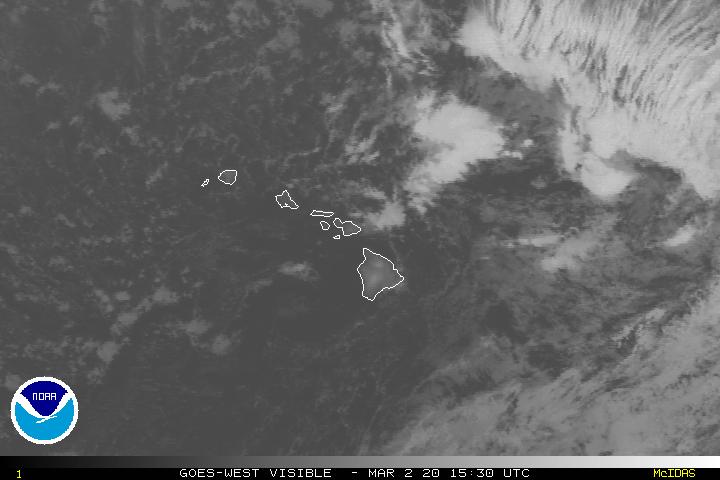
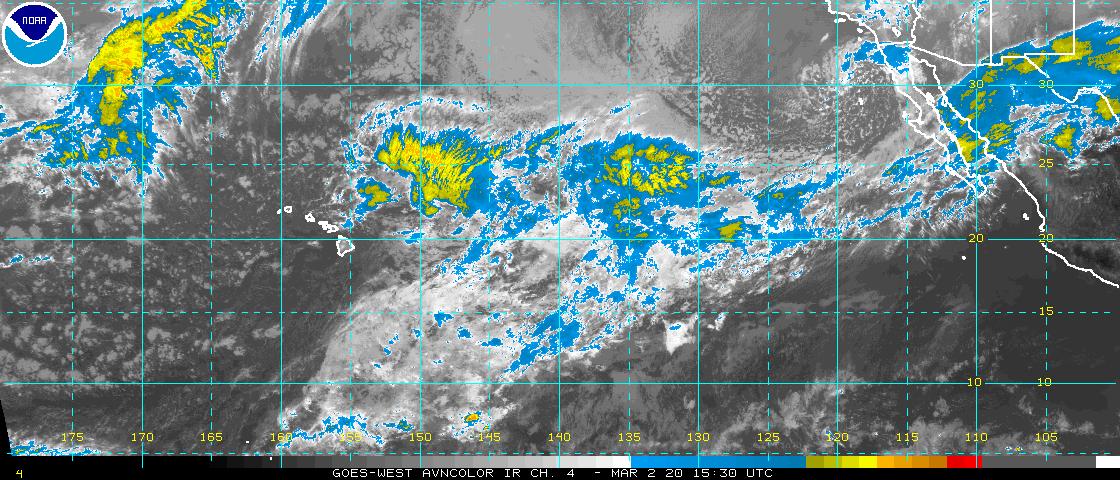
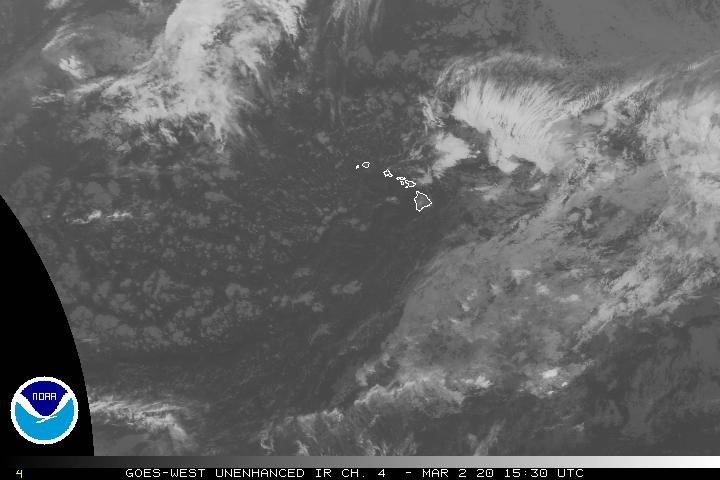
Satellite and Radar Images: To view the cloud conditions we have here in Hawaii, please use the following satellite links, starting off with this Infrared Satellite Image of the islands to see all the clouds around during the day and night. This next image is one that gives close images of the islands only during the daytime hours, and is referred to as a Close-up visible image. This next image shows a larger view of the Pacific…giving perspective to the wider ranging cloud patterns in the Pacific Ocean. Finally, here’s a Looping IR satellite image, making viewable the clouds around the islands 24 hours a day. To help you keep track of where any showers may be around the islands, here’s the latest animated radar image.
Hawaii’s Mountains – Here’s a link to the live webcam on the summit of near 14,000 foot Mauna Kea on the Big Island of Hawaii. The tallest peak on the island of Maui is the Haleakala Crater, which is near 10,000 feet in elevation. These two webcams are available during the daylight hours here in the islands…and when there’s a big moon rising just after sunset for an hour or two! Plus, during the nights and early mornings you will be able to see stars, and the sunrise too…depending upon weather conditions.
Tropical Cyclone activity in the eastern and central Pacific – Here’s the latest weather information coming out of the National Hurricane Center, covering the eastern north Pacific. You can find the latest tropical cyclone information for the central north Pacific (where Hawaii is located) by clicking on this link to the Central Pacific Hurricane Center. Here’s a tracking map covering both the eastern and central Pacific Ocean. A satellite image, which shows the entire ocean area between Hawaii and the Mexican coast…can be found here. Of course, as we know, our hurricane season won’t begin again until June 1st here in the central Pacific.
Aloha Paragraphs

What an interesting wave!
The trade winds will remain the most pronounced feature in our
The small craft wind advisories are back with us again, prompted by the anticipated increase in trade wind speeds. As usual, they appear across those windiest channels and coastal waters around Maui and the
An overhead ridge of high pressure remains overhead, keeping the clouds capped to some degree…limiting their resulting showers in turn. This doesn’t mean that there won’t be showers around at times, particularly along our windward sides, and as usual…during the night and early morning hours. This satellite image shows an area of moisture impacting the windward sides of the islands, from Oahu down to the
It’s Thursday
evening as I begin writing this last section of today’s narrative update. The weather continues to be pretty nice, although the windward sides are a bit damp, and the trade winds might even carry a few light showers over to the leeward sides of the islands…on the smaller islands. We see what looks like a clear slot in the clouds, just behind the current slug of moisture moving through the state now. Although, we can see yet another area of showery clouds just to the east of that clear area, which could arrive later Friday into the early weekend. ~~~ Meanwhile, far to the southwest of Hawaii, we see quite an extensive area of thunderstorms brewing. This doesn’t have the look of a spin, although if the tops of those towering clouds, called cirrus, gets carried our way on the upper winds…we could see more high clouds arriving with time. This is what gives us our colorful sunrise and sunset colors. ~~~ Looking out the windows here in Kihei, before taking the drive back upcountry to Kula, I see lots of clouds. They certainly won’t keep me from getting out for my evening walk, that’s for sure. I’ll be back early Friday morning with your next new weather narrative from paradise, I hope you have a great Thursday night. The moon is past its prime, in terms of being full, although it’s still holding its own in regards to its size these nights! Aloha for now…Glenn.
Extra: First of all, on the way home from work this evening I ran into some nice light showers, as I got upcountry on the Haleakala Highway. When I got ready to take my walk, it was sprinkeling lightly. At any rate, often I see this small black goat at my neighbors house just down the way. I’ve always wanted to pet it, but have never had the opportunity, until now. These neighbors weren’t home when I walked by, and I found this fat little goat out in the street, with his broken rope wrapped around the tire of a truck.
I soon realized, once a car went by, that this little guy was totally unaware of cars, and the danger. So, taking matters into my own hands, I took this little guy, since he has six inch horns, and tied him up to a nearby tree. I took full opportunity while I was doing this, to get lots of pets and rubs in. He was having fun trying to gently get me with his horns, which was interesting. Meanwhile, the cat that lives at this house too, was rubbing up against both the goat and I. It was good getting friendly with this goat, so I thought I’d share this unusual tidbit with all of you.
Interesting: An unusual substance known as "dry water," which resembles powdered sugar, could provide a new way to absorb and store carbon dioxide, the major greenhouse gas that contributes to global warming, scientists reported at the 240th National Meeting of the American Chemical Society. The powder shows bright promise for a number of other uses, they said. It may, for instance, be a greener, more energy-efficient way of jumpstarting the chemical reactions used to make hundreds of consumer products. Dry water also could provide a safer way to store and transport potentially harmful industrial materials.
"There’s nothing else quite like it," said Ben Carter, Ph.D., researcher for study leader Professor Andrew Cooper. "Hopefully, we may see ‘dry water’ making waves in the future." Carter explained that the substance became known as "dry water" because it consists of 95 percent water and yet is a dry powder. Each powder particle contains a water droplet surrounded by modified silica, the stuff that makes up ordinary beach sand.
The silica coating prevents the water droplets from combining and turning back into a liquid. The result is a fine powder that can slurp up gases, which chemically combine with the water molecules to form what chemists term a hydrate. Dry water was discovered in 1968 and got attention for its potential use in cosmetics. Scientists at the University of Hull, U.K. rediscovered it in 2006 in order to study its structure, and Cooper’s group at the University of Liverpool has since expanded its range of potential applications.
One of the most recent involves using dry water as a storage material for gases, including carbon dioxide. In laboratory-scale research, Cooper and co-workers found that dry water absorbed over three times as much carbon dioxide as ordinary, uncombined water and silica in the same space of time.
This ability to absorb large amounts of carbon dioxide gas as a hydrate could make it useful in helping to reduce global warming, the scientists suggested. Cooper and colleagues demonstrated in previous studies that dry water is also useful for storing methane, a component of natural gas, and may help expand its use as a future energy source.
In particular, they hope that engineers can use the powder to collect and transport stranded deposits of natural gas. This also exists on the ocean floor in the form of gas hydrates, a form of frozen methane also known as the "ice that burns." The powder could also provide a safer, more convenient way to store methane fuel for use in vehicles powered by natural gas.
"A great deal of work remains to be done before we could reach that stage," Carter added. In another potential new application, the scientists also showed that dry water is a promising means to speed up catalyzed reactions between hydrogen gas and maleic acid to produce succinic acid, a feedstock or raw material widely used to make drugs, food ingredients, and other consumer products.
Manufacturers usually have to stir these substances together to get them to react. By developing dry water particles that contain maleic acid, Cooper and colleagues showed that they could speed up the acid’s reaction with hydrogen without any stirring, resulting in a greener, more energy-efficient process.
"If you can remove the need to stir your reactions, then potentially you’re making considerable energy savings," Carter said. Prof. Cooper’s team describes an additional new application in which dry water technology shows promise for storing liquids, particularly emulsions.
Emulsions are mixtures of two or more unblendable liquids, such as the oil and water mixture in mayonnaise. The scientists showed that they could transform a simple emulsion into a dry powder that is similar to dry water. The resulting powder could make it safer and easier for manufacturers to store and transport potentially harmful liquids.
Interesting2: Coral living off the coast of Puerto Rico may provide researchers valuable information about the potential impact of the Gulf of Mexico oil spill. University of Central Florida biologist John Fauth, National Oceanic and Atmospheric Administration (NOAA) scientists and non-governmental agencies are studying the threatened Elkhorn Coral in the Vega Baja area of Puerto Rico.
While most of the area appears healthy, some coral are suffering from algal overgrowth and disease — problems similar to those the oil spill could cause off the coast of Florida. Sediment from a nearby construction site and runoff from storm sewers are potential causes for the harm to coral off Puerto Rico’s coast. Fauth says that the same techniques the team used to study the health of the reefs in Vega Baja will be used to determine the impact of the oil spill in the Gulf.
Scientists collect multiple samples that provide information about the enzymes present and the chemical signature of contaminants found within the coral. Scientists then can determine if there is damage to the coral’s cells and analyze sediment samples to learn what contaminants are present on the sea floor. "Our site provides an ideal case study for an environmental assessment that pinpoints probable stressors for coral and determines their source," Fauth said.
The process is time consuming, and each dive includes a long regimen to ensure researchers don’t add to the problem. "Before sampling, our team showered with laboratory soap and did not use any personal care products — for example, sunscreen — that could show up in contaminant analyses," Fauth said. "We also cleaned all of our dive gear with lab soap." It’s a comprehensive approach that researchers in the Gulf will likely duplicate as they search for answers, Fauth said.
Interesting3: A secluded island in the Aleutian chain is revealing secrets of how land and marine ecosystems react to and recover from a catastrophic volcanic eruption that at first wiped life off the island. Kasatochi, an island in the Alaska Maritime National Wildlife Refuge rarely studied by scientists before its Aug. 7, 2008, volcanic eruption, is showing signs of recovery. Kasatochi Island also known as Kasatochi volcano is an active stratovolcano and one of the Andreanof Islands subgroup of the Aleutian Islands of southwestern Alaska.
It lies at the Atka Pass northwest of the western tip of Atka Island and east of Great Sitkin Island. Kasatochi Island has a land area of 1.9503 square miles and is unpopulated. On August 7, 2008, Kasatochi began erupting explosively with an ash plume maintaining an altitude of 35,000 feet and reaching 45,000 feet.
In the summer of 2009, scientists with the U.S. Geological Survey, U.S. Fish and Wildlife Service, and the University of Alaska Museum of the North returned to the island to begin long term studies to better understand the effects of the eruption and how quickly the island’s ecosystems recover.
Despite the frequency of volcanic eruptions in Alaska, this is one of the first studies of its kind in the remote Aleutian Islands. Their findings are detailed in a series of 10 reports published in the August 2010 issue of the journal Arctic, Antarctic, and Alpine Research.
Prior to the eruption, Kasatochi was one of the most picturesque of the Aleutian Islands. Its steep slopes were covered with low-growing grasses and wildflowers, and in the center of the island there was a steep-walled crater filled at the bottom with a small turquoise lake.
Kasatochi Island hosted a colony of about 250,000 least and crested auklets, making it one of the major seabird breeding colonies in the Aleutian Islands. In turn, the numerous seabirds attracted avian predators such as bald eagles, peregrine falcons and ravens. Immediately after the eruption, other than sea lions loafing on a newly formed beach, the island appeared to be completely devoid of life. The entire island and neighboring seafloor were covered with thick layers of volcanic ash and deposits from the eruption.
That first summer after the eruption, A baseline survey was made. The team also set up sampling plots and equipment such as seismometers, time lapse cameras and bird song recorders. “When we first landed on the island, we were unsure of what we would find. The formerly lush, green island was uniformly gray and in the 10 months since the eruption, considerable erosion of volcanic ash had occurred." said project manager Tony DeGange of the USGS.
By late summer, the team found several kinds of green plants scattered around the island bravely poling green leaves above the ground. USGS research geneticist Sandra Talbot stated: “Most of the plants likely originated from underground root systems, rhizomes or seed banks that survived the eruption, particularly in areas that were protected from the hot volcanic flows and where the ash eroded off quickly to expose the pre-eruption soils."
Entomologist Derek Sikes from the University of Alaska Museum of the North also discovered that terrestrial arthropods had survived the eruption. He found wingless carrion beetles, a centipede and a spider, as well as kelp flies and a blowfly that were eating bird carcasses and kelp that had washed up on the island.
Thousands of seabirds returned to the island that first summer, although none nested successfully, according to Jeff Williams of the U.S. Fish and Wildlife Service’s Alaska Maritime National Wildlife Refuge. "The auklet colony was buried under volcanic debris and ash. They were unable to locate suitable nesting crevices and laid eggs on the ground or in the water instead.
It will be interesting to see if erosion eventually exposes the rock crevices that these birds need for nesting or if they eventually abandon the island." said Wlliama Similar to what the research team found onshore, near shore habitats were blanketed with sediments and were largely devoid of life.
Most of the kelp forests in the ocean around the island had been covered with volcanic debris. “We are now in the midst of our second year of research at Kasatochi Island, and our intent is to continue this work for many years,:" said DeGange.
Interesting4: Distributing new varieties of drought tolerant maize to African farmers could save more than $1.5 billion dollars, boost yields by up to a quarter and lift some of the world’s poorest out of poverty, a study found. The study published on Thursday by the Mexico-based International Maize and Wheat Improvement Center (CIMMYT), with input from other food research institutes, focused on 13 African countries in which it has been handing out drought tolerant maize to farmers over the past four years. It described maize as "the most important cereal crop in Africa," a lifeline to 300 million vulnerable people.
The Drought Tolerant Maize for Africa plan aims to hasten the adoption of maize varieties that withstand dry weather. "The vision of this project is to generate by 2016 drought tolerant maize that … increases the average productivity of maize under smallholder farmer conditions by 20-30 percent on adopting farms (and) reaches 30-40 million people."
It also aims to add an annual average of $160 – $200 million worth of additional grain to Africa’s harvest, it said. Wilfred Mwangi, a Kenyan agricultural economist on the project, said the drought resistant maize shows comparative yields that beat other varieties even if there’s no drought. "We are saying that comparing with whatever farmers are growing now, these varieties will outperform what they are doing," he told Reuters in a telephone interview.
Interesting5: A traffic jam stretching for 60 miles along a China highway has tested the patience of untold thousands of motorists, leaving them exposed to the whims of late-summer weather. Since the jam started on Aug. 13, temperatures have been rising daily to the 80s and 90s along the effected leg of Highway 110, outside of Beijing, which leads westward from China’s capital city.
A cleaner picks up waste on the roadside of a jammed section of the Beijing-Zhangjiakou highway in Huailai, in north China’s Hebei province, Tuesday, Aug. 24, 2010. The massive traffic jam that stretches for dozens of miles and hit its 10-day mark on Tuesday stems from road construction in Beijing that will not be finished until the middle of next month, an official said.
No doubt blazing sun and baking pavement have made it feel hotter, especially inside automobiles and trucks without air conditioning. Last week brought torrential thunderstorm downpours on a few days. According to media sources, the cause of the traffic jam is grounded in the overwhelming growth of China’s motor vehicle fleet even as the nation struggles to keep pace in updating infrastructure.
One such major construction project has apparently caused people to seek out Highway 110 in far greater numbers than can be handled by the roadway. Authorities say that the return to normal traffic along this route will not return to normal before Sept. 17, when construction is slated to end which will allow all lanes on the new roadway to be opened.
For at least another week, daily temperatures will climb mostly into the 80s along the snarled roadway with about 90F in some areas. Dry weather will dominate, though widely separated thunderstorms may arise.
 Email Glenn James: