August 25-26, 2010
Air Temperatures – The following maximum temperatures were recorded across the state of Hawaii Wednesday afternoon:
Lihue, Kauai – 84
Honolulu, Oahu – 87
Kaneohe, Oahu – 83
Kaunakakai, Molokai – 85
Kahului, Maui – 89
Hilo, Hawaii – 83
Kailua-kona – 83
Air Temperatures ranged between these warmest and coolest spots near sea level – and on the highest mountain tops…as of 4pm Wednesday afternoon:
Kahului, Maui – 86
Molokai airport – 78
Haleakala Crater – 57 (near 10,000 feet on Maui)
Mauna Kea summit – 46 (near 14,000 feet on the Big Island)
Precipitation Totals – The following numbers represent the largest precipitation totals (inches) during the last 24 hours on each of the major islands, as of Wednesday afternoon:
0.96 Kilohana, Kauai
0.80 Moanalua RG, Oahu
0.07 Molokai
0.00 Lanai
0.05 Kahoolawe
0.08 Puu Kukui, Maui
0.16 Pahoa, Big Island
Marine Winds – Here’s the latest (automatically updated) weather map showing a large 1033 millibar high pressure system located far to the north of the islands. Our local trade winds will remain active Thursday and Friday…gradually strengthening.
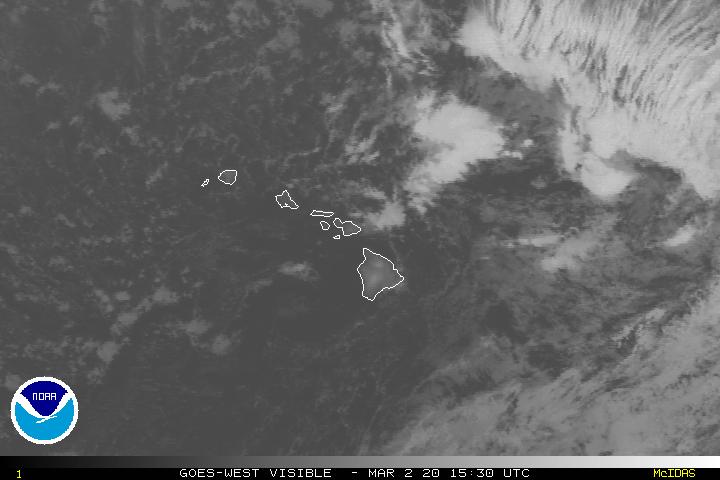
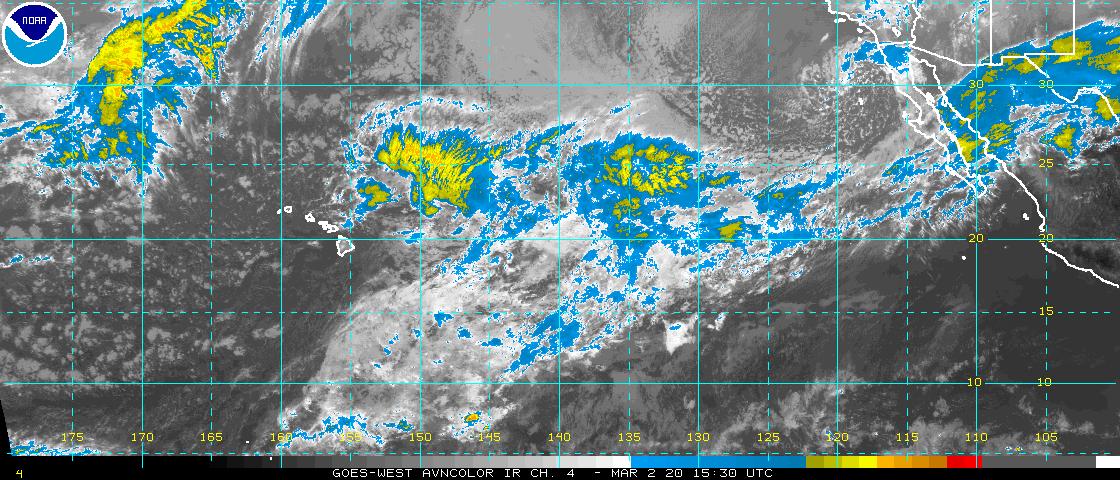
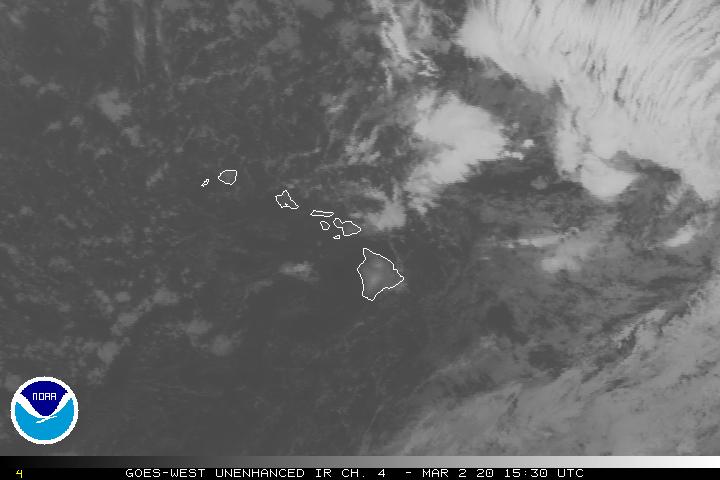
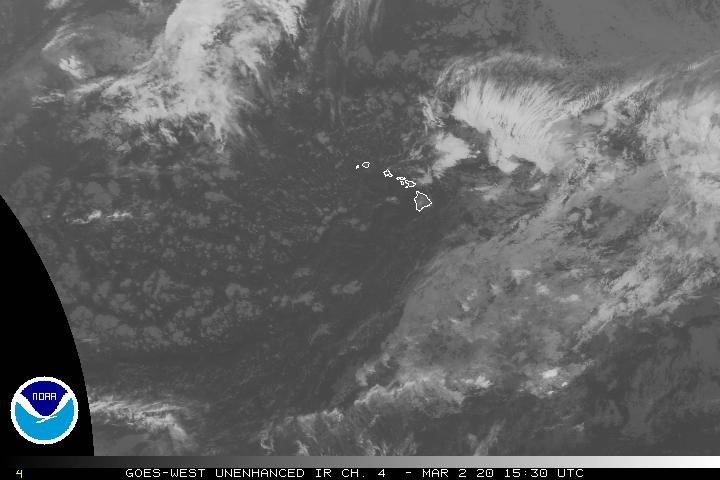
Satellite and Radar Images: To view the cloud conditions we have here in Hawaii, please use the following satellite links, starting off with this Infrared Satellite Image of the islands to see all the clouds around during the day and night. This next image is one that gives close images of the islands only during the daytime hours, and is referred to as a Close-up visible image. This next image shows a larger view of the Pacific…giving perspective to the wider ranging cloud patterns in the Pacific Ocean. Finally, here’s a Looping IR satellite image, making viewable the clouds around the islands 24 hours a day. To help you keep track of where any showers may be around the islands, here’s the latest animated radar image.
Hawaii’s Mountains – Here’s a link to the live webcam on the summit of near 14,000 foot Mauna Kea on the Big Island of Hawaii. The tallest peak on the island of Maui is the Haleakala Crater, which is near 10,000 feet in elevation. These two webcams are available during the daylight hours here in the islands…and when there’s a big moon rising just after sunset for an hour or two! Plus, during the nights and early mornings you will be able to see stars, and the sunrise too…depending upon weather conditions.
Tropical Cyclone activity in the eastern and central Pacific – Here’s the latest weather information coming out of the National Hurricane Center, covering the eastern north Pacific. You can find the latest tropical cyclone information for the central north Pacific (where Hawaii is located) by clicking on this link to the Central Pacific Hurricane Center. Here’s a tracking map covering both the eastern and central Pacific Ocean. A satellite image, which shows the entire ocean area between Hawaii and the Mexican coast…can be found here. Of course, as we know, our hurricane season won’t begin again until June 1st here in the central Pacific.
Aloha Paragraphs

Papaya…ready to pick
The trade winds will remain the most pronounced feature in our
Showers will be active at times, and then less so again…depending upon the amount of moisture upstream of the islands. Overall however, the state remains dry, as many places have received less than half of their average rainfall this year. The major airports of
It’s Wednesday
evening as I begin writing this last section of today’s narrative update. The weather here in the islands remains pretty much right on the mark, in terms of its following the general outlook. The trade winds continue to be the basic mover and shaker, which in turn are carrying periodic showers to our windward sides. We may see an increase in these showers, which may become a bit more numerous in the Friday to Saturday time frame…we’ll see. Meanwhile, those high cirrus clouds, which have been inching in our direction the last couple of days, have arrived. This suggests that we’ll begin to see a little color in our local skies around sunset and sunrise for the next several days. ~~~ Here in Kihei, Maui, before I take the drive back upcountry to Kula, and the cooler air up that way, it’s breezy and warm, and partly cloudy too. I’ll be out on my weather deck this evening for the sunset, just in case we have some some pink or orange glow to witness. I hope you have a great Wednesday night, and that you can join me here again come Thursday, when I’ll have your next new weather narrative ready for the reading around 630am. Aloha for now…Glenn.
Interesting: As the contradictions of Asia’s water challenges have been laid bare this summer—with millions affected by flooding while others are hit by droughts—one thing has been made clearer: the coming water crisis could exacerbate already simmering domestic and regional tensions. Heavy monsoon rains have produced the worst flooding in Pakistan’s history, with more than three weeks of flooding leaving at least 1,500 dead and more than 4 million homeless.
Millions of Pakistanis already require humanitarian assistance, yet the likelihood that many more could be added to this list has grown with the announcement that 200,000 have been evacuated as flood waters continue to rise in Singh Province in the country’s south. Meanwhile, flash floods and mudslides have submerged some villages in China’s Gansu Province, killing hundreds and leaving more than a thousand missing.
Today, Chinese state media announced 250,000 had been evacuated in the north of the country after the Yalu River burst its banks. But while attention has been focused on disasters in Pakistan in China, South-east Asia has been hit by its own torrential downpours. Last month, Singapore suffered three major floods—an unprecedented number for the prosperous city state—with even the shopping and financial districts hit in the first serious flooding disaster in the city since 1978.
Vietnam has also been affected, with many parts of Hanoi under water last month after a major storm struck the country. What added insult to injury in Vietnam’s case is that the flooding came after a nine-month dry spell that disrupted the country’s power supply (about a third of Vietnam’s power source comes from hydroelectric power plants whose operations have been adversely affected by falling water levels in the Mekong River).
Continuous research and development of alternative energy could soon lead to a new era in human history in which two renewable sources — solar and wind — will become Earth’s dominant contributor of energy, a Nobel laureate said in Boston at a special symposium at the American Chemical Society’s 240th National Meeting on August 24.
Walter Kohn, Ph.D., who shared the 1998 Nobel Prize in Chemistry, noted that total oil and natural gas production, which today provides about 60 percent of global energy consumption, is expected to peak about 10 to 30 years from now, followed by a rapid decline. He is with the University of California, Santa Barbara.
"These trends have created two unprecedented global challenges," Kohn said. "One is the threatened global shortage of acceptable energy. The other is the unacceptable, imminent danger of global warming and its consequences." Kohn noted that these challenges require a variety of responses.
"The most obvious is continuing scientific and technical progress providing abundant and affordable alternative energies, safe, clean and carbon-free," he said. Because the challenges are global in nature, the scientific and technical work should enjoy a maximum of international cooperation, which fortunately is beginning to evolve, he said.
The global photovoltaic energy production increased by a factor of about 90 and wind energy by a factor of about 10 over the last decade. He expects vigorous growth of these two effectively inexhaustible energies to continue during the next decade and beyond, thereby leading to a new era, the SOL/WIND era, in human history, in which solar and wind energy have become the earth’s dominant energy sources.
Another important issue, incumbent primarily on developed countries, whose population has pretty much leveled off, is reduction in per capita energy consumption, Kohn said. "A striking example is the U.S. per capita consumption of gasoline, approximately 5 times higher than the global average," he said.
"The less developed world, understandably, aims to bring their standard of living to a level similar to that of the highly developed countries; in return they should stabilize their growing populations." Kohn noted that he is impressed by students on his campus who spent their own collective funds to fully solarize an athletic building.
"When it comes to providing leadership by young people in the area of energy conservation and energy efficiency and global warming — they are fantastic," he said. "It is a major social commitment for our times."
Interesting2: "Computer modeling of global climate is perhaps the most complex endeavor ever undertaken by mankind," writes MIT atmospheric scientist Kerry Emanuel in his short book What we know about climate change. Now, news comes that a powerful new climate model has been created by the National Center for Atmospheric Research, which will augment the dozen or so existing models worldwide.
NCAR says that the new model, known as the Community Earth System Model (CESM), will help scientists understand some of the key mysteries of global warming, including:
• The impact that warming temperatures will have on the ice sheets in Greenland and Antarctica.
• How patterns in the ocean and atmosphere might affect regional climate in coming decades.
• How climate change might influence the severity and frequency of tropical cyclones, including hurricanes.
• The effects of tiny airborne particles, known as aerosols, on clouds and temperatures.
The CESM will be used to simulate the many aspects of Earth’s climate system, including the oceans, atmosphere, sea ice, and land cover.
"With the Community Earth System Model, we can pursue scientific questions that we could not address previously," says NCAR scientist James Hurrell. "It gives us a better representation of the real world."
The CESM will be one of the primary climate models used for the next assessment by the Intergovernmental Panel on Climate Change, slated for 2013 or 2014.
"Decision makers in diverse arenas need to know the extent to which the climate events they see are the product of natural variability, and hence can be expected to reverse at some point, or are the result of potentially irreversible, human-influenced climate change," Hurrell says. "CESM will be a major tool to address such questions."
Interesting3: If you think that your favorite coffee shop is a great gathering place for discussion, you should have been around in the Ottoman Empire starting in the 1550s. A new study in the Journal of Consumer Research examines the role of coffee houses in the evolution of the consumer. Authors Eminegül Karababa (University of Exeter, Exeter, UK) and Güliz Ger (Bilkent University, Ankara, Turkey) dug wide and deep into the history of coffeehouses in the early modern Ottoman Empire and found they offered their patrons a lot more than coffee.
They found that patrons engaged in gambling, taking drugs, meeting with "young beautiful boys," as well as performing or watching entertainments such as puppet theatres, storytellers, and musical and dance performances. The early coffee houses were controversial enterprises. "Formation, normalization, and legalization of such a site for transgressive pleasures was controversial since formal religious morality of the period (orthodox Islam) considered it as sinful and illegal.
Thus, they were repeatedly banned by the state." Yet, the coffee houses flourished, and by the sixteenth and seventeenth centuries, Ottomans from all ranks of the society met to drink coffee, socialize, and have literary discussions. Coffee house discourse often challenged the authority of the state and religion and led to changes in the society.
"Simultaneously, a new Ottoman consumer, resisting the prescriptions of the state and religion, actively constructing selfethics, and taking part in the formation of the coffeehouse culture, was forming as well." "Obviously, the early modern Ottoman context was very different than any modern capitalist system," the authors write. "But the active consumer may not be as recent or even a chronological phenomenon as many consumer researchers think."
Interesting4: The Wildlife Conservation Society (WCS) and the Zoological Society of London (ZSL) are requesting that the Government of Tanzania reconsider the proposed construction of a commercial road through the world’s best known wildlife sanctuary — Serengeti National Park — and recommend that alternative routes be used that can meet the transportation needs of the region without disrupting the greatest remaining migration of large land animals in the world. At issue is the proposed Arusha-Musoma highway, slated for construction in 2012. According to the proposed route, the highway would bisect the northern portion of the park and jeopardize the annual migration of wildebeest and zebra, a spectacle comprising nearly two million animals.
The Serengeti is a World Heritage Site and is universally regarded as one of world’s great natural wonders. "The Serengeti is the site of one of the last great ungulate migrations left on Earth, the pre-eminent symbol of wild nature for millions of visitors and TV viewers, and a hugely important source of income for the people of Tanzania through ecotourism," said Dr. James Deutsch, Executive Director of the WCS’s Africa Program.
"To threaten this natural marvel with a road would be a tragedy. We implore the Tanzanian government — known around the world for its commitment to conservation — to reconsider this proposal and explore other options." "A commercial road would not only result in wildlife collisions and human injuries, but would serve to fragment the landscape and undermine the ecosystem in a variety of ways," said Prof. Jonathan Baillie, Director of Conservation Programmes for ZSL, which partners with WCS in the long-term monitoring and conservation of Serengeti’s cheetahs.
"To diminish this natural wonder would be a terrible loss for Tanzania and all future generations." WCS and ZSL are two of numerous organizations — including the Frankfurt Zoological Society (FZS) — in growing opposition to the proposed road. Supporters of the proposed road point to the need for linkage between the districts of Serengeti and Loliondo and the national road system, as well as a need for increased transport infrastructure between the coast and the hinterland.
However it is possible to achieve these objectives without bisecting the Serengeti. Conservationists predict that building the road through Serengeti National Park would not only result in a catastrophic decrease in numbers of wildebeest, zebra, and other species as a result of the interruption of the migration. It could also potentially cut Kenya’s Masaai Mara National Reserve off from the migration, jeopardizing that country’s most important tourism destination.
 Email Glenn James: