August 24-25, 2010
Air Temperatures – The following maximum temperatures were recorded across the state of Hawaii Tuesday afternoon:
Lihue, Kauai – 84
Honolulu, Oahu – 87
Kaneohe, Oahu – 83
Kaunakakai, Molokai – 83
Kahului, Maui – 87
Hilo, Hawaii – 84
Kailua-kona – 84
Air Temperatures ranged between these warmest and coolest spots near sea level – and on the highest mountain tops…as of 5pm Tuesday evening:
Port Allen, Kauai – 84
Molokai airport – 79
Haleakala Crater – 55 (near 10,000 feet on Maui)
Mauna Kea summit – 50 (near 14,000 feet on the Big Island)
Precipitation Totals – The following numbers represent the largest precipitation totals (inches) during the last 24 hours on each of the major islands, as of Tuesday afternoon:
0.71 Mount Waialeale, Kauai
0.46 Oahu Forest NWR, Oahu
0.06 Molokai
0.00 Lanai
0.18 Kahoolawe
0.24 Puu Kukui, Maui
0.09 Waiakea Uka, Big Island
Marine Winds – Here’s the latest (automatically updated) weather map showing two high pressure systems located to the north and northeast of the islands. Our local trade winds will remain active Wednesday and Thursday.
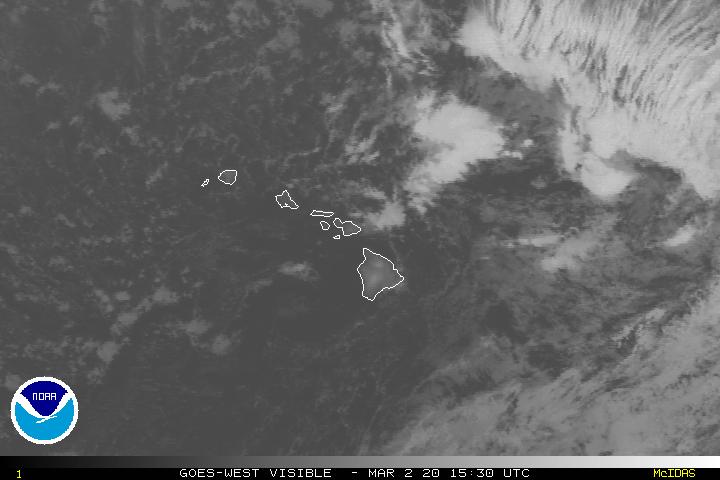
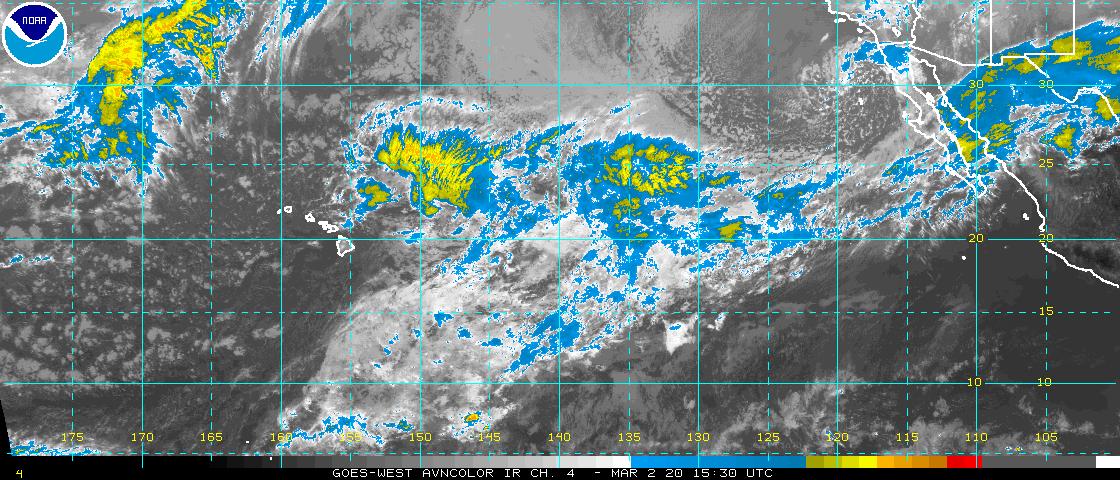
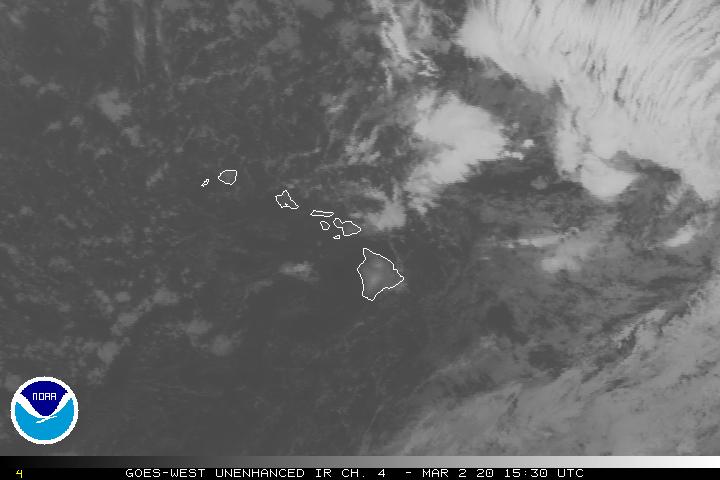
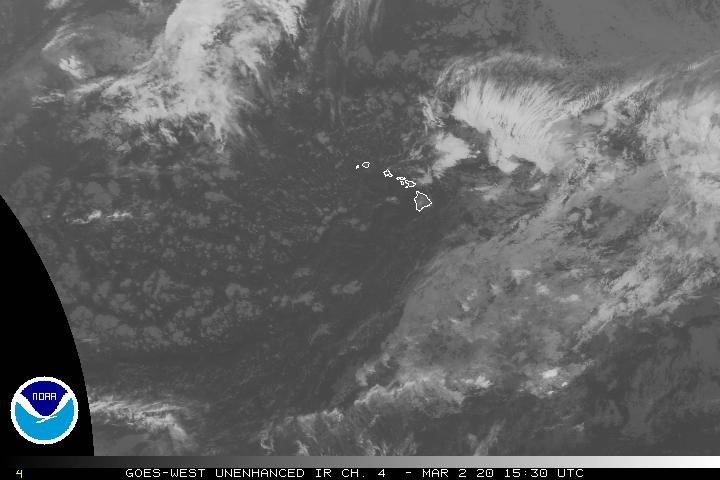
Satellite and Radar Images: To view the cloud conditions we have here in Hawaii, please use the following satellite links, starting off with this Infrared Satellite Image of the islands to see all the clouds around during the day and night. This next image is one that gives close images of the islands only during the daytime hours, and is referred to as a Close-up visible image. This next image shows a larger view of the Pacific…giving perspective to the wider ranging cloud patterns in the Pacific Ocean. Finally, here’s a Looping IR satellite image, making viewable the clouds around the islands 24 hours a day. To help you keep track of where any showers may be around the islands, here’s the latest animated radar image.
Hawaii’s Mountains – Here’s a link to the live webcam on the summit of near 14,000 foot Mauna Kea on the Big Island of Hawaii. The tallest peak on the island of Maui is the Haleakala Crater, which is near 10,000 feet in elevation. These two webcams are available during the daylight hours here in the islands…and when there’s a big moon rising just after sunset for an hour or two! Plus, during the nights and early mornings you will be able to see stars, and the sunrise too…depending upon weather conditions.
Tropical Cyclone activity in the eastern and central Pacific – Here’s the latest weather information coming out of the National Hurricane Center, covering the eastern north Pacific. You can find the latest tropical cyclone information for the central north Pacific (where Hawaii is located) by clicking on this link to the Central Pacific Hurricane Center. Here’s a tracking map covering both the eastern and central Pacific Ocean. A satellite image, which shows the entire ocean area between Hawaii and the Mexican coast…can be found here. Of course, as we know, our hurricane season won’t begin again until June 1st here in the central Pacific.
Aloha Paragraphs

Full August moon Tuesday
Moderately strong trade winds will continue to blow over the Hawaiian Islands through mid-week…increasing some Friday into the weekend. This weather map shows two moderately strong high pressure systems to our north and northeast, the source of our trade breezes Tuesday night. The wind flow across our islands remains light enough at the moment, that small craft wind advisories aren’t required. As the trade winds increase in a day or two, they will likely go up again around Maui and the Big Island.
Showers over and around our windward coasts and slopes will be about normal for time being…with a modest drying trend during the second half of the week. This satellite image shows scattered clouds upstream of the islands, which will bring the windward sides showers at times
It’s Tuesday
evening as I begin writing this last section of today’s narrative update. The skies across the state will range from clear, to partly cloudy…to locally cloudy at times – what else is new? Those high clouds looming just to our west look like they may make a run towards us. This would bring some color at the beginning and ending our late summer days…which will be a good thing. The moon has big lately, and beautiful during the nights the last several days, and peaked in its fullness today. Finally, the trade winds will remain with us for as far as the eye can see, at least well into next week. ~~~ Here in Kihei, Maui, before I leave for the drive back upcountry to Kula, it’s generally clear in just about all directions. The winds are blowing as usual, with the strongest gust early this evening being reported at where else…but Maalaea Bay, at 35 mph. The lightest wind in contrast at the same time, was the 10 mph sustained winds at both Hilo and Kona airports, on the Big Island of Hawaii. ~~~ I’ll be back early Wednesday morning with your next new weather narrative from paradise, and I do mean paradise! I hope you have a great Tuesday night until then. Aloha for now…Glenn.
Interesting: Scientists aboard a U.S. research ship have started an around-the-clock search for elusive signs of oil lurking beneath the Gulf of Mexico’s surface in what they jokingly call "Operation Dipstick." As debate rages among scientists over how much oil remains in the water after BP Plc’s massive oil spill, their research vessel circles above the blown-out Macondo well, some 40 miles southeast of the mouth of the Mississippi River.
Oil is not visible on the surface around the well, but as waters reopen to fishing, many question what the crude will do to this season’s fish, shrimp and oyster catch, as well as its long-term effect on marine life. The 35-member crew of the Pisces, operated by the National Oceanic and Atmospheric Administration, on August 18 started a three-week mission to collect sea water samples and study them for hydrocarbons or depleted oxygen levels that could indicate its presence.
Last week, oceanographers from the Woods Hole Oceanographic Institution said that the oil spill left at large plume of hydrocarbons in deep waters in the Gulf, and those chemicals could be there for some time. While the Woods Hole researchers found the plume in June, it showed that subsurface oil droplets were not being easily degraded by microbes, as some had speculated.
The head of NOAA told reporters at a briefing in Venice, Louisiana, last week that the government stands by their figures that others dispute. "We believe those numbers remain to be the best ones that are out there," Jane Lubchenco, said, adding that the government’s figures would be refined as more data becomes available.
Interesting2: Scientists report progress in using a common virus to develop improved materials for high-performance, rechargeable lithium-ion batteries that could be woven into clothing to power portable electronic devices. They discussed development of the new materials for the battery’s cathode, or positive electrode, at the 240th National Meeting of the American Chemical Society (ACS), being held in Boston.
These new power sources could in the future be woven into fabrics such as uniforms or ballistic vests, and poured or sprayed into containers of any size and shape, said Mark Allen, Ph.D., who presented the report. He is a postdoc in Angela Belcher’s group at the Massachusetts Institute of Technology (MIT). These conformable batteries could power smart phones, GPS units, and other portable electronic devices.
"We’re talking about fabrics that also are batteries," Allen said. "The batteries, once woven into clothing, could provide power for a range of high-tech devices, including handheld radios, GPS devices and personal digital assistants. They could also be used in everyday cell phones and smart phones." Batteries produce electricity by converting chemical energy into electrical energy using two electrodes — an anode and cathode — separated by an electrolyte.
At the ACS meeting, Allen described development of new cathodes made from an iron-fluoride material that could soon produce lightweight and flexible batteries with minimal loss of power, performance, or chargeability compared to today’s rechargeable power sources. Allen has extended ground-breaking work done last year by MIT scientist Angela Belcher and her colleagues, who were the first to engineer a virus as a biotemplate for preparing lithium ion battery anodes and cathodes.
The virus, called M13 bacteriophage, consists of an outer coat of protein surrounding an inner core of genes. It infects bacteria and is harmless to people. "Using M13 bacteriophage as a template is an example of green chemistry, an environmentally friendly method of producing the battery," Allen said. "It enables the processing of all materials at room temperature and in water."
And these materials, he said, should be less dangerous than those used in current lithium-ion batteries because they produce less heat, which reduces flammability risks. The Belcher Biomaterials group is in the beginning stages of testing and scaling up the virus-enabled battery materials, which includes powering unmanned aerial vehicles for surveillance operations.
Making light-weight and long-lasting batteries that could result in rechargeable clothing would have several advantages for both military personnel and civilians, Allen added. "Typical soldiers have to carry several pounds of batteries. But if you could turn their clothing into a battery pack, they could drop a lot of weight. The same could be true for frequent business travellers ? the road warriors ? who lug around batteries and separate rechargers for laptop computers, cell phones, and other devices. They could shed some weight."
Interesting3: Americans are using less energy overall and making more use of renewable energy resources. The United States used significantly less coal and petroleum in 2009 than in 2008, and significantly more wind power. There also was a decline in natural gas use and increases in solar, hydro and geothermal power according to the most recent energy flow charts released by the Lawrence Livermore National Laboratory.
"Energy use tends to follow the level of economic activity, and that level declined last year. At the same time, higher efficiency appliances and vehicles reduced energy use even further," said A.J. Simon, an LLNL energy systems analyst who develops the energy flow charts using data provided by the Department of Energy’s Energy Information Administration.
"As a result, people and businesses are using less energy in general." The estimated U.S. energy use in 2009 equaled 94.6 quadrillion BTUs ("quads"), down from 99.2 quadrillion BTUs in 2008. (A BTU or British Thermal Unit is a unit of measurement for energy, and is equivalent to about 1.055 kilojoules). Energy use in the residential, commercial, industrial and transportation arenas all declined by .22, .09, 2.16 and .88 quads, respectively.
Wind power increased dramatically in 2009 to.70 quads of primary energy compared to .51 in 2008. Most of that energy is tied directly to electricity generation and thus helps decrease the use of coal for electricity production. "The increase in renewables is a really good story, especially in the wind arena," Simon said. "It’s a result of very good incentives and technological advancements. In 2009, the technology got better and the incentives remained relatively stable.
The investments put in place for wind in previous years came online in 2009. Even better, there are more projects in the pipeline for 2010 and beyond." The significant decrease in coal used to produce electricity can be attributed to three factors: overall lower electricity demand, a fuel shift to natural gas, and an offset created by more wind power production, according to Simon. Nuclear energy use remained relatively flat in 2009.
No new plants were added or taken offline in this interval, and the existing fleet operated slightly less than in 2008. Of the 94.6 quads consumed, only 39.97 ended up as energy services. Energy services, such as lighting and machinery output, are harder to estimate than fuel consumption, Simon said. The ratio of energy services to the total amount of energy used is a measure of the country’s energy efficiency.
Carbon emissions data are expected to be released later this year, but Simon suspects they will tell a similar story. "The reduction in the use of natural gas, coal and petroleum is commensurate with a reduction in carbon emissions," he said. "Simply said, people are doing less stuff. Therefore, they’re burning less fuel." Lawrence Livermore National Laboratory has helped to visualize the Energy Information Administration’s U.S. energy data since the early 1970s.
Interesting4: Fires and floods which raged across the Isle of Wight some 130 million years ago made the island the richest source of pick ‘n’ mix dinosaur remains of this age anywhere in the world. A new study has revealed the Island’s once violent weather explains why thousands of tiny dinosaur teeth and bones lie buried alongside the huge bones of their gigantic relatives. The research was carried out by University of Portsmouth palaeontologist Dr Steve Sweetman and Dr Allan Insole from the University of Bristol.
It is published in the journal Palaeogeography, Palaeoclimatology, Palaeoecology. "When a fire was rapidly followed by an intense flood a snapshot of life on the Isle of Wight 130 million years ago was taken and preserved for us to see today, making the Isle of Wight one of the most important dinosaur sites in the world.
Apart from the sheer diversity of dinosaurs found on the island we also have the remains of the animals and plants that lived with them," Dr Sweetman said. "During the Early Cretaceous when dinosaurs roamed, the climate was much warmer than today. This was partly to do with the geographical position of the Isle of Wight at the time — the latitude was roughly where Gibraltar is now — but also reflects the extreme greenhouse conditions of that era.
"Rainfall occurred all year round but during the summer months, when temperatures soared to between 36 — 40o C, evaporation exceeded rainfall causing drought conditions. At these times vegetation became parched leaving it vulnerable to fires caused by lightning strike. "Occasionally very heavy rain would follow electrical storms and wild fires causing flash floods. These swept up all loose objects in their path, swallowed complete dinosaur skeletons and eroded floodplain sediments.
The more debris and sediment the water collected the thicker and thicker it became until eventually it was like mixed concrete." This chaotic mixture, in which most of the skeletons became jumbled up, was then deposited in hollows to form what are now known as the island’s plant debris beds. They are so called because they contain large amounts of scorched and unburned plant fossils ranging in size from large logs to tiny fragments of leaves.
The rotting plants in these beds removed oxygen providing ideal conditions for the preservation of bones. Dr Sweetman said: "On the Isle of Wight you get a complete muddle of the smallest fossils blended with the biggest, nothing quite like it has been seen anywhere else in the world. The plant debris beds and the mixture of fossils they contain are unique to the island."
 Email Glenn James: