August 21-22, 2010
Air Temperatures – The following maximum temperatures were recorded across the state of Hawaii Saturday afternoon:
Lihue, Kauai – 85
Honolulu, Oahu – 86
Kaneohe, Oahu – 85
Kaunakakai, Molokai – 85
Kahului, Maui – 88
Hilo, Hawaii – 80
Kailua-kona – 83
Air Temperatures ranged between these warmest and coolest spots near sea level – and on the highest mountain tops…as of 4pm Saturday afternoon:
Barking Sands, Kauai – 86
Hilo, Hawaii – 73
Haleakala Crater – 61 (near 10,000 feet on Maui)
Mauna Kea summit – 46 (near 14,000 feet on the Big Island)
Precipitation Totals – The following numbers represent the largest precipitation totals (inches) during the last 24 hours on each of the major islands, as of Saturday afternoon:
0.18 Mount Waialeale, Kauai
0.06 Manoa Valley, Oahu
0.01 Molokai
0.00 Lanai
0.00 Kahoolawe
0.12 West Wailuaiki, Maui
0.24 Kawainui Stream, Big Island
Marine Winds – Here’s the latest (automatically updated) weather map showing a 1029 millibar high pressure system located far to the north of the islands. Our local trade winds will remain active Sunday and Monday.
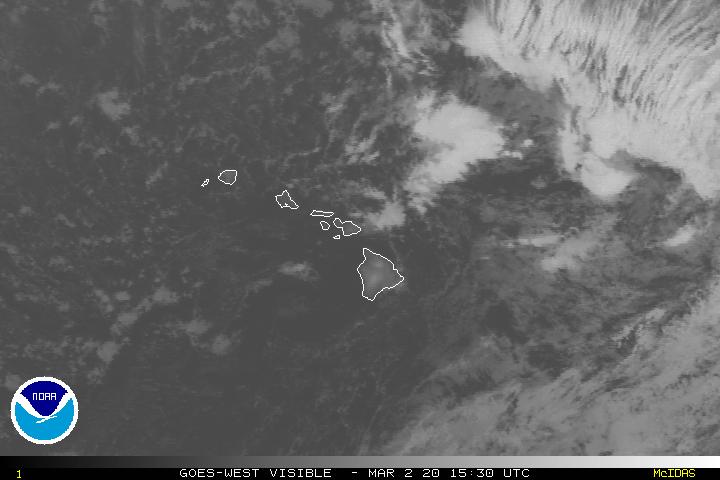
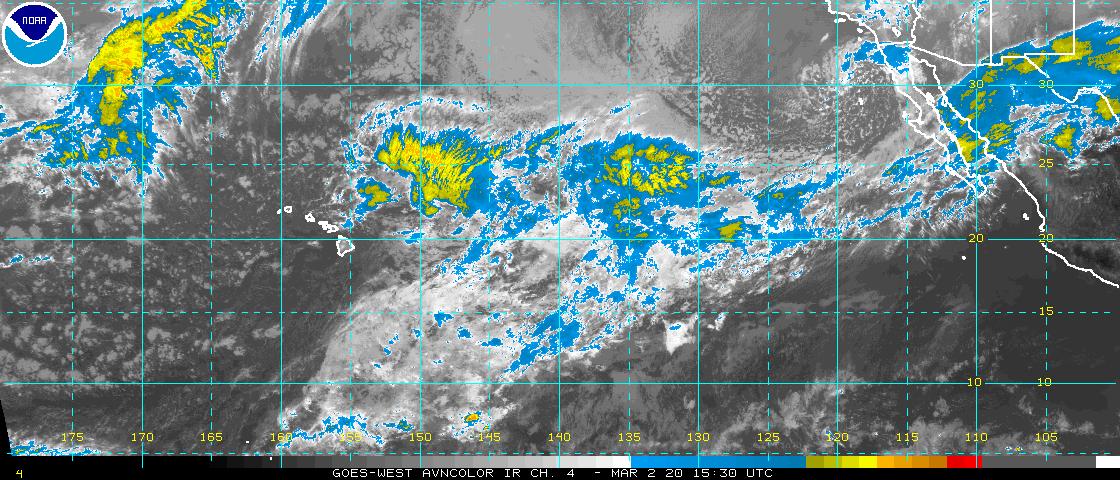
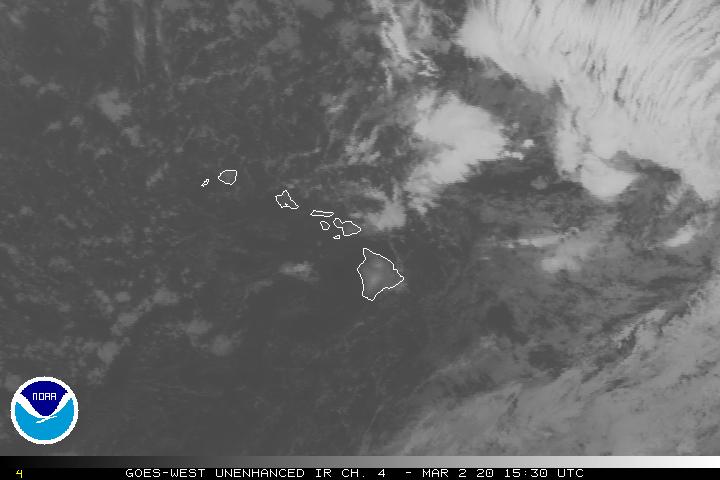
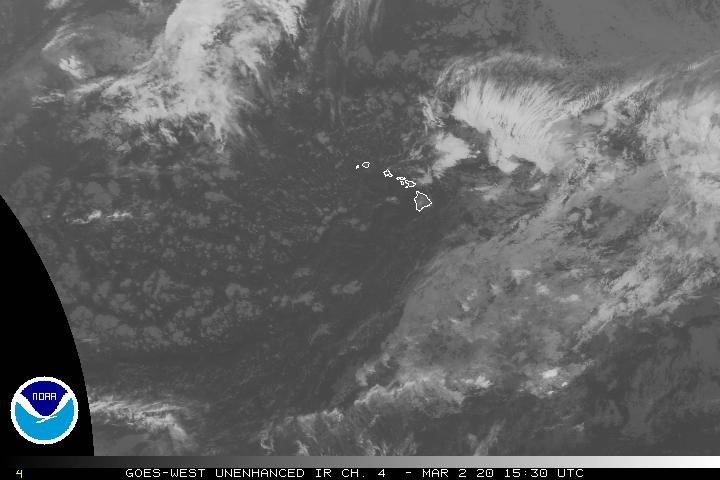
Satellite and Radar Images: To view the cloud conditions we have here in Hawaii, please use the following satellite links, starting off with this Infrared Satellite Image of the islands to see all the clouds around during the day and night. This next image is one that gives close images of the islands only during the daytime hours, and is referred to as a Close-up visible image. This next image shows a larger view of the Pacific…giving perspective to the wider ranging cloud patterns in the Pacific Ocean. Finally, here’s a Looping IR satellite image, making viewable the clouds around the islands 24 hours a day. To help you keep track of where any showers may be around the islands, here’s the latest animated radar image.
Hawaii’s Mountains – Here’s a link to the live webcam on the summit of near 14,000 foot Mauna Kea on the Big Island of Hawaii. The tallest peak on the island of Maui is the Haleakala Crater, which is near 10,000 feet in elevation. These two webcams are available during the daylight hours here in the islands…and when there’s a big moon rising just after sunset for an hour or two! Plus, during the nights and early mornings you will be able to see stars, and the sunrise too…depending upon weather conditions.
Tropical Cyclone activity in the eastern and central Pacific – Here’s the latest weather information coming out of the National Hurricane Center, covering the eastern north Pacific. You can find the latest tropical cyclone information for the central north Pacific (where Hawaii is located) by clicking on this link to the Central Pacific Hurricane Center. Here’s a tracking map covering both the eastern and central Pacific Ocean. A satellite image, which shows the entire ocean area between Hawaii and the Mexican coast…can be found here. Of course, as we know, our hurricane season won’t begin again until June 1st here in the central Pacific.
Aloha Paragraphs

Interesting breaking wave
The trade winds will continue, keeping favorably inclined weather conditions in place well into the future. This weather map shows a moderately strong 1029 milibar high pressure system located far to our north, the source of our trade breezes Saturday night. The wind flow across our islands remains strong enough to require small craft wind advisories through the channels around Maui and the Big Island, along with a few of the windier coastal areas in the southern part of the state as well. These breezy trade winds may finally lose enough strength by Sunday afternoon…that the advisories end.
The trade winds remain dry enough, that the NWS is keeping the red flag warning in force Saturday…with the high threat of fire danger along our leeward sides. This satellite image shows patchs of clouds upstream of the windward sides, although with our dry atmosphere now, mostly light showers will fall. Glancing down further to the south of the islands, in the deeper tropics, using this satellite picture, we see just a few spotty thunderstorms. There’s no sign of any spin to those thunderstorm areas, so there’s nothing to worry about in terms of tropical cyclone activity in our central north Pacific.
It’s Saturday
as I begin writing this last section of today’s narrative update. Our trade winds remained rather strong and gusty today, with gusts commonly above the 30+ mph range on all of the islands. Early Saturday evening the strongest wind gust was being reported on the Big Island, where one gust had reached 38 mph. Please be careful with matches, as the danger of wild fires remains dangerously high.
~~~ Looking out the windows of my Kula, Maui weather tower, it’s partly cloudy late in the day. The air temperature was 74.8F degrees a little before 5pm. Looking at that satellite image above, we can see quite a few patches of clouds being carried our way on the stiff trade wind breezes. I would imagine that we’ll see some light showers falling during the night, which is common. All things considered though, I expect Sunday to be another nice day here in Hawaii, which will prevail into the new week ahead. ~~~ I had a nice day, starting off with a long walk this morning out in Keokea. I came home and had some breakfast, and a cup of espresso before heading down to Kahului. I needed to buy some new walking shoes, which I bought at one of the sporting goods stores. I then went to Baldwin Beach in Paia for a little sunshine, and a very pleasant swim in the warm ocean. I went shopping, and grabbed something to take home at Fresh Mint, the Vietnamese vegetarian restaurant on Baldwin Ave. I’m going to rest up, before I head back down to Paia again tonight, for some dancing. This doesn’t start until 10pm, so I have a while to hang out before getting back into my car. I’ll let you know what I thought of the dancing Sunday morning. Since I may be out late, my next update probably won’t be at the crack of dawn. I hope you have a great Saturday night until then! Aloha for now…Glenn.
Interesting: Afghanistan and nations in sub-Saharan Africa are most at risk from shocks to food supplies such as droughts or floods while Nordic countries are least vulnerable, according to an index released on Thursday. "Of 50 nations most at risk, 36 are located in Africa," said Fiona Place, an environmental analyst at British-based consultancy Maplecroft, which compiled the 163-nation food security risk index.
Maplecroft said that it hoped the index could help in directing food aid or to guide investments in food production. Upheavals in 2010 include Russia’s grain export ban from August 15 spurred by the country’s worst drought in more than a century.
Afghanistan’s food supplies were most precarious, based on factors such as rates of malnutrition, cereal production and imports, gross domestic product per capita, natural disasters, conflicts and the effectiveness of government.
It was followed by the Democratic Republic of Congo, Burundi, Eritrea, Sudan, Ethiopia, Angola, Liberia, Chad and Zimbabwe, all of which suffer from poverty and risk ever more extreme weather because of climate change. At the other end of the scale, the survey said that Finland had the most secure food supplies, followed by Sweden, Denmark, Norway, Canada and the United States.
Interesting2: The year 2010 is on track to become the hottest year on record since modern record keeping began, according to climate researchers at the National Oceanographic and Atmospheric Administration. This follows confirmation that the first seven months of 2010 were the warmest since 1880, when the modern climate record began.
Worldwide, July was the second warmest July on record with an average temperature of 61.7 F. The warmest July recorded was July 1998. But for land alone, July 2010 was the warmest on record. All-time national record high temperatures were reached during July in Finland, Belarus and Ukraine due to the strength of severe European heat waves.
Moscow, Russia, had its highest temperature ever at 100.8 F. Other nations reaching their highest-ever temperatures included Saudi Arabia, Pakistan, Iraq, Kuwait, Cyprus, Chad, Sudan, Niger, Myanmar, Colombia and even the Solomon Islands.
Interesting3: A new simulation of oil and methane leaked into the Gulf of Mexico suggests that deep hypoxic zones or "dead zones" could form near the source of the pollution. The research investigates five scenarios of oil and methane plumes at different depths and incorporates an estimated rate of flow from the Deepwater Horizon spill, which released oil and methane gas into the Gulf from April to mid July of this year.
A scientific paper on the research has been accepted for publication by Geophysical Research Letters, a journal of the American Geophysical Union. Scientists at the National Oceanic and Atmospheric Administration (NOAA) and Princeton University conducted the research.
Based on their simulations, they conclude that the ocean hypoxia or toxic concentrations of dissolved oil arising from the Deepwater Horizon blowout are likely to be "locally significant but regionally confined to the northern Gulf of Mexico." A hypoxic or "dead" zone is a region of ocean where oxygen levels have dropped too low to support most forms of life, typically because microbes consuming a glut of nutrients in the water use up the local oxygen as they consume the material.
"According to our simulations, these hypoxic areas will be peaking in October," says study coauthor Robert Hallberg of the NOAA Geophysical Fluid Dynamics Laboratory in Princeton, N.J.. "Oxygen drawdown will go away slowly, as the tainted water is mixed with Gulf waters that weren’t affected. We’re estimating a couple of years" before the dead zone has dissipated, he adds.
Although the Princeton-NOAA study was carried out when the flow rate from the Deepwater Horizon spill was still underestimated, the simulated leak lasted longer than did the actual spill. Consequently, says Alistair Adcroft of Princeton University and the NOAA Geophysical Fluid Dynamics Laboratory, another study coauthor, "the overall impact on oxygen turns out to be about the same" as would be expected from the Deepwater Horizon spill.
Interesting4: New research confirms the existence of a huge plume of dispersed oil deep in the Gulf of Mexico and suggests that it has not broken down rapidly, raising the possibility that it might pose a threat to wildlife for months or even years. The study, the most ambitious scientific paper to emerge so far from the Deepwater Horizon spill, casts some doubt on recent statements by the federal government that oil in the gulf appears to be dissipating at a brisk clip. However, the lead scientist in the research, Richard Camilli, cautioned that the samples were taken in June and circumstances could have changed in the last two months.
The paper, which appears in Friday’s issue of the journal Science, adds to a welter of recent, and to some extent conflicting, scientific claims about the status of the gulf. While scientists generally agree that the risk of additional harm at the surface and near shore has diminished since the well was capped a month ago, a sharp debate has arisen about the continuing risk from oil in the deep ocean.
So far, information has emerged largely from government reports and press statements by scientists. Many additional research papers are in the works, and it could be months before a clear scientific picture emerges.
The slow breakdown of deep oil that Dr. Camilli’s group found had a silver lining: it meant that the bacteria trying to eat the oil did not appear to have consumed an excessive amount of oxygen in the vicinity of the spill, alleviating concerns that the oxygen might have declined so much that it threatened sea life.
But Dr. Camilli said the plume, at the time he studied it, was dissipating so slowly that it could still be in the gulf many months from now. Assuming that the physics of the plume are still similar to what his team saw in June, “it’s going to persist for quite a while before it finally dissipates or dilutes away,” he said.
Concentrations of hydrocarbons in the plume were generally low and declined gradually as the plume traveled through the gulf, although Dr. Camilli’s team has not yet completed tests on how toxic the chemicals might be to sea life.
In a report on Aug. 4, a team of government and independent scientists organized by the National Oceanic and Atmospheric Administration estimated that 74 percent of the oil from the leak had been captured directly from the wellhead; had been skimmed, burned, dispersed chemically or by natural processes; had evaporated from the ocean surface; or had dissolved into the water in microscopic droplets.
The report found the remaining 26 percent of the oil had mostly washed ashore or been collected there, was buried in sand and sediment, or was still on or below the water surface as sheen or tar balls.
While the government report expressed concern about the continuing impact of the spill, it was widely viewed as evidence that the risk of additional harm in the gulf was declining.
This week, scientists at the University of Georgia, who in May were among the first to report the existence of the large plume studied by Dr. Camilli’s team, sharply challenged the government’s assessment. They contended that the government had overestimated rates of evaporation and breakdown of the oil.
“The idea that 75 percent of the oil is gone and is of no further concern to the environment is just incorrect,” said Samantha Joye, a professor of marine sciences at the University of Georgia. She has studied the spill extensively but has not yet published her results.
Responding to the University of Georgia criticism, Jane Lubchenco, the N.O.A.A. administrator, declared that the government stood by its calculations. “Some of those numbers we can measure directly,” she said. “The others are the best estimates that are out there.”
In another report this week, researchers from the University of South Florida reported that they had found oil droplets scattered in sediment along the gulf floor and in the water column, where they could pose a threat to some of the gulf’s most important fisheries. The dispersed oil appeared to be having a toxic effect on bacteria and on phytoplankton, a group of microorganisms that serves as a vital food for fish and other marine life, the scientists said, although they cautioned that further testing was needed.
Dr. Camilli’s paper tends to support the view that considerable oil may be lingering below the surface of the gulf. He said he was not especially surprised by the slow rate of breakdown, considering that the deep waters of the gulf are cold, about 40 degrees Fahrenheit in the vicinity of the plume.
“In colder environments, microbes operate more slowly,” Dr. Camilli said. “That’s why we have refrigerators.”
For weeks, BP, the company that owned the out-of-control well, disputed claims from scientists that a huge plume of dispersed oil droplets had formed in the gulf, with its chief executive at the time, Tony Hayward, declaring at one point, “There aren’t any plumes.”
The new paper settles that issue, providing detailed evidence that one major plume and at least one minor plume exist and that they contain large quantities of hydrocarbons, albeit dispersed into tiny droplets.
Dr. Camilli’s team measured the main plume at roughly 3,600 feet below the surface; it extended for more than 20 miles southwest of the well. It was more than a mile wide in places and 600 feet thick, traveling at about four miles a day.
At the time his team studied it in June, the plume appeared to have narrowed from measurements reported early in the spill by a team that included Dr. Joye and Vernon Asper, a marine scientist from the University of Southern Mississippi, but his results otherwise matched their report.
The slow breakdown of the plume, if verified by additional research, suggests that scientists may find themselves tracking the toxic compounds from BP’s well and trying to discern their impact on sea life for a long time.
“I expect the hydrocarbon imprint of the BP discharge will be detectable in the marine environment for the rest of my life,” Ian MacDonald, 58, an oceanographer at Florida State University, told Congress in prepared testimony on Thursday. “The oil is not gone and is not going away anytime soon.”
 Email Glenn James: