











August 2-3, 2010
Air Temperatures – The following maximum temperatures were recorded across the state of Hawaii Monday afternoon:
Lihue, Kauai – 84
Honolulu, Oahu – 87
Kaneohe, Oahu – 83
Kaunakakai, Molokai – 83
Kahului, Maui – 87
Hilo, Hawaii – 81
Kailua-kona – 84
Air Temperatures ranged between these warmest and coolest spots near sea level – and on the highest mountain tops too…as of 4pm Monday afternoon:
Barking Sands, Kauai – 86
Hilo, Hawaii – 79
Haleakala Crater – 50 (near 10,000 feet on Maui)
Mauna Kea summit – 43 (near 14,000 feet on the Big Island)
Precipitation Totals – The following numbers represent the largest precipitation totals (inches) during the last 24 hours on each of the major islands, as of Monday afternoon:
0.92 Mount Waialeale, Kauai
1.29 Manoa Valley, Oahu
0.35 Molokai
0.00 Lanai
0.22 Kahoolawe
1.37 Puu Kukui, Maui
1.06 Pahoa, Big Island
Marine Winds – Here’s the latest (automatically updated) weather map showing a 1032 millibar high pressure system to the northeast of the islands. Our local trade winds will remain active Tuesday and Wednesday.
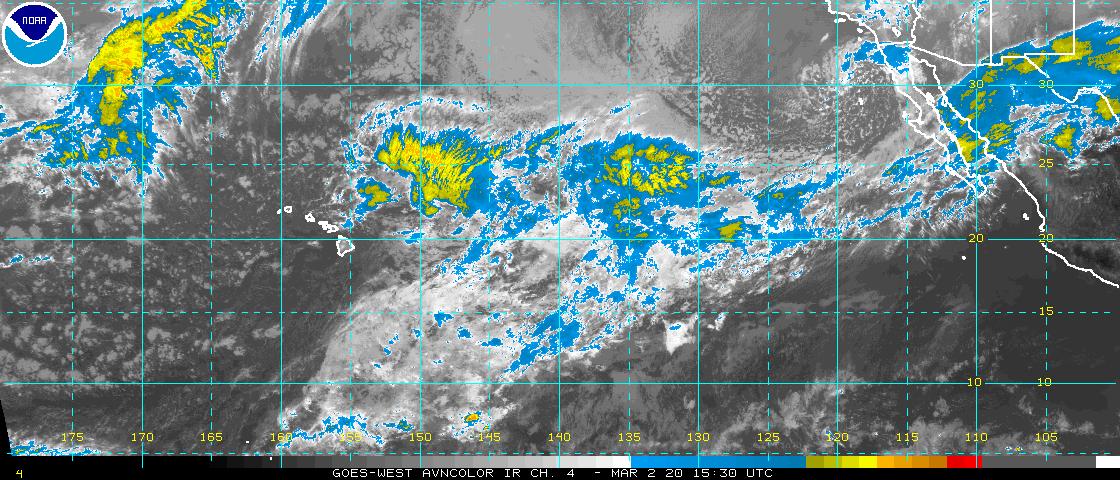
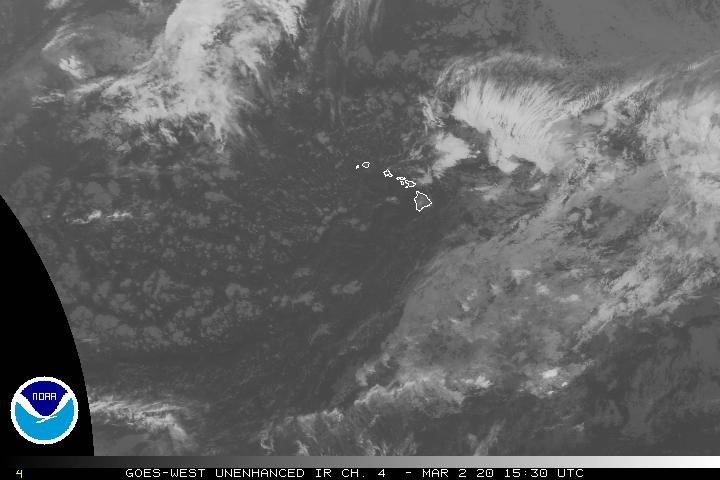
Satellite and Radar Images: To view the cloud conditions we have here in Hawaii, please use the following satellite links, starting off with this Infrared Satellite Image of the islands to see all the clouds around during the day and night. This next image is one that gives close images of the islands only during the daytime hours, and is referred to as a Close-up visible image. This next image shows a larger view of the Pacific…giving perspective to the wider ranging cloud patterns in the Pacific Ocean. Finally, here’s a Looping IR satellite image, making viewable the clouds around the islands 24 hours a day. To help you keep track of where any showers may be around the islands, here’s the latest animated radar image.
Hawaii’s Mountains – Here’s a link to the live webcam on the summit of near 14,000 foot Mauna Kea on the Big Island of Hawaii. The tallest peak on the island of Maui is the Haleakala Crater, which is near 10,000 feet in elevation. These two webcams are available during the daylight hours here in the islands…and when there’s a big moon rising just after sunset for an hour or two! Plus, during the nights and early mornings you will be able to see stars, and the sunrise too…depending upon weather conditions.
Tropical Cyclone activity in the eastern and central Pacific – Here’s the latest weather information coming out of the National Hurricane Center, covering the eastern north Pacific. You can find the latest tropical cyclone information for the central north Pacific (where Hawaii is located) by clicking on this link to the Central Pacific Hurricane Center. Here’s a tracking map covering both the eastern and central Pacific Ocean. A satellite image, which shows the entire ocean area between Hawaii and the Mexican coast…can be found here. Of course, as we know, our hurricane season won’t begin again until June 1st here in the central Pacific.
Aloha Paragraphs

Windward showers, trade winds…generally quite nice leeward
The early August trade winds will continue to blow…diminishing a little during the second half of this new week. Small craft advisories remain in force over those windiest areas around the
Our local atmosphere has become somewhat more shower prone tonight…and will remain that way into Tuesday morning. The windward sides will benefit from these showers the most, although a few showers will be carried over into the leeward sides locally…on the gusty trade winds. Satellite imagery shows partly to mostly cloudy conditions to the east and northeast of the islands…as we see on this IR satellite image. One batch of showery looking clouds is moving over our windward sides now. Using this same satellite image we see thunderstorm activity down to the southwest and southeast, in the deeper tropics.
It’s Monday evening as I begin writing this last section of this morning’s narrative update. As noted above, our trade winds remain quite breezy this week, with no end in sight to our gusty weather. To get an idea how strong the trade winds are near sea level, in gusts…these were the highest as of early Monday evening, on each of the islands:
Kauai – 31 mph
Oahu – 35
Molokai – 30
Kahoolawe – 37
Lanai – 23
Maui – 39
Big Island – 35
~~~ The numbers above suggest that our trade winds are definitely still active. Showers will be more active now too, and will remain that way along our windward sides tonight. We’d like to see some of this precipitation carry over into those dry leeward areas, which could happen on the smaller islands here and there. Here in Kihei, Maui before I leave for the near 40 minute drive back upcountry to Kula, it’s partly cloudy. I can see those thicker clouds over towards Makawao, and Haiku, which look like they could be shower producers. It’s cloudy looking upcountry towards Kula, although it looks dry from down here. I got a picture from my neighbor however, that showed a heavy shower fell up that way during the afternoon. The trade winds are blowing, and speaking of which, they were pretty darn gusty down at the beach here in Kihei at lunch. The ocean was all frothed-up with white caps, that’s for sure. It certainly didn’t seem to be keeping anyone away from the beach though. I’ll be back here early Tuesday morning with your next new weather narrative, I hope you have a great Monday night until then! Aloha for now…Glenn.
Interesting: Scorching heat across Moscow, and the rest of western Russia, will continue for at least another week. The average temperature in Moscow was 15 degrees Fahrenheit above normal for the month of July. This makes July the hottest month ever recorded, according to the Moscow Meteorological Bureau. For the month to average 15 degrees above normal, temperatures all 31 days were at least 5 degrees to as much as 26 degrees above normal, so it was quite an incredible feat.
An "Omega block" weather pattern has set up over western Russia. Once the weather pattern goes into an "Omega block" setup, it is very hard to get out of that pattern. This is why temperatures will stay much hotter than normal for the next one or two weeks. The normal high temperature for Moscow in July is 72 degrees Fahrenheit .
The temperature was above 90 degrees Fahrenheit more than a dozen days during the month, and the temperature today was once again near 100 degrees Fahrenheit. Not only has it been hot, but it has been very dry. According to the Russia Emergency Ministry, wildfires have burned more than 300,000 acres of land. Another problem has been drownings. According to Russia Emergency Ministry, more than 1,200 people have drown this year in Russia’s lakes and rivers.
Officials believe many of the people that drown had been drinking vodka. Floods caused by a week of heavy rain have killed more than 1,000 people in Pakistan’s northwest and rescuers battled on Sunday to distribute relief to tens of thousands of trapped people. A westerly weather system moving in from Iran and Afghanistan, combined with heavy monsoon rain, caused the worst floods on record in Pakistan in the past week, with the northwestern province of Khyber-Pakhtunkhwa the worst hit.
Interesting2: Moscow, Russia, 29 July 2010, was World Tiger Day—the Russian government introduced measures to protect the Korean pine, a key species found in Amur tiger habitat in the Russian Far East. Rising global demand for Korean pine has led to a massive increase in logging, much of it carried out illegally, in Russia’s remaining temperate forests. To help regulate the logging, Russia has listed the Korean pine in Appendix III of CITES (the Convention on International Trade in Endangered Species of Wild Fauna and Flora).
The listing means exports of Korean pine timber from Russia will need CITES permits, which will make it harder for the illegal timber trade to carry on. "TRAFFIC and WWF-Russia warmly welcome the measures to regulate the trade in Korean pine timber, which is good news for the local people whose livelihoods depend on the trade in Korean pine nuts and for Amur tigers which live where these trees grow," said Alexey Vaisman, Senior Program Officer with TRAFFIC Europe-Russia.
"The new measures will need to be backed up with appropriate enforcement action," added Vaisman. Analysis of export data show the commercial trade in Korean pine timber rising over the last decade, in spite the global economic downturn which has reduced trade in most timber species. The new measures will benefit the legal pine nut trade in the region which WWF and TRAFFIC have been promoting as a means of providing legal and sustainable income.
"We hope the listing in CITES will finally help break the system of illegal logging of Korean pines and help the survival of trade in alternative, sustainable forestry products from the region," said Evgeny Lepeshkin, Forestry Projects Co-ordinator with the Amur branch of WWF Russia. The recently introduced measures come in the midst of a particularly active year for tiger conservation.
Interesting3: Wildlife experts in the United States have announced an ambitious plan to rescue hundreds of turtle nests and eggs from the potential impacts of the oil spill in the Gulf of Mexico. Using a strategy never tested before on such a massive scale, the U.S. Fish and Wildlife Service will coordinate the collection of around 80,000 eggs from 800 nests on the beaches of Alabama and northwest Florida and move them hundreds of miles away to the oil-free Atlantic coast.
Collected at a point in the incubation cycle where the loss of viable eggs should be minimized, the nests will be transported in protective containers and kept at a climate-controlled location before successful hatchlings are released on the east central coast of Florida.
As the oil spill coincided with the turtle’s breeding season, it is feared that without action many turtle hatchlings could become coated in oil or be poisoned by food soaked in crude. So far, the loggerhead turtle, the world’s largest hard-shelled turtle, and Kemp’s ridley turtle, the most critically endangered sea turtle, have been most severely affected.
Both these species are already threatened by habitat loss and bycatch in commercial fisheries; however, it is hoped that the bulk of the nests in the northern gulf will be saved, protecting these vulnerable reptiles from further declines.
Interesting4: NASA scientists braced for ‘solar tsunami’ to hit earth. The earth could be hit by a wave of violent space weather as early as Tuesday after a massive explosion of the sun, scientists have warned. The solar fireworks at the weekend were recorded by several satellites, including Nasa’s new Solar Dynamics Observatory which watched its shock wave rippling outwards. Astronomers from all over the world witnessed the huge flare above a giant sunspot the size of the Earth, which they linked to an even larger eruption across the surface of Sun.
The explosion was aimed directly towards Earth, which then sent a “solar tsunami” racing 93 million miles across space. Images from the SDO hint at a shock wave travelling from the flare into space, the New Scientist reported. Experts said the wave of supercharged gas will likely reach the Earth on Tuesday, when it will buffet the natural magnetic shield protecting Earth.
It is likely to spark spectacular displays of the aurora or northern and southern lights. Scientists have warned that a really big solar eruption could destroy satellites and wreck power and communications grids around the globe if it happened today. NASA recently warned that Britain could face widespread power blackouts and be left without critical communication signals for long periods of time, after the earth is hit by a once-in-a-generation “space storm”.
The Daily Telegraph disclosed in June that senior space agency scientists believed the Earth will be hit with unprecedented levels of magnetic energy from solar flares after the Sun wakes “from a deep slumber” sometime around 2013. It remains unclear however, how much damage this latest eruption will cause the world’s communication tools. Dr Lucie Green, of the Mullard Space Science Laboratory, Surrey, followed the flare-ups using Japan’s orbiting Hinode telescope.
"What wonderful fireworks the Sun has been producing,” the UK solar expert said. “This was a very rare event – not one, but two almost simultaneous eruptions from different locations on the sun were launched toward the Earth. "These eruptions occur when immense magnetic structures in the solar atmosphere lose their stability and can no longer be held down by the Sun’s huge gravitational pull.
Just like a coiled spring suddenly being released, they erupt into space.” She added: "It looks like the first eruption was so large that it changed the magnetic fields throughout half the Sun’s visible atmosphere and provided the right conditions for the second eruption. "Both eruptions could be Earth-directed but may be travelling at different speeds. “This means we have a very good chance of seeing major and prolonged effects, such as the northern lights at low latitudes."
 Email Glenn James: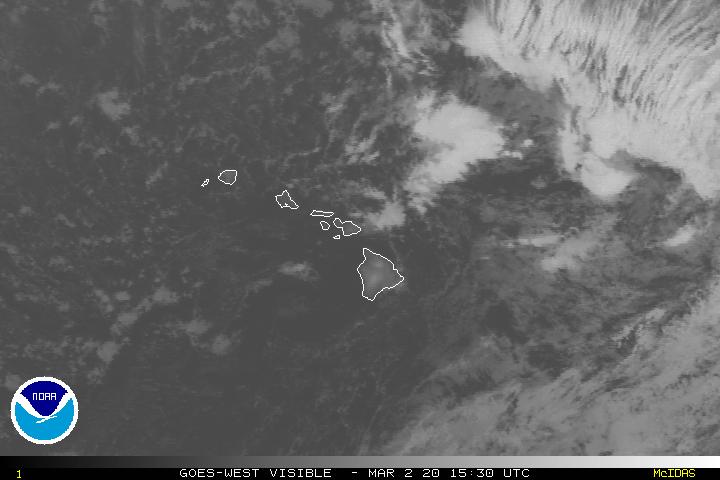


jennifer Says:
hello, we have never been to maui and are thinking about going in early july 2011. is that the rainy season? we are from seattle so light rain WITH sun would not spoil our visit. thanks.~~~Hello Jennifer, early July is a great time to visit Maui, typically the trade winds are blowing, warm temperatures, and not much rainfall. I think yours is a good idea, come visit paradise. Aloha, Glenn