August 15-16, 2010
Air Temperatures – The following maximum temperatures were recorded across the state of Hawaii Sunday afternoon:
Lihue, Kauai – 84
Honolulu, Oahu – 87
Kaneohe, Oahu – 83
Kaunakakai, Molokai – 84
Kahului, Maui – 88
Hilo, Hawaii – 83
Kailua-kona – 83
Air Temperatures ranged between these warmest and coolest spots near sea level – and on the highest mountain tops…as of 6pm Sunday evening:
Barking Sands, Kauai – 83
Kapalua, Maui – 77
Haleakala Crater – 54 (near 10,000 feet on Maui)
Mauna Kea summit – 43 (near 14,000 feet on the Big Island)
Precipitation Totals – The following numbers represent the largest precipitation totals (inches) during the last 24 hours on each of the major islands, as of Sunday afternoon:
0.06 Mount Waialeale, Kauai
0.04 Wilson Tunnel, Oahu
0.01 Molokai
0.00 Lanai
0.00 Kahoolawe
0.12 Puu Kukui, Maui
0.31 Piihonua, Big Island
Marine Winds – Here’s the latest (automatically updated) weather map showing a 1023 millibar high pressure system located northeast of the islands. Our local trade winds will remain active Monday and Tuesday.
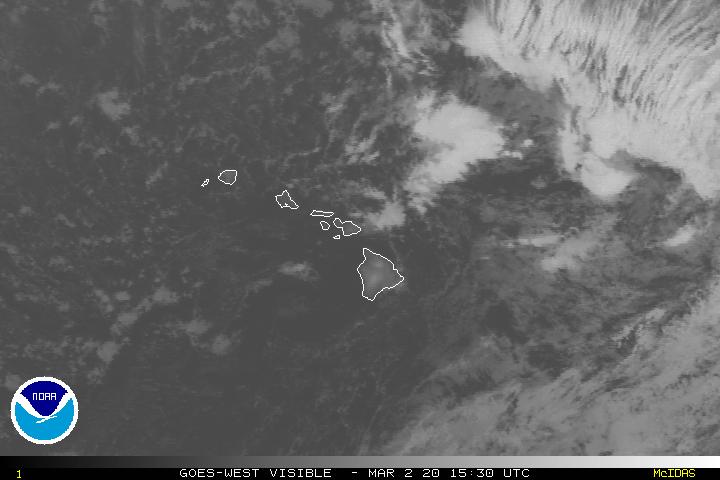
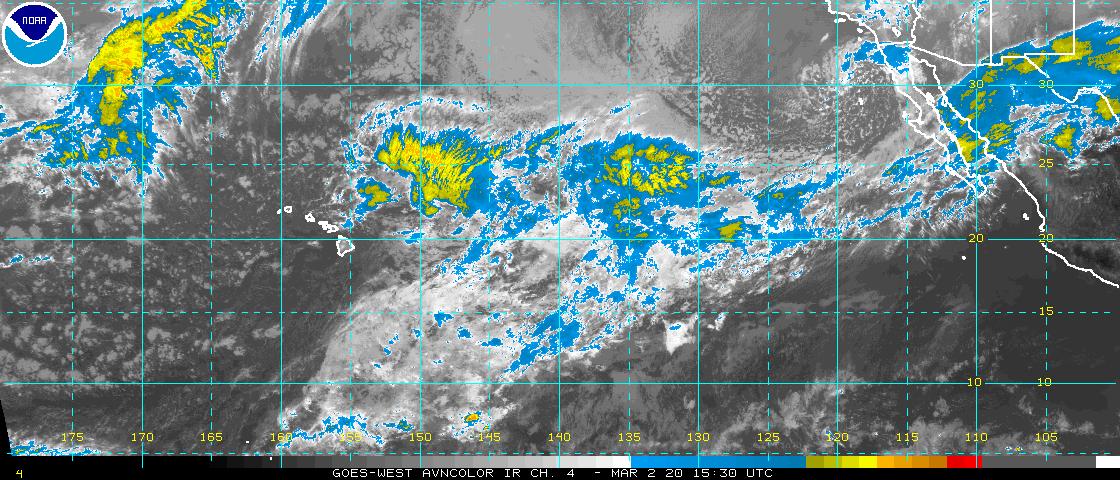
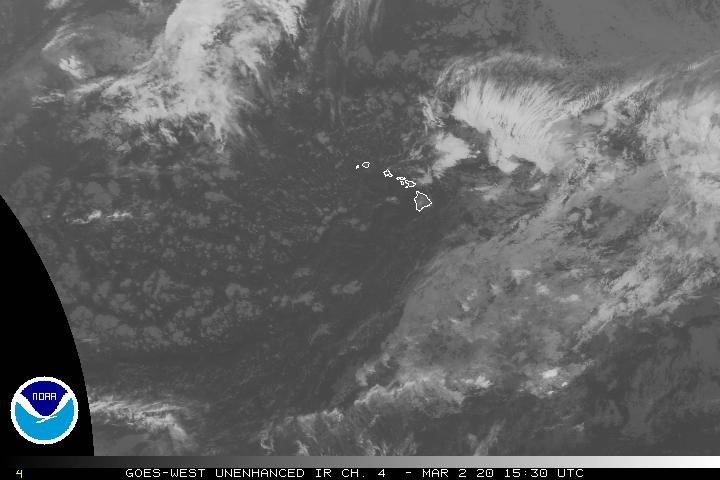
Satellite and Radar Images: To view the cloud conditions we have here in Hawaii, please use the following satellite links, starting off with this Infrared Satellite Image of the islands to see all the clouds around during the day and night. This next image is one that gives close images of the islands only during the daytime hours, and is referred to as a Close-up visible image. This next image shows a larger view of the Pacific…giving perspective to the wider ranging cloud patterns in the Pacific Ocean. Finally, here’s a Looping IR satellite image, making viewable the clouds around the islands 24 hours a day. To help you keep track of where any showers may be around the islands, here’s the latest animated radar image.
Hawaii’s Mountains – Here’s a link to the live webcam on the summit of near 14,000 foot Mauna Kea on the Big Island of Hawaii. The tallest peak on the island of Maui is the Haleakala Crater, which is near 10,000 feet in elevation. These two webcams are available during the daylight hours here in the islands…and when there’s a big moon rising just after sunset for an hour or two! Plus, during the nights and early mornings you will be able to see stars, and the sunrise too…depending upon weather conditions.
Tropical Cyclone activity in the eastern and central Pacific – Here’s the latest weather information coming out of the National Hurricane Center, covering the eastern north Pacific. You can find the latest tropical cyclone information for the central north Pacific (where Hawaii is located) by clicking on this link to the Central Pacific Hurricane Center. Here’s a tracking map covering both the eastern and central Pacific Ocean. A satellite image, which shows the entire ocean area between Hawaii and the Mexican coast…can be found here. Of course, as we know, our hurricane season won’t begin again until June 1st here in the central Pacific.
Aloha Paragraphs

Popular eating fish in Hawaiian waters
Our trade winds will continue blowing…through the next week. Wind speeds will range between the light to moderately strong levels. There are no expectations of small craft advisory level winds returning through at least the first half of this new work week.
We’ll find a few showers falling along the windward sides at times. This more or less normal trade wind weather pattern will remain in place through the new week. This satellite image shows just a scattering of clouds upstream of the islands. Glancing down further to the south of the islands, in the deeper tropics, using this satellite picture, we see thunderstorm activity to the south of our islands…with some cirrus clouds in the picture too.
It’s Sunday
evening as I begin writing this last section of today’s narrative update. Friday night after work I went to see The Expendables (2010), starring Sylvester Stallone, Jason Statham, Jet Li, Bruce Willis, Arnold Schwarzenegger, Mickey Rourke…among others. This was another one of those heavy duty action films, with lots of adventure, crime, and with gangsters of course. The critics reviews are coming with a B- grade, while the viewers are giving it an A- grade. This film was very macho, which I didn’t have a problem with. There were big guns, some cool music, lots of killing of course, the attractive woman…and all the rest of the stuff that goes along with these kinds of films. The theatre in Kahului was packed, so that there must be some interest in this kind of subject matter. I would give it a B- grade. Here’s a trailer just in case you have any interest in seeing it.
~~~ Our skies are quite cloudy over Kula, Maui at the time of this writing, with clouds around in other areas on this island just before sunset. The air temperature here at my house, at around 630pm, was 66.9F degrees. This morning I started the day with a good long walk out along Thompson Ranch Rd. I came back here and had a good breakfast, coffee and a pastry. I sat around and read a little while, before starting the project of changing the oil, and oil filter in my car. I have a 1997 BMW M3, which is an old car, but I love it nonetheless. At any rate, I got that important job done, and then settled down for some more rest this afternoon. I cooked myself some food for the upcoming work work with, which included a batch of organic okra, carrots, mushrooms, red onion, and brussel spouts. Towards the end of the cooking, I put in four nice pieces of boneless organic chicken thighs. I look forward to having a portion of this together with crackers, avocado, and cheese Mondary through Thursday nights for dinner. I’ll pop a nice bottle of red wine, and have a glass with each meal as well. ~~~ Right now I’ve got to go down and take a rinse
in my outdoor shower, which is lovely. I’ll meet you back here early Monday morning, when I’ll have your next new weather narrative waiting for you around 555am, Hawaii standard time. I hope you have a great Sunday night until then! Aloha for now…Glenn.
Interesting: When a JetBlue flight attendant creatively deplaned earlier this week, many questions arose as to why someone would be willing to give up a steady paycheck during these tough economic times. While this "working man’s hero" will most likely be questioning his motives as he hands over his lawyer’s fees, a new report in Perspectives on Psychological Science, a journal of the Association for Psychological Science, suggests that his action may be a sign of trouble for JetBlue and other large companies.
We spend a lot of our waking time at work, so it’s not surprising that work has an influence on our well-being: Numerous studies have linked general attitudes towards work to mood outside of work and health outcomes such as coronary heart disease. However, psychological scientist James K. Harter of Gallup, Inc. and his colleagues found that employee perceptions of work conditions may also have a big impact on the bottom line of employing organizations.
In this study, the researchers examined data from more than 2,000 business units (e.g., retail stores, factories, sales offices) of ten companies. The data consisted of employee satisfaction surveys, employee retention rates, customer loyalty, and financial performance of the organizations. Analyses of the data were conducted to identify relationships between employee job satisfaction and outcome measures of the organizations.
The results indicate that employee work perceptions predict important organizational outcomes — if employees have positive perceptions of their jobs, their organizations benefit via higher employee retention, increased customer loyalty, and improved financial outcomes. Interestingly, the analysis suggests that employee perceptions affect outcomes more than outcomes affect employee perceptions of their jobs.
"One implication is that changes in management practices that improve employee perceptions of specific work situation variables will increase business-unit outcomes, including financial outcomes," the authors note. Additionally, Harter and colleagues offer that one way managers can help boost job satisfaction and help their organization may be to "clarify expectations for employees by helping employees see the ultimate outcomes the organization is working to achieve and how they play a role in achieving those outcomes."
Interesting2: The growing amount of human noise pollution in the ocean could lead fish away from good habitat and off to their death, according to new research from a UK-led team working on the Great Barrier Reef. After developing for weeks at sea, baby tropical fish rely on natural noises to find the coral reefs where they can survive and thrive. However, the researchers found that short exposure to artificial noise makes fish become attracted to inappropriate sounds.
In earlier research, Dr Steve Simpson, Senior Researcher in the University of Bristol’s School of Biological Sciences discovered that baby reef fish use sounds made by fish, shrimps and sea urchins as a cue to find coral reefs. With human noise pollution from ships, wind farms and oil prospecting on the increase, he is now concerned that this crucial behavior is coming under threat.
He said: "When only a few weeks old, baby reef fish face a monumental challenge in locating and choosing suitable habitat. Reef noise gives them vital information, but if they can learn, remember and become attracted towards the wrong sounds, we might be leading them in all the wrong directions." Using underwater nocturnal light traps, Dr Simpson and his team collected baby damselfish as they were returning to coral reefs.
The fish were then put into tanks with underwater speakers playing natural reef noise or a synthesized mix of pure tones. The next night the fish were put into specially designed choice chambers (long tubes with contrasting conditions at each end in which fish can move freely towards the end they prefer) with natural or artificial sounds playing. All the fish liked the reef noise, but only the fish that had experienced the tone mix swam towards it, the others were repelled by it.
Dr Simpson said: "This result shows that fish can learn a new sound and remember it hours later, debunking the 3-second memory myth." His collaborator, Dr Mark Meekan added: "It also shows that they can discriminate between sounds and, based on their experience, become attracted to sounds which might really mess up their behavior on the most important night of their life."
In noisy environments the breakdown of natural behavior could have devastating impacts on success of populations and the replenishment of future fish stocks. Dr Simpson said: "Anthropogenic noise has increased dramatically in recent years, with small boats, shipping, drilling, pile driving and seismic testing now sometimes drowning out the natural sounds of fish and snapping shrimps. If fish accidentally learn to follow the wrong sounds, they could end up stuck next to a construction site or follow a ship back out to sea."
Interesting3: Our cities play a vital role in the quest to achieve global ecological sustainability. They are the largest contributors to greenhouse gases and climate change. However, if we can achieve sustainable construction and use of urban infrastructure, our cities could become a critical leverage point in global efforts to drastically reduce emissions and avoid the social and economic costs associated with climate change, as well as enhance energy security and resilience in the face of high fossil energy prices.
The world’s urban centers already account for close to 80 percent of CO2 emissions. In the next three decades, the global population will continue to grow and become ever more urban. Booz & Company analysis conducted for this report shows that under business-as-usual (BAU) assumptions, $350 trillion will be spent on urban infrastructure and usage during this period.
This huge expenditure either can cause the ecological impact of our cities to become even more pronounced or can be a tremendous opportunity to reduce that impact. To meet the urban challenge, cities around the world—in developed and developing nations—need to tackle climate change directly. Cities in developed nations can apply new technologies to mitigate greenhouse gas emissions stemming from the usage of their existing infrastructure.
They can invest in mobility management and incentivize sustainable lifestyle choices. Cities in developing nations can adopt best practices in urban planning and mobility management, as well as technological advances, to design sustainability into their new infrastructure. Every city is part of the solution—now is the time to act!
Interesting4: Decades ago the only type of car was the internal combustion (gasoline) type. Other varieties have arrived such as Hybrid and electric. With the new choices are other decisions such as which one reduces most the carbon footprint (or is the most green) and which one is the most cost effective. No more is "the miles per gallon" a standard that can be applied across the board as a specification. The efficiency of a car will depend, obviously, on the overall weight and size. Consumers will buy vehicles for their perceived needs.
The new breeds of cars that are evolving depend on other features to improve performance and efficiency. They fall into the following categories: hybrid, all electric, high efficiency gasoline engines. A hybrid electric (HEV) is a type of vehicle which combines a conventional internal combustion engine (ICE) propulsion system with an electric propulsion system. The presence of the electric power train is intended to achieve either better fuel economy than a conventional vehicle, or better performance.
A variety of types of HEV exist, and the degree to which they function as EVs varies as well. The most common form of HEV is the hybrid electric car, although hybrid electric trucks (pickups and tractors) also exist. Modern HEVs make use of efficiency improving technologies such as regenerative braking, which converts the vehicle’s kinetic energy into battery replenishing electric energy, rather than wasting it as heat energy as conventional brakes do.
Some varieties of HEVs use their internal combustion engine to generate electricity by spinning an electrical generator (this combination is known as a motor-generator), to either recharge their batteries or to directly power the electric drive motors. Many HEVs reduce idle emissions by shutting down the ICE at idle and restarting it when needed; this is known as a start-stop system.
A hybrid-electric produces less emissions from its ICE than a comparably-sized gasoline car, as an HEV’s gasoline engine is usually smaller than a pure fossil-fuel vehicle, and if not used to directly drive the car, can be geared to run at maximum efficiency, further improving fuel economy. A hybrid car definitely reduces air emissions because of its using sources of energy otherwise wasted in a conventional car engine.
An electric car is an automobile which is propelled by an electric motor which is entirely powered by electrochemical cells. Electric cars are usually powered by on board battery packs, and as such are usually battery electric vehicles, although some are powered by fuel cells. Although electric cars often give good acceleration and have generally acceptable top speed, the lower specific energy of production batteries available in 2010 compared with fossil fuels means that electric cars have relatively low range between charges, and recharging can take significant lengths of time.
For shorter range commuter type journeys, rather than long journeys, electric cars are practical forms of transportation and can be inexpensively recharged overnight. Longer range journey options are currently being pursued as cities such as New York and states such as Washington start building a charging station infrastructure. Electric cars will not emit as many pollutants as an conventional car engine but the electricity is generated somewhere and at that source the same (though more controlled) air emissions will occur.
There are other factors to consider also such as the relative capital cost of a vehicle and how much it costs per mile to drive. At the moment due to limited production capacities, capital costs are higher than they will be eventually though governmental subsidies help reduce this burden. Also there is limited durability and long term maintenance of the new breeds of cars that is still to be determined by real data.
Hybrid cars, because they still use gasoline, can still be measured in miles per gallon. Hybrids can get 40 -50 miles per gallon as compared to the equivalent gasoline engine performance of 25 to 35. This is about 6 cents per mile for gasoline cost alone for hybrids. A comparable gasoline vehicle would be about 10 cents per mile. Electric costs for electric cars are variable depending on where you live as well as when you use it (night time rates can be lower to less demand). Others have estimated this cost as around 2 to 4 cents per mile which is comparable to hybrid and gasoline vehicles.
 Email Glenn James: