











August 12-13, 2010
Air Temperatures – The following maximum temperatures were recorded across the state of Hawaii Thursday afternoon:
Lihue, Kauai – 84
Honolulu, Oahu – 88
Kaneohe, Oahu – 84
Kaunakakai, Molokai – 84
Kahului, Maui – 89
Hilo, Hawaii – 84
Kailua-kona – 84
Air Temperatures ranged between these warmest and coolest spots near sea level – and on the highest mountain tops…as of 5pm Thursday evening:
Kahului, Maui – 84
Lihue, Kauai – 75
Haleakala Crater – 54 (near 10,000 feet on Maui)
Mauna Kea summit – 36 (near 14,000 feet on the Big Island)
Precipitation Totals – The following numbers represent the largest precipitation totals (inches) during the last 24 hours on each of the major islands, as of Thursday afternoon:
0.64 Mount Waialeale, Kauai
0.12 Moanalua RG, Oahu
0.02 Molokai
0.00 Lanai
0.00 Kahoolawe
0.03 West Wailuaiki, Maui
0.05 Mountain View, Big Island
Marine Winds – Here’s the latest (automatically updated) weather map showing high pressure systems far to the north-northeast and northeast of the islands. Our local trade winds will remain active Friday and Saturday.
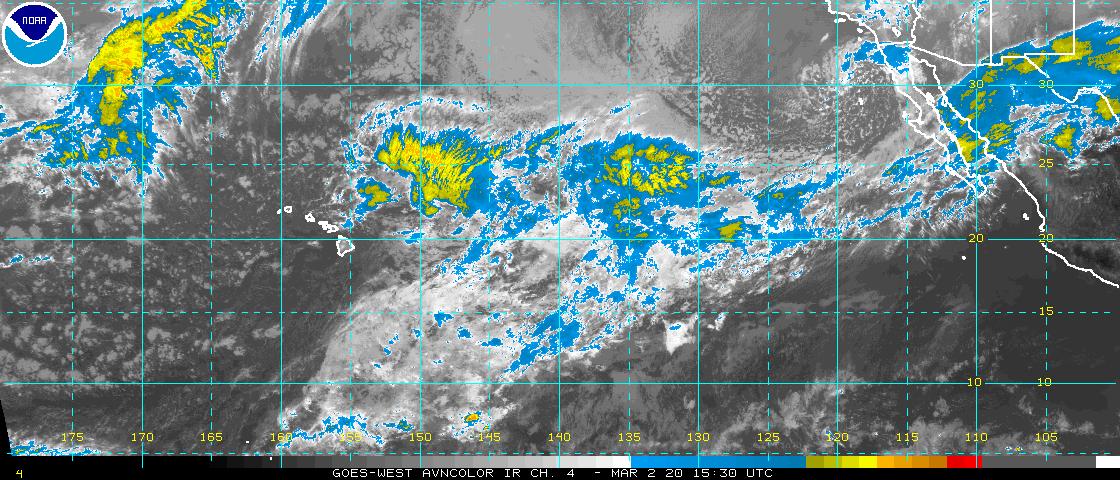
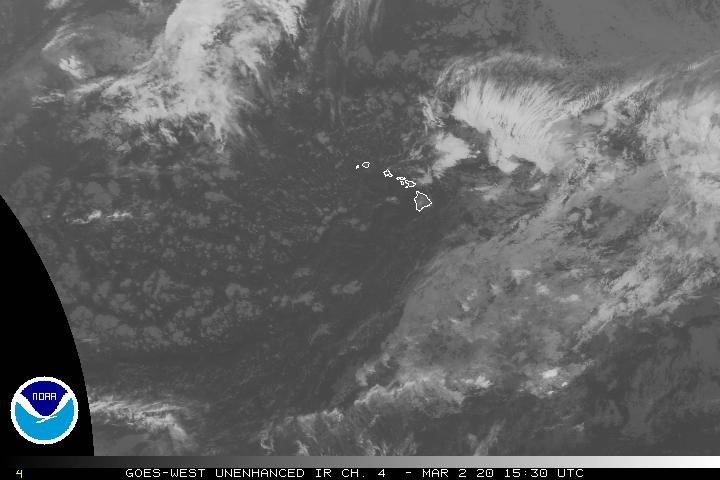
Satellite and Radar Images: To view the cloud conditions we have here in Hawaii, please use the following satellite links, starting off with this Infrared Satellite Image of the islands to see all the clouds around during the day and night. This next image is one that gives close images of the islands only during the daytime hours, and is referred to as a Close-up visible image. This next image shows a larger view of the Pacific…giving perspective to the wider ranging cloud patterns in the Pacific Ocean. Finally, here’s a Looping IR satellite image, making viewable the clouds around the islands 24 hours a day. To help you keep track of where any showers may be around the islands, here’s the latest animated radar image.
Hawaii’s Mountains – Here’s a link to the live webcam on the summit of near 14,000 foot Mauna Kea on the Big Island of Hawaii. The tallest peak on the island of Maui is the Haleakala Crater, which is near 10,000 feet in elevation. These two webcams are available during the daylight hours here in the islands…and when there’s a big moon rising just after sunset for an hour or two! Plus, during the nights and early mornings you will be able to see stars, and the sunrise too…depending upon weather conditions.
Tropical Cyclone activity in the eastern and central Pacific – Here’s the latest weather information coming out of the National Hurricane Center, covering the eastern north Pacific. You can find the latest tropical cyclone information for the central north Pacific (where Hawaii is located) by clicking on this link to the Central Pacific Hurricane Center. Here’s a tracking map covering both the eastern and central Pacific Ocean. A satellite image, which shows the entire ocean area between Hawaii and the Mexican coast…can be found here. Of course, as we know, our hurricane season won’t begin again until June 1st here in the central Pacific.
Aloha Paragraphs

Perseids Meteor Shower tonight
Moderately strong trade winds today, will give way to somewhat lighter winds Friday into the wekeend. This weather map shows moderately strong high pressure systems located far to our north-northeast and northeast, the source of our trade breezes Thursday night. The small craft wind advisory was cancelled late Thursday afternoon around Maui and the Big Island. At the higher elevations on Maui and the
Here’s the strongest gusts as of early evening Thursday:
Kauai – 30 mph
Oahu – 30
Molokai – 27
Kahoolawe – 35
Maui – 39
Lanai – 04 – blocked from the gusty trade winds
Big Island – 35
We’ll find a few showers falling along the windward sides at times…with dry conditions for the most part along our leeward sides. This more or less normal trade wind flow will remain in place through the rest of this week. This satellite image shows a fairly normal distribution of clouds around the islands…bringing in those occasional showers noted above. Glancing down further to the south of the islands, in the deeper tropics, using this satellite picture, we see thunderstorm activity…to the southwest and southeast of our islands. The trough of low pressure to our south is keeping a few towering cumulonimbus clouds (thunderstorms) around.
It’s Thursday
evening as I begin writing this last section of today’s narrative update. Our trade winds will remain active for the time being. These winds will likely ease up a touch Friday into the weekend…although continue on into next week.
~~~ Somehow a small mouse got into my house four days ago, and I was going to ask my neighbor to borrow his humane mouse trap. This is one of those things that you can catch the mouse, and then let it go out a field someplace. Well, when I went down to get some water this morning, I heard this rustling in my trash container. The mouse had somehow got up the side, and I guess fell in! So, I heard this scampering around, where he/she/it trapped itself. I took the container down to Kihei with me yesterday morning, to let this lucky mouse go in the field there. I prefer this to the typical mouse traps.
~~~ The next episode of this mouse in the house story, is that it may have turned into a mouse in the car story! I brought the furry little creature down to Kihei as planned, and was going to give it back its freedom shortly after I came into the office, and got my first couple of products emailed out…here at the Pacific Disaster Center. I went out there to get the bag, and walked out into the nearby field, and lo and behold, the mouse had chewed a hole in this bag, and escaped into my car! So, I left my car doors opened all day, and will do that again on Wednesday. Come Thursday though, if he or she hasn’t had the good sense to jump out of my car, I’ll have to take more drastic measures. This will be to put a regular mouse trap into my car, baited with cheese or peanut butter, and hope that this mouse is long gone already. I’ll keep you abreast of this story until I find out one way or the other on Thursday.
~~~ I’ve seen no sign of my little mouse friend in the car. I’ve had a new thought today, and that is rather than to test to see if he as moved out of my car, with a regular trap on Thursday…I’ll simply put a little cheese on the floor of my car, and see if it’s gone at the end of the day. If it is gone, I’ll try opening my car doors for another day, and then I’ll be forced to put a mouse trap in there. Although, it just occurred to me that I could put the humane trap in the car on Friday, and catch it that way. I’m hoping however, that the little chunk of cheese will still be there at the end of the day, and I’ll figure that Mr. or Mrs. mouse has taken the hint to leave. Thursday will be the proving day, as either the cheese will be eaten, not good…or it will remain in place. I’ll let you know which way it goes later Thursday.
~~~ Ok, this is the last installment on this mouse story. This morning when I left home I took a little chunk of organic colby cheese, and a leaf with me to work. When I got to Kihei, I left that cheese on the leaf, and with the windows rolled down several inches just in case, came into the office. A couple of hours later I went out there, hoping to still see the cheese, and fortunately there it was! I came back in another couple of hours, and it was still there. I figured that this was enough of a test, to ensure that my mouse friend had jumped out of my car that first day…probably within minutes of my going into the office when he had escaped from the paper bag. I’m perfectly comfortable knowing that that mouse is scampering around in the bushes someplace here in Kihei. It’s a bit hotter down here, then where he was raised by his Mom up in Kula, but at least he had a fighting chance to experience life for a while longer. So, end of story!
~~~ Here in Kihei, Maui,its mostly clear at around 530pm, which is fortunate for us folks who want to get out there and watch the meteor shower tonight. Last night was too cloudy to see many stars, at least upcountry in Kula. I’m taking off now, for the drive back home, and out on my early evening walk, before coming in for dinner. I’ll go to bed around my usual time, and then be up at least several times tonight, peeling myself out of bed and out on my weather deck. I’m hoping that all the hype about this meteor shower being a great one will come true. I’ll either get back on the computer late tonight, to exclaim how many I saw, or at the latest early Friday morning with more about this. I hope you have a great Thursday night, and best of luck on your own viewing prospects. Let me know what you see! On the east coast, at the time of this writing it’s already almost 1am Friday morning, and the meteor shower is probably going well by now. On the west coast, it’s going on 9pm. There’s a reply box down at the bottom of this page, and if there’s anyone out there reading, please let us know what your name is, where you live, and how many shooting stars you saw for the time period you were watching. If anyone writes anything, we can all read their words down near the reply box. I’m going to write a quick note now, so you will be able to see where people might be willing to write a quick something. Aloha for now…Glenn.
Extra: Perseid Meteor Shower information (new link provided Wednesday evening), best viewing tonight, August 12th…into early Friday morning.
Interesting: The worst flooding in decades across Pakistan shows no signs of relenting. 15 million people have been impacted by the catastrophic flooding, including over 1,300 deaths, 1,588 injured and over 350,000 rescued. Heavy rain will persist across northern and parts of central Pakistan through the weekend as the monsoon season continues. The monsoon season typically spans from July into September.
Daily bouts of heavy rain occur, often leading to deadly flash floods. This season has been exceptionally wet, with many areas of northern Pakistan receiving daily rainfall amounts of 3-5 inches. With a deep south to southeast wind flow bringing very tropical air northward over the next several days, more downpours will further aggravate flooding throughout the nation.
Pakistan officials are expecting flood levels on the Indus River to reach ‘very high to exceptionally high’ levels over the next few days. Officials are also fearing a rise of water-borne diseases to start impacting residence over the next several days.
Interesting2: Some of Russia’s smog-causing peat land fires are likely to burn for months, part of a global problem of drained marshes that emit climate-warming greenhouse gases, experts said on Wednesday. Novel carbon markets could offer a long-term fix for peat bogs, from Indonesia to South Africa, if negotiators of a U.N. climate treaty can agree ways to pay to safeguard marshes that are often drained to make way for farms, roads or homes.
"Peat fires continue underground and…they will not be extinguished in Russia before winter rains and snow set in," said Hans Joosten, professor of peat land studies and paleoecology at the University of Greifswald in Germany. To put out fires "you must inundate the area completely," he said, adding that one peat fire in South Africa near the border with Botswana, for instance, had smoldered for 5 years.
Peat is formed from partly decayed vegetation. Environmental group Wetlands International estimated 80 to 90 percent of the smog in Moscow was from peat land fires near the capital, rather than forest fires linked to what weather officials call Russia’s hottest summer in a millennium. "In Russia, peat fires can sometimes last under snow cover through the winter," said Ilkka Vanha-Majamaa, a scientist at the Finnish Forestry Research Institute.
Water dumped from planes, part of Russia’s response, is rarely enough to halt peat fires, said Alex Kaat, spokesman for Wetlands International. Moscow has pledged more action to extinguish the blazes. "Russia promised the same after peat fires in 2002 and nothing was done," Kaat said, saying past efforts to use water from the Volga River to soak peat lands had been half-hearted.
Interesting3: The Gulf of Mexico has been a problem for fishing and other marine life even since the BP oil spill earlier this year. Things are looking up finally. The National Oceanic and Atmospheric Administration (NOAA) has just reopened 5,144 square miles of Gulf waters to commercial and recreational finfish fishing. Since July 3, NOAA data have shown no oil in the newly reopened area, and United States Coast Guard observers flying over the area in the last 30 days have also not observed any visible oil.
Even more importantly, fish caught in the area and tested by NOAA experts have shown no signs of contamination. The area to be reopened lies to the northeast of the spill site in the area closest to Florida. At its closest point, the area to be reopened is about 115 miles northeast of the Deepwater/BP wellhead.
From June 27 through July 20, NOAA sampled 153 finfish, including grouper, snapper, tuna and mahi mahi, from the area. Sensory and chemical testing of these finfish followed the methodology and procedures in the re-opening protocol, with sensory analysis finding no detectable oil or dispersant odors or flavors, and results of chemical analysis well below any levels of concern.
NOAA will continue to take samples for testing from the newly re-opened area, and the agency has also implemented dockside sampling to test fish caught throughout the Gulf by commercial fishermen. NOAA continues to work closely with the U.S. Food and Drug Administration and the Gulf states to ensure seafood safety. NOAA and FDA are working together on broad scale seafood sampling that includes sampling seafood from inside and outside the closure area, as well as dockside and market based sampling.
The remaining closed area still covers 52,395 square miles, or 22 percent of the federal waters in the Gulf. This is down from about 88,000 square miles that had been closed at the height of the no fishing area alert. Earlier in July, NOAA reopened 26,388 square miles of Gulf waters off of the Florida Peninsula. Recreational fishing is different from commercial fishing.
In mid-July, the Louisiana Department of Wildlife and Fisheries and the Louisiana Wildlife and Fisheries Commission announced significant re-openings for recreational fishing that were previously closed due to the oil spill. With this action, approximately 86 percent of recreational fishing in Louisiana was allowed to return to active service. The openings allow recreational anglers, including recreational shrimping, crabbing and fishing, to resume.
This opening includes licensed charter boat guides and bait fishermen or dealers who harvest for and sell to recreational fishermen exclusively. So there are signs of a return to normalcy in the Gulf region. The no fishing area had steadily expanded since May 2010 and only started to slow and contract in mid-July. So several more months may yet pass until normalcy is achieved once more.
Interesting4: Tonight and tomorrow night marks peak viewing for one of the most prolific and awe-inspiring annual meteor showers visible on Earth, the Perseids, which will rise from the northeast beginning around 10 p.m. This year’s Perseids will be "a little better than average," says Cooke. "I’m looking for a good shower tonight. Normally they’re about 70 to 80 an hour but tonight it could get up to over 100 an hour, thats more than one a minute," he said from his office at NASA’s Marshall Space Flight Center in Huntsville, Alabama. The absolute best viewing times will be between 3 and 4 a.m. Friday morning, says Cooke.
But "generally we tell people to go out, get comfy and around 10 p.m. they’ll start seeing the first meteors." All times are local, as the spinning of the Earth will insure that everyone sees them. The great thing about meteor showers is that you don’t need any special equipment, "just yourself and a good dark place," Cooke says.
As long as you’re well away from city lights, this bright shower of falling stars will be a great show free for the watching. "My advice to people is to lie flat on your back, look straight up and take in as much of the sky as you can, that’s the best way to view meteors," Cooke says.
Named because they come from the direction of the constellation Perseus, the meteors are actually the stream of debris cascading from the comet Swift-Tuttle, which orbits the sun once every 133 years. Because there’s a waxing crescent moon just now, the Perseids should be visible in most of the country where skies are clear.
They will be visible across most of the planet, except in South America south of Brazil, the southern tip of Africa and southern Australia. While the eye adapts to the dark within 10 minutes, a full switch to night vision can take up to 45 minutes, so the falling stars will become brighter and more visible as the night wears on. Be careful not to place yourself where you see oncoming car headlights, which can ‘reset’ the eyes for light, meaning it will take another 45 minutes to get full night vision back.
Most of the meteors in the shower Americans will see tonight and tomorrow night are from a filament of dust from the comet that streamed off in 1862. The Earth passes through the tiny debris cloud that trails the comet every August. The particles of ice and dust burn up as they enter the Earth’s atmosphere, creating a beautiful shower of meteors.
 Email Glenn James: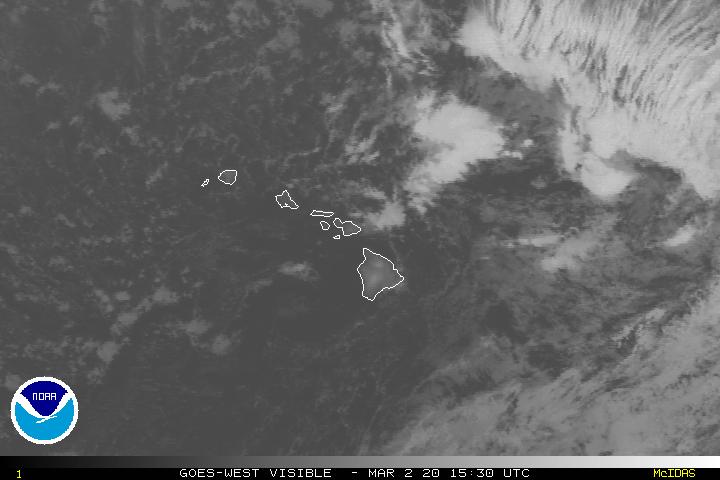


Matt Says:
Nothing at 11pm in Kihei. It’s far too cloudy out. 🙁 Might try again around midnight.~~~Hi Matt, what a night to have all these clouds! Aloha, Glenn
Janet Says:
Went out at 9:30ish in South Kihei and cloud cover was obstructing most of the northern sky. Will try again later.~~~Hi Janet, still lots of clouds up here, and sorry to hear that you have them down there too. Aloha, Glenn
Cathy Says:
saw the Venus, Mars, Saturn triangle tonight
cathy~~~Thanks for the report Cathy. It’s around 345am Friday morning, and still lots of clouds here in Kula. Aloha, Glenn
Cathy Says:
Hi Glenn
going out in a while to take a look..we are on the far west end of Moloka’i. nice and dark here..perfect for watching.
Cathy~~~Hi Cathy, good to hear, unfortunately, here on the western slope of the Haleakala Crater on Maui, we have lots of clouds. Aloha, Glenn
Glenn Says:
Hi everyone, the sunset just happened here on Maui, and I’m getting excited about the meteor shower later tonight, I sure hope I see some! Glenn