











August 10-11, 2010
Air Temperatures – The following maximum temperatures were recorded across the state of Hawaii Tuesday afternoon:
Lihue, Kauai – 85
Honolulu, Oahu – 88
Kaneohe, Oahu – 84
Kaunakakai, Molokai – 85
Kahului, Maui – 88
Hilo, Hawaii – 84
Kailua-kona – 84
Air Temperatures ranged between these warmest and coolest spots near sea level – and on the highest mountain tops too…as of 5pm Tuesday evening:
Barking Sands, Kauai – 85
Hilo, Hawaii – 78
Haleakala Crater – 54 (near 10,000 feet on Maui)
Mauna Kea summit – 41 (near 14,000 feet on the Big Island)
Precipitation Totals – The following numbers represent the largest precipitation totals (inches) during the last 24 hours on each of the major islands, as of Tuesday afternoon:
0.75 Mount Waialeale, Kauai
0.03 Kamehame, Oahu
0.01 Molokai
0.00 Lanai
0.00 Kahoolawe
0.06 Puu Kukui, Maui
0.03 Mountain View, Big Island
Marine Winds – Here’s the latest (automatically updated) weather map showing two near 1032 millibar high pressure systems to the north-northeast of the islands. Our local trade winds will remain active Tuesday and Wednesday.
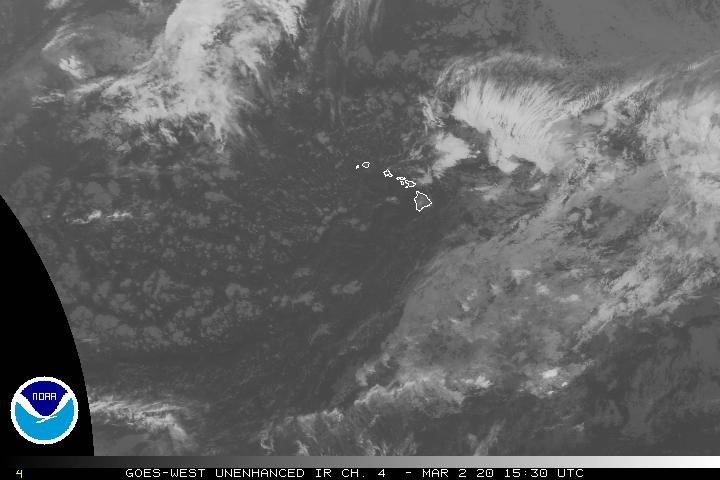
Satellite and Radar Images: To view the cloud conditions we have here in Hawaii, please use the following satellite links, starting off with this Infrared Satellite Image of the islands to see all the clouds around during the day and night. This next image is one that gives close images of the islands only during the daytime hours, and is referred to as a Close-up visible image. This next image shows a larger view of the Pacific…giving perspective to the wider ranging cloud patterns in the Pacific Ocean. Finally, here’s a Looping IR satellite image, making viewable the clouds around the islands 24 hours a day. To help you keep track of where any showers may be around the islands, here’s the latest animated radar image.
Hawaii’s Mountains – Here’s a link to the live webcam on the summit of near 14,000 foot Mauna Kea on the Big Island of Hawaii. The tallest peak on the island of Maui is the Haleakala Crater, which is near 10,000 feet in elevation. These two webcams are available during the daylight hours here in the islands…and when there’s a big moon rising just after sunset for an hour or two! Plus, during the nights and early mornings you will be able to see stars, and the sunrise too…depending upon weather conditions.
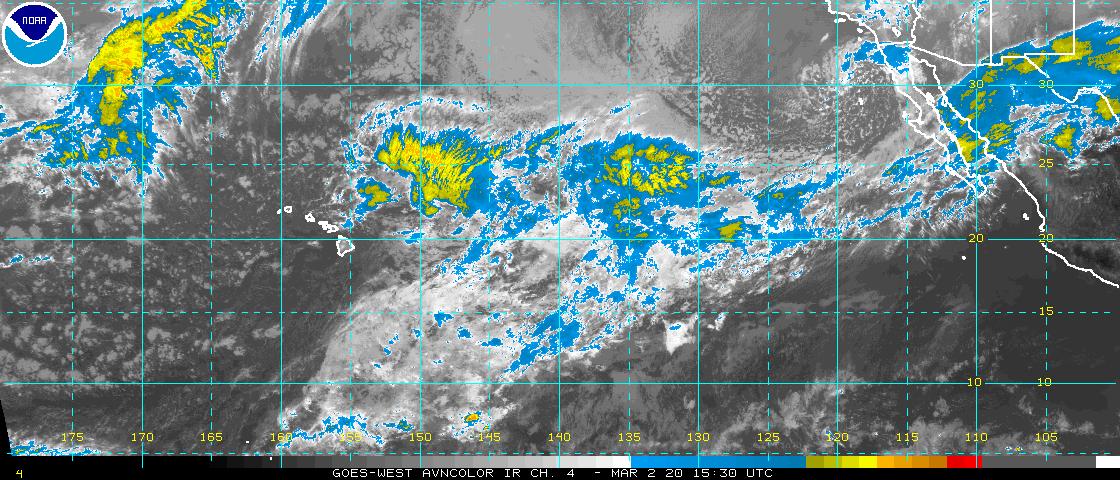
Tropical Cyclone activity in the eastern and central Pacific – Here’s the latest weather information coming out of the National Hurricane Center, covering the eastern north Pacific. You can find the latest tropical cyclone information for the central north Pacific (where Hawaii is located) by clicking on this link to the Central Pacific Hurricane Center. Here’s a tracking map covering both the eastern and central Pacific Ocean. A satellite image, which shows the entire ocean area between Hawaii and the Mexican coast…can be found here. Of course, as we know, our hurricane season won’t begin again until June 1st here in the central Pacific.
Aloha Paragraphs

We love our great Hawaiian beaches!
Moderately strong trade winds will prevail this week, easing off potentially this weekend…picking up a bit as we move into early next week. This weather map shows a moderately strong 1032 milibar high pressure system located far to our north-northeast, the source of our trade breezes Tuesday night. The small craft wind advisory flags remain up through the major channels around Maui and the
Here’s the strongest gusts as of late Tuesday afternoon:
Kauai – 31 mph
Oahu – 36
Molokai – 33
Kahoolawe – 39
Maui – 40
Lanai – 21
Big Island – 37
We’ll find just a few showers falling most of this week, almost exclusively along the windward sides…due to our very dry and stable overlying atmosphere. This drier than normal trade wind flow Tuesday will remain in place through most of this week. As always however, moisture pockets will bring a few passing showers to our windward coasts and slopes…most often during the night and early morning hours. This satellite image shows quite a few clouds upwind of the islands, with a few streaks of high cirrus clouds around the edges too. Glancing down further to the south of the islands, in the deeper tropics, using this satellite picture, we see spots of increased thunderstorm activity…especially to the south and southwest of our islands. To verify the dry nature of our surrounding air Tuesday afternoon, we can check out this looping radar image.
It’s Tuesday
evening as I begin writing this last section of today’s narrative update. Our trade winds will be on the gusty side now, and remain so during the next several days. As noted above, these winds will ease up some Friday into the weekend…although continue on into next week. The atmosphere is dry and stable, which will limit showers to a bare minimum for the time being, with little change expected anytime soon. In other words, nothing with much of an edge in our weather picture through the week.
~~~ Somehow a small mouse got into my house two days ago, and I was going to ask my neighbor for his humane mouse trap. This is one of those things that you can catch the mouse, and then let it go out a field someplace. Well, when I went down to get some water this morning, I heard this rustling in my trash container. The mouse had somehow got up the side, and I guess fell in! So, I heard this scampering around, where he/she/it trapped itself. I’ll take the container down to Kihei with me this morning, and let this lucky mouse go in the field there. I prefer this to the typical mouse traps.
~~~ The next episode of this mouse in the house story, is that it could have turned into a mouse in the car story! I brought the furry little creature down to Kihei as planned, and was going to give it back its freedom shortly after I came into the office, and got my first couple of products emailed out…here at the Pacific Disaster Center. I went out there to get the bag, and walked out into the nearby field, and lo and behold, the mouse had chewed a hole in this bag, and escaped into my car! So, I left my car doors opened all day, and will do that again on Wednesday. Come Thursday though, if he or she hasn’t had the good sense to jump out of my car, I’ll have to take more drastic measures. This will be to put a regular mouse trap into my car, baited with cheese or peanut butter, and hope that this mouse is long gone already. I’ll keep you abreast of this story until I find out one way or the other on Thursday.
~~~ Here in Kihei, just before I take the drive upcountry to Kula…with my car doors closed of course. Some folks here at the PDC have been asking me what I’ll do if I’m driving, and the mouse starts crawling up my leg? I’m not even going to think about that, thank you very much! At any rate, it’s clear to partly cloudy, with just a light breeze blowing. I’ll be back very early Wednesday morning with your next new weather narrative from paradise. I hope you have a great Tuesday night until then! Aloha for now…Glenn.
Extra: Perseid Meteor Shower information…best viewing August 12th
Interesting: Smoke from forest fires smothering Moscow adds to health problems of "brown clouds" from Asia to the Amazon and Russian soot may stoke global warming by hastening a thaw of Arctic ice, environmental experts say. "Health effects of such clouds are huge," said Veerabhadran Ramanathan, chair of a U.N. Environment Program (UNEP) study of "brown clouds" blamed for dimming sunlight in cities such as Beijing or New Delhi and hitting crop growth in Asia.
The clouds — a haze of pollution from cars or coal-fired power plants, forest fires and wood and other materials burned for cooking and heating — are near-permanent and blamed for causing chronic respiratory and heart diseases. "In Asia just the indoor smoke – because people cook with firewood – causes over a million deaths a year," Ramanathan, of the University of California, San Diego, told Reuters.
Moscow’s top health official said on Monday that about 700 people were dying every day, twice as many as in normal weather, as Russia grapples with its worst heat wave in 130 years. "The Russian fires are in principle similar to what you see from other brown clouds," said Henning Rodhe of Stockholm University, a vice-chair of the UNEP Atmospheric Brown Cloud study. "The difference is that this only lasts a few weeks."
Asian pollution has been blamed for dusting Himalayan glaciers with black soot that absorbs more heat than reflective snow and ice and so speeds a thaw. Worldwide, however, the polluting haze blocks out sunlight and so slows climate change. For the climate, "the main concern … is what impact the Russian smoke would have on the Arctic, in terms of black carbon and other (particles) in the smoke settling on the sea ice," Ramanathan said.
ARCTIC ICE
In past years "we have had episodes of biomass burning that have brought clouds in over the Arctic," said Kim Holmen, director of research at the Norwegian Polar Institute. Holmen, who runs a pollution monitoring station in Svalbard in the high Arctic, said the air over Russia was fairly stable in recent days, concentrating smoke over land. But a shift in winds, easing pollution in Moscow, could sweep smog northwards.
Arctic sea ice, which shrinks in mid-September to an annual minimum before the winter freeze, now covers a slightly bigger area than in 2007 and 2008, the smallest extents since satellite measurements began in the 1970s. The exposure of Arctic Ocean water to sunlight is a threat to the livelihoods of Arctic peoples and creatures such as polar bears. It also accelerates global warming, blamed by the U.N. panel of climate experts on mankind’s use of fossil fuels.
"Such conditions are likely to become more common in the future," Rodhe said of the Russian heat wave and related fires. Asia is most studied for brown clouds but they also form over parts of North America, Europe, the Amazon basin and southern Africa. Burning of savannah in sub-Saharan Africa, to clear land for crops, is a new source. Forest and peat bog fires are burning over 672 sq miles, the Russian Emergencies Ministry said.
By contrast, official Brazilian data show the Amazon rainforest lost 1,810 sq kms in almost a year to June 2010. Holmen also echoed Russian authorities’ worries that the fires may also release radioactive elements locked in vegetation since the Chernobyl nuclear disaster of 1986. Radioactive isotopes include strontium 90 and cesium 137. Other industrial pollutants such as PCBs could also be freed.
Interesting2: Large portions of the United States were expected to continue to experience temperatures at or near the triple digits Tuesday, with no relief in sight until at least the weekend. "Much of the southern Plains into the Lower Ohio Valley down to the Lower Mississippi Valley is covered by heat advisories and excessive heat warnings, where it’s going to feel like 100 to almost 110 degrees this afternoon," said Mike Eckert, senior branch forecaster at the National Weather Service in Camp Springs, Maryland.
Advisories will be in place in at least a dozen states, he said, and that could expand eastward later this week into the Mid-Atlantic states around Washington, D.C., and Philadelphia. As high as the mercury is rising, the main problem is not the heat, but the humidity. "The temperatures are not really record-breaking, but we’ve got such high humidity levels that it feels so oppressive outside," Eckert told CNN Radio.
The hottest places in the country Monday were over the southern Plains, particularly in Kansas. Wichita, Kansas, reached a high of 103 degrees and the city of Hutchinson in the central part of the state reached 105. Throughout the region, residents took steps to try to beat the heat. Marlene Anderson, 60, of Oklahoma City, cooled off at a local senior center. "My kitchen is very hot and I cannot cook in it, so yes, this is a lifesaver for me," Anderson told CNN affiliate KWTV.
DeSoto, Texas, was expected to see temperatures in the triple digits through the next few days — hardly ideal conditions for football practice at DeSoto High School. The team’s head athletic trainer, Scott Galloway, said efforts are being made to help the student athletes cope.
"Our guys have unlimited access to water, and we provide student trainers and water to every station," Galloway told CNN affiliate WFAA. Players are also being given ample break time, he said. "There’s a limit to the amount of quality reps you can get out of an athlete when conditions are so unfavorable on the body," Galloway said.
The National Weather Service’s Eckert didn’t predict much in the way of short-term relief for states feeling the brunt of the heat wave. "The heat will slowly spread eastward, and then it does look like maybe over the weekend we will see a little bit of relief along the northern edge of the heat," he said. The heat isn’t the only extreme weather expected to cause problems Tuesday.
Heavy rain will continue in portions of Colorado, Nebraska, Iowa and Illinois. Eckert said parts of Iowa and Illinois were receiving two inches of rain per hour early Tuesday. Some of those areas received as much as five inches of rain Monday, and the National Weather Service has issued flash flood warnings in the region.
Interesting3: Tropical Storm Dianmu will sweep through southern Korea with strong winds and torrential rain, bringing with it potential flooding. As of Tuesday morning, EDT, the center of Dianmu was located about 300 miles south of Seoul, South Korea. Movement was toward the north at nearly 15 mph, with highest sustained winds of 55 to 60 mph.
Veering northeastward, Dianmu will sweep across South Korea later Tuesday into Wednesday. Such a track would bring a serious threat of flooding rain, mostly to southernmost Korea. A lesser threat of damaging winds would accompany the storm. Later in the week, Dianmu will cross northern Japan as a tropical rainstorm with some heavy rain.
Interesting4: Rising temperatures could slow the growth of rice production unless farmers adapt by changing management practices and switch to more heat-tolerant varieties, scientists say. Rice is among the world’s most important crops and a staple for people in Asia and Africa, with Asia producing and consuming more than 90 percent of the world’s output.
A drop in production could lead to higher prices, fears over food security and more hunger in a world with a rising human population. A team of researchers led by Jarrod Welch of the University of California, San Diego, found that rice yields drop as night time temperatures rise over time, although the exact reasons why are not perfectly understood.
Rising temperatures could slow the growth of rice production unless farmers adapt by changing management practices and switch to more heat-tolerant varieties, scientists say. Rice is among the world’s most important crops and a staple for people in Asia and Africa, with Asia producing and consuming more than 90 percent of the world’s output.
A drop in production could lead to higher prices, fears over food security and more hunger in a world with a rising human population. A team of researchers led by Jarrod Welch of the University of California, San Diego, found that rice yields drop as night time temperatures rise over time, although the exact reasons why are not perfectly understood.
 Email Glenn James: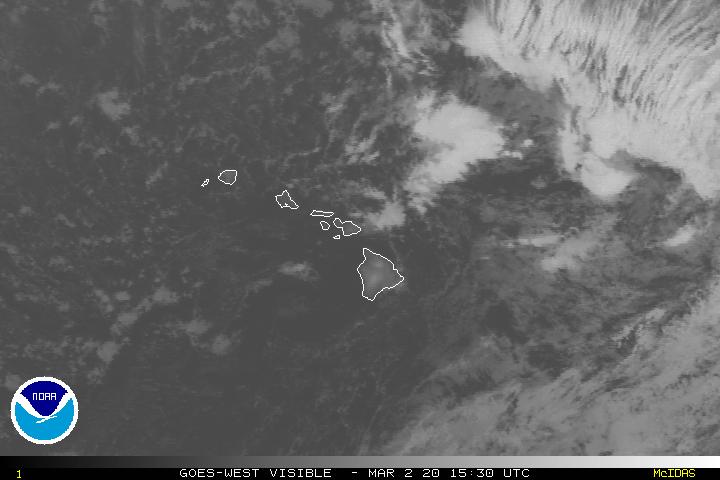


Myrtle Says:
Hi Glenn — Love the mouse saga. Perhaps more mice will enter your car during the day while the doors are open, to escape the blistering heat in Kihei and to keep your little Kula mouse company! Aloha, Myrtle~~~Lets hope not, mice should be living on their own out in the fields, where there is plenty of food, water…and company of their own kind. Aloha, Glenn
Eliza Says:
Hi Glenn –
Peanut or almond chunky butter. Works like a dream as bait. Had an unexpected invasion at my parents’ house. Good luck to you both! ~ Eliza~~~Thanks Eliza, hoping for the best! Aloha, Glenn
Nancy Says:
Is the mousie free, free at last? You’re so nice.~~~Nancy, there is more to this story! I brought the mouse down in the grocery paper bag that he got itself into naturally last night. Unfortunately, on the way down to Kihei from Kula, he chewed a hole in the bag! He is either in my car, or hopefully has jumped out…as I’ve left my car doors open in the parking lot. I’m going to give him two days, I’ll leave my doors open again tomorrow, and then I’ll have to set a regular mouse trap in my car on the third day, as I don’t want him, or her to make my car its home. I’ll update the page as we go through this little exercise – smile. Wish me and the mouse luck! Aloha, Glenn