July 8-9, 2010
Air Temperatures – The following maximum temperatures were recorded across the state of Hawaii Thursday afternoon:
Lihue, Kauai – 81
Honolulu, Oahu – 85
Kaneohe, Oahu – 83
Kaunakakai, Molokai – 83
Kahului, Maui – 87
Hilo, Hawaii – 83
Kailua-kona – 84
Air Temperatures ranged between these warmest and coolest spots near sea level – and on the highest mountain tops too…as of 5pm Thursday evening:
Port Allen, Kauai – 84
Molokai airport – 78
Haleakala Crater – 57 (near 10,000 feet on Maui)
Mauna Kea summit – 50 (near 14,000 feet on the Big Island)
Precipitation Totals – The following numbers represent the largest precipitation totals (inches) during the last 24 hours on each of the major islands, as of Thursday afternoon:
1.75 Mount Waialeale, Kauai
0.98 Manoa Lyon Arboretum, Oahu
0.09 Molokai
0.00 Lanai
0.00 Kahoolawe
0.21 Puu Kukui, Maui
0.54 Kawainui Stream, Big Island
Marine Winds – Here’s the latest (automatically updated) weather map showing a near 1027 millibar high pressure cell to the northeast, moving closer to the islands…which will prompt strengthening trade winds Friday and Saturday.
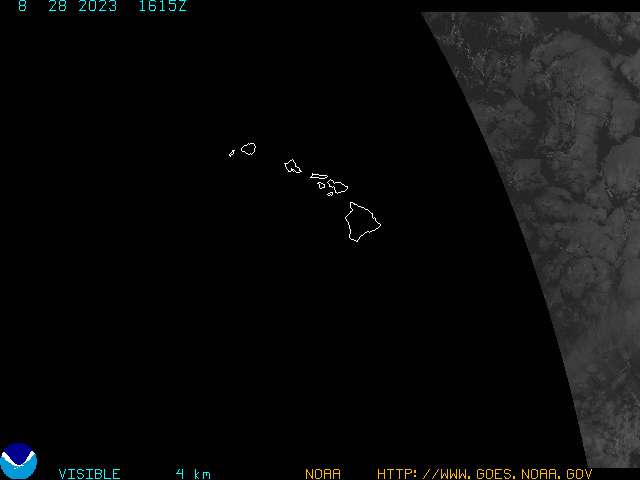
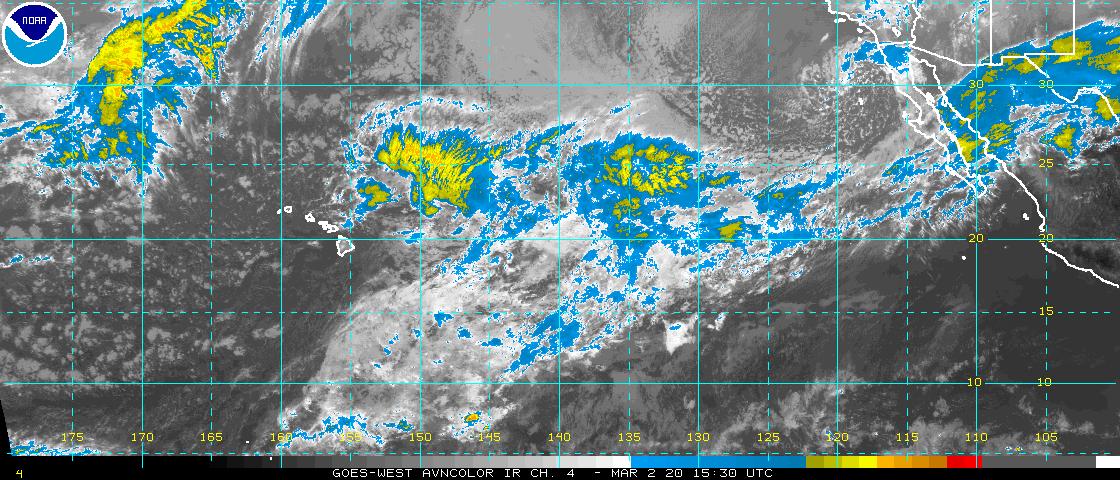
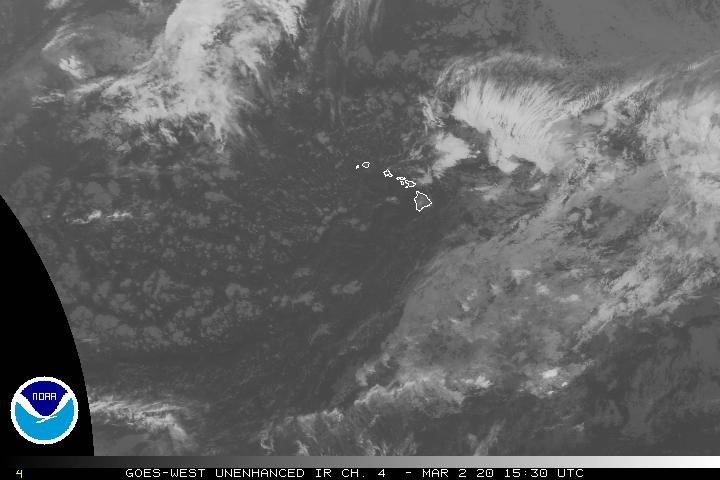
Satellite and Radar Images: To view the cloud conditions we have here in Hawaii, please use the following satellite links, starting off with this Infrared Satellite Image of the islands to see all the clouds around during the day and night. This next image is one that gives close images of the islands only during the daytime hours, and is referred to as a Close-up visible image. This next image shows a larger view of the Pacific…giving perspective to the wider ranging cloud patterns in the Pacific Ocean. Finally, here’s a Looping IR satellite image, making viewable the clouds around the islands 24 hours a day. To help you keep track of where any showers may be around the islands, here’s the latest animated radar image.
Hawaii’s Mountains – Here’s a link to the live webcam on the summit of near 14,000 foot Mauna Kea on the Big Island of Hawaii. The tallest peak on the island of Maui is the Haleakala Crater, which is near 10,000 feet in elevation. These two webcams are available during the daylight hours here in the islands…and when there’s a big moon rising just after sunset for an hour or two! Plus, during the nights and early mornings you will be able to see stars, and the sunrise too…depending upon weather conditions.
Tropical Cyclone activity in the eastern and central Pacific – Here’s the latest weather information coming out of the National Hurricane Center, covering the eastern north Pacific. You can find the latest tropical cyclone information for the central north Pacific (where Hawaii is located) by clicking on this link to the Central Pacific Hurricane Center. Here’s a tracking map covering both the eastern and central Pacific Ocean. A satellite image, which shows the entire ocean area between Hawaii and the Mexican coast…can be found here. Of course, as we know, our hurricane season won’t begin again until June 1st here in the central Pacific.
Aloha Paragraphs

A sunny Hawaiian pineapple
It’s summer, and the trade winds are blowing, as they should be. If they weren’t, we’d be surprised, and muggy too – more about this further into the paragraph. As is always the case, we have high pressure systems anchored to the northwest or northeast, and in this case, both. Glancing at this weather map, we see a near 1027 millibar high pressure cell to the northeast of the
As for rainfall, there will be some, although it doesn’t look like very much through Friday…and perhaps less than that going into the weekend. Whatever showers that do happen to fall, will make it to the ground along the windward coasts and slopes for the most part. Almost like a broken record we could say that those windward sides will pick up the most generous showers, with very few along the leeward sides, and most of those on the smaller islands, like
The west, central and east north Pacific has no active tropical cyclones Thursday night. The seasons second tropical cyclone made landfall over extreme southern Texas this morning. This system was called tropical depression two, with this track map showing where its going. Here’s a satellite image of this now dissipated depression, as it moves further inland. Locally gusty winds and heavy, and flooding rainfall arrived along the coast. Here’s a radar image from the Brownsville, Texas NWS office…to see the heavy rains, until they go out of the picture to the west. This system is dissipating quickly as it moves overland, although rainfall will carry far inland.
It’s Thursday evening as I begin writing this last section of today’s narrative update. As noted above, the moderately strong trade winds will be on the rise over the next few days. A small craft wind advisory began over those windiest areas around Maui and the Big Island today, which will continue well into the weekend. Meanwhile, that weak area of disturbed weather to the southeast of the Big Island, will pass by to the south of the Hawaiian Islands, helping to make our winds blustery for a few days, and perhaps bring a brief increase in showers over the southern part of the state eventually. The forecast models are now back to saying that the winds will decline again after the weekend, I’m still not too sure about this, and would like to request another day to let the models completely make up their minds. If they decide on the light wind scenario, we could be looking at muggy weather, and a chance of afternoon clouds and showers locally. ~~~ Here in Kihei, Maui, before I leave for the drive back upcountry to Kula, its clear to partly cloudy, with hardly a breath of wind outside the window. I’m sure its windier down near the beaches, as it was during my lunch time break earlier today. I’ll catch up with you early Friday morning, at which point I’ll have your next new weather narrative, ready to read along with your morning cup of coffee. I hope you have a great Thursday night until then! Aloha for now…Glenn.
Extra: Cool art
Interesting: Exceptionally long heat waves and other hot events could become commonplace in the United States in the next 30 years, according to a new study by Stanford University climate scientists. "Using a large suite of climate model experiments, we see a clear emergence of much more intense, hot conditions in the U.S. within the next three decades," said Noah Diffenbaugh, an assistant professor of environmental Earth system science at Stanford and the lead author of the study.
Writing in the journal Geophysical Research Letters (GRL), Diffenbaugh concluded that hot temperature extremes could become frequent events in the U.S. by 2039, posing serious risks to agriculture and human health. "In the next 30 years, we could see an increase in heat waves like the one now occurring in the eastern United States or the kind that swept across Europe in 2003 that caused tens of thousands of fatalities," said Diffenbaugh, a center fellow at Stanford’s Woods Institute for the Environment.
"Those kinds of severe heat events also put enormous stress on major crops like corn, soybean, cotton and wine grapes, causing a significant reduction in yields." The GRL study took two years to complete and is co-authored by Moetasim Ashfaq, a former Stanford postdoctoral fellow now at the Oak Ridge National Laboratory.
The study comes on the heels of a recent NASA report, which concluded that the previous decade, January 2000 to December 2009, was the warmest on record. 2-degree threshold In the study, Diffenbaugh and Ashfaq used two dozen climate models to project what could happen in the U.S. if increased carbon dioxide emissions raised the Earth’s temperature by 1.8 degrees Fahrenheit between 2010 and 2039 — a likely scenario, according to the International Panel on Climate Change.
In that scenario, the mean global temperature in 30 years would be about 3.6 degrees F hotter than in the preindustrial era of the 1850s. Many climate scientists and policymakers have targeted a 2-degree C temperature increase as the maximum threshold beyond which the planet is likely to experience serious environmental damage.
For example, in the 2009 Copenhagen Climate Accord, the United States and more than 100 other countries agreed to consider action to reduce greenhouse gas emissions "so as to hold the increase in global temperature below 2 degrees Celsius." But that target may be too high to avoid dangerous climate change, Diffenbaugh said, noting that millions of Americans could see a sharp rise in the number of extreme temperature events before 2039, when the 2-degree threshold is expected to be reached.
"Our results suggest that limiting global warming to 2 degrees Celsius above preindustrial conditions may not be sufficient to avoid serious increases in severely hot conditions," Diffenbaugh said. Record heat For the GRL study, the researchers analyzed temperature data for the continental U.S. from 1951-1999. Their goal was to determine the longest heat waves and hottest seasons on record in the second half of the 20th century.
Those results were fed into an ensemble of climate forecasting models, including the high-resolution RegCM3, which is capable of simulating daily temperatures across small sections of the U.S. "This was an unprecedented experiment," Diffenbaugh said. "With the high-resolution climate model, we can analyze geographic quadrants that are only 15.5 miles to a side. No one has ever completed this kind of climate analysis at such a high resolution."
The results were surprising. According to the climate models, an intense heat wave — equal to the longest on record from 1951 to 1999 — is likely to occur as many as five times between 2020 and 2029 over areas of the western and central United States. The 2030s are projected to be even hotter. "Occurrence of the longest historical heat wave further intensifies in the 2030-2039 period, including greater than five occurrences per decade over much of the western U.S. and greater than three exceedences per decade over much of the eastern U.S.," the authors wrote.
Seasonal records The Stanford team also forecast a dramatic spike in extreme seasonal temperatures during the current decade. Temperatures equaling the hottest season on record from 1951 to 1999 could occur four times between now and 2019 over much of the U.S., according to the researchers. The 2020s and 2030s could be even hotter, particularly in the American West.
From 2030 to 2039, most areas of Utah, Colorado, Arizona and New Mexico could endure at least seven seasons equally as intense as the hottest season ever recorded between 1951 and 1999, the researchers concluded. "Frankly, I was expecting that we’d see large temperature increases later this century with higher greenhouse gas levels and global warming," Diffenbaugh said.
"I did not expect to see anything this large within the next three decades. This was definitely a surprise." The researchers also determined that the hottest daily temperatures of the year from 1980 to 1999 are likely to occur at least twice as often across much of the U.S. during the decade of the 2030s. "By the decade of the 2030s, we see persistent, drier conditions over most of the U.S.," Diffenbaugh said.
"Not only will the atmosphere heat up from more greenhouse gases, but we also expect changes in the precipitation and soil moisture that are very similar to what we see in hot, dry periods historically. In our results for the U.S., these conditions amplify the effects of rising greenhouse gas concentrations."
Besides harming human health and agriculture, these hot, dry conditions could lead to more droughts and wildfires in the near future, he said. And many of these climate change impacts could occur within the next two decades — years before the planet is likely to reach the 2-degree C threshold targeted by some governments and climate experts, he added.
"It’s up to the policymakers to decide the most appropriate action," Diffenbaugh said. "But our results suggest that limiting global warming to 2 degrees C does not guarantee that there won’t be damaging impacts from climate change." The GRL study was supported by the U.S. Department of Energy and the National Science Foundation. The high-resolution climate model simulations were generated and analyzed at Purdue University. GRL is a publication of the American Geophysical Union.
 Email Glenn James: