











July 4-5, 2010
Air Temperatures – The following maximum temperatures were recorded across the state of Hawaii Saturday afternoon:
Lihue, Kauai – 83
Honolulu, Oahu – 81
Kaneohe, Oahu – 79
Kaunakakai, Molokai – 86
Kahului, Maui – 86
Hilo, Hawaii – 80
Kailua-kona – 80
Air Temperatures ranged between these warmest and coolest spots near sea level – and on the highest mountain tops too…as of 7am Sunday morning:
Lihue, Kauai – 77
Hilo, Hawaii – 71
Haleakala Crater – 52 (near 10,000 feet on Maui)
Mauna Kea summit – 45 (near 14,000 feet on the Big Island)
Precipitation Totals – The following numbers represent the largest precipitation totals (inches) during the last 24 hours on each of the major islands, as of Sunday morning:
2.45 Mount Waialeale, Kauai
1.29 Oahu Forest NWR, Oahu
0.10 Molokai
0.00 Lanai
0.20 Kahoolawe
1.28 Puu Kukui, Maui
1.70 Kawainui Stream, Big Island
Marine Winds – Here’s the latest (automatically updated) weather map showing a 1033 millibar high pressure system far to the northeast of the islands. Trade winds holding at moderately strong levels…gradually becoming somewhat lighter.
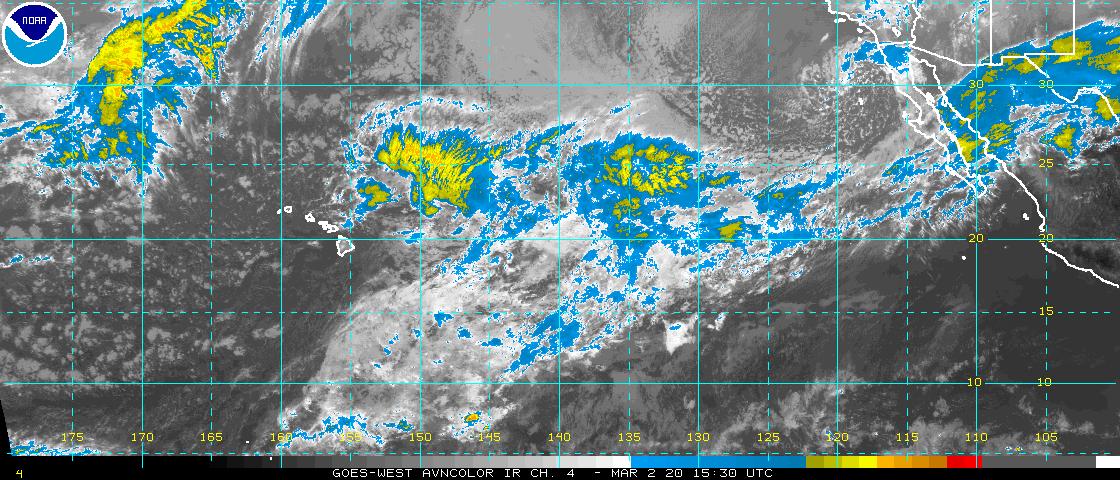
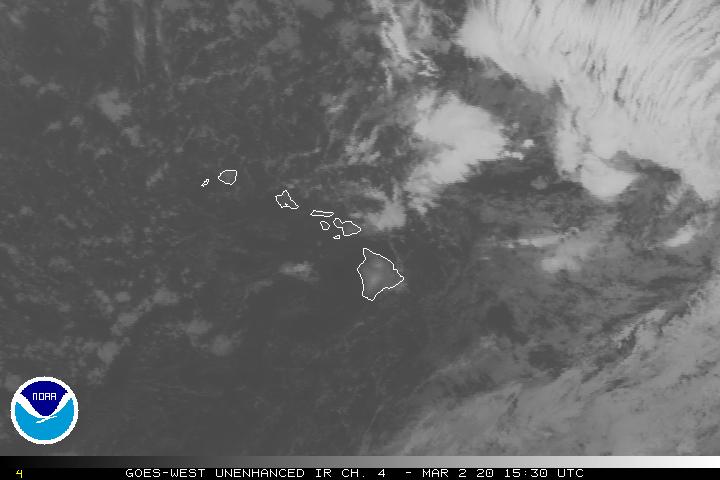
Satellite and Radar Images: To view the cloud conditions we have here in Hawaii, please use the following satellite links, starting off with this Infrared Satellite Image of the islands to see all the clouds around during the day and night. This next image is one that gives close images of the islands only during the daytime hours, and is referred to as a Close-up visible image. This next image shows a larger view of the Pacific…giving perspective to the wider ranging cloud patterns in the Pacific Ocean. Finally, here’s a Looping IR satellite image, making viewable the clouds around the islands 24 hours a day. To help you keep track of where any showers may be around the islands, here’s the latest animated radar image.
Hawaii’s Mountains – Here’s a link to the live webcam on the summit of near 14,000 foot Mauna Kea on the Big Island of Hawaii. The tallest peak on the island of Maui is the Haleakala Crater, which is near 10,000 feet in elevation. These two webcams are available during the daylight hours here in the islands…and when there’s a big moon rising just after sunset for an hour or two! Plus, during the nights and early mornings you will be able to see stars, and the sunrise too…depending upon weather conditions.
Tropical Cyclone activity in the eastern and central Pacific – Here’s the latest weather information coming out of the National Hurricane Center, covering the eastern north Pacific. You can find the latest tropical cyclone information for the central north Pacific (where Hawaii is located) by clicking on this link to the Central Pacific Hurricane Center. Here’s a tracking map covering both the eastern and central Pacific Ocean. A satellite image, which shows the entire ocean area between Hawaii and the Mexican coast…can be found here. Of course, as we know, our hurricane season won’t begin again until June 1st here in the central Pacific.
Aloha Paragraphs

Happy 4th of July!
The trade winds will remain breezy, although gradually become lighter on this 4th of July holiday…into the new week. We’ll see a gradual tapering off of the recent gusty trade winds over the next several days…which should continue through the better part of the upcoming new week. The source of our trade winds can be tracked to a 1033 millibar high pressure system to our northeast Sunday…as shown on this weather map. The computer forecast models suggest that as this high pressure cell moves away towards the east, it will take some of the trade wind strength with it. There will be enough wind however, to keep fireworks smoke from being a problem Sunday evening.
A few showers will be carried our way on the trade winds, generally falling during the night and early morning hours. Here’s an IR satellite image showing just a fairly normal amount of clouds around the islands Sunday. As this looping radar image of the islands shows, we find a few showers moving in our direction. The moist atmosphere and abundant lower level moisture, which we saw Friday night into Saturday, seems to be a thing of the past now, at least for the most part. The leeward sides will be quite dry, while the Kona slopes may find a few afternoon showers falling at times.
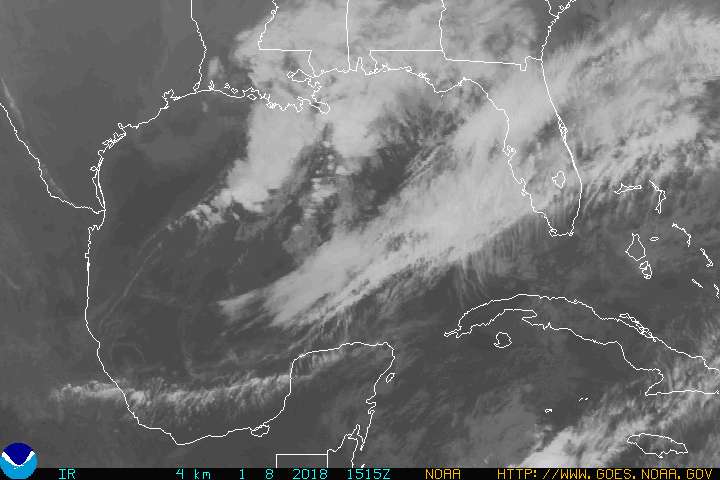
The west, east and central north Pacific Ocean has no active tropical cyclones Sunday. There continues to be an area of disturbed weather to the south of the Mississippi River today. Here’s a picture of that area, circled in yellow. This area has a low chance (10%) of becoming a tropical cyclone over the next couple of days. Here’s a satellite image, showing that it certainly isn’t very impressive at this point. We’d perfer to not have this spin up into a tropical system, as it is directly over the oil spill area of the Gulf. Meanwhile, further south, down in the western Caribbean, we see another area of distubed weather, with a better 30% chance of spinning up over the next few days.
It’s Sunday as I begin writing this last section of this morning’s narrative update. As noted above, the trade winds continue to blow, and despite slowing down some over the next few days, will remain moderately strong. The abundant showers that we saw recently, has backed off, leaving us in a drier weather pattern. ~~~ Here in Kula, Maui this morning, at about 820am, its mostly clear. The air temperature was 62.8F degrees, warming up from the upper 50’s earlier. There’s still a few clouds over along the windward sides, although nothing compared to Saturday morning at this time. I’m heading over to Haiku, on the windward side later today, to visit a friend. We’ll do some work together, and then have dinner and a glass of wine. I won’t be back until late, so I’ll catch up with you again Monday morning. This is one of those unusual times that I won’t be updating this website until then, so please pardon my being away temporarily. Here’s wishing you a great 4th of July, celebrating this great countries independence! Aloha for now…Glenn.
Something not easy to read, and yet…so sad but true:
We Are All Trapped in an Oil Slick
By Johann Hari
Has our crude awakening begun, at last? It’s not just the pelicans of Louisiana that are flapping and flailing in an oil slick — it’s all of us. We live permanently doused in petrol. Every time we move further than our feet can carry us, or eat food we didn’t grow, or go shopping, we burn more barrels.
Petrol pours off each of us like an invisible sweat. The 20th century was propelled into the stratosphere on a great gushing geyser of oil, and in the adrenaline-frenzy, nobody wanted to ask where it was coming from, or what it would cost us in the end.
But in this decade, the true costs of oil — the ones that have been steadily accumulating since 1901, when it began to spurt from a hilltop in Texas — have begun to finally distract our gaze from the speed-dial. They silently dominate almost every long-term question we face.
Extracting oil from the ground has almost always been disastrous for the people who live nearby. The only thing that is unusual about this morphing of "Drill, Baby, Drill" into "Spill, Baby, Spill" is that, this time, the world noticed the victims. From the Niger Delta to Azerbaijan, the world is littered with places poisoned by the petroleum industry.
To pluck one random example, Ecuador’s oil pipeline — fueling California — is located above ground, next to roads. It leaks constantly. The oil companies have to pump water into the Amazonian oil fields in order to extract it, which leaves behind a toxic soup of mercury, benzene and chromium 6.
For decades, they simply pumped it into the local rivers, causing an epidemic of cancers and severely deformed babies. A US court calculated that the unpaid liabilities for destroying so many lives total more than $27bn. Who has heard of it?
Big Oil is occasionally, fleetingly honest about how it works. Sadad al-Husseini was vice president for exploration and production at Saudi Aramco, and he said of the industry:
If your tanker is old and you ought to retire it, you keep it working. If you have an offshore platform that is beyond the boundaries of a certain country and you can dump chemicals into the sea, you do. If you have to abandon a facility that is a pollutant, you abandon it without cleaning it up. If you’ve hired people and you can work them in unhealthy environments where you’ve got sulphur dioxide, you do it. All these are ways in which you say, it’s not my problem. It’s not my cost.
This will only metastasize from here on in, because we have already burned up all the easy-to-access oil. The last year in which humans found more oil than we burned was when I was born: 1979. The sources that remain are in hard-to-reach places: far beneath the oceans, or the Arctic, or beneath conflict-zones, where protections are more lax, and accidents are more likely and even harder to staunch.
But it is now clear that oil does not only trash local environments. That was only a taster before the main course. It turns out oil spills so many warming gases into the atmosphere when it burns that it is radically altering the biosphere. The Arctic just hit its lowest level of sea ice for this time of year since records began.
NASA says we could be on course for the hottest year yet known. The International Energy Agency warns that if we can extract and burn the remaining oil left, we will be on course for 6 degrees of global warming — a level that hasn’t been seen for 251 million years, when it triggered one of the biggest mass extinctions in the fossil record.
The people who say we shouldn’t worry about global warming because we’ll find a way to adapt further down the line should look again at the Gulf. The most powerful country on earth can’t stop a single leaking pipe. How will they — or the rest — deal with rapidly rising sea levels, the drying up of agricultural land, and super-charged hurricanes?
It doesn’t stop there. Oil fever has driven the other great stories of this century. The demand for petrol is massively increasing, just as supply gets harder to meet — a virtual guarantee that we will fight for what remains. The invasion of Iraq, which has caused a million deaths, was a down-payment on this dystopia.
It also leads our governments to support some of the world’s worst dictators in return for easy access to their ol’ black magic: We pay the Saudi dictatorship, and they use the cash to whip women who dare to sit behind the wheel of a car and to promote vile fundamentalist hatred of us.
As our addiction to oil goes on longer and our supply becomes more squeezed, we will become even more like junkies who are prepared to suck up to any dealer or rob anyone to get our next fix. In the film Three Days of the Condor, Robert Redford says free people will never back wars for oil. His CIA boss replies:
Ask ’em when they’re running out. Ask ’em when there’s no heat in their homes and they’re cold. Ask ’em when their engines stop. Ask ’em when people who have never known hunger start going hungry. You wanna know something? They won’t want us to ask ’em. They’ll just want us to get it for ’em."
It doesn’t have to be this way. We can stop this SUV. We can get out. It wouldn’t even be that hard, compared to the challenges faced by previous generations. The technologies exist to replace oil now. For example, if we lined just 0.3 percent of the Sahara — the area of Belgium — with solar technology, it would meet all of Europe’s energy needs indefinitely.
Yes, it’s expensive, but we are already spending that money on making the dirtiest fuels cheaper. Oil Change International have shown that $250-400 billion is currently spent every year subsidizing the use of fossil fuels, while renewable energy sources get less than $12 billion. Switch the money and you’re almost there — and you have a massive jobs program to rebuild our infrastructure thrown in for free.
We will have to make this switch in the end, because the oil will run out. The only question is — do we do it now, skipping all the wars and all the warming, or do we wait to do it on a trashed and unraveling globe?
As long ago as 1979, Jimmy Carter gave a devastating speech saying the need for the West to wean itself off oil was "the moral equivalent of war." Nothing happened. Barack Obama’s Oval Office address last week had more detail about the prayers we should offer to shrimp farmers than how his words about moving beyond oil could be made real. The stimulus cash didn’t go towards building green energy: When Obama last week wanted to boast about the fiscal stimulus, where did he go? To the 10,000th road that has been built.
Why? The clue to the biggest cause lies in the current Gulf disaster, where the crudest forces can be seen in microcosm. The oil companies gave so many "gifts" to the safety inspectors that, by this year, they were often just handed the inspection forms and told to fill them in themselves.
On the national stage in the US, politicians on all sides (including Barack Obama) are sprayed with petro-money at election time. Gradually, they become an oiligarchy that sees moving beyond petrol as irrational: Turning off the spigot would turn off their election funds. A more subtle but just as certain process happens here in Europe. To protect the profits of a very rich minority, the public interest is lost in a broken pipeline.
And so we are all left slithering in the global oil slick. Yet the anger of the sane citizenry — those of us who don’t want to engage in collective self-destruction — has been weirdly muted. Most of us know instinctively that we can’t carry on like this.
Most of us know Big Oil is a swelling tumor. But it is still much more common to see protests for cheap oil than to see protests to build a world beyond it. We wait passively for a rational politician to emerge through the corruption, when we should be relentlessly pressuring them all.
The oilman John Paul Getty once joked: "The meek will inherit the earth, but not the mineral rights." If the sane proponents of a post-oil world stay so meek and mild, we may not inherit much worth having at all.
 Email Glenn James: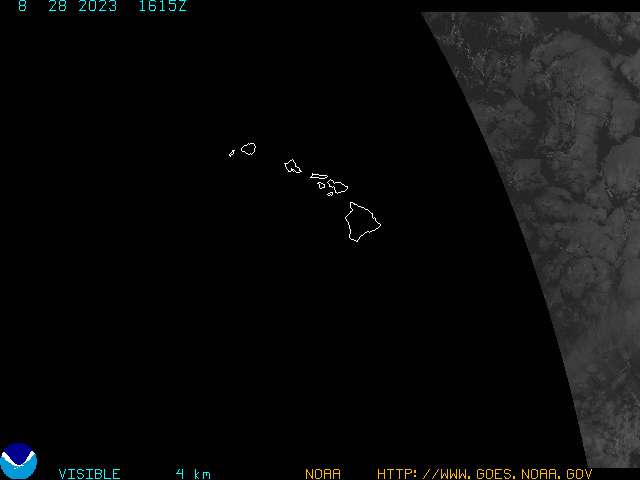



jack weber Says:
Great article, Glenn. Appreciate your posting these inspirational and motivating, and ultimately empowering articles. hope you have fun in Haiku, my old stomping grounds…J*~~~Thanks Jack, I had a great time in Haiku! Haiku was my old stomping grounds too. Aloha, Glenn