











July 29-30, 2010
Air Temperatures – The following maximum temperatures were recorded across the state of Hawaii Thursday afternoon:
Lihue, Kauai – 85
Honolulu, Oahu – 86
Kaneohe, Oahu – 84
Kaunakakai, Molokai – 85
Kahului, Maui – 87
Hilo, Hawaii – 83
Kailua-kona – 81
Air Temperatures ranged between these warmest and coolest spots near sea level – and on the highest mountain tops too…as of 5pm Thursday evening:
Port Allen, Kauai – 86
Kapalua, Maui – 77
Haleakala Crater – 59 (near 10,000 feet on Maui)
Mauna Kea summit – 45 (near 14,000 feet on the Big Island)
Precipitation Totals – The following numbers represent the largest precipitation totals (inches) during the last 24 hours on each of the major islands, as of Thursday afternoon:
0.59 Mount Waialeale, Kauai
0.51 Manoa Valley, Oahu
0.17 Molokai
0.00 Lanai
0.14 Kahoolawe
0.77 West Wailuaiki, Maui
1.07 Kawainui Stream, Big Island
Marine Winds – Here’s the latest (automatically updated) weather map showing a 1031 millibar high pressure system to the northeast of the islands. Our local trade winds will remain active Friday and Saturday…locally strong and gusty.
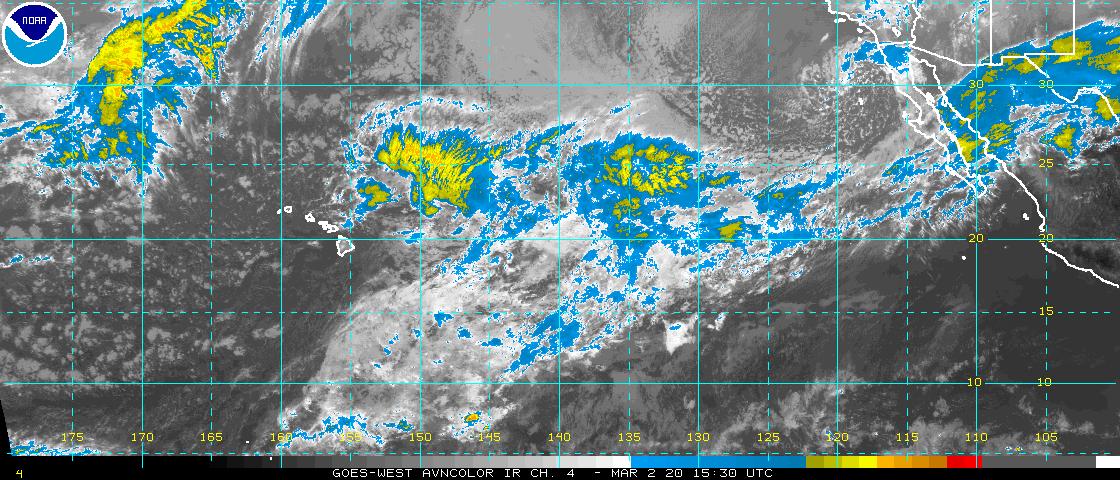
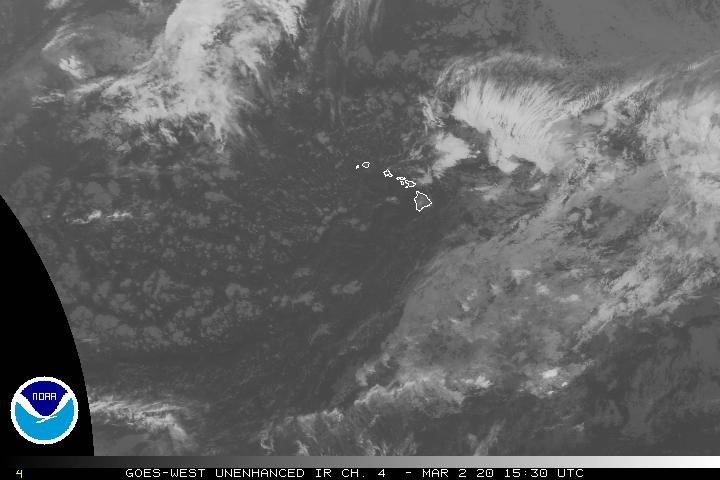
Satellite and Radar Images: To view the cloud conditions we have here in Hawaii, please use the following satellite links, starting off with this Infrared Satellite Image of the islands to see all the clouds around during the day and night. This next image is one that gives close images of the islands only during the daytime hours, and is referred to as a Close-up visible image. This next image shows a larger view of the Pacific…giving perspective to the wider ranging cloud patterns in the Pacific Ocean. Finally, here’s a Looping IR satellite image, making viewable the clouds around the islands 24 hours a day. To help you keep track of where any showers may be around the islands, here’s the latest animated radar image.
Hawaii’s Mountains – Here’s a link to the live webcam on the summit of near 14,000 foot Mauna Kea on the Big Island of Hawaii. The tallest peak on the island of Maui is the Haleakala Crater, which is near 10,000 feet in elevation. These two webcams are available during the daylight hours here in the islands…and when there’s a big moon rising just after sunset for an hour or two! Plus, during the nights and early mornings you will be able to see stars, and the sunrise too…depending upon weather conditions.
Tropical Cyclone activity in the eastern and central Pacific – Here’s the latest weather information coming out of the National Hurricane Center, covering the eastern north Pacific. You can find the latest tropical cyclone information for the central north Pacific (where Hawaii is located) by clicking on this link to the Central Pacific Hurricane Center. Here’s a tracking map covering both the eastern and central Pacific Ocean. A satellite image, which shows the entire ocean area between Hawaii and the Mexican coast…can be found here. Of course, as we know, our hurricane season won’t begin again until June 1st here in the central Pacific.
Aloha Paragraphs

The natural beauty of Kauai
The trade winds are light to moderately strong at the moment, although are still expected to increase a notch as we push through the next couple of days…remaining active through the weekend into early next week. As this increase in strength occurs, we’ve seen small craft wind advisories going up around Maui and the
The windward sides have been a bit showery, although should take a break for a while…before picking up again. Satellite imagery shows clear to partly cloudy conditions to the east and northeast of the islands…as we see on this IR satellite image. This same satellite image shows more clouds upstream of the islands however, which will bring more showers with them. There are ares of thunderstorms in the area southeast and southwest of the islands. The leeward sides will see some clouds at times, although a few will sneak over into those areas on the strengthening trade wind flow.
It’s Thursday evening as I begin writing this last section of today’s narrative update. As noted above, our trade winds will be quite breezy over the next several days. The mountain peaks on both Maui and the Big Island are windy now too, so the NWS has issued a wind advisory for those summits into Friday. The showers that have been falling along our windward sides, will take a short break, before resuming on Friday. To get an idea how strong the trade winds are now, in gusts, these were the highest as of early Thursday evening on each of the islands:
Kauai – 29 mph
Oahu – 32
Molokai – 36
Kahoolawe – 43
Lanai – 16
Maui – 37
Big Island – 29
~~~ Here in Kihei, Maui, at 530pm, it was clear to partly cloudy, with some clouds stacked up around the mountains. The winds here where I work, at the Pacific Disaster Center, were near calm. I’ll be taking the drive back upcountry to Kula soon, and shortly thereafter be out on my evening walk. It feels so good to get outside after sitting at a desk, in front of a computer all day. I love my weather work, although I love to be outside too. I’ll be back early Friday morning with your next new weather narrative, I hope you have a great Thursday night until then! Aloha for now…Glenn.
Interesting: Scientists from around the world are providing even more evidence of global warming, one day after President Barack Obama renewed his call for climate legislation. "A comprehensive review of key climate indicators confirms the world is warming and the past decade was the warmest on record," the annual State of the Climate report declares.
Compiled by more than 300 scientists from 48 countries, the report said its analysis of 10 indicators that are "clearly and directly related to surface temperatures, all tell the same story: Global warming is undeniable."
Concern about rising temperatures has been growing in recent years as atmospheric scientists report rising temperatures associated with greenhouse gases released into the air by industrial and other human processes. At the same time, some skeptics have questioned the conclusions.
The new report, the 20th in a series, focuses only on global warming and does not specify a cause.
"The evidence in this report would say unequivocally yes, there is no doubt," that the Earth is warming, said Tom Karl, the transitional director of the planned NOAA Climate Service.
Deke Arndt, chief of the Climate Monitoring Branch at the National Climatic Data Center, noted that the 1980s was the warmest decade up to that point, but each year in the 1990s was warmer than the ’80s average.
That makes the ’90s the warmest decade, he said.
But each year in the 2000s has been warmer than the ’90s average, so the first 10 years of the 2000s is now the warmest decade on record.
The new report noted that continuing warming will threaten coastal cities, infrastructure, water supply, health and agriculture.
"At first glance, the amount of increase each decade – about a fifth of a degree Fahrenheit – may seem small," the report said.
"But," it adds, "the temperature increase of about 1 degree Fahrenheit experienced during the past 50 years has already altered the planet. Glaciers and sea ice are melting, heavy rainfall is intensifying and heat waves are becoming more common and more intense."
Last month was the warmest June on record and this year has had the warmest average temperature for January-June since record keeping began, NOAA reported last week.
And a study by Princeton University researchers released Monday suggested that continued warming could cause as many as 6.7 million more Mexicans to move to the United States because of drought affecting crops in their country.
The new climate report, released by the National Oceanic and Atmospheric Administration and published as a supplement to the Bulletin of the American Meteorological Society, focused on 10 indicators of a warming world, seven which are increasing and three declining.
Rising over decades are average air temperature, the ratio of water vapor to air, ocean heat content, sea surface temperature, sea level, air temperature over the ocean and air temperature over land.
Indicators that are declining are snow cover, glaciers and sea ice.
The 10 were selected "because they were the most obviously related indicators of global temperature," explained Peter Thorne of the Cooperative Institute for Climate and Satellites, who helped develop the list when at the British weather service, known as the Met Office.
"What this data is doing is, it is screaming that the world is warming," Thorne concluded.
Interesting2: This past June and July have been some of the hottest months ever for the northeastern United States. The unwelcome heat wave has not only raised the mercury, but also the concentration of ground-level ozone. The Environmental Protection Agency (EPA) has predicted that the elevated ozone will significantly decrease air quality in parts of Connecticut, Massachusetts, and Maine.
Temperature and humidity have a large role in how much ozone is produced, and this summer has seen its share of both. In fact, ozone production is almost doubled when the ambient air is very humid rather than very dry. So far in 2010, New England has had 19 days in which ozone concentrations exceeded the 2008 ozone air quality health standard set by the EPA which is 0.075 parts per million.
Hot, sticky conditions also add to overall energy usage, and the burning of fossil fuels is a primary source for ozone. First of all, it is the heart of the summer driving season, so there are more cars on the road. Most of the cars are cranking up the air conditioning which requires more gasoline combustion. Also, more small motors are being used such as lawn mowers, leaf blowers, dirt bikes, etc.
Furthermore, there are also lots of power boats out on the water which can consume large quantities of fuel. Last of all, energy use in buildings has increased due to air conditioning, so power plants have ramped up operations. Add to this mix an abundant number of sunny days (ozone is formed by reaction of gas emissions to sunlight), and you get the perfect storm of ozone formation in the northeast.
Elevated levels of this air pollutant can cause serious breathing problems, especially for those with a history of respiratory dysfunction. People must be mindful of the situation should they have to perform outdoor work. "As this hot summer weather continues, we’re expecting another day tomorrow where parts of New England will experience unhealthy air quality," said Curt Spalding, regional administrator of EPA’s New England office.
"When air quality is unhealthy, EPA and the medical community suggest that people limit their strenuous outdoor activity." The EPA encourages people to take the following actions to help reduce ozone/smog:
– Decrease driving (use public transit, car pool, combining trips)
– Refuel cars at night (gasoline vapors react with sunlight to form ozone)
– Avoid using small gasoline powered engines (lawn care, recreational vehicles)
– Set air conditioning thermostats a few degrees higher.
Interesting3: The Arctic still has unmapped and unknown areas. In particular, there is the continental shelf that extends out from the American and Canadian northern lands. Who controls it? Who has the right to drill for example which then leads into the complicated morass of environmental rules and controls.
American and Canadian scientists are setting sail this summer to map the Arctic seafloor and gather data to help define the outer limits of the continental shelf. Each coastal nation may exercise sovereign rights over the natural resources of their continental shelf, which includes the seabed and subsoil.
These rights include control over minerals, petroleum, and sedentary organisms such as clams, crabs and coral. Under international law, specifically the United Nations Convention on the Law of the Sea, every coastal nation automatically has a continental shelf out to 200 nautical miles or to a maritime boundary.
The Convention also states that a nation is entitled to continental shelf beyond 200 nautical miles if certain criteria are met, an area that is referred to as the extended continental shelf. Just off shore is the continental shelf which is part of the tectonic plate that is a continent. From the shelf is a slope that goes to the abyssal ocean bottom.
These shelf criteria include the continental margin comprising the submerged portion adjacent to the coastal State. It does not include the deep ocean floor with its oceanic ridges. What has to happen is that the edge of the continental shelf has to be measured based on the geology and sediments present.
Where this has most impacts is in the Arctic and Atlantic coasts where the shelf extends a bit. For example, just off Alaska are a series of islands that are portion of this shelf that are not submerged. In between the islands and Alaska is part of this extended shelf.
In other parts of the world such as the East China Sea, the North Sea and the borders of Brunei and Malaysia, there is and has long been considerable dispute of who owns what rights to what part of this shelf. Establishing clear rights will reduce not only the threat of war but the problems of interfering operations infringing on the environmental controls of each others operations.
The U.S. Geological Survey is the lead science agency for the United States in the 2010 mission. ‘In this expedition, Canada and the U.S. are working together to delineate the extended continental shelf in the Arctic to better determine where the Convention’s criteria can be met," said USGS scientist Brian Edwards, chief scientist on the U.S. Coast Guard Cutter Healy.
The Healy will sail August 2 — September 6, 2010, meeting up with the Canadian Coast Guard Ship Louis S. St-Laurent at sea. The ships will alternately break through the Arctic sea ice for each other. The Healy will map the shape of the seafloor using a multi-beam echo sounder, and the Louis S. St-Laurent will collect multi-channel seismic reflection and refraction data to determine sediment thickness. This is the third year the United States and Canada have collaborated in extended continental shelf data collection in the Arctic.
"The Arctic Ocean is an area of great interest for science, resource conservation, and possible economic development,” said USGS scientist Deborah Hutchinson. “Because there is an area with considerable overlap between the U.S. and Canadian extended continental shelves, it makes sense to share data sets and work together in the remote and challenging environments of the Arctic Ocean."
Interesting4: When purchasing a hybrid car, consumers have become accustomed to paying up to several thousand dollars extra in order to buy that set of wheels with the fuel-saving regenerative braking system. It’s almost hard to believe over 10 years have passed since the Prius first hit the roads, the inaugural hybrid has evolved from a curiosity to the milestone of one million in sales during 2008.
Many consumers have become comfortable with hybrid cars’ higher sticker price, figuring they will save money on gas in the long run. Some would debate the environmental factors, but obviously decreasing fuel consumption is a factor in purchasing decision as well. Now Ford is turning hybrid pricing on its head.
Its 2011 Lincoln MKZ hybrid, upon this fall’s release, will have a sticker price identical to its twin that runs solely on gasoline. Ford touts that it is the first automaker to offer a luxury hybrid vehicle with a manufacturer’s suggest retail price equal to the same model only using gas. Naturally some questions arise.
I admit I was surprised to learn that Ford was still manufacturing Lincoln cars. Then I wondered why a carmaker would bother offering both if the pricing is the same—which of course is because the difference comes down to horsepower. The standard gas model offers 263 horsepower, while its hybrid twin falls behind at 191 horsepower.
For many consumers, however, the miles per gallon difference will be the selling point: the hybrid boasts a combined rating of 39 mpg—the conventional model, 21 mpg. Will this shift in pricing motivate other automobiles to slash the price of its hybrid models? That’s a nice thought, but doubtful: hybrid cars are more expensive simply because their powertrain technology remains relatively costly.
 Email Glenn James: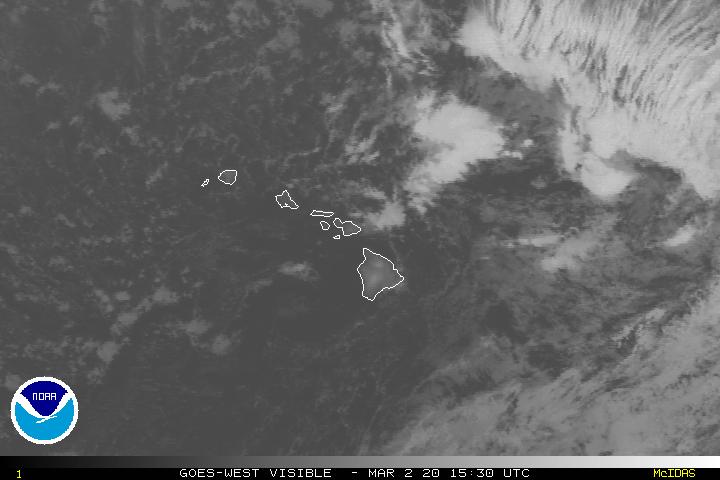


Linda Bannerman Says:
Hello Glenn,
Is there a way to monitor vog on Maui on a daily basis through your website?~~~Linda, yes, whenever there is vog on Maui, or I think vog is coming our way from the Big Island, I’ll write about it on my narrative page…in the Aloha paragraphs. Aloha, Glenn
dee Says:
Glen, do you have a facebook page? Would be interested in reading if you do.~~~Hi Dee I do have a face book page, although I don’t give it any time to speak of. I rarely go there, as I’m so busy with this website and my regular weather job in Kihei. Aloha, Glenn
jack weber Says:
Glenn, it is so wet over here in Puna, Big Island…rain rain rain…and I look at the radar and I see rain rain for the the other windward sides of the islands. When you say we will continue DRY, where are you talking about? Just leeward sides? Good for the Earth, bad for my building project! thanks for the Interestings, as always…~~~Jack, I look at the precipitation totals to gauge how dry or wet we are, and actually the Big Island doesn’t look wet according to the numbers. I see that there are clouds upstream, which are bringing some showers, although nothing looks all that wet. You must live in an especially wet area, which has its good and bad points. It doesn’t seem all that long ago that you were complaining about how dry it was – smile. Hang in there, and good luck with your building project. Aloha, Glenn