July 27-28, 2010
Air Temperatures – The following maximum temperatures were recorded across the state of Hawaii Tuesday afternoon:
Lihue, Kauai – 83
Honolulu, Oahu – 87
Kaneohe, Oahu – 83
Kaunakakai, Molokai – 88
Kahului, Maui – 90
Hilo, Hawaii – 81
Kailua-kona – 83
Air Temperatures ranged between these warmest and coolest spots near sea level – and on the highest mountain tops too…as of 5pm Tuesday evening:
Port Allen, Kauai – 86
Hilo, Hawaii – 80
Haleakala Crater – 59 (near 10,000 feet on Maui)
Mauna Kea summit – 46 (near 14,000 feet on the Big Island)
Precipitation Totals – The following numbers represent the largest precipitation totals (inches) during the last 24 hours on each of the major islands, as of Tuesday afternoon:
0.72 Mount Waialeale, Kauai
0.77 Punaluu Stream, Oahu
0.01 Molokai
0.00 Lanai
0.00 Kahoolawe
0.53 West Wailuaiki, Maui
0.19 Kawainui Stream, Big Island
Marine Winds – Here’s the latest (automatically updated) weather map showing high pressure systems far to the northeast of the islands. Our local trade winds will remain active Wednesday and Thursday…gradually gaining strength.
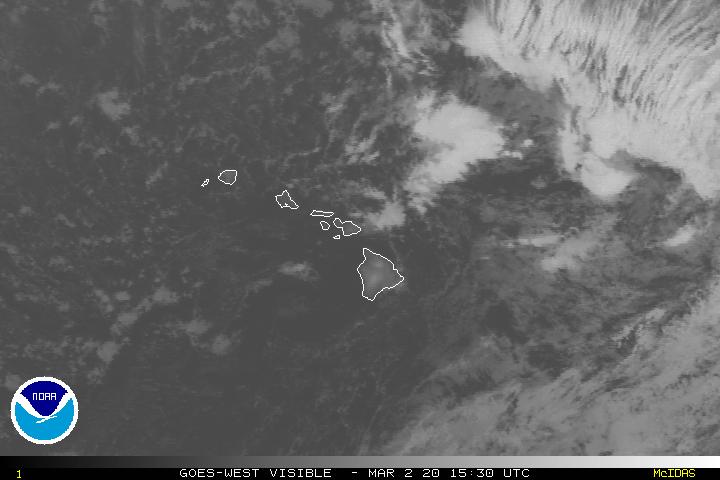
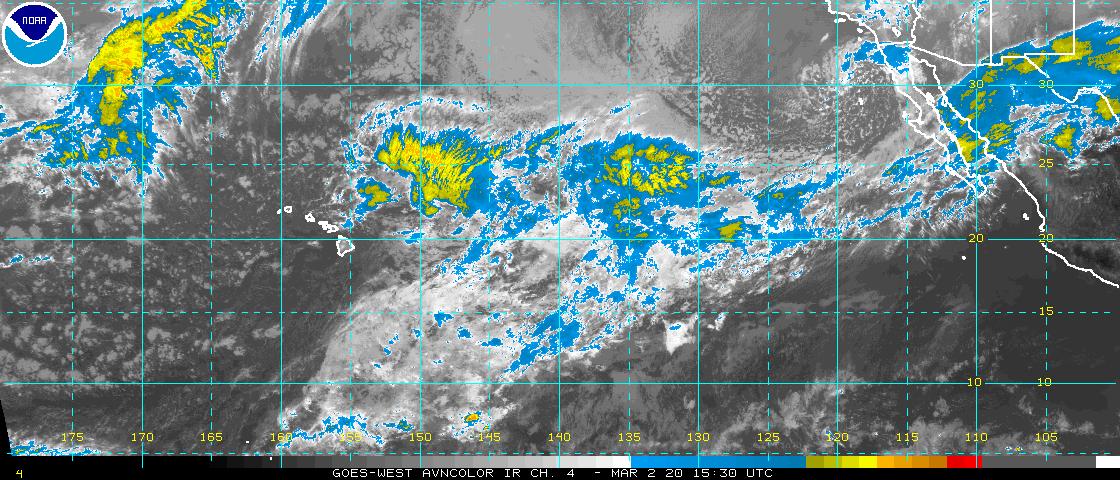
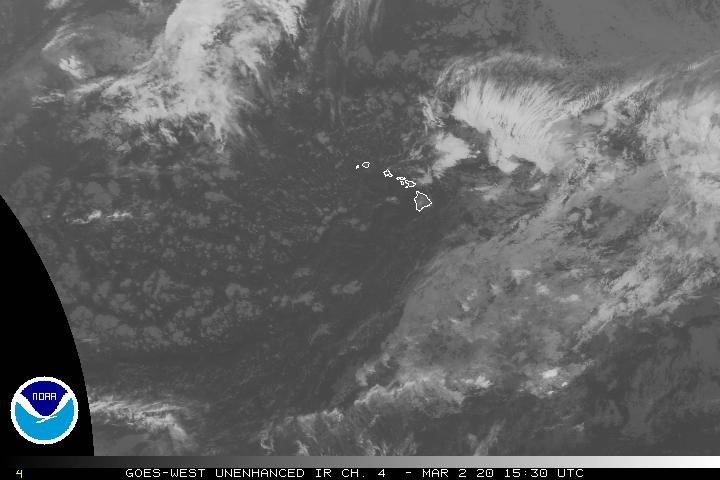
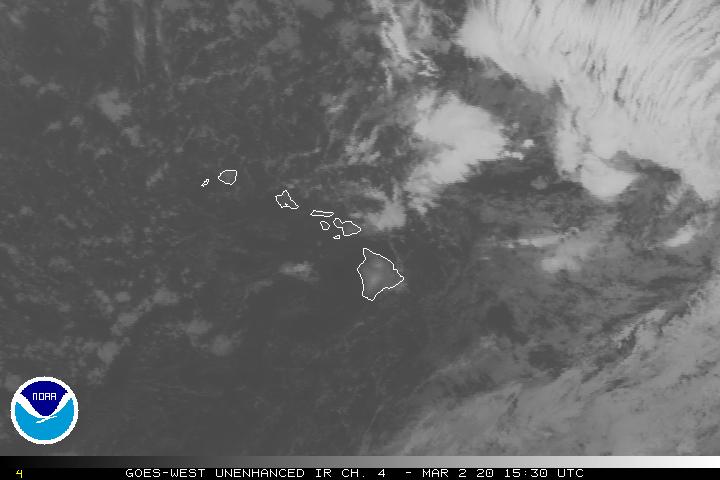
Satellite and Radar Images: To view the cloud conditions we have here in Hawaii, please use the following satellite links, starting off with this Infrared Satellite Image of the islands to see all the clouds around during the day and night. This next image is one that gives close images of the islands only during the daytime hours, and is referred to as a Close-up visible image. This next image shows a larger view of the Pacific…giving perspective to the wider ranging cloud patterns in the Pacific Ocean. Finally, here’s a Looping IR satellite image, making viewable the clouds around the islands 24 hours a day. To help you keep track of where any showers may be around the islands, here’s the latest animated radar image.
Hawaii’s Mountains – Here’s a link to the live webcam on the summit of near 14,000 foot Mauna Kea on the Big Island of Hawaii. The tallest peak on the island of Maui is the Haleakala Crater, which is near 10,000 feet in elevation. These two webcams are available during the daylight hours here in the islands…and when there’s a big moon rising just after sunset for an hour or two! Plus, during the nights and early mornings you will be able to see stars, and the sunrise too…depending upon weather conditions.
Tropical Cyclone activity in the eastern and central Pacific – Here’s the latest weather information coming out of the National Hurricane Center, covering the eastern north Pacific. You can find the latest tropical cyclone information for the central north Pacific (where Hawaii is located) by clicking on this link to the Central Pacific Hurricane Center. Here’s a tracking map covering both the eastern and central Pacific Ocean. A satellite image, which shows the entire ocean area between Hawaii and the Mexican coast…can be found here. Of course, as we know, our hurricane season won’t begin again until June 1st here in the central Pacific.
Aloha Paragraphs
An old travel poster
The trade winds are lighter today than they have been, qualifying for the light to moderately strong category in most areas Tuesday afternoon. There’s expected to be a gradual rise in strength over the next few days, leading to small craft wind advisory flags going up around Maui and the
Precipitation has been generally on the light side, with a few exceptions on each of the islands. This limited rainfall pattern isn’t expected to change much through the rest of this week. Satellite imagery shows both cloudy spots and clear areas to the east and northeast of the islands…as we see on this IR satellite image. We can see some high cirrus clouds coming up towards the
It’s Tuesday evening as I begin writing this last section of today’s narrative update. As noted above, our trade winds will be on the rise over the next several days, and our precipitation pattern won’t be anything unusual. Perhaps the most interesting aspect of our local weather will occur in the marine environment later Wednesday or Thursday into Friday. A storm in the southern hemisphere last week, generated a south swell in our direction. It’s a little too early to know for sure, although there’s a chance it could be large enough, by the time it reaches our leeward beaches…that it could prompt a high surf advisory. ~~~ In a more immediate sense, the internet was down in many parts of the state today, and I’m not sure how long that will last? Apparently the undersea fiber optic cable coming from Oahu was somehow broken last night, taking down phones, TV, and the internet! This occurred about 3,000 feet deep in the Molokai channel. I understand from unofficial sources that this problem may be fixed later today, although I’m not sure about that. I was able to use the internet at work, where we have a special connection. I’ll have a wireless connection this evening when I get home, and again tomorrow morning too, so I should be able to do my regular updating. Aloha for now…Glenn.
Interesting: Public swimming pools are more dangerous than you might think, a new study suggests. When sweat and urine, among other organics, mix with the disinfectants in pool water, the result can be hazardous to health. The findings, announced this week, link the application of disinfectants in recreational pools to genetic cell damage that has been shown to be linked with adverse health outcomes such as asthma and bladder cancer.
Pool water represents extreme cases of disinfection that differ from the disinfection of drinking water as pools are continuously exposed to disinfectants. But with so many people cooling off and exercising in pools and water parks (339 million visits across the United States each year), the disinfectants are a must to prevent outbreaks of infectious disease. The problem occurs when the sanitizers mix with organic matter.
"All sources of water possess organic matter that comes from decaying leaves, microbes and other dead life forms," said study researcher Michael Plewa, University of Illinois professor of genetics. "In addition to organic matter and disinfectants, pool waters contain sweat, hair, skin, urine [1 in 5 adults admits peeing in the pool] and consumer products such as cosmetics and sunscreens from swimmers."
These consumer products are often nitrogen-rich, and when mixed with disinfectants, these products may become chemically modified and converted into more toxic agents. Long-term exposure to these disinfection byproducts can mutate genes, induce birth defects, accelerate the aging process, cause respiratory ailments, and even induce cancer, according to the researchers. While the new study did not examine actual effects on humans, it suggests such research might be warranted.
Interesting2: Almost a quarter of China’s surface water remains so polluted that it is unfit even for industrial use, while less than half of total supplies are drinkable, data from the environment watchdog showed on Monday. Inspectors from China’s Ministry of Environmental Protection tested water samples from the country’s major rivers and lakes in the first half of the year and declared just 49.3 percent to be safe for drinking, up from 48 percent last year, the ministry said in a notice posted on its website.
China classifies its water supplies using six grades, with the first three grades considered safe for drinking and bathing. Another 26.4 percent was said to be categories IV and V — fit only for use in industry and agriculture — leaving a total of 24.3 percent in category VI and unfit for any purpose.
Despite tougher regulations over the last decade, the ministry has struggled to rein in the thousands of small paper mills, cement factories and chemical plants discharging industrial waste directly into the country’s waterways, and the overuse of fertilizers has also left large sections of China’s lakes and rivers choking with algae.
Interesting3: A new study by researchers at the University of Cambridge has discovered that people who have received more education are less likely to develop dementia. Previous studies have looked at this issue but have been unable to determine if it was education, and not its effects such as higher economic status or healthier living, that impacted the chances of dementia.
This new study has found that dementia is in fact a direct consequence of the amount of education received earlier in life. Dementia originates from the Latin de- "without" —ment "mind". It is a loss of cognitive ability by a previously unimpaired mind that goes beyond the expectations of normal aging.
It is much more common in the elderly population, but may occur at any stage throughout adulthood. Areas of cognition that are affected include memory, attention, language, and problem solving. For all cases of dementia, the higher mental functions are the first to go, then so on until even the most basic mental abilities are impaired.
The Cambridge study, led by Professor Carol Brayne, has found that individuals with varied levels of education have similar brain pathology. However, those with more education are more equipped to compensate for the effects of dementia. "Previous research has shown that there is not a one-to-one relationship between being diagnosed with dementia during life and changes seen in the brain at death," says co-author, Dr. Hannah Keage.
"One person may show lots of pathology in their brain while another shows very little, yet both may have had dementia. Our study shows education in early life appears to enable some people to cope with a lot of changes in their brain before showing dementia symptoms."
In other words, learning acts as an exercise for the brain, which is a muscle. Like other muscles in the body, the more it is used, the more it is challenged, the stronger it will become. Therefore, a stronger brain is more able to withstand the onset of dementia at an old age.
The researchers examined the brains of 872 people who were part of other aging studies. They had answered questionnaires about their level of education prior to their deaths. Because of the large size of the survey group, the study was able to determine its conclusions more accurately than previous studies. This is a timely study due to the public health implications of aging populations in developed countries.
It supports investment in education at a young age as a way to decrease health costs at a later age. It is also important for students to want to learn. However, it is even more important that adults never stop learning either. The mind must be kept sharp, so keep it educated. Instead of younger generations being burdened with caring for demented grandparents, they should be benefited by the wisdom of their elders.
 Email Glenn James: