











July 23-24, 2010
Air Temperatures – The following maximum temperatures were recorded across the state of Hawaii Friday afternoon:
Lihue, Kauai – 85
Honolulu, Oahu – 88
Kaneohe, Oahu – 83
Kaunakakai, Molokai – 86
Kahului, Maui – 89
Hilo, Hawaii – 81
Kailua-kona – 83
Air Temperatures ranged between these warmest and coolest spots near sea level – and on the highest mountain tops too…as of 5pm Friday evening:
Kahului, Maui – 86
Princeville, Kauai – 77
Haleakala Crater – 57 (near 10,000 feet on Maui)
Mauna Kea summit – 37 (near 14,000 feet on the Big Island)
Precipitation Totals – The following numbers represent the largest precipitation totals (inches) during the last 24 hours on each of the major islands, as of Friday afternoon:
1.49 Mount Waialeale, Kauai
0.99 Oahu Forest NWR, Oahu
0.20 Molokai
0.00 Lanai
0.00 Kahoolawe
0.59 Puu Kukui, Maui
0.74 Kawainui Stream, Big Island
Marine Winds – Here’s the latest (automatically updated) weather map showing a 1032 millibar high pressure system far to the northeast of the islands. Our local trade winds will remain active this weekend…light to moderately strong.
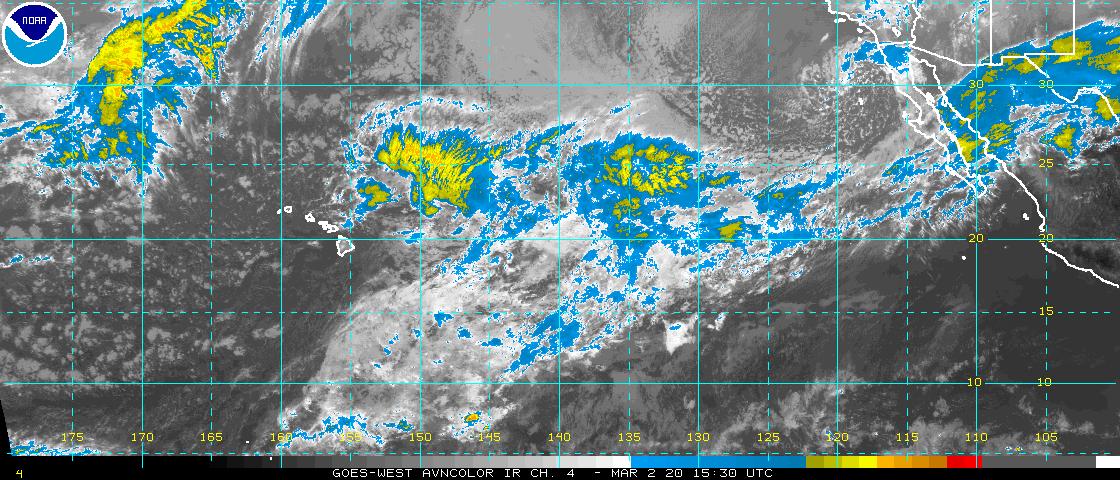
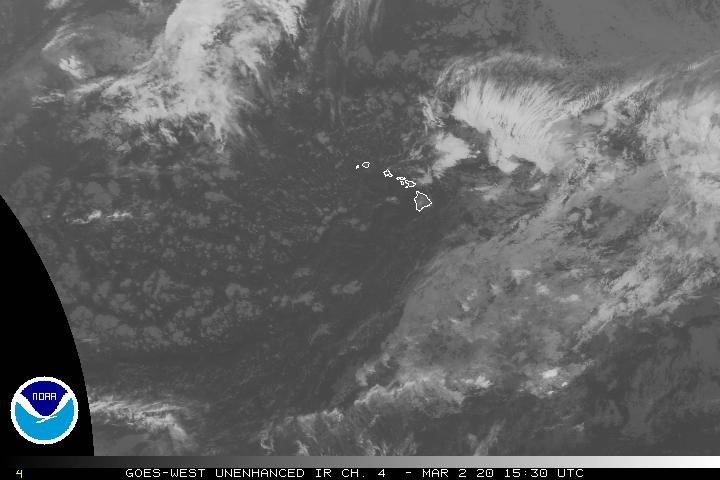
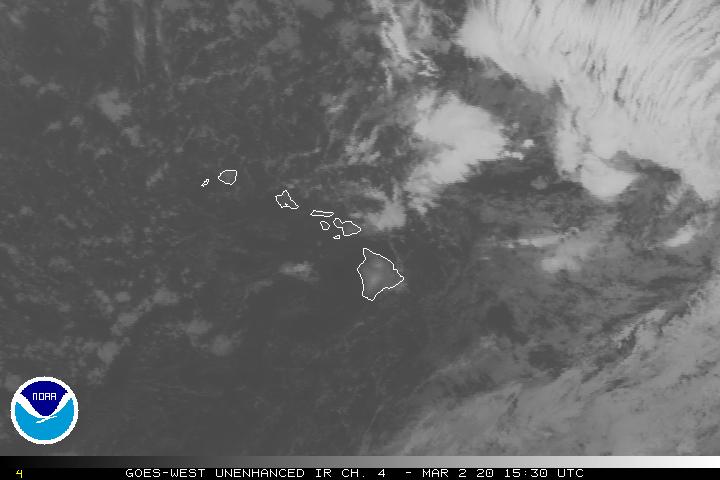
Satellite and Radar Images: To view the cloud conditions we have here in Hawaii, please use the following satellite links, starting off with this Infrared Satellite Image of the islands to see all the clouds around during the day and night. This next image is one that gives close images of the islands only during the daytime hours, and is referred to as a Close-up visible image. This next image shows a larger view of the Pacific…giving perspective to the wider ranging cloud patterns in the Pacific Ocean. Finally, here’s a Looping IR satellite image, making viewable the clouds around the islands 24 hours a day. To help you keep track of where any showers may be around the islands, here’s the latest animated radar image.
Hawaii’s Mountains – Here’s a link to the live webcam on the summit of near 14,000 foot Mauna Kea on the Big Island of Hawaii. The tallest peak on the island of Maui is the Haleakala Crater, which is near 10,000 feet in elevation. These two webcams are available during the daylight hours here in the islands…and when there’s a big moon rising just after sunset for an hour or two! Plus, during the nights and early mornings you will be able to see stars, and the sunrise too…depending upon weather conditions.
Tropical Cyclone activity in the eastern and central Pacific – Here’s the latest weather information coming out of the National Hurricane Center, covering the eastern north Pacific. You can find the latest tropical cyclone information for the central north Pacific (where Hawaii is located) by clicking on this link to the Central Pacific Hurricane Center. Here’s a tracking map covering both the eastern and central Pacific Ocean. A satellite image, which shows the entire ocean area between Hawaii and the Mexican coast…can be found here. Of course, as we know, our hurricane season won’t begin again until June 1st here in the central Pacific.
Aloha Paragraphs

Our lovely islands of Hawaii
Our trade winds have dropped off some in speed, enough so that the NWS forecast office in
Rainfall across the islands hasn’t amounted to all that much lately, with a couple of exceptions…little change is expected through the rest of the week. There has been some thought that we might see some modest increase around Sunday, although that’s still a question at the time of this writing. We still have a thinning amount of high cirrus clouds over the state, having slipped down generally around Maui to the Big Island…as this satellite image shows. We also see a line of active thunderstorms to the south, southwest and southeast of the islands, in the deeper tropics. This closer look shows the high cirrus clouds, and still some clouds out to the east and north of
Tropical depression Bonnie has moved into the Gulf of Mexico Friday night. The current NHC graphical track map takes this storm across the Gulf of Mexico this weekend. It looks very likely to pass over the oil spill area, making impact near the Louisiana or Mississippi coasts Saturday night. Here’s a satellite image of the system over Florida. This depression may reach the tropical storm stage again, as it moves towards the coast.
It’s Friday evening as I begin writing this last section of today’s narrative update. As noted above, our trade winds seem to be getting a little lighter now, with this trend continuing into the weekend. There will be some occasional showers, generally along the windward coasts and slopes…perhaps increasing a touch later Sunday into early Monday, especially around the Big Island. ~~~ Since it’s Friday evening after work, I’ll be heading into Kahului to get something to eat, and to take in a new film. I’m looking forward to seeing Salt (2010) with Angelina Jolie and Liev Schreiber, although since its opening night, I’m quite sure it will be sold out. Instead, I’m going to see if I can get into the film called Inception (2010) starring Leonardo DiCaprio and Ken Watanable…among others. This film is being highly praised, with high grades from the critics and viewers both. The Yahoo critics are giving it a B+, while users are giving it an A-…which is high in anybodys terms. The synopsis: a master sorcerer in modern-day Manhattan is trying to defend the city from his arch-nemesis. Here’s the trailer for this film. ~~~ At 540pm here in Kihei, Maui, its breezy out, with generally clear skies, other than the high cirrus clouds that are still around. Those will light up into a gorgeous pink and orange sunset tonight, if you’re here in Hawaii, check it out. I’ll meet you back here Saturday morning with your next new weather narrative, I hope you have a great Friday night! Aloha for now…Glenn.
Extra: new parking garage!
Interesting: Tropical cyclone Bonnie could stir up more than high winds and waters if it hits the Gulf this weekend as anticipated, it may also impact the oil slick, though the exact nature of the effects is unclear, experts say. There’s good and bad news when a tropical storm or hurricane churns across the oil-slicked Gulf of Mexico.
The high winds and seas typically cause upwelling of water that would generally mix up and disperse the oil, making it easier for bacteria to break down and consume than the larger clumps. That would essentially speed up the biodegradation process, according to the National Oceanic and Atmospheric Administration (NOAA).
What happens will depend in part on which way the wind blows. Hurricanes move in a counter-clockwise direction and so tend to move water from east to west — the opposite direction from the way the oil has generally been spreading so far. That means a tropical storm or hurricane passing to the west of the oil slick could drive oil to the coast, while one to the east could push oil away from the coast, according to NOAA.
Whether Bonnie will pass on the east or west of the oil slick is not yet predicted. Storm surges can carry oil onto coasts and inland as far as the surge reaches, NOAA scientists say. But "if there’s not oil in the water then that actually could help flush out the marshes if there’s any oil that made its way into the marshes earlier," said Rick Luettich, director of the Marine Sciences Institute at the University of North Carolina, Chapel Hill.
Practically speaking, the stormy weather can also shut down oil spill cleanup operations, with crews having reportedly evacuated the Gulf ahead of Tropical Storm Bonnie. All of these factors could play out in the coming months as scientists are predicting this hurricane season, which officially began on June 1, could be as intense as or worse than in 2005 (the most active Atlantic season ever recorded and the year Hurricane Katrina struck).
Interesting2: An undersea 6.9-magnitude earthquake hit the southern Philippines on Saturday morning but it was too deep to cause any damage, officials said. No tsunami alert was issued, said the Pacific Tsunami Warning Center, based in Hawaii. The quake hit the Moro Gulf off Mindanao Island at 7:15 a.m. (2315 GMT), the U.S. Geological Survey said. It said the quake had a preliminary magnitude of 7.4 but the Philippine Institute of Volcanology and Seismology later reported a 6.9 magnitude.
"The origin of the quake was 375 miles underground so it was barely felt," the institute’s Director Renato Solidum Jr. said in an interview on DZBB radio. The temblor was centered about 75 miles (121 kilometers) southwest of Cotabato city and about 566 miles (910 kilometers) southeast of the capital, Manila.
The Philippine archipelago lies in the so-called Pacific Ring of Fire where earthquakes are common. It is flanked by the Pacific Ocean to the east and the South China Sea to the west with undersea trenches — potential quake triggers — running alongside its coast on both sides. A major quake that registered a magnitude 7.7 in 1990 killed nearly 2,000 people on the main northern island of Luzon.
Interesting3: Authorities in Guatemala say they’ve detected an increase in vibration inside a volcano that killed three people when it erupted in May. Researchers recently detected "an increase in internal vibration" at the Pacaya volcano, about 18 miles (30 kilometers) south of Guatemala City. The increase could cause further eruptions, according to a statement from CONRED, an emergency agency of the Guatemalan government.
Seismologists have not ruled out a complete eruption that could, depending on the wind direction, bring ash and soot to the capital. An eruption of the volcano in May killed three people and shut down the international airport in Guatemala City.
Interesting4: More winemakers around the world, however, are turning to synthetic alternatives. Wineries in Australia and New Zealand gravitate towards metal caps because importing cork is expensive. Some foodies would argue that synthetics avoid cork mold that can taint wine while providing an easier way to seal a bottle—and any neophyte who has mauled a cork while opening a new bottle would probably sympathize with that argument.
While many high-end vintners still use cork, synthetics are still gaining in popularity, so now the cork industry is pressuring the winemakers and distributors to stay with cork for environmental and economic reasons. The 100% Cork campaign features a Facebook page has over 15,500 members and counting. Corticeira Amorim, a leading Portuguese cork manufacturer, has launched a web site detailing all sorts of facts and statistics.
The company touts a PricewaterhouseCoopers study explaining that synthetic corks create a carbon footprint exponentially higher than that of naturally derived cork. Other studies explain that cork taint is overhyped; outline Amorim’s efforts to reduce greenhouse gas emissions; and articulate how cork recycling is increasing and how the results of which are beneficial for the planet. All these reports and campaigns have the purpose of pressuring winemakers to come turn away from synthetics and return to cork.
The environmental and social impacts of cork’s decline are clear: cork provides some of the few high-paying agricultural jobs remaining on the planet. A decline in cork production could devastate cork forests, which house trees hundreds of years old and contain rare ecosystems that would disappear should cork production cease. While many of us romanticize the Mediterranean (easy to do), much of this region has suffered from drought—cork trees protect local soil from drying out and halts erosion.
 Email Glenn James: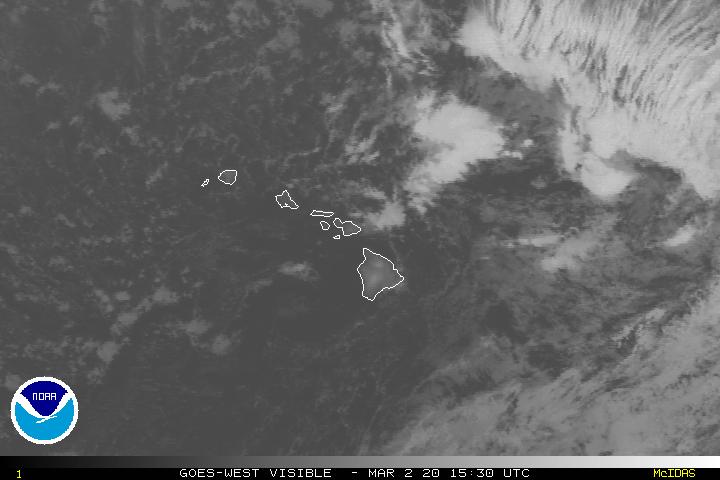




Noel Says:
Glenn, the Extra was simply amazing….LMAO! Imagine maintaining the systems/controls. Imagine when it breaks down!! We need one of these in Pa’ia I reckon;-)~~~Hi Noel, thanks for your response, I agree, we need one of those everywhere…lets start off with Paia. Aloha, Glenn