











July 21-22, 2010
Air Temperatures – The following maximum temperatures were recorded across the state of Hawaii Wednesday afternoon:
Lihue, Kauai – 84
Honolulu, Oahu – 88
Kaneohe, Oahu – 84
Kaunakakai, Molokai – 88
Kahului, Maui – missing
Hilo, Hawaii – 84
Kailua-kona – 83
Air Temperatures ranged between these warmest and coolest spots near sea level – and on the highest mountain tops too…as of 5pm Wednesday evening:
Kalaeloa, Oahu – 87
Molokai AP – 81
Haleakala Crater – 52 (near 10,000 feet on Maui)
Mauna Kea summit – 45 (near 14,000 feet on the Big Island)
Precipitation Totals – The following numbers represent the largest precipitation totals (inches) during the last 24 hours on each of the major islands, as of Wednesday afternoon:
0.55 Puu Opae, Kauai
0.25 Oahu Forest NWR, Oahu
0.00 Molokai
0.00 Lanai
0.00 Kahoolawe
0.78 Hana airport, Maui
1.36 Pahoa, Big Island
Marine Winds – Here’s the latest (automatically updated) weather map showing a strong 1038 millibar high pressure system far to the north of the islands. Our local trade winds will remain active through Thursday and Friday…gradually increasing in strength.
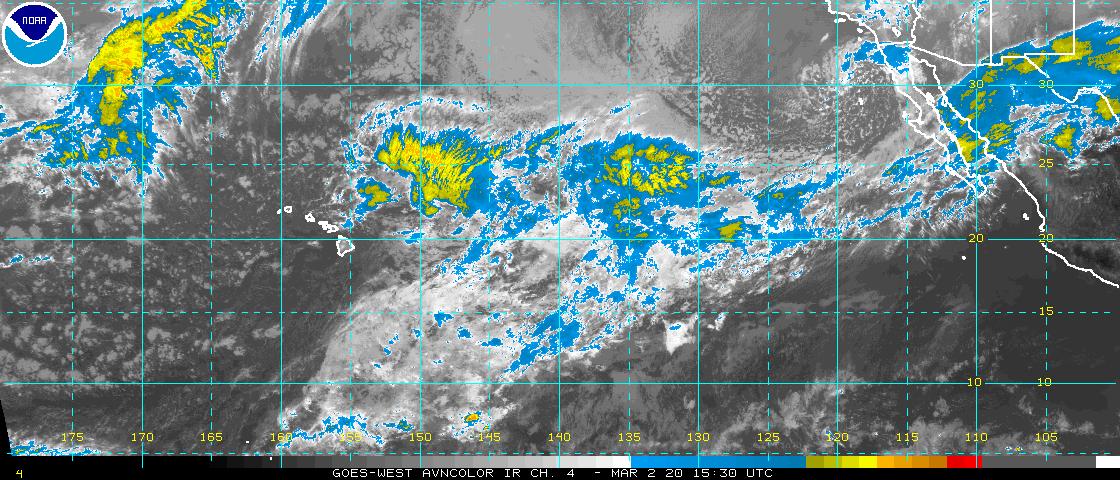
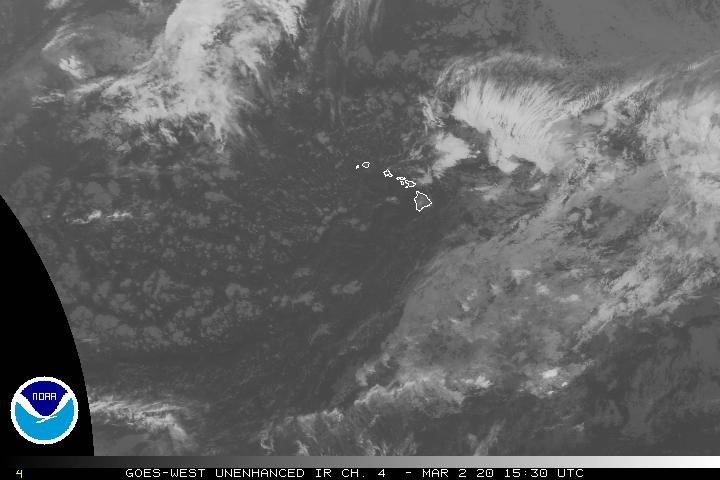
Satellite and Radar Images: To view the cloud conditions we have here in Hawaii, please use the following satellite links, starting off with this Infrared Satellite Image of the islands to see all the clouds around during the day and night. This next image is one that gives close images of the islands only during the daytime hours, and is referred to as a Close-up visible image. This next image shows a larger view of the Pacific…giving perspective to the wider ranging cloud patterns in the Pacific Ocean. Finally, here’s a Looping IR satellite image, making viewable the clouds around the islands 24 hours a day. To help you keep track of where any showers may be around the islands, here’s the latest animated radar image.
Hawaii’s Mountains – Here’s a link to the live webcam on the summit of near 14,000 foot Mauna Kea on the Big Island of Hawaii. The tallest peak on the island of Maui is the Haleakala Crater, which is near 10,000 feet in elevation. These two webcams are available during the daylight hours here in the islands…and when there’s a big moon rising just after sunset for an hour or two! Plus, during the nights and early mornings you will be able to see stars, and the sunrise too…depending upon weather conditions.
Tropical Cyclone activity in the eastern and central Pacific – Here’s the latest weather information coming out of the National Hurricane Center, covering the eastern north Pacific. You can find the latest tropical cyclone information for the central north Pacific (where Hawaii is located) by clicking on this link to the Central Pacific Hurricane Center. Here’s a tracking map covering both the eastern and central Pacific Ocean. A satellite image, which shows the entire ocean area between Hawaii and the Mexican coast…can be found here. Of course, as we know, our hurricane season won’t begin again until June 1st here in the central Pacific.
Aloha Paragraphs

This kind of thing happens here in the islands all the time!
The winds were somewhat lighter the last couple of days, although most areas have cruised through with moderately strong breezes blowing. The winds in gusts were topping 35 mph, getting up to almost 40 mph Wednesday afternoon. This weather map shows our trade wind producing high pressure system is being rated at a robust 1038 millibars at the moment. The center of this high pressure cell is quite far away, and is very large. Its impact on our islands will include a boost in wind speeds over the next couple of days, through Friday. As this strengthening of the trade winds occurs now, we may very well see small craft advisory flags going up over some coastal waters, and through the major channels in
The precipitation associated with the trough of low pressure, which moved across the state overnight into today, was somewhat disappointing. I use this word because there had been some hope that perhaps some of the very dry leeward sides might get a few showers. As it turned out, the
It’s Wednesday evening as I begin writing this last section of toay’s narrative update. As noted above, our trade winds will continue to blow this week, increasing in strength into Thursday. These trade winds will blow clouds our way, with some showers falling here and there. The overlying atmosphere remains rather stable though, which will limit any showers quite a bit. The rather thick area of high cirrus clouds continues to move over the state this evening as well. ~~~ Here in Kihei, Maui, at around 545pm, its rather cloudy, although mostly in the upper realms, with these high icy clouds. As was the case last evening at sunset, and this morning at sunrise too, we could see another dynamically colorful sky as the sun sets tonight…keep an eye out, and then again Thursday morning as well. I’m getting ready to head up the mountain now, taking the drive upcountry to Kula. I’ll take my usual walk, and have dinner ready for the potential nice sunset to accompany me. I’ll be back early Thursday morning with your next new weather narrative, I hope you have a great Wednesday night until then! Aloha for now…Glenn.
Interesting: Two new fish species — with pancake-flat bodies, wiggling lures on their faces, and elbowed fins for "walking" on the seafloor — have been discovered in the path of spewing Gulf of Mexico oil. One of these pancake batfishes lives in the northern Gulf where oil is already spreading from the Deepwater Horizon blowout, says ichthyologist Prosanta Chakrabarty of Louisiana State University’s Museum of Natural Sciences in Baton Rouge, a co-discoverer of the species.
Chakrabarty calls this narrowly distributed species the Louisiana pancake batfish. Its full scientific name, in the genus Halieutichthys, hasn’t even been published yet. The oil’s impact on the soon-to-be new species isn’t clear. "All we can say is that its habitat is threatened," Chakrabarty says. The other newly identified pancake batfish has a somewhat broader range.
Yet all pancake batfishes, now three species in total, live in water that could be fouled if Gulf oil heavily taints the Loop Current off Florida’s west coast. Louisiana pancake batfish grow only about "that big," Chakrabarty says, making a circle of his thumb and forefinger. They’re as thick as an exceptionally fluffy pancake. Fins that work almost like stubby arms prop them up or let them waddle along the bottom.
Unlikely as it may sound, these little squashed-looking fishes are anglerfish, a group most people know from nature documentaries depicting these chunky, fanged creatures of the deep ocean. Anglerfishes get their name from projections that dangle somewhere in the vicinity of their mouths and invite overly curious passersby in for lunch. Pancake batfishes have a lure too, a stubby projection that twitches where a nose would be on a mammal face.
Interesting2: Four large oil companies are committing $1 billion to set up a rapid response system to deal with oil spills in the Gulf of Mexico’s deep waters. The effort is aimed partly at deflecting efforts by some state and federal officials to stop or severely restrict drilling in the gulf in the wake of the BP spill.
The plan is expected to be announced on Thursday and involves Exxon Mobil, Chevron, ConocoPhillips and Royal Dutch Shell. But it will be open to any company with offshore drilling and production in the gulf — including BP, whose runaway Macondo well has shown how unprepared the industry was for a major drilling accident.
According to a document describing the plan, the initial funding will be used to build containment equipment, including underwater systems and pipelines, that will be able to deal with a variety of deepwater problems. The companies expect the system will be able to operate in waters as deep as 10,000 feet and capture 100,000 barrels of oil a day.
The April 20 explosion of the Deepwater Horizon and subsequent oil spill has been a wakeup call for the industry. While it has invested billions of dollars to develop oil and gas resources offshore, in ever-deeper waters, its spill-response technology has not advanced much in recent decades.
Oil companies hope the initiative will help persuade government regulators and the administration to allow them to resume offshore drilling in the Gulf of Mexico as soon as possible. The Obama administration imposed a six-month ban on deepwater drilling days after the Deepwater Horizon accident.
“Chevron knows that it can only operate with the public’s confidence that the energy we need will be produced safely and reliably,” said John Watson, chairman and chief executive officer of Chevron, in a statement. “We are committed to advancing safe operations through enhanced prevention, better well containment and intervention and improved spill response.
This new system significantly enhances the industry’s ability to effectively respond to any unforeseen incidents.” It has taken BP nearly three months to finally cap its gushing oil well in the gulf, after repeated failures to plug the well. While it was drilling a relief well to permanently seal its damaged well, BP has relied on inflatable booms, chemical dispersants, and controlled burning to address the spill.
The new initiative comes after four weeks of intensive effort by the major oil companies. It is the first product of a larger discussion within the industry on how to operate safely in the Gulf of Mexico. The response system will include specially designed sub-sea containment equipment that will be ready for rapid deployment in the event of a spill, as well as a team of permanent specialists.
As part of the plan, a new not-for profit entity, called the Marine Well Containment Company, will be created and will be in charge of operating and maintaining this emergency capability. The new entity will also have a research and development arm charged with devising ways of tackling an underwater spill. Frank Verrastro, an energy expert at the Center for Strategic and International Studies, said such an initiative was badly needed.
“The spill exposed the fact that the industry’s capability on capture and clean-up was 1980s vintage, in part because there was so much reliance on blowout preventers,” he said. “Companies have used their technology to get into the deepwater but they didn’t have an adequate plan to intervene at these depths or to contain a large-scale spill.”
 Email Glenn James: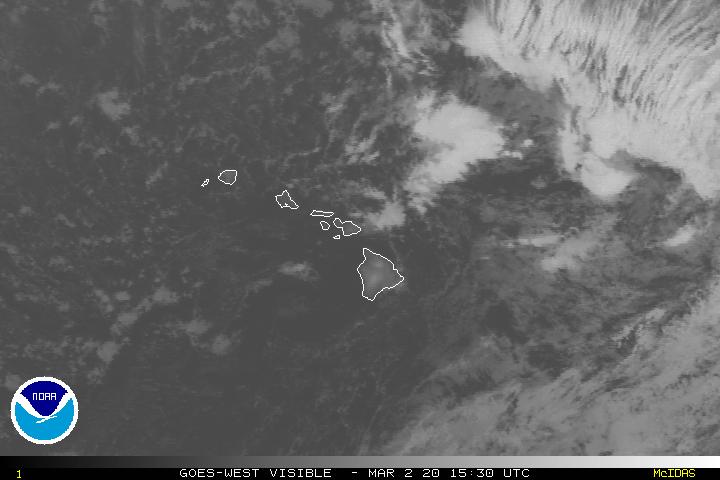


jack weber Says:
We got pretty well drenched starting earlier than expected yesterday, at about 2 pm. Rained non-stop all day through the evening. Looks clear this morning overhead, but with clouds on the horizon….will unroll the plastic from the house pad and hope for the best…J* PS—nice painting above!~~~Thanks for the report for your area on the Big Island Jack, we didn’t see much anywhere else…so you were the big winners down there. Yea, that is a nice painting, thanks. Aloha, Glenn