July 20-21, 2010
Air Temperatures – The following maximum temperatures were recorded across the state of Hawaii Tuesday afternoon:
Lihue, Kauai – 84
Honolulu, Oahu – 88
Kaneohe, Oahu – 83
Kaunakakai, Molokai – 86
Kahului, Maui – 87
Hilo, Hawaii – 84
Kailua-kona – 84
Air Temperatures ranged between these warmest and coolest spots near sea level – and on the highest mountain tops too…as of 5pm Tuesday evening:
Barking Sands, Kauai – 85
Hilo, Hawaii – 76
Haleakala Crater – 48 (near 10,000 feet on Maui)
Mauna Kea summit – 41 (near 14,000 feet on the Big Island)
Precipitation Totals – The following numbers represent the largest precipitation totals (inches) during the last 24 hours on each of the major islands, as of Tuesday afternoon:
1.65 Mount Waialeale, Kauai
0.85 Manoa Valley, Oahu
0.00 Molokai
0.00 Lanai
0.00 Kahoolawe
1.55 Ulupalakua, Maui
0.41 Kawainui Stream, Big Island
Marine Winds – Here’s the latest (automatically updated) weather map showing a very strong 1039 millibar high pressure system far to the north of the islands. Our local trade winds remain active through Wednesday and Thursday…gradually increasing in strength.
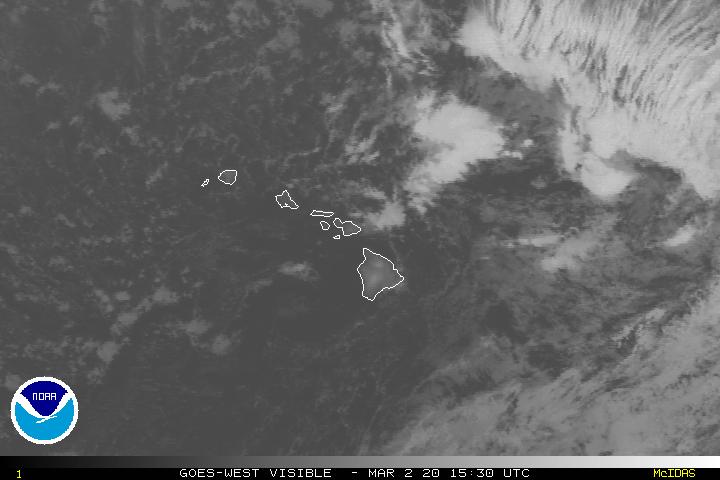
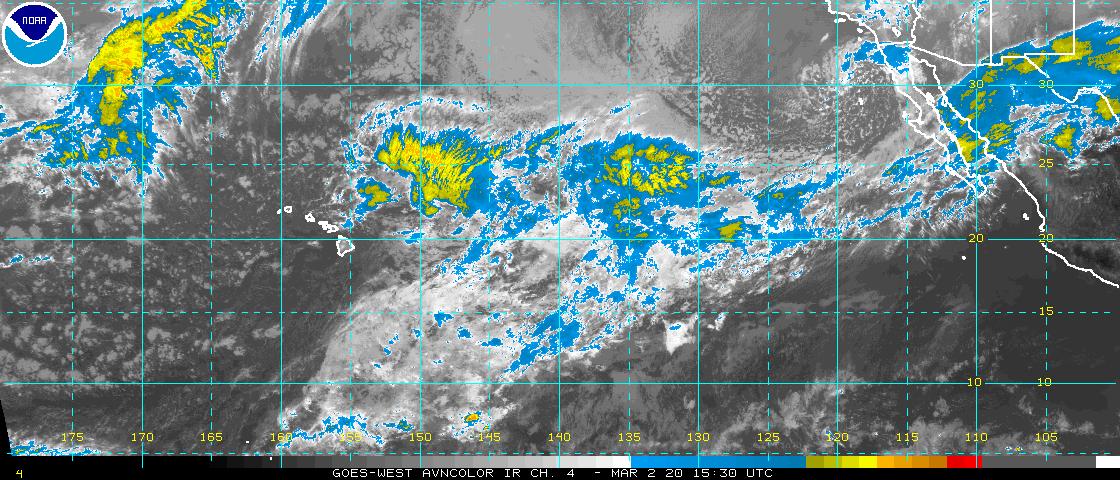
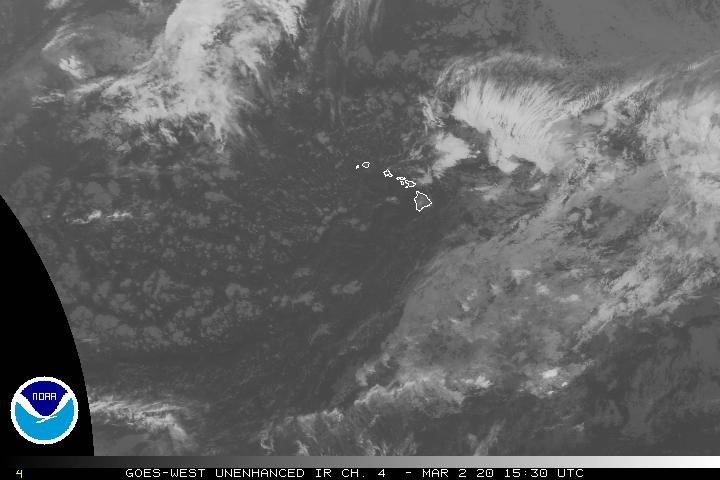
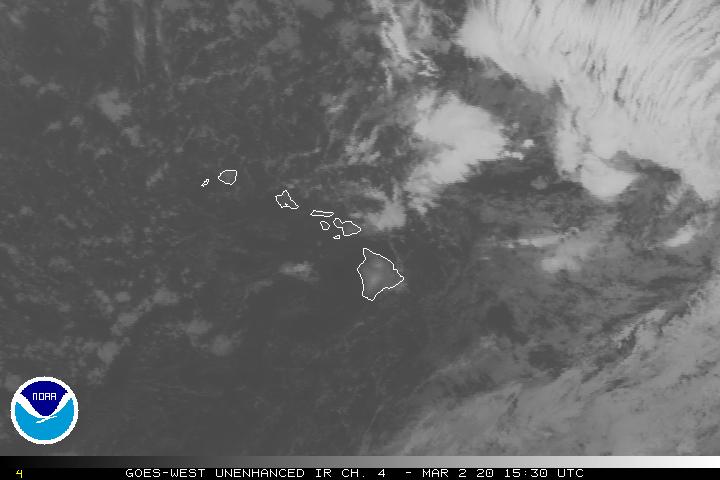
Satellite and Radar Images: To view the cloud conditions we have here in Hawaii, please use the following satellite links, starting off with this Infrared Satellite Image of the islands to see all the clouds around during the day and night. This next image is one that gives close images of the islands only during the daytime hours, and is referred to as a Close-up visible image. This next image shows a larger view of the Pacific…giving perspective to the wider ranging cloud patterns in the Pacific Ocean. Finally, here’s a Looping IR satellite image, making viewable the clouds around the islands 24 hours a day. To help you keep track of where any showers may be around the islands, here’s the latest animated radar image.
Hawaii’s Mountains – Here’s a link to the live webcam on the summit of near 14,000 foot Mauna Kea on the Big Island of Hawaii. The tallest peak on the island of Maui is the Haleakala Crater, which is near 10,000 feet in elevation. These two webcams are available during the daylight hours here in the islands…and when there’s a big moon rising just after sunset for an hour or two! Plus, during the nights and early mornings you will be able to see stars, and the sunrise too…depending upon weather conditions.
Tropical Cyclone activity in the eastern and central Pacific – Here’s the latest weather information coming out of the National Hurricane Center, covering the eastern north Pacific. You can find the latest tropical cyclone information for the central north Pacific (where Hawaii is located) by clicking on this link to the Central Pacific Hurricane Center. Here’s a tracking map covering both the eastern and central Pacific Ocean. A satellite image, which shows the entire ocean area between Hawaii and the Mexican coast…can be found here. Of course, as we know, our hurricane season won’t begin again until June 1st here in the central Pacific.
Aloha Paragraphs

A few showers locally tonight into Wednesday
The trade winds continue to blow across the state of
As far as rainfall goes, it looks like we’ll get some, at least on the windward sides…and most notably perhaps on the southernmost
It’s Tuesday evening as I begin writing this last section of today’s narrative update. As noted above, our trade winds will continue to blow this week, increasing in strength later Wednesday or by Thursday. These trade winds will blow clouds our way, with some showers falling here and there. These showers will be focused most intently along the windward sides, as the trade winds continue to blow. The overlying atmosphere however is rather stable, which will limit the showers quite a bit. A rather thick area of high cirrus clouds are moving over the state early this morning as well. As we move through Wednesday, these clouds should have moved through the state by Thursday, with more normal drier weather taking their place then. ~~~ Here in Kihei, Maui, it was quite clear, although the high cirrus clouds were making the sky look quite cloudy this evening. There were some lower level clouds around in places too. I’m going to bring this looping radar image down to this lower paragraph, so it will be easy to access, as some showers pass through the state Wednesday morning. Check out the potential colorful sunrise Wednesday morning, with the high cirrus clouds still around. I’ll be back early Wednesday morning with your next new weather narrative. I hope you have a good Tuesday night until then! Aloha for now…Glenn.
Interesting: A team of researchers from the University of Valencia (UV) has found that 34% of ultraviolet radiation filters through under beach umbrellas. According to a new study, umbrellas intercept the full direct flow that comes from the Sun, but not the diffused radiation that penetrates through from the sides.
"We have proven that irradiance (radiation incidence per unit of surface area) that reaches the ground covered by an umbrella is 34% of the total," says José Antonio Martínez-Lozano, co-author of the study and coordinator of the Research Group of Solar Radiation in UV.
To carry out the project, which was published recently in the journal Photochemistry and Photobiology, the team positioned an ultraviolet ray sensor on the base of a canvas umbrella painted blue and white, with a radius of 80cm and height of 1.5 meters.
"The umbrella intercepts the direct radiation that comes from the Sun, but part of the diffused radiation, which makes up approximately 60% of the total, reaches the sensor from the sky not covered by the umbrella," explains Martínez-Lozano.
The results show that canvas has a very high capacity for absorbing radiation, "with only 5% transmissivity," but this does not prevent diffused ultraviolet radiation from penetrating through on the sides.
In addition, the team has developed a geometric model to obstruct the sky to calculate the irradiance that is received on the different horizontal and vertical planes under the umbrella. In the case of horizontal irradiance, the values that the model provides coincide with those registered experimentally with only a relative error of 3%.
In this way, and using various configurations of sky, ground and umbrella, the researchers have been able to simulate the real situation of people, who do not always remain lying down under sunshades, as they often tend to rise, sit or stand up.
Protection against skin cancer Scientists believe that this study can help to gain a better understanding of the epidemiology of some skin cancers. An excess of ultraviolet radiation is not only related to the appearance of melanoma, it is also connected to sunburn, photo-ageing, many eye disorders -especially cataracts-, weakness of the immune system and DNA damage.
The earth’s atmosphere is a natural barrier that reduces the harmful effects of UV rays, but experts recommend the use of others such as umbrellas, pieces of clothing, hats with a brim over 7cm, sunglasses with protection and sun creams.
They also recommend reducing the exposure time and avoiding hours when the sun is at its highest (between midday and 4pm local time). In any case, rational use of ultraviolet rays also has beneficial effects for human health, as they help to treat dermatological disorders and form vitamin D3. Some studies even highlight its properties for limiting hypertension and reducing the appearance of certain internal cancers, such as prostrate cancer.
Interesting2: Air travel poses no "significant threat" to cardiovascular health, with few conditions likely to warrant restrictions, concludes new guidance published in the journal Heart. The guidance, which has been drawn up by the British Cardiovascular Society, was prompted by widespread public concern about the impact of air travel on health and a House of Lords Science and Technology Committee report on this same issue, published in 2007.
The House of Lords report called for definitive specialist guidance to help passengers, doctors, and commercial airline carriers properly assess the health risks of flying for those with cardiovascular disorders. Several sets of guidelines on this subject already exist, but the recommendations vary widely, particularly in respect of the appropriate time lag between an incident or medical procedure and a flight.
The new guidance draws on the published evidence, such as it is, and the expertise of a panel of specialists in cardiology, respiratory disease, and aviation science. The main impact of air travel is breathing in air with a reduced oxygen content — resulting in lower circulating oxygen levels in the blood — in a pressurized environment, referred to as hypobaric hypoxia, says the guidance.
Passengers already at high risk of angina, heart attack, heart failure or abnormal heart rhythms, may be adversely affected by hypoxia, but the blood oxygen levels induced by flying "appear to have little or no adverse circulatory effects" and certainly not for short and medium haul flights, it says. The guidance acknowledges the deleterious impact of "airport stresses" such as security measures, the threat of terrorism, and luggage handling, on cardiovascular health.
But most airports provide "excellent services" to assist those with health problems or disabilities, it says. Even passengers with more serious forms of cardiovascular disorders can fly, providing they take their medication, don’t overexert themselves, and can access in-flight oxygen and airport assistance, it says. Some procedures/conditions may also require waiting an appropriate length of time before flying, to check there are no complications or to ensure the condition is stable.
The guidance also confirms that having a pacemaker does not prohibit flying, and while a long haul flight doubles the risk of deep vein thrombosis (DVT), the risk is similar to that incurred during car, bus or train travel for a similar period. The absolute risk of DVT for a fit and healthy person is one in 6000 for a flight of more than four hours, says the guidance, pointing out that pilots are at no greater risk than the general population.
Even those at high risk — those who have already had a DVT or recent surgery lasting more than 30 minutes — can still fly, providing they take plenty of fluids, excluding caffeine and alcohol, wear compression stockings, and take a blood thinner, it says. Aspirin is not recommended.
"For those with cardiovascular disease who are not critically ill, but who wish to fly on commercial aircraft, the aircraft environment does not pose a significant risk to their health," concludes the guidance. "It is only when their underlying condition is associated with a significant risk of acute deterioration that reasonable restrictions should apply."
 Email Glenn James: