











July 2-3, 2010
Air Temperatures – The following maximum temperatures were recorded across the state of Hawaii Friday afternoon:
Lihue, Kauai – 85
Honolulu, Oahu – 86
Kaneohe, Oahu – 83
Kaunakakai, Molokai – 83
Kahului, Maui – 86
Hilo, Hawaii – 79
Kailua-kona – 82
Air Temperatures ranged between these warmest and coolest spots near sea level around – and on the highest mountains…as of 6pm Friday evening:
Barking Sands, Kauai – 84
Molokai AP – 75
Haleakala Crater – 54 (near 10,000 feet on Maui)
Mauna Kea summit – 48 (near 14,000 feet on the Big Island)
Precipitation Totals – The following numbers represent the largest precipitation totals (inches) during the last 24 hours on each of the major islands, as of Friday afternoon:
0.47 Mount Waialeale, Kauai
1.03 Moanalua RG, Oahu
0.24 Molokai
0.00 Lanai
0.01 Kahoolawe
0.83 West Wailuaiki, Maui
0.51 Kawainui Stream, Big Island
Marine Winds – Here’s the latest (automatically updated) weather map showing a 1034 millibar high pressure system to the northeast of the islands…moving northeast. Trade winds holding at moderately strong levels…gradually becoming lighter.
Satellite and Radar Images: To view the cloud conditions we have here in Hawaii, please use the following satellite links, starting off with this Infrared Satellite Image of the islands to see all the clouds around during the day and night. This next image is one that gives close images of the islands only during the daytime hours, and is referred to as a Close-up visible image. This next image shows a larger view of the Pacific…giving perspective to the wider ranging cloud patterns in the Pacific Ocean. Finally, here’s a Looping IR satellite image, making viewable the clouds around the islands 24 hours a day. To help you keep track of where any showers may be around the islands, here’s the latest animated radar image.
Hawaii’s Mountains – Here’s a link to the live webcam on the summit of near 14,000 foot Mauna Kea on the Big Island of Hawaii. The tallest peak on the island of Maui is the Haleakala Crater, which is near 10,000 feet in elevation. These two webcams are available during the daylight hours here in the islands…and when there’s a big moon rising just after sunset for an hour or two! Plus, during the nights and early mornings you will be able to see stars, and the sunrise too…depending upon weather conditions.
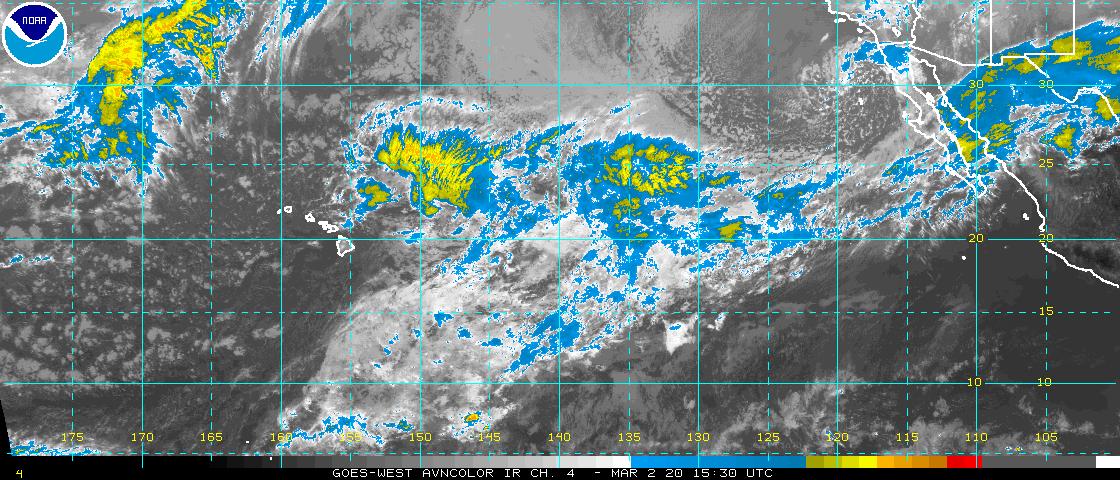
Tropical Cyclone activity in the eastern and central Pacific – Here’s the latest weather information coming out of the National Hurricane Center, covering the eastern north Pacific. You can find the latest tropical cyclone information for the central north Pacific (where Hawaii is located) by clicking on this link to the Central Pacific Hurricane Center. Here’s a tracking map covering both the eastern and central Pacific Ocean. A satellite image, which shows the entire ocean area between Hawaii and the Mexican coast…can be found here. Of course, as we know, our hurricane season won’t begin again until June 1st here in the central Pacific.
Aloha Paragraphs
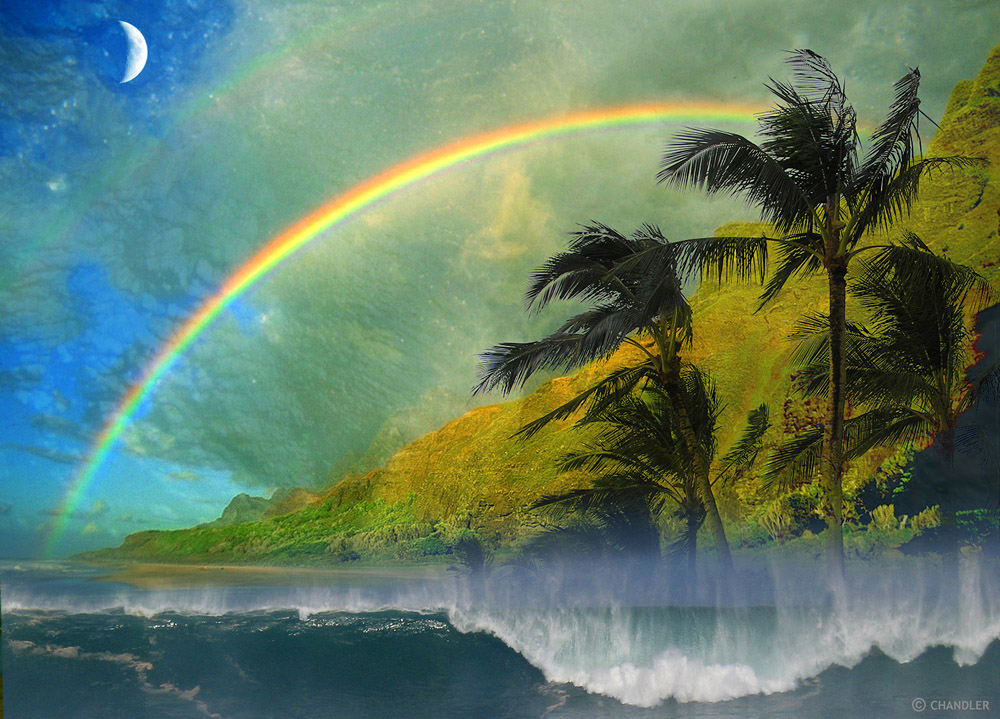
Molokai..created by Geoffrey Chandler
The trade winds will remain breezy, although become gradually lighter into this holiday weekend…into the new week ahead. We’ll see a gradual tapering off of the recent gusty trade winds over the next several days. The source of our trade winds can be tracked to a fairly strong 1034 millibar high pressure system to our northeast Friday night…as shown on this weather map. The computer forecast models suggest that as this high pressure cell moves away towards the east-northeast, our winds will become a little lighter. There will be enough wind however, to disperse whatever fireworks smoke there is…during the 4th of July holiday festivities Sunday evening.
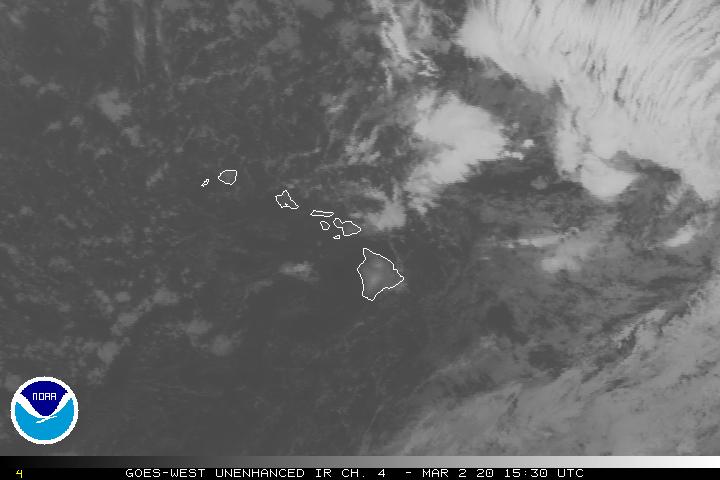
There are no organized areas of precipitation taking aim on our islands at this time. We’ll find off and on passing showers though, generally on the light side…falling along our windward coasts and slopes at times. Here’s an IR satellite image showing a fairly normal cloud distribution around the islands Friday night…along with some high cirrus clouds located to the west and southwest. As this looping radar image of the islands shows, there will be some showers falling along our windward sides…evenly divided between each of the islands for the most part. Our weather in general will be favorably inclined, with no major changes on the horizon at the moment. This suggests that the 4th of July holiday will be just fine for most outdoor activities.
The west, east and central north Pacific Ocean has no active tropical cyclones Friday night.
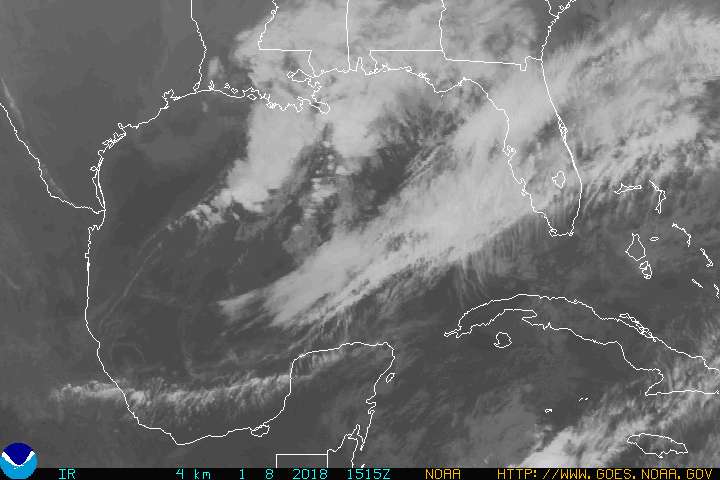
There’s a new area of disturbed weather in the far northeast corner of the Gulf now. This area has a low chance (10%) of becoming a tropical cyclone over the next couple of days. Here’s a satellite image of this area near the panhandle of Florida.
It’s Friday evening as I begin writing this last section of today’s narrative update. As noted above, the trade winds continue to be the main event in our local Hawaiian Island weather picture. All things considered, we’re looking good through the next three days, with lots of fair weather prevailing. This is important, as we move into the big holiday weekend, with lots of folks heading out to enjoy themselves. I’m late leaving Kihei, although perhaps I can still make a film, probably the Prince of Persia: The Sands of Time (2010). If I make it, I’ll write more about it in the morning. I’d better get on the road now, I’ll catch up with you again Saturday morning. I hope you have a great Friday night! Aloha for now…Glenn.
Interesting: The dark deeps of the ocean has always been mysterious because they are dark (of course) as well hard to visit and see what is down there. For example the Coelacanth, long thought extinct, lives down deep and was only discovered in 1938 as well the elusive giant squids of legend. A study of the occurrence of fishes in the ocean’s deepest reaches (the hadal zone, below 20,000 feet) has provided evidence that some species of fishes are more numerous at such depths than experts had thought.
The authors of the study, which is published in the July/August issue of BioScience, observed 10 to 20 snailfish congregating at a depth of 25,000 feet around a baited video lander in the Japan Trench. The observation period lasted only five hours, so the occurrence of so many snailfish was a surprise.
The hadal zone (from the Greek for "like Hades") is the term used for the deepest oceanic trenches. This zone is found from a depth of around 20,000 feet to the bottom of the ocean. It is believed that most life at this depth is sustained by organic debris falling from the upper regions of the ocean or the chemical reactions around thermal vents.
The lack of light and intense pressure create hostile living conditions, and few species are adapted to these conditions. As no sunlight reaches this layer of the ocean, deep sea creatures have adapted with reduced eyesight, having very large eyes for receiving only bioluminescent flashes.
Most of the deep sea dwelling creatures lack any pigmentation since coloration is not useful in an environment with no light. Life is weird to those more used to other marine forms. The habitats chosen by snailfish are as widely variable as their size; they are found in both shallow intertidal zones and at depths of abour 24,000 feet or more, in both cold and warm waters.
Some live closely related lives with scallops or kelp forests. Other species are found on muddy or silty bottoms of continental slopes. Observations at such extreme depths (marine life is much more abundant on continetal shelves and in shallower water where sunlight is more abundant) is technically demanding and therfore rare.
The researchers who conducted the new study, Toyonobu Fujii of the University of Aberdeen, United Kingdom, and four of his colleagues, used a free fall lander that made video recordings of an illuminated patch of the sea floor for one minute every five minutes. This enabled the scientists to distinguish at least 10 individual fish and record their behavior, which was similar to the behavior of fishes observed in 1965 from a bathyscaphe at a depth of 7300 meters in the west Atlantic.
The fishes observed by Fujii and colleagues fed on crustaceans that were attracted to the mackerel bait. How fish can live so far deep and removed from normal food supplies has long been a vexing question. Fish are often reported as being caught at great depths in fishing nets but there is uncertainty about what depth the fish were caught at.
Fujii and colleagues remark that "current understanding of the hadal environment is inadequate." They nonetheless suggest that fish populations may routinely occur far deeper than previously thought in ocean trenches. The depths of the ocean are poorly understood and there may be more interaction than suspected from the shallow depths to the deep abysmal levels.
Interesting2: Will Starbucks really increase recycling? I admit I have a slanted approach to this story. I have met too many single mothers and college students who have relied on employment at Starbucks to keep their families on a health insurance plan or to put themselves through school. Now, I know many peers who rely on a clean, quiet Starbucks store to start a new business via their laptops or search for employment, thanks to Starbucks’ (now unlimited) WiFi access.
As a road warrior sales executive in a past life, Starbucks provided a safe haven between business appointments, or a place to dry out when caught in the rain. The notion that Starbucks mows over independent stores is nonsense: more coffee stores exist because of the Seattle icon, not despite of it. Plus, in a nation beset by growing health problems and an obesity epidemic, I am pragmatic: I am all for an addiction to caffeine over one to fried foods.
Nevertheless, I still wince when I order a Starbucks coffee, knowing that those cups cannot be recycled. I admit I always stuff the java jacket into my back pocket or into a briefcase to ensure it will be recycled at home, but I know that token effort is not enough. And, even if those cups are made from 5% or 10% or 20% post-consumer content, I know that means the rest of the cup comes from pre-consumer trees.
The waste is especially ridiculous when I order an espresso that comes in a cup that can carry 20 shots with room to spare. Finally, the fact that shareholders voted down a recent initiative to step up recycling efforts is more than disappointing—it’s irresponsible. But there may be hope that Starbucks will solve its trash problem: its Chicago stores will start recycling used cups.
This fall, stores in the Second City will start sending used cups to a Green Bay, WI, paper mill, where a Georgia Pacific facility will turn them into napkins. The program will start small but is a significant step to address the company’s devouring of 3 billion paper cups and 1 billion plastic cups annually. Starbucks wants recycling at all of its stores by 2015 and the company’s leadership is focusing on two approaches: first, recycling bins at all of its stores, and second, finding a market for all those dirty cups that otherwise end up in a landfill.
The issue is not entirely Starbucks’ fault: restaurant managers often resist change, partly because the industry endures high labor turnover, which makes rigorous training expensive and time-consuming. The As You Sow Foundation, which led the failed shareholder proposal, is impressed with this latest step, and acknowledges that finding a market for used paper cups while dealing with municipal waste procedures that vary from city to city is a huge challenge.
Interesting3: Oil spills can increase levels of toxic arsenic in the ocean, creating an additional long-term threat to the marine ecosystem, according to research published July 2 in the journal Water Research. Arsenic is a poisonous chemical element found in minerals and it is present in oil. High levels of arsenic in seawater can enable the toxin to enter the food chain.
It can disrupt the photosynthesis process in marine plants and increase the chances of genetic alterations that can cause birth defects and behavioral changes in aquatic life. It can also kill animals such as birds that feed on sea creatures affected by arsenic. In the study, a team from Imperial College London has discovered that oil spills can partially block the ocean’s natural filtration system and prevent this from cleaning arsenic out of the seawater.
The researchers say their study sheds light on a new toxic threat from the Gulf of Mexico oil leak. Arsenic occurs naturally in the ocean, but sediments on the sea floor filter it out of seawater, which keeps the levels of naturally occurring arsenic low. However, arsenic is also flushed into the ocean in wastewater from oil rigs and from accidental oil spills and leakages from underground oil reservoirs.
In the study, the researchers discovered that oil spills and leakages clog up sediments on the ocean floor with oil, which prevents the sediments from bonding with arsenic and burying it safely underground with subsequent layers of sediment. The scientists say this shutdown of the natural filtration system causes arsenic levels in seawater to rise, which means that it can enter the marine ecosystem, where it becomes more concentrated and poisonous the further it moves up the food chain.
The scientists say their work demonstrates how the chemistry of sediments in the Gulf of Mexico may be affected by the current oil leak. Professor Mark Sephton, from the Department of Earth Science and Engineering at Imperial College London, says: "We can’t accurately measure how much arsenic is in the Gulf at the moment because the spill is ongoing. However, the real danger lies in arsenic’s ability to accumulate, which means that each subsequent spill raises the levels of this pollutant in seawater.
Our study is a timely reminder that oil spills could create a toxic ticking time bomb, which could threaten the fabric of the marine ecosystem in the future." Wimolporn Wainipee, postgraduate and lead author of the study from the Department of Earth Science and Engineering at Imperial College London, adds: "We carried out our study before the leak in the Gulf of Mexico occurred, but it gives us a big insight into a potential new environmental danger in the region.
Thousands of gallons of oil are leaked into the world’s oceans every year from big spills, offshore drilling and routine maintenance of rigs, which means many places may be at risk from rising arsenic levels, which could in the long run affect aquatic life, plants and the people who rely on the oceans for their livelihoods." For their research, the team analyzed a mineral called goethite, one of the most abundant ocean sediments in the world, which is an iron bearing oxide.
The team carried out experiments in the laboratory that mimicked conditions in the ocean, to see how the goethite binds to arsenic under natural conditions. They discovered that seawater alters the chemistry of goethite, where low pH levels in the water create a positive change on the surface of goethite sediments, making them attractive to the negatively charged arsenic.
However, the scientists discovered that when they added oil, this created a physical barrier, covering the goethite sediments, which prevented the arsenic in the oil from binding to them. The team also found that the oil changed the chemistry of the sediments, which weakened the attraction between the goethite and arsenic.
In the future, the researchers plan to analyze other minerals such as clays and carbonates that are sediments on the ocean floor. Sediment content varies from ocean to ocean and the researchers will analyze how oil affects their ability to bind to arsenic after a spill
 Email Glenn James: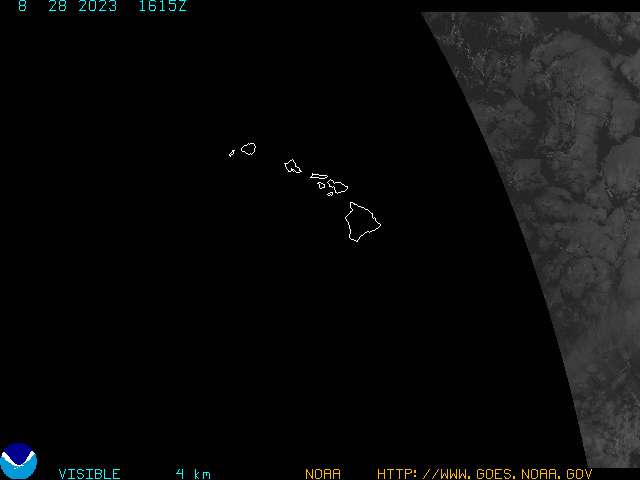


billy conner Says:
aloha glenn , love your column , question please …..what are the occasional images that show up on the “base reflectivity” satellite images periodically that look like meteors , mahalo for your time~~~Hi Billy, if I understand your question correctly, they are the low level salt spray that is being detected by the radar beams…most noticeably on Kauai and the Big Island. Aloha, Glenn