July 15-16, 2010
Air Temperatures – The following maximum temperatures were recorded across the state of Hawaii Thursday afternoon:
Lihue, Kauai – 84
Honolulu, Oahu – 87
Kaneohe, Oahu – 84
Kaunakakai, Molokai – 83
Kahului, Maui – 87
Hilo, Hawaii – 87
Kailua-kona – 82
Air Temperatures ranged between these warmest and coolest spots near sea level – and on the highest mountain tops too…as of 5pm Thursday evening:
Port Allen, Kauai – 88
Molokai AP – 78
Haleakala Crater – 59 (near 10,000 feet on Maui)
Mauna Kea summit – 52 (near 14,000 feet on the Big Island)
Precipitation Totals – The following numbers represent the largest precipitation totals (inches) during the last 24 hours on each of the major islands, as of Thursday afternoon:
0.30 Mount Waialeale, Kauai
0.20 Oahu Forest NWR, Oahu
0.00 Molokai
0.00 Lanai
0.00 Kahoolawe
0.05 Puu Kukui, Maui
0.19 Kealakekua, Big Island
Marine Winds – Here’s the latest (automatically updated) weather map showing a 1035 millibar high pressure cell far to the northeast, which will keep the trade winds blowing…increasing in strength into Saturday.
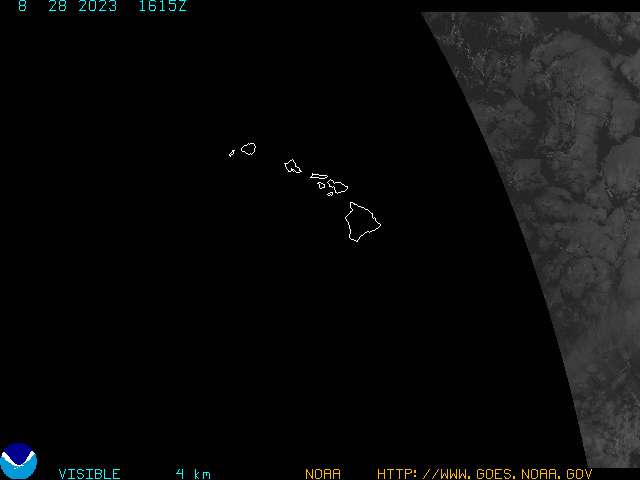
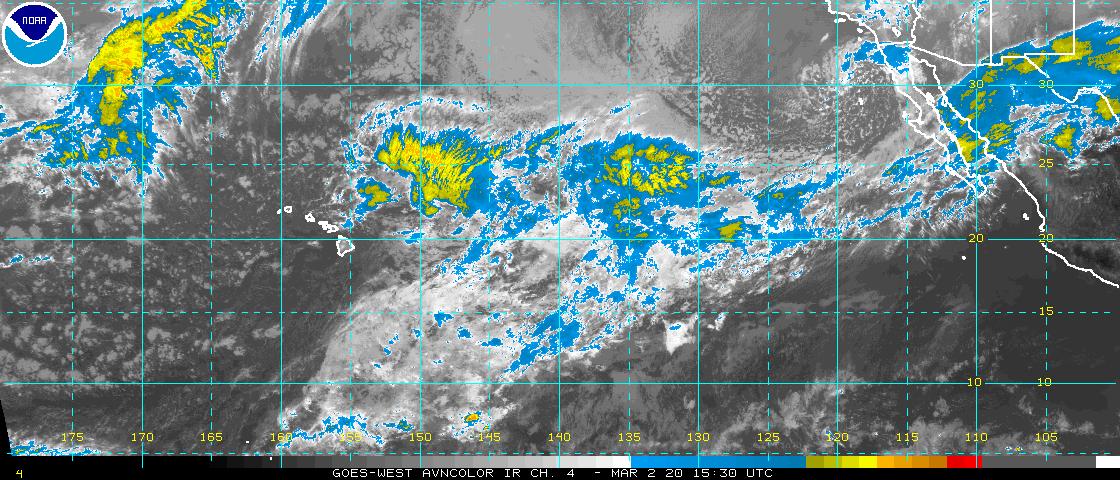
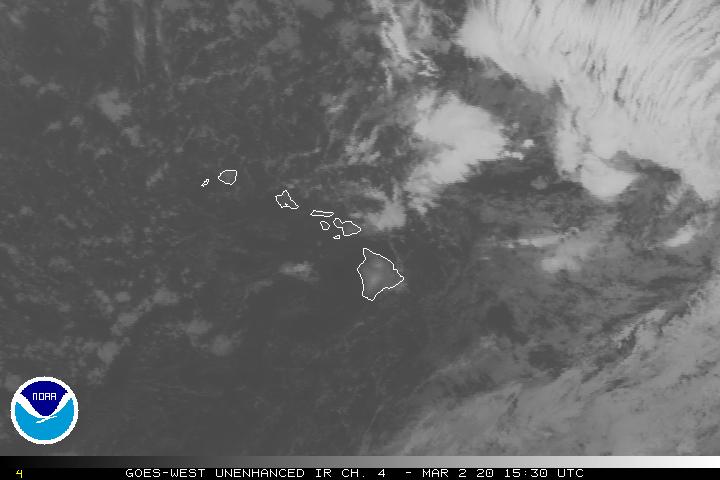
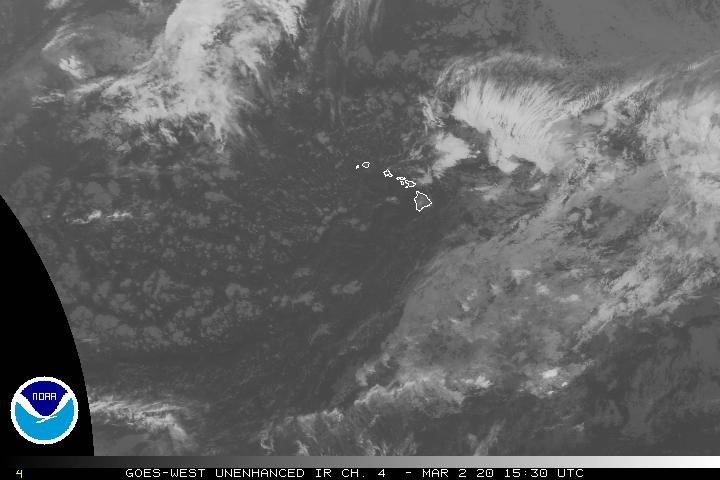
Satellite and Radar Images: To view the cloud conditions we have here in Hawaii, please use the following satellite links, starting off with this Infrared Satellite Image of the islands to see all the clouds around during the day and night. This next image is one that gives close images of the islands only during the daytime hours, and is referred to as a Close-up visible image. This next image shows a larger view of the Pacific…giving perspective to the wider ranging cloud patterns in the Pacific Ocean. Finally, here’s a Looping IR satellite image, making viewable the clouds around the islands 24 hours a day. To help you keep track of where any showers may be around the islands, here’s the latest animated radar image.
Hawaii’s Mountains – Here’s a link to the live webcam on the summit of near 14,000 foot Mauna Kea on the Big Island of Hawaii. The tallest peak on the island of Maui is the Haleakala Crater, which is near 10,000 feet in elevation. These two webcams are available during the daylight hours here in the islands…and when there’s a big moon rising just after sunset for an hour or two! Plus, during the nights and early mornings you will be able to see stars, and the sunrise too…depending upon weather conditions.
Tropical Cyclone activity in the eastern and central Pacific – Here’s the latest weather information coming out of the National Hurricane Center, covering the eastern north Pacific. You can find the latest tropical cyclone information for the central north Pacific (where Hawaii is located) by clicking on this link to the Central Pacific Hurricane Center. Here’s a tracking map covering both the eastern and central Pacific Ocean. A satellite image, which shows the entire ocean area between Hawaii and the Mexican coast…can be found here. Of course, as we know, our hurricane season won’t begin again until June 1st here in the central Pacific.
Aloha Paragraphs

The north side of the Big Island
Since we’re in the summer month of July, a time known for steady trade winds, we seem to be matching climatology quite well. There are expected to be rather small variations in our local wind speeds through the next 7-10 days, which isn’t unusual. The computer models suggest that wind speeds will be blowing between 10-25 mph through the foreseeable future. During those lighter wind days, we won’t see any small craft wind advisory flags hoisted, with flags flying around those windiest channel and coastal waters in
Similar to the winds, described above, our rainfall will show a fairly minor range in intensity and frequency through the next week or so. As is almost always the case, when the trade winds are the main driver in our
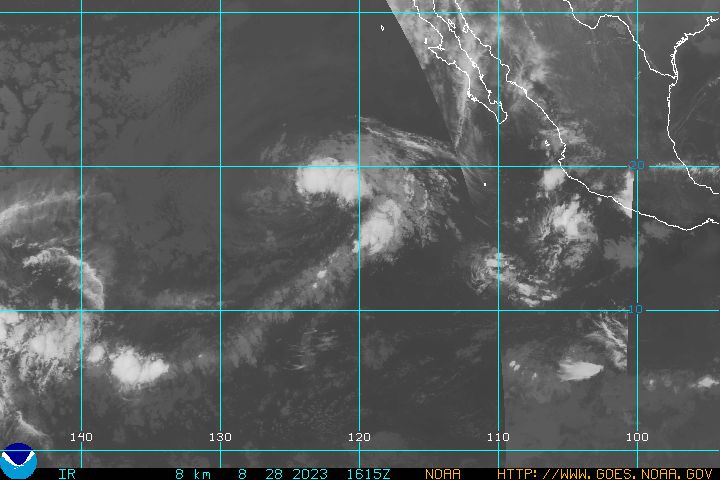
Tropical cyclone 06E continues as a weak tropical cyclone in the eastern Pacific Ocean. This 6th storm of the 2010 hurricane season is expected to remain weak, and isn’t now expected to reach tropical storm strength. Here’s a track map, which shows the depression in relation to the Hawaiian Islands. There is no worry for the Hawaiian Islands, as this system will dissipate far to our east. Here’s a satellite image of this area towards Mexico.
It’s Thursday evening as I begin writing this last section of today’s narrative update. As noted above, the winds are still forecast to increase, which isn’t necessarily a bad thing at all. At the same time, rainfall won’t be a problem either, with rather limited showers in most areas. I honestly don’t see anything that looks like a threat to our fine weather at the moment. We do however need to remain careful in the wild fire department, as we have so much dry tinder in our surrounding fields. The windy weather, and the dry brush, add up to be a great fire danger…considering the depth of our drought conditions at this time. This will likely follow us through the rest of summer, into the autumn season. ~~~ Here in Kihei this evening, it’s rather cloudy, although glancing over towards the windward sides, it looks a little less cloudy. The winds are blowing, although the strongest gust around the state early this evening, was 28 mph at Maalaea Bay here on Maui. I expect a fair amount of cloudiness to prevail over some parts of the islands tonight. I’ll be back early Friday morning with your next new weather narrative, I hope you have a great Thursday night until then! Aloha for now…Glenn.
Interesting: Torrential rain and flooding have directly affected millions of people, and killed scores, in the Yangtze River basin of central and eastern China during July. The Yangtze, being greatest river in East Asia, swells yearly during heavy spring and summer rains. So far in July, rainfall well above the normally high seasonal rain has flooded many streams and rivers in the basin’s provinces of Anhui, Jiangxi and Hunan.
For example, the city of Anqing, Anhui, has had nearly 28 inches of rain within the first half of July, of which more than 2 feet fell within a seven-day stretch. Normal rainfall for the whole month of July in Anhui is about 7 inches.
People stand on a road covered by mud and rocks after a landslide triggered by heavy rains in Xiaohe, Qiaojia county, in southwest China’s Yunnan province, Tuesday, July 13, 2010. Landslides slammed into three mountain hamlets in western China early Tuesday, killing 17 people and leaving 44 missing, while crews drained a fast-rising reservoir in another part of the country following heavy rains.
It was in the area of neighboring Tongcheng, Anhui, that Chinese soldiers blasted a leaking dike on Wednesday, July 14. According to Xinhua News, this was to lessen or prevent the flooding of riverside towns along the Dasha River, a small Yangtze tributary. The news service said that water levels lowered following the blast.
Thus far, the torrential rain and flooding was said to have disrupted the lives of more than 4 million people within Anhui alone. South of Anhui, northern Jiangxi has also reeled from extreme rainfall and flooding. Evacuations as of Wednesday topped 10,000 in a region near the city of Nanchang, which is the site of a big lake, Poyang, linked to the Yangtze.
The hard-hit areas, already having had 100 to more than 300 percent of normal monthly rainfall within two weeks, will continue to get heavy to excessive rainfall in areas for at least the coming week. Runoff will keep water levels on the Yangtze and its tributaries high. Regional rainfall may get a boost next week from Tropical Storm Conson, which is forecast to landfall and break up over south China near Vietnam on Friday and Saturday.
Interesting2: The US military is preparing to find alternative ways of powering its aircraft after being ordered to cut $20 billion in fuel costs. Algae, vegetable oil and animal fat were being considered by the armed services for use in aircraft, ships and armored vehicles as part of the Pentagon’s biggest-ever energy-saving campaign. The Air Force, the largest fuel-guzzling organization on the planet, was due to be the first target. As well as transporting troops and cargo around the world, an average fighter aircraft mission uses 11,000 to 19,00 litres of fuel.
The US Navy was planning to have every aircraft and all escort ships powered by a 50-50 mix of standard jet fuel and biofuel by 2016. The carriers are nuclear-powered “so that’s already alternative”, said Rear Admiral Philip Cullom, the head of the Navy’s Task Force Energy. Cullom said that pilots who recently flew an F/A18 Green Hornet powered with half the fuel tank containing a mustard-extract oil could not tell any difference.
He planned to use the equivalent of eight million barrels of biofuel by 2020. A C17 transport aircraft was due to attempt flying on tallow [animal fat] Aug. 26. Jeff Braun, the director of the U.S. Air Force alternative fuels certification office, said, “What’s left over from the meat process is what we call yellow grease, and you extract the oil from it.”
Algae is another alternative oil source with potential. “The beauty with algae is that you can grow it anywhere and to grow it needs to absorb carbon dioxide, so it’s not only a very effective fuel, in theory it’s also a carbon sink. That’s a pretty good deal,” said Alan Shaffer, the Pentagon’s principal deputy director of defense research and engineering.
 Email Glenn James: