











July 1-2, 2010
Air Temperatures – The following maximum temperatures were recorded across the state of Hawaii Thursday afternoon:
Lihue, Kauai – 83
Honolulu, Oahu – 87
Kaneohe, Oahu – 83
Kaunakakai, Molokai – 83
Kahului, Maui – 88
Hilo, Hawaii – 82
Kailua-kona – 84
Air Temperatures ranged between these warmest and coolest spots near sea level around – and on the highest mountains…as of 5pm Thursday evening:
Honolulu, Oahu – 76
Kahului, Maui – 67
Haleakala Crater – 48 (near 10,000 feet on Maui)
Mauna Kea summit – 37 (near 14,000 feet on the Big Island)
Precipitation Totals – The following numbers represent the largest precipitation totals (inches) during the last 24 hours on each of the major islands, as of Thursday afternoon:
0.63 Mount Waialeale, Kauai
1.09 Palolo Fire Station, Oahu
0.07 Molokai
0.00 Lanai
0.04 Kahoolawe
0.26 West Wailuaiki, Maui
0.71 Kawainui Stream, Big Island
Marine Winds – Here’s the latest (automatically updated) weather map showing a 1035 millibar high pressure system to the north-northeast of the islands. Trade winds holding at moderately strong, with stronger and gusty winds in a few places through Saturday.
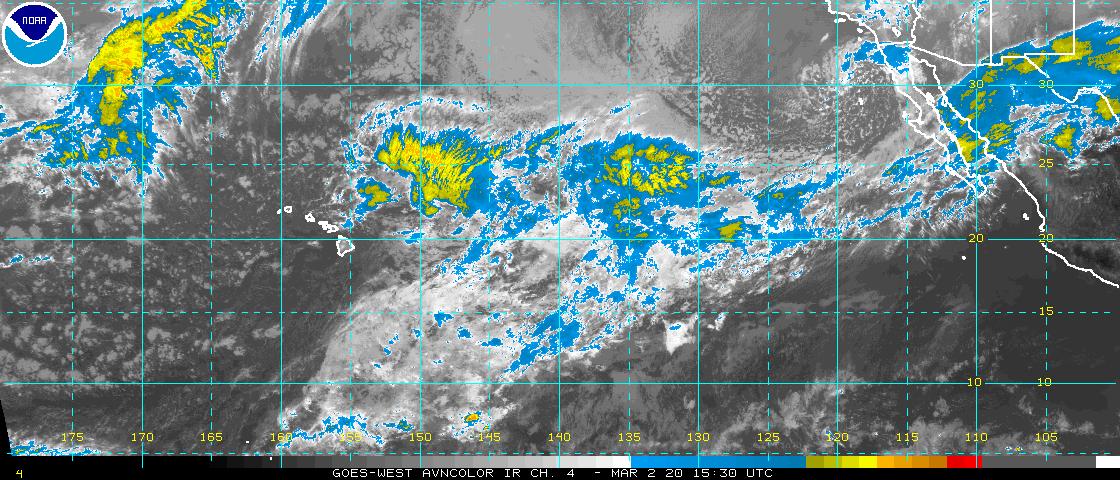
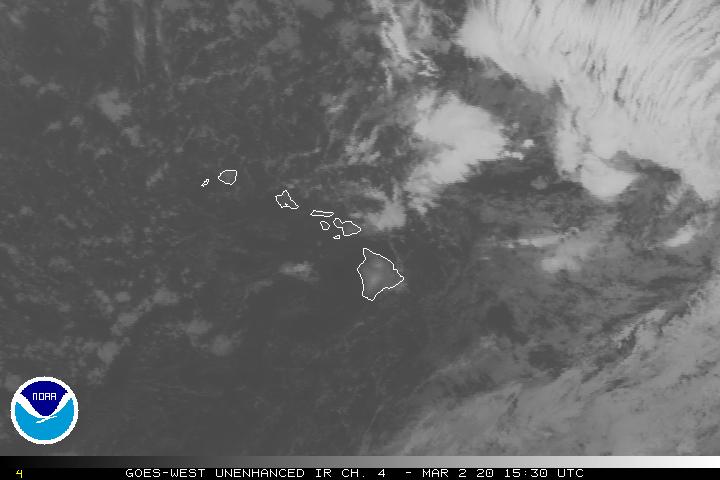
Satellite and Radar Images: To view the cloud conditions we have here in Hawaii, please use the following satellite links, starting off with this Infrared Satellite Image of the islands to see all the clouds around during the day and night. This next image is one that gives close images of the islands only during the daytime hours, and is referred to as a Close-up visible image. This next image shows a larger view of the Pacific…giving perspective to the wider ranging cloud patterns in the Pacific Ocean. Finally, here’s a Looping IR satellite image, making viewable the clouds around the islands 24 hours a day. To help you keep track of where any showers may be around the islands, here’s the latest animated radar image.
Hawaii’s Mountains – Here’s a link to the live webcam on the summit of near 14,000 foot Mauna Kea on the Big Island of Hawaii. The tallest peak on the island of Maui is the Haleakala Crater, which is near 10,000 feet in elevation. These two webcams are available during the daylight hours here in the islands…and when there’s a big moon rising just after sunset for an hour or two! Plus, during the nights and early mornings you will be able to see stars, and the sunrise too…depending upon weather conditions.
Tropical Cyclone activity in the eastern and central Pacific – Here’s the latest weather information coming out of the National Hurricane Center, covering the eastern north Pacific. You can find the latest tropical cyclone information for the central north Pacific (where Hawaii is located) by clicking on this link to the Central Pacific Hurricane Center. Here’s a tracking map covering both the eastern and central Pacific Ocean. A satellite image, which shows the entire ocean area between Hawaii and the Mexican coast…can be found here. Of course, as we know, our hurricane season won’t begin again until June 1st here in the central Pacific.
Aloha Paragraphs

Windward Oahu…painted by John Heinrichs
The trade winds remain active across the
There are no organized areas of precipitation taking aim on our islands at this time. We’ll find off and on passing showers though, generally on the light side…falling along our windward coasts and slopes. Here’s an IR satellite image showing a fairly normal cloud distribution around the islands Thursday evening…along with some high cirrus clouds coming our way from the west. As this looping radar image of the islands shows, there will be some showers falling along our windward sides tonight. Our weather in general will be favorably inclined though, with no major changes on the horizon at the moment. The best chances for a change in this pattern would likely take the passage of an upper level area of low pressure, or the arrival of an old tropical cyclone coming in from the east…neither of which are on our weather radar at this point.
The west, east and central north Pacific Ocean has no active tropical cyclones Thursday.
Meanwhile, yesterday’s category 2 hurricane Alex has been downgraded to a tropical storm Thursday evening. This quickly weakening storm has brought copious rainfall to northeast Mexico, and southern Texas, as it moves further inland. Alex will dissipate tonight as it interacts with the higher mountains of northern Mexico. Here’s the latest graphical track map…along with a satellite image.
It’s Thursday evening as I begin writing this last section of today’s narrative update. As noted above, the trade winds continue to be the primary mover and shaker in our local Hawaiian Island weather picture. To get a sense of how strong they are, here’s the strongest gusts on each of the islands early Thursday evening:
Kauai – 30 mph
Oahu – 39
Molokai – 42
Lanai – 21
Kahoolawe – 38
Maui – 44
Big Island – 43
Those numbers above should begin to moderate as we get to sunset and then into the dark of night. They will likely mellow out even further until the daytime heat of Friday begins kicking in. I’ll be back early in the morning, to add the new gusty numbers. Here in Kihei, Maui, before I leave for the drive back upcountry to Kula, it looks mostly clear out the window. It’s breezy too, although looks to be in the 20 mph range, rather than the low to middle 40’s! Tomorrow is Friday, which is a good day, as I’ll likely go see a new film, and then it will be a three day holiday weekend…which is very good. I’ll be back early in the morning, as I mentioned above, with your next new weather narrative from paradise. I hope you enjoy your Thursday night wherever you happen to be spending it! Aloha for now…Glenn.
Interesting: The oil spill in the Gulf of Mexico is having a devastating impact on marine wildlife. Fishery stocks are off limits in the affected areas. However, there are still large portions of the Gulf which the National Oceanic and Atmospheric Administration (NOAA) has kept open to fishing activities. To ensure the safety of the seafood caught in these areas, federal and state agencies have joined together to implement a comprehensive and coordinated safety program.
Let’s say you went to a local restaurant last week and order popcorn shrimp for an appetizer. Or perhaps, you went to a hibachi restaurant and order the hibachi shrimp dinner. At the time, you may be not concerned with safety, only that you love shrimp. You might later realize that this shrimp in all likelihood came from the Gulf of Mexico. It has been over two months since the oil spill began, and this batch of shrimp could have been caught from contaminated waters.
How is it that seafood from the Gulf is still reaching your dinner plate? There are several federal agencies working on ensuring Food safety in the gulf region: NOAA, the US Food and Drug Administration (FDA), and the Environmental Protection Agency (EPA). They have teamed with state health officers from Alabama, Florida, Louisiana, Mississippi, and Texas to implement a joint protocol for sampling and reopening that would apply to both state and federal waters.
They will establish this program to make sure that Gulf of Mexico seafood is safe for the consumers, and to allow fishermen to be able to confidently sell their products. It is a joint effort because of the monumental size of the task. "No single agency could adequately ensure the safety of seafood coming from the Gulf following this tragedy, but in working together, we can be sure that tainted waters are closed as appropriate, contaminated seafood is not allowed to make it to market, and that closed waters can be reopened to fishing as soon as is safe," said Eric Schwaab, NOAA assistant administrator for NOAA’s Fisheries Service.
Oil contamination will slowly start to abate as the well is plugged, skimming activities continue, and the oil disperses throughout the rest of the Gulf and the Atlantic Ocean. As this happens, these government agencies will coordinate their efforts to reopen previously closed fisheries. Whether or not the availability of marine life will be there is another question altogether.
Currently, NOAA and Louisiana officials are using the protocol to consider reopening two closed areas off the Louisiana and Florida coasts. NOAA together with the FDA are monitoring fish caught just outside the currently closed areas and analyzing them for oil contamination. At this point, fish flesh analyzed from these areas have tested well below the level of concern for oil contamination.
In a press release from June 29, NOAA stated that "The first and most important preventive step in protecting the public from potentially contaminated seafood is to close fishing and shellfish harvesting areas in the Gulf that have been or are likely to be exposed to oil from the spill." As long as they stick to their word and do a good job, you will be ok from those questionable meals you had last week. In fact, it might even be a good idea to grill up some shrimp for the Fourth of July. Good old petroleum-free shrimp, made in the USA!
Interesting2: Russia on Wednesday took a big step toward the controversial creation of the world’s first floating nuclear power station, putting a barge that will house the plant into the water. Environmentalists say Russia’s plan to dot its northern coastline with floating nuclear power plants is risky. The head of Russia’s nuclear agency Rosatom, Sergei Kiriyenko, said the plant would be "absolutely safe" and predicted "big interest from foreign customers."
Nearly a quarter-century after the Chernobyl nuclear power station disaster in Soviet Ukraine, Russia is planning to expand its own network of nuclear power plants and pursuing deals to build more abroad. The vessel housing the plant, which Kiriyenko said should be ready to operate late in 2012, was launched at the Baltiisky shipyard in Russia’s Imperial-era capital on the Baltic Sea.
Kiriyenko said nuclear fuel for the plant would be loaded later in the Murmansk region, further north, and the station towed to its place of operation. It would be hauled away after 32 years of service, he said, leaving the surrounding area "the same as before the station arrives."
Environmentalists are not convinced. "The danger begins when the reactor is installed and nuclear fuel put there," said Vladimir Chuprov, Greenpeace Russia’s energy projects chief. "If something goes wrong … it could mean the nuclearization of several dozen hectares of land at a minimum and tens of thousands of people evacuated from the polluted area," he said.
Interesting3: Even before the dawn of agriculture, people may have caused the planet to warm up, a new study suggests. Mammoths used to roam modern-day Russia and North America, but are now extinct — and there’s evidence that around 15,000 years ago, early hunters had a hand in wiping them out. A new study, accepted for publication in Geophysical Research Letters, a journal of the American Geophysical Union (AGU), argues that this die-off had the side effect of heating up the planet.
"A lot of people still think that people are unable to affect the climate even now, even when there are more than 6 billion people," says the lead author of the study, Chris Doughty of the Carnegie Institution for Science in Stanford, California. The new results, however, "show that even when we had populations orders of magnitude smaller than we do now, we still had a big impact."
In the new study, Doughty, Adam Wolf, and Chris Field — all at Carnegie Institution for Science — propose a scenario to explain how hunters could have triggered global warming. First, mammoth populations began to drop — both because of natural climate change as the planet emerged from the last ice age, and because of human hunting.
Normally, mammoths would have grazed down any birch that grew, so the area stayed a grassland. But if the mammoths vanished, the birch could spread. In the cold of the far north, these trees would be dwarfs, only about 6 feet tall. Nonetheless, they would dominate the grasses.
The trees would change the color of the landscape, making it much darker so it would absorb more of the Sun’s heat, in turn heating up the air. This process would have added to natural climate change, making it harder for mammoths to cope, and helping the birch spread further.
To test how big of an effect this would have on climate, Field’s team looked at ancient records of pollen, preserved in lake sediments from Alaska, Siberia, and the Yukon Territory, built up over thousands of years. They looked at pollen from birch trees (the genus Betula), since this is "a pioneer species that can rapidly colonize open ground following disturbance," the study says. The researchers found that around 15,000 years ago — the same time that mammoth populations dropped, and that hunters arrived in the area — the amount of birch pollen started to rise quickly.
To estimate how much additional area the birch might have covered, they started with the way modern-day elephants affect their environment by eating plants and uprooting trees. If mammoths had effects on vegetation similar to those of modern elephants , then the fall of mammoths would have allowed birch trees to spread over several centuries, expanding from very few trees to covering about one-quarter of Siberia and Beringia — the land bridge between Asia and Alaska.
In those places where there was dense vegetation to start with and where mammoths had lived, the main reason for the spread of birch trees was the demise of mammoths, the model suggests.
Another study, published last year, shows that "the mammoths went extinct, and that was followed by a drastic change in the vegetation," rather than the other way around, Doughty says. "With the extinction of this keystone species, it would have some impact on the ecology and vegetation — and vegetation has a large impact on climate."
Doughty and colleagues then used a climate simulation to estimate that this spread of birch trees would have warmed the whole planet more than 0.18 degrees Fahrenheit over the course of several centuries. (In comparison, the planet has warmed about six times more during the past 150 years, largely because of people’s greenhouse gas emissions.)
Only some portion — about one-quarter — of the spread of the birch trees would have been due to the mammoth extinctions, the researchers estimate. Natural climate change would have been responsible for the rest of the expansion of birch trees. Nonetheless, this suggests that when hunters helped finish off the mammoth, they could have caused some global warming. In Siberia, Doughty says, "about 0.36 degrees F of regional warming is the part that is likely due to humans."
Earlier research indicated that prehistoric farmers changed the climate by slashing and burning forests starting about 8,000 years ago, and when they introduced rice paddy farming about 5,000 years ago. This would suggest that the start of the so-called "Anthropocene" — a term used by some scientists to refer to the geological age when human beings began shaping the entire planet — should be dated to several thousand years ago.
However, Field and colleagues argue, the evidence of an even earlier human-made global climate impact suggests the Anthropocene could have started much earlier. Their results, they write, "suggest the human influence on climate began even earlier than previously believed, and that the onset of the Anthropocene should be extended back many thousands of years."
 Email Glenn James: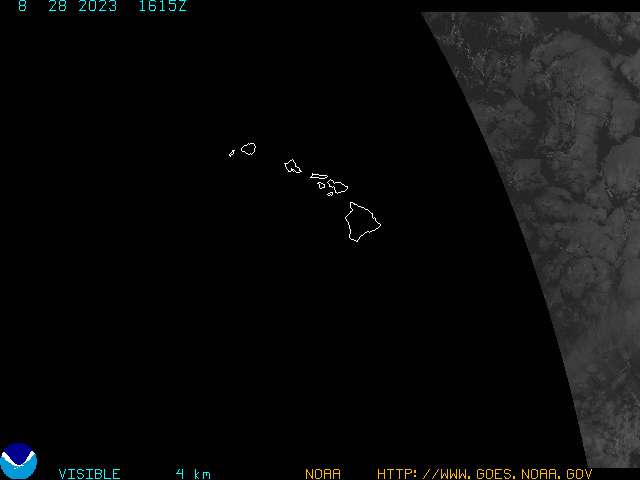




petermac Says:
love your ‘interestings’. I did have a thought on the language of the first item. Oil contamination is not going to abate any time soon; it is a gusher unabated, one of many messes world wide. Lets vote for freedom from oil!~~~Hi Peter, glad you like the variety of the interesting stories, I find it stimulating find them online during the day. We are so mired in oil it seems, which unfortunately I support each day…by driving my car to work. Aloha, Glenn