











May 5-6, 2010
Air Temperatures – The following maximum temperatures were recorded across the state of Hawaii Wednesday afternoon:
Lihue, Kauai – 81
Honolulu, Oahu – 84
Kaneohe, Oahu – 80
Kaunakakai, Molokai – 82
Kahului, Maui – 84
Hilo, Hawaii – 79
Kailua-kona – 81
Air Temperatures ranged between these warmest and coolest spots near sea level around the state – and on the highest mountains…at 4pm Wednesday afternoon:
Kalaeloa, Oahu – 84F
Kapalua, Maui – 77
Haleakala Crater – 63 (near 10,000 feet on Maui)
Mauna Kea summit – 46 (near 14,000 feet on the Big Island)
Precipitation Totals – The following numbers represent the largest precipitation totals (inches) during the last 24 hours on each of the major islands, as of Wednesday afternoon:
0.40 Mount Waialaele, Kauai
0.03 Mililani, Oahu
0.00 Molokai
0.00 Lanai
0.00 Kahoolawe
0.32 West Wailuaiki, Maui
0.25 Mountain View, Big Island
Marine Winds – Here’s the latest (automatically updated) weather map showing a 1033 millibar high pressure system far to the northeast of the islands. Meanwhile, the old cold front to the northwest of Kauai…continues moving away. The trade winds will remain active Thursday and Friday.
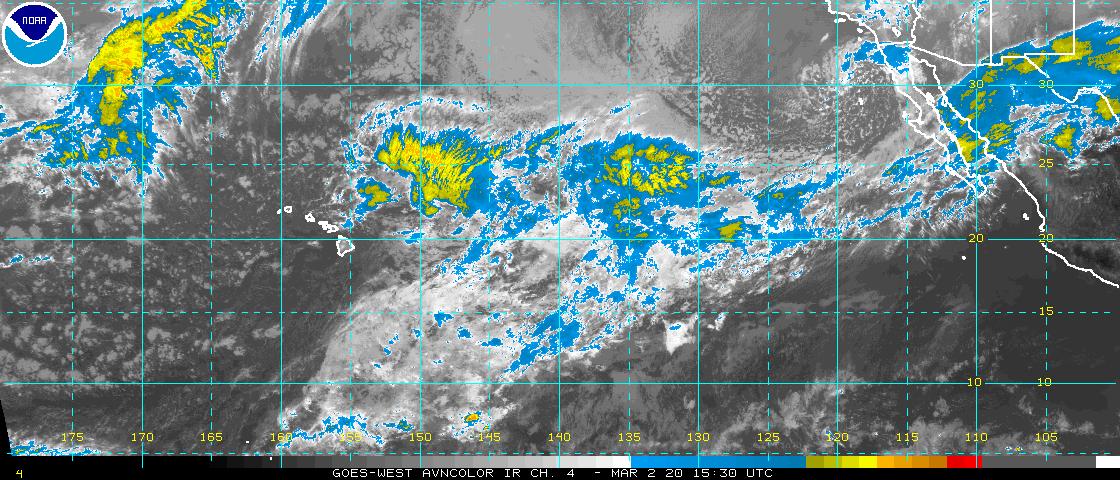
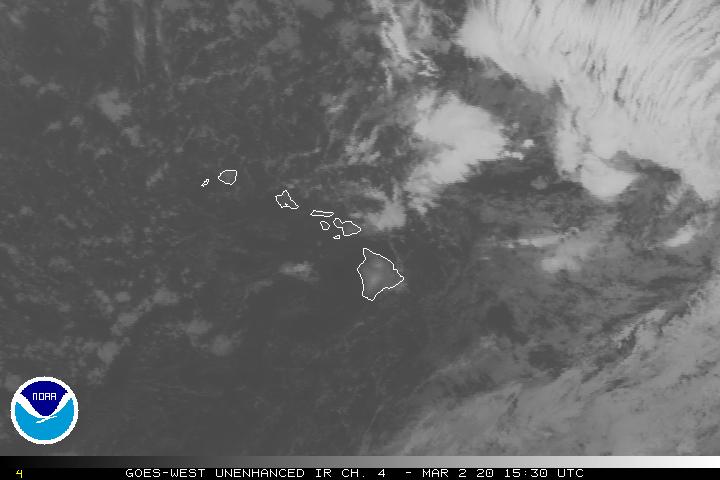
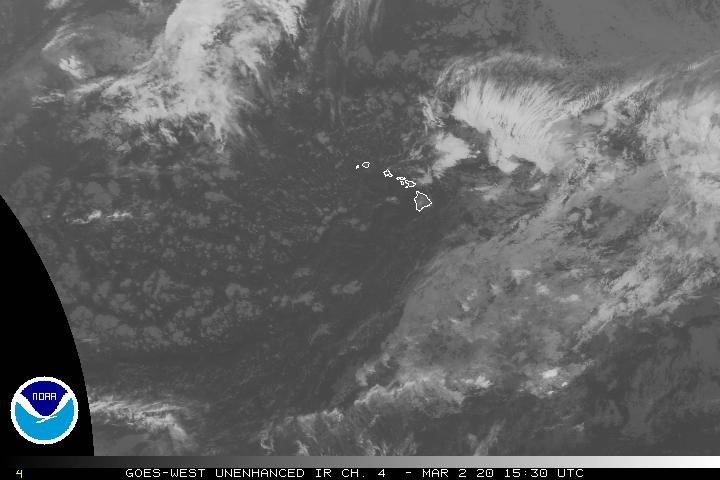
Satellite and Radar Images: To view the cloud conditions we have here in Hawaii, please use the following satellite links, starting off with this Infrared Satellite Image of the islands to see all the clouds around the state during the day and night. This next image is one that gives close images of the islands only during the daytime hours, and is referred to as a Close-up visible image. This next image shows a larger view of the Pacific…giving perspective to the wider ranging cloud patterns in the Pacific Ocean. Finally, here’s a Looping IR satellite image, making viewable the clouds around the islands 24 hours a day. To help you keep track of where any showers may be around the islands, here’s the latest animated radar image.
Hawaii’s Mountains – Here’s a link to the live webcam on the summit of near 14,000 foot Mauna Kea on the Big Island of Hawaii. The tallest peak on the island of Maui is the Haleakala Crater, which is near 10,000 feet in elevation. These two webcams are available during the daylight hours here in the islands…and when there’s a big moon rising just after sunset for an hour or two! Plus, during the nights and early mornings you will be able to see stars, and the sunrise too…depending upon weather conditions.
Tropical Cyclone activity in the eastern and central Pacific – Here’s the latest weather information coming out of the National Hurricane Center, covering the eastern north Pacific. You can find the latest tropical cyclone information for the central north Pacific (where Hawaii is located) by clicking on this link to the Central Pacific Hurricane Center. Here’s a tracking map covering both the eastern and central Pacific Ocean. A satellite image, which shows the entire ocean area between Hawaii and the Mexican coast…can be found here. Of course, as we know, our hurricane season won’t begin again until June 1st here in the central Pacific.
Aloha Paragraphs

Incoming trade wind shower…Molokai
The trade winds will continue on through the next week, with some fairly minor ups and downs…in terms of wind speed and direction. Last weekend’s light south to southeast winds were unusual, associated with the late season cold front, which pushed into the state as far as
When the trade winds blow, we usually have some sort of precipitation falling along our windward coasts and slopes. Since this more or less the golden rule, we will continue to see a few showers ending up there during the night and early morning hours for the most part. This IR satellite picture shows some minor clouds hanging around on the windward sides, with more of these moisture pockets looming upstream. None of these clouds look all that showery, and with no precipitation enhancing upper level troughs in our area, rainfall with be light to moderately intense…and probably on the lighter side of that spectrum. Broadening our view, using this larger satellite image, we see the tail end of this past weekend’s cold front to our northwest…along with some minor high cirrus clouds slipping southward over parts of the state as well. At the same time, we see a long line of stable looking cumulus and stratocumulus clouds far to our east. The dry conditions on all the leeward sides of the islands has caused a NWS issued Red Flag Warning…meaning there’s a threat of wild fires breaking out.
It’s Wednesday evening as I begin writing this last section of today’s narrative. As is described above, our trade winds will prevail well out into the future, with no real end in sight…from this vantage point. It appears that we’re moving into a fairly typical late spring trade wind weather pattern. This means dry weather along the leeward sides, with just those normal passing showers along the windward sides. The trade winds are strong enough now, that the NWS has issued a small craft wind advisory for those windiest coasts and channel waters, in the southern part of the state. All that wind, and the dry conditions along those leeward south and west facing sides, are working together in such a way, that there is an increased danger of wild fires. This is what’s up with the NWS issued red flag warning, which remains enfore through Thursday. ~~~ Here in Kihei, Maui, before I leave for the ~40 minute drive home to Kula, I see quite a few clouds out the window. They are generally packed around the mountains, although are stretching out towards the coasts locally. As we can see by looking at this looping radar image, there aren’t many showers out there, despite the ample amount of clouds. We’ll likely see the typical increase in windward biased showers during the night into early Thursday morning, although not many, if any elsewhere. I’ll be up and at em well before dawn, ready to begin preparing your next new weather narrative. I hope you have a great Wednesday night until then! Aloha for now…Glenn.
Interesting: An undersea conveyor belt to Florida is approaching the Gulf Coast oil spill, and should it stretch past its typical bounds, oil from the BP PLC accident, blobbing placidly off the Louisiana coast, could soon stream into the Florida Keys and up the United States’ Eastern Seaboard. Or the current could miss the spill entirely. Government officials and scientists from Mississippi to Florida are holding their collective breath to see whether a strong but unpredictable current in the Gulf of Mexico, known as the Loop Current, will continue to expand north toward Louisiana. Two days ago — the latest time for which satellite data are available — the current sat 125 miles south of the spill, its rotating tendrils licking at the slick’s eastern edge.
"It is a very important concern," said Bob Weisberg, an oceanographer at the University of South Florida, who has long warned of the flow’s potential impact on his state. "The Loop Current is actually moving toward the oil." For the current to begin conveying the oil at any volume, it would still have to surge much farther north, which some computer models like Weisberg’s are predicting. However, as Weisberg confesses, many of these models are deeply flawed, and the behavior of the Loop Current — when it will decide to surge or instead break apart — is prohibitively complex to forecast.
In other words, "no one has really been able to predict with much accuracy what the Loop Current will do," said Nan Walker, the director of the Earth Scan Laboratory at Louisiana State University, who is monitoring the oil and current with several sets of satellite data. The worst-case scenarios have been concerning enough for communities in Florida ranging from Tampa Bay to Key West to begin mobilizing contingency plans.
Should the current reach the spill, oil would begin to flow down past Florida’s western coast, which would be largely spared due to its wide coastal shelf, and into the Florida Strait. There, the chemical dispersants used to break up the oil could turn on vulnerable wildlife. "The dispersants could kill corals," Walker said. "Obviously, oil is not going to be good for corals. That is probably one of the biggest concerns if [the oil] was entrained." But this devastation is far from a sure bet, scientists say.
The Loop Current runs from the Yucatan Peninsula to the Florida Strait, where it eventually feeds the Gulf Stream. Often, the current lies low in the latitudes, barely extending into the Gulf of Mexico. But then, in erratic but frequent intervals, the current plunges deep up into the Gulf’s eastern waters, like a sharp elbow extending from Cuba into the gut of Louisiana.
Without fail, however, the current cannot sustain this intrusion, and the current’s northernmost reaches break apart. Small currents, known as eddies or ring separations, begin rotating toward the west, against the current’s flow. And eventually, the whole top of the current breaks apart and floats west toward Texas. The current "usually grows and eventually runs out of room," said Villy Kourafalou, a Gulf of Mexico modeler at the University of Miami’s Rosenstiel School.
"The whole top of the Loop Current gets disconnected." When this will happen to the present iteration of the current is nearly impossible to say, though scientists hope it will shed its top before approaching the oil spill. The current’s lifetime can run from a half-year to almost 18 months, showing little seasonal variability. When and why the separation occurs is an area of very active research, Kourafalou said. Even satellite imagery of the current, which can run up to 1,000 meters deep, is difficult to compile.
It takes a week of data to get an accurate picture, said Tony Sturges, an oceanographer at Florida State University. Sturges, one of the foremost experts on the current, is concerned that oil could sluice down to Miami. But "do I have any idea whether it will come to pass?" he said. "Not a clue." No prediction system Weisberg has been using several models to attempt to predict the Loop Current, hoping their various flaws will average out, much as is done with hurricane prediction.
Those models indicate the current is moving toward the oil, but Weisberg can’t say for certain when or if the current will hit. More likely, but still uncertain, is that small eddies could swirl off the current and entrain at least a small amount of oil, Walker said. These currents are generally weak; some are already helping to both push the oil toward the shore and draw some of it toward the east. How much oil could circulate this way is difficult to say.
The prevailing winds on the Gulf Coast, which typically run from east to west, are likely to begin blowing instead toward Florida. Some of the oil will go toward Louisiana beaches and marshes, and some will push farther east, though with all the complex currents running in the area, long-term predictions are tough, Walker said, though there is one certainty. "This oil spill is going to be around for a while, I’m afraid," she said. There is some precedence for the conveyor belt action of the Loop Current.
In the 1990s, the current transported floodwaters flush with nutrients out of the Mississippi Delta all the way to eastern Florida. But instances when the current comes so close are rare, Walker said. It is also far from certain that the current would provide a straight shot to the Florida Keys. In particular, Kourafalou is eyeing a large vortex down the current’s path east that could delay the oil or even pitch it off. Or, she added, the oil could miss it entirely and flow like a "flume" eastward. If the worst comes to pass, Florida’s eastern shores would be particularly vulnerable, she added.
The narrow shelf of the Florida Keys could cause the current to break apart, delivering oil and dispersants to the shore. Unlike the state’s west, the Atlantic shore lies close to deep water and the Florida Current, which the Loop Current feeds. Everglades researchers are already expressing fear that the oil could run into Florida Bay and potentially devastate its fisheries, sea grasses and shallows. More water evaporates from the bay than flows into it from the Everglades this time of year, creating a sink-like effect that leaves the delicate ecosystem at some risk of attracting oil flows, said James Fourqurean, a sea-grass ecologist at Florida International University.
"That means, then, that if a surface slick runs down very close to shore along the southern tip of the peninsula, that slick could be pulled into Florida Bay and remain resident there for a number of years," he said. While the fate of the Everglades remains to be seen, Kourafalou finds it shameful that the government and oil companies have not been better prepared and committed the money to get a full-fledged, accurate prediction system operating for the Gulf, she said. "It’s amazing that there’s no prediction system in place for the Gulf of Mexico," she said. "It should be in real time. It should be ready."
Interesting2: Lawsuits are already being prepared alleging harm to people who are living near or working to clean up the Deepwater Horizon oil spill off the coast of Louisiana. The law firm Smith Stag in New Orleans says it has assembled a group of lawyers in the Gulf states to process such claims. Stuart Smith, a partner, says he’s been in touch with people in Alaska who say they were hurt during the Exxon Valdez spill in 1989 by chemicals in the oil and dispersants used to keep it from reaching shore "which are also toxic." So he says he’s concerned about the potential health effects on the thousands of out-of-work fishermen, shrimpers and oystermen who will be taking part in the cleanup in the Gulf. So what are the human health risks from a disaster like this?
LuAnn White, a toxicologist and director of Tulane University’s Center for Applied Environmental Public Health, doesn’t believe there’s much danger to people, especially those on the coast or inland. "Oil spills are ecological events, not human health events," she says. The most dangerous gases that come off the hydrocarbons in crude oil, benzene and toluene, will disperse as they come up through 5,000 feet of ocean water and then into the air, she says. And as the entire event "is happening in the middle of the Gulf of Mexico," they won’t have much effect on people on land.
Benzene is a known carcinogen in humans, according to the U.S. Centers for Disease Control and Prevention. As to workers trying to clean the spill and cap the well, if they follow standard procedures "chances are when they load up the diesel on their boats they’re getting a higher dose" of hydrocarbons, which can cause lung irritation, than from the spilled oil, she says. However, others disagree. Riki Ott, a marine biologist and activist from Cordova, Alaska, who has written two books about the Exxon Valdez spill, says there were 6,722 cases of upper-respiratory illness among workers who helped clean up.
A study done by the Korea Centers for Disease Control and Prevention found that residents exposed to oil from the 2007 sinking of the Hebei Spirit oil tanker off the Korean coast had increased risks of headache, nausea, dizziness, fatigue, tingling of limbs, sore throat, cough, runny nose, shortness of breath, itchy skin, rash, and sore eyes. Jeffrey Short, a scientist with the ocean conservation group Oceana, says in previous spills, especially Exxon Valdez, that was a danger during the shoreline cleanup phase.
There isn’t much scientific literature on the topic in part because "the people who got sickest and won against Exxon got settlements that required that the records be sealed. But there were a lot of anecdotal complaints about the impact on cleanup workers," says Short, who was lead chemist for the National Oceanic and Atmospheric Administration on the damage assessment at the Exxon spill. Another issue relates to the chemical dispersants being injected underwater near the leaks in an attempt to break up the oil and keep it from being blown toward beaches where it could do more damage. More than 156,000 gallons of dispersant have been used on the spill.
The dispersants act like detergent, reducing surface tension so the oil breaks into fine droplets instead of being a sheet on the water surface. The potential human hazard for the two dispersants being used to break up the oil is rated high for one of them, moderate for another, according to the Material Data Safety Sheets posted on the government’s Deepwater Horizon Response website.
The biggest issue for people on shore will be coming into direct contact with globs of the "mousse," as the heavier elements of the oil that have been whipped up by wind and wave action are called because of their resemblance to the chocolate dessert. Eventually, the weathering process — decomposition, evaporation and dissolution — turns them "into a fairly hard asphalt-like substance fairly quickly" which makes any toxic substances that might be trapped in it relatively inert, Short says. "You wouldn’t want to eat" these tar balls but they’re not considered dangerous. The beaches in Santa Barbara, Calif., site of a 1969 spill, "have tar balls all over them to this day," he says.
Interesting3: Iceland’s Eyjafjoell volcano spewed more ash yesterday than in recent days, but the level remained much lower than when the eruption began three weeks ago, Icelandic geophysicists said. "The plume has increased. It is black… There is more ash in the plume and it is (rising) higher," Sigrun Hreinsdottir of the University of Iceland in Reykjavik said today. But "this is only about 5-10 per cent of what the activity" was when the eruption was at its peak last month, said Bjoern Oddson, a geologist and geophysicist at the University of Iceland’s Institute of Earth Sciences.
The Eyjafjoell volcano began erupting on April 14, sending a cloud of ash into European skies that paralysed airspace for a week. "This increased activity however means more ash coming up again (than in the last week) but it’s much more coarse and therefore it falls to earth quicker and can’t travel as far as before," Mr Oddson said.
Ireland reimposed a partial ban on flights early Wednesday as the cloud of volcanic ash drifted south from Iceland, while flight restrictions were also imposed in Scotland and Northern Ireland. "Of course every precaution should be taken regarding air traffic but the ash clouds that do reach the European fly zones are much smaller and vanish much quicker than before so the airports close for a much shorter time," said Mr Oddson.
The Icelandic Meteorology Office said today the higher plume "strongly indicates that ‘new’ magma is intruding into the magma conduit and pushing on the over-lying magma, causing a difference in pressure at the surface". "It is therefore anticipated that the eruption will continue at full force in the next days," it said. The ash and steam plume yesterday reached 6000 meters, against 5200 meters on Tuesday, and around 9000 meters at the pinnacle of the chaos. Bad weather prevented scientists from making observations today.
Interesting4: A 6.3 magnitude earthquake struck off Indonesia’s coast late last night. The U.S. Geological Survey (USGS) said the earthquake was centered 234 miles south of Padang, Sumatra. The USGS initially said the earthquake had a magnitude of 6.6, before revising it back down to 6.3. There was no threat of a destructive widespread tsunami, the National Oceanic and Atmospheric Administration’s Pacific Tsunami Warning Center said. There were also no immediate reports of damage or injuries.
 Email Glenn James: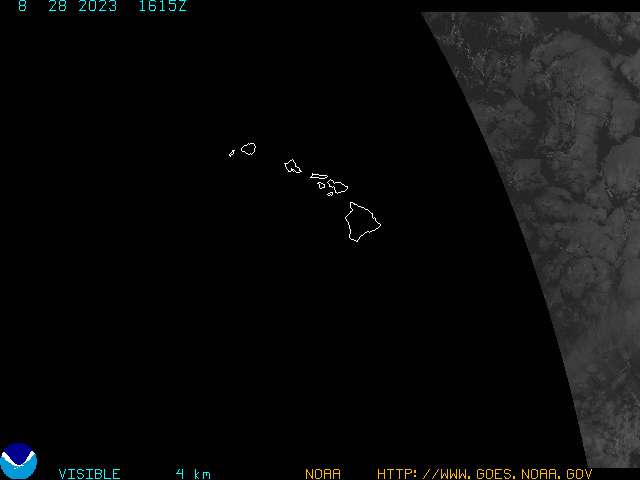

Benno Klinkhammer Says:
The oil disaster is crazy because the leak is so deep. I hope BP does all it can against the spread of the oil. The nature will be destroyed for a long time. I agree Benno, all of us are hoping for the best! Aloha, Glenn