











May 27-28, 2010
Air Temperatures – The following maximum temperatures were recorded across the state of Hawaii Thursday afternoon:
Lihue, Kauai – 83
Honolulu, Oahu – 83
Kaneohe, Oahu – 81
Kaunakakai, Molokai – 82
Kahului, Maui – 88
Hilo, Hawaii – 80
Kailua-kona – 83
Air Temperatures ranged between these warmest and coolest spots near sea level around the state – and on the highest mountains…at 4pm Thursday afternoon:
Kahului, Maui – 84F
Hilo, Hawaii – 76
Haleakala Crater – 55 (near 10,000 feet on Maui)
Mauna Kea summit – 39 (near 14,000 feet on the Big Island)
Precipitation Totals – The following numbers represent the largest precipitation totals (inches) during the last 24 hours on each of the major islands, as of Thursday afternoon:
1.01 Mount Waialaele, Kauai
0.17 Oahu Forest NWR, Oahu
0.00 Molokai
0.00 Lanai
0.00 Kahoolawe
0.01 Puu Kukui, Maui
0.12 Kawainui Stream, Big Island
Marine Winds – Here’s the latest (automatically updated) weather map showing a 1024 millibar high pressure system to our northeast…with elongated ridges of high pressure extending from its center northeast and west of our islands. Our local winds will be lighter into Friday…picking up Saturday.
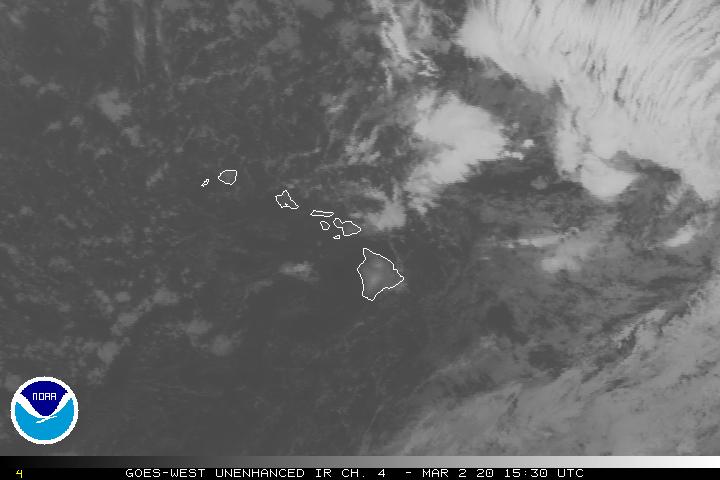
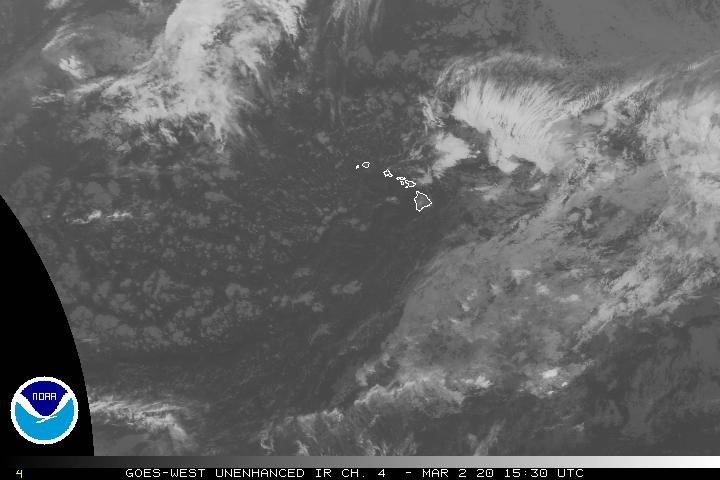
Satellite and Radar Images: To view the cloud conditions we have here in Hawaii, please use the following satellite links, starting off with this Infrared Satellite Image of the islands to see all the clouds around the state during the day and night. This next image is one that gives close images of the islands only during the daytime hours, and is referred to as a Close-up visible image. This next image shows a larger view of the Pacific…giving perspective to the wider ranging cloud patterns in the Pacific Ocean. Finally, here’s a Looping IR satellite image, making viewable the clouds around the islands 24 hours a day. To help you keep track of where any showers may be around the islands, here’s the latest animated radar image.
Hawaii’s Mountains – Here’s a link to the live webcam on the summit of near 14,000 foot Mauna Kea on the Big Island of Hawaii. The tallest peak on the island of Maui is the Haleakala Crater, which is near 10,000 feet in elevation. These two webcams are available during the daylight hours here in the islands…and when there’s a big moon rising just after sunset for an hour or two! Plus, during the nights and early mornings you will be able to see stars, and the sunrise too…depending upon weather conditions.
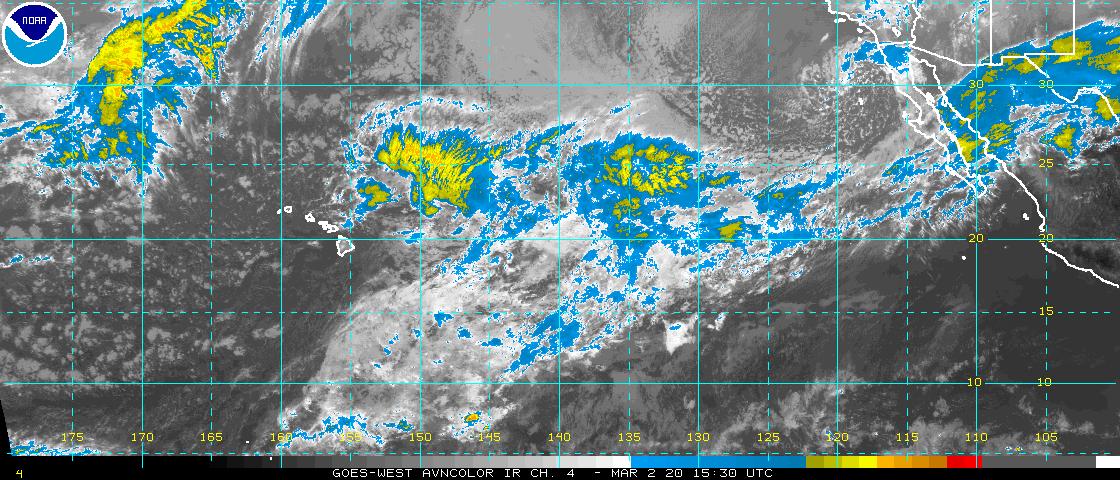
Tropical Cyclone activity in the eastern and central Pacific – Here’s the latest weather information coming out of the National Hurricane Center, covering the eastern north Pacific. You can find the latest tropical cyclone information for the central north Pacific (where Hawaii is located) by clicking on this link to the Central Pacific Hurricane Center. Here’s a tracking map covering both the eastern and central Pacific Ocean. A satellite image, which shows the entire ocean area between Hawaii and the Mexican coast…can be found here. Of course, as we know, our hurricane season won’t begin again until June 1st here in the central Pacific.
Aloha Paragraphs

Great day Friday…returning trades Saturday
The light wind episode will remain in place until the trade winds return this weekend. As this weather map shows, we have a 1024 millibar high pressure system to the northeast of the islands Thursday night. At the same time, we find a late season cold front to our northwest.
Meanwhile, we have an upper trough of low pressure to the northeast of the islands…which is moving away. Despite the presence of this trough however, not much is happening in terms of its influence on our weather. A
s this IR satellite image shows, there’s nothing unusual, with just a bit of minor high cirrus clouds just to the southeast of the
It’s Thursday evening as I begin writing this last section of this morning’s narrative.
As noted above, our winds are light, with generally clear skies, and hardly any showers whatsoever. This is great weather, with just a tad of volcanic haze floating around the edges here and there. I expect that Friday will be a lot like what we’ve seen Thursday, which is actually quite pleasant. As the long three day holiday weekend rolls around, the trade winds will fill back in, and our good weather will continue. ~~~ As I say everyday, at least on these work days, I’m heading back upcountry to Kula, Maui now. Looking out the window here in Kihei, before I jump in the car, it’s hazy out there, with some dark clouds over the Haleakala Crater. I don’t see any showers falling up that way though, as the air mass is dry and stable. Clouds will clear again tonight, and we will likely see cloud free skies again Friday morning…and a little on the cool side again too. I’ll catch up with you again early Friday morning, I hope you have a great Thursday night until then. By the way, even though the full moon occurred Thursday afternoon, tonight will be ablaze with beaming moon light, like it was last night. Aloha for now…Glenn.
Interesting: The enthusiasm is building — we’re just a few months from the U.S. launch of the first electric vehicles aimed at mainstream consumers. Nissan is touting the success of the registration program for its upcoming Leaf EV, boasting 13,000 orders for its vehicles. It is hoped across the industry (and in Washington DC) that sales of EVs will revive the American auto industry.
While Pike Research believes that sales of EVs will grow relatively quickly, EV sales would likely grow much higher if it weren’t for our relatively cheap gasoline. China will be the global leader in EV sales, with more than a quarter million of EVs sold in 2015, according to our projections at Pike Research.
Sales of EVs in Europe — even with fewer homes with convenient access to home charging — are expected to outpace the American market. As shown in the table below, the cost of fuel in the U.S. is the lowest in the world thanks to lower taxes. While the average cost of electricity is also among the lowest in the world, the relative cost of fuel to electricity is the lowest in the world.
We calculated the annual savings of driving an EV instead of an equivalent passenger car and found that American drivers would save less than half as much (just over $800) by switching to an EV as drivers in Japan, France, Great Britain and Norway, who can save up to $2,000.
This model even allows that in Europe, more fuel-efficient cars would be replaced (30 mpg was assumed for vehicles in the U.S., and 35 mpg diesel vehicles in Europe). This simplistic model does not include the cost of the vehicle or any consumer tax incentives. Still it underscores how much can be saved by operating the vehicle.
Smaller annual savings means a longer time to pay back the premium that EV buyers are likely to pay. While many of the early EV owners will be thinking more about the environment (and showing off to their neighbors) than about their wallets when buying, a shorter payback period would help to convince consumers who are more price-sensitive to purchase an EV.
Interesting2: Shark attacks are most likely to occur on Sunday, in less than 6 feet of water, during a new moon and involve surfers wearing black and white bathing suits, a first of its kind study from the University of Florida suggests. Researchers analyzed statistics from shark attacks that occurred in Florida’s Volusia County, dubbed the "Shark Attack Capital of the World," between 1956 and 2008.
They also spent a year observing people between Daytona Beach and New Smyrna Beach, said George Burgess, director of the International Shark Attack File at UF. "It’s basically an analysis of why, where and when in an area that traditionally has had more shark-human interactions than any other stretch of coastline in the world," he said.
"One of our students, Brittany Garner, essentially camped out there, counted the number of heads on the beach and took photographs." While this 47-mile-long section of Central Florida’s Atlantic coast leads in human-shark skirmishes, making up 21 percent of all global attacks between 1999 and 2008, most are "hit and run" incidents that seldom cause serious injury and no fatalities occurred, he said.
"Calling them attacks is probably a misnomer because the consequences are usually no more severe than a dog bite," he said. "They’re not the same kind of bites made by 10- to 20-foot-long white sharks that you have off the coast of California. Here we see a different style of attack, primarily perpetrated by smaller fish-eating sharks such as spinners and black tips that are less than 6 to 7 feet long, which because of their size normally seek smaller prey."
There have been 231 shark attacks between the first one reported in 1956 in Volusia County and 2008, said Burgess, who works at UF’s Florida Museum of Natural History. The study, part of which was published recently in the edited volume "Sharks and Their Relatives II," uses statistics from 220 of those cases for which detailed information is available. Human, shark and environmental factors combine to create a perfect storm of favorable conditions in Volusia County for attacks, particularly near Ponce Inlet between Daytona Beach and New Smyrna Beach, he said.
The more people in the water the greater the chances they will encounter a shark, and New Smyrna Beach south of the inlet is a "hot spot" for surfers with its well developed sand bars and good waves, Burgess said. Hand splashing and feet kicking provoke sharks, which bite and release what they mistake for normal prey items in the turbid waters, he said. Also, the strong tidal flow in the inlet makes it "an aquatic smorgasbord of food items for sharks, barracudas, mackerel and other large predators," boosting shark numbers, he said.
Young white males were attacked most because they spend the most time in the water, Burgess said. Ninety percent of victims were male, 77 percent of 196 victims were between 11 and 30 years old and in the 171 cases where race was known, 98 percent were white, he said. Well over half of the 220 victims were bit on the leg — 158 — more than five times the number bit on the arms — 34 — the second highest body part to be injured, he said. Surfers were the most frequent victims, making up 61 percent of the total, Burgess said.
They tended to be bitten more in the early morning and late afternoon when waves were highest and they spend more time surfing, he said. "At the time of the attack, most of the surfers were sitting or holding onto the board waiting for a wave, which explains why most surf victims were bitten on the legs," he said. Sharks are not weekend warriors. Rather it is human leisure that leads to the fewest number of human encounters on Wednesdays and the highest on Sundays, followed by Saturdays, Burgess said.
"There are a fair number of attacks on Fridays as well, reflective of people skipping work and taking three-day weekends," he said. The greatest number of attacks occurred during new moons, followed by full moons, the edges of the lunar extreme when the moon has its biggest pull on the tidal phase, Burgess said. Probably the moon’s phases influence the movements and reproductive patterns of fish, the shark’s food source, just as they affect human behavior, he said.
Not surprisingly, attacks were highest during the swimming season, from May through October, peaking in August, Burgess said. They spiked in April as sharks began their seasonal northern migration up the eastern coast of the United States, he said. Most incidents involved one bite, occurred in turbid, murky or muddy waters and were at the water’s surface, Burgess said. Only one attack was on a diver, he said.
More victims wore swimsuits that were black and white than any other color combination, followed by black and yellow, attesting to sharks’ abilities to see contrast, he said. Between 1999 and 2008, shark attacks worldwide numbered 639, of which there were 428 reports in the United States, 275 in Florida and 135 in Volusia County. Burgess said.
Interesting3: The BP oil blowout in the Gulf of Mexico threatens the existence of a critically endangered sawfish and its relative that recently has been proposed to join it as the only two marine fish in United States waters to receive such federal protection, says a University of Florida researcher. The large tooth sawfish, a popular curio item known for its saw like snout, was proposed as a federally endangered species on May 7, less than three weeks after massive amounts of oil started gushing into Gulf waters, said George Burgess, a UF ichthyologist and sawfish expert.
"The oil spill will not only have very dire effects on such highly visible creatures as seabirds and dolphins, but also threatens a multitude of bottom-dwelling organisms including the small tooth sawfish, which already is in considerable trouble as its range diminished and its numbers dwindled," he said.
What’s left of the small tooth sawfish population is confined to the lower peninsula of Florida, Burgess said, with the most important area ranging from Charlotte Harbor through the Ten Thousand Islands area of the Everglades into Florida Bay and the Keys. That’s where the largest portion of its nurseries is found and these are now threatened by the oil spill, he said.
"As oil gets caught up in the loop current, it will be pulled down into the Gulf Stream, which goes right by Key West on its way up the U.S. East Coast," Burgess said. "The opportunities for serious ecological problems are mind boggling, with dire implications for what’s left of that species in the northwest Atlantic Ocean if the oil reaches critical mangrove habitat."
The large tooth sawfish, which was most common in the northwestern Gulf of Mexico, has not been encountered in decades. Its close relative, the small tooth sawfish, was listed as an endangered species in 2003 and survives in the U.S. only at the southern tip of Florida. Conservationists had hoped conditions would become favorable for both sawfish species eventually to stage a comeback in Gulf waters, Burgess said.
Far more common to South and Central America, the large tooth sawfish migrated up the Central American coast during the summer into the Gulf, the edge of its natural geographic range, he said. "If important underwater habitat is destroyed, neither species will have a place to return to," he said.
"They can’t come back to an underwater desert." A creature of historic and cultural interest, the sawfish was sometimes depicted as a so-called monster on postcards from the turn of the century, with stories of its catching routinely published in newspapers outside Florida, Burgess said. Today it is not unusual to find the fish’s "saw" hanging from the walls of South Florida bars, he said.
 Email Glenn James: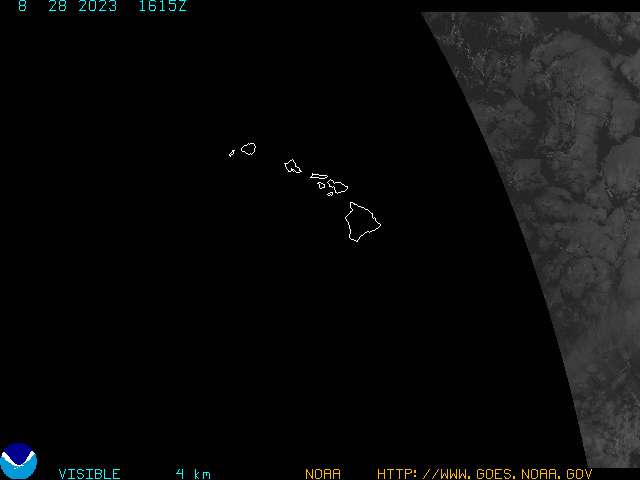


Annabel Childs Says:
Hi Glenn, We are visiting from Sydney on the 15th June, staying at Hilo. What will the weather and temperature be then? Thanks Annabel.~~~Hi Annabel, Hilo will be quite moderate in temperature, ranging between about 70F degrees and 80 degrees in general. As far as weather, it will be generally partly cloudy, with some passing showers. I think you will enjoy it very much, I hope you have a great vacation on the lovely Big Island! Aloha, Glenn
Jeffery Rothschild Says:
Hi Glenn. How are the temperatures and humidity in Kula during June, july and August at the 3500ft level? How does that compare to Kihei? Does Kula escape the vog when the trades falter and the wind shifts? Does it settle most heavily at sea level? Thanks Jeff~~~Hi Jeff, Kula is cooler and drier than Kihei all year round, being that much higher in elevation. Kula does not however escape the vog, although it seems to be thicker downcountry. Aloha, Glenn