May 26-27, 2010
Air Temperatures – The following maximum temperatures were recorded across the state of Hawaii Wednesday afternoon:
Lihue, Kauai – 83
Honolulu, Oahu – 84
Kaneohe, Oahu – 81
Kaunakakai, Molokai – 85
Kahului, Maui – 86
Hilo, Hawaii – 82
Kailua-kona – 83
Air Temperatures ranged between these warmest and coolest spots near sea level around the state – and on the highest mountains…at 5pm Wednesday evening:
Barking Sands, Kauai – 85F
Princeville, Kauai – 77
Haleakala Crater – 52 (near 10,000 feet on Maui)
Mauna Kea summit – 37 (near 14,000 feet on the Big Island)
Precipitation Totals – The following numbers represent the largest precipitation totals (inches) during the last 24 hours on each of the major islands, as of Wednesday afternoon:
1.00 Mount Waialaele, Kauai
0.11 Moanalua RG, Oahu
0.16 Molokai
0.00 Lanai
0.00 Kahoolawe
0.21 West Wailuaiki, Maui
0.61 Honaunau, Big Island
Marine Winds – Here’s the latest (automatically updated) weather map showing a 1026 millibar high pressure system to our north-northeast…with elongated ridges of high pressure extending from its center northeast and west of our islands. The trade winds will gradually becoming lighter into Friday.
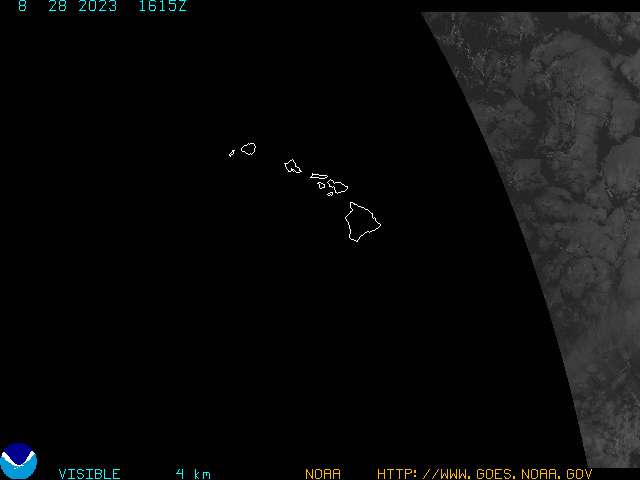
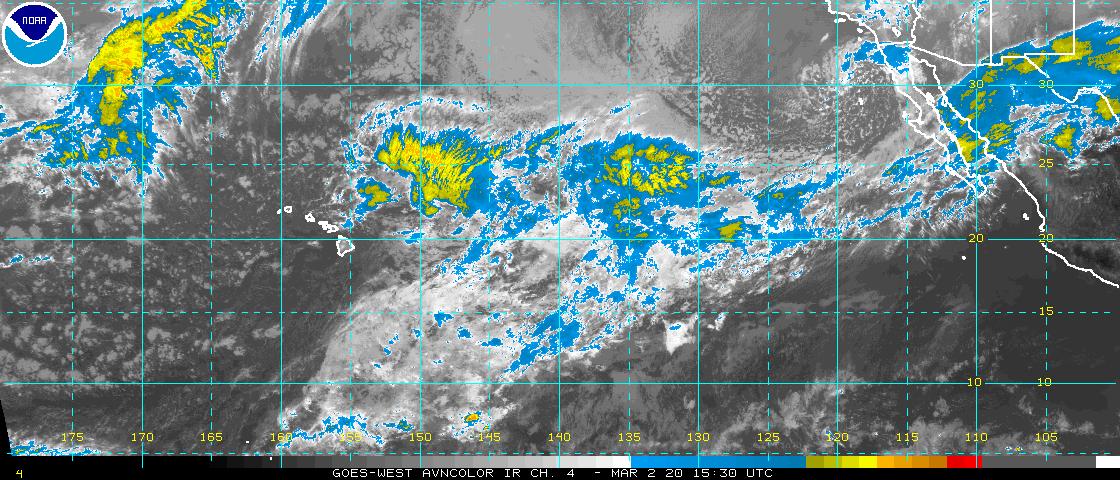
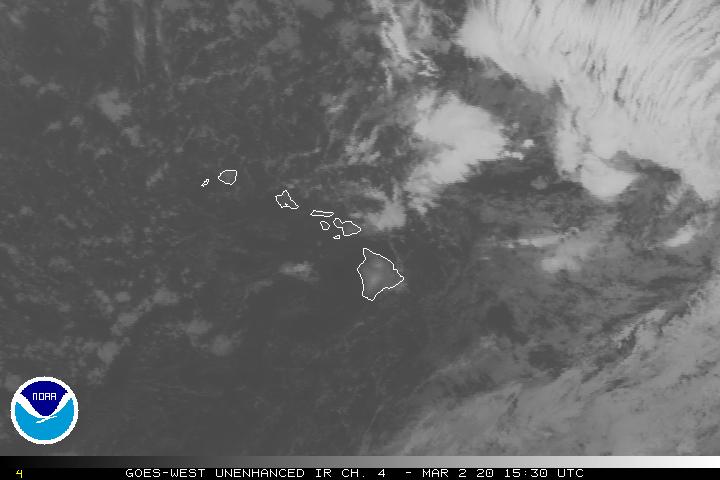
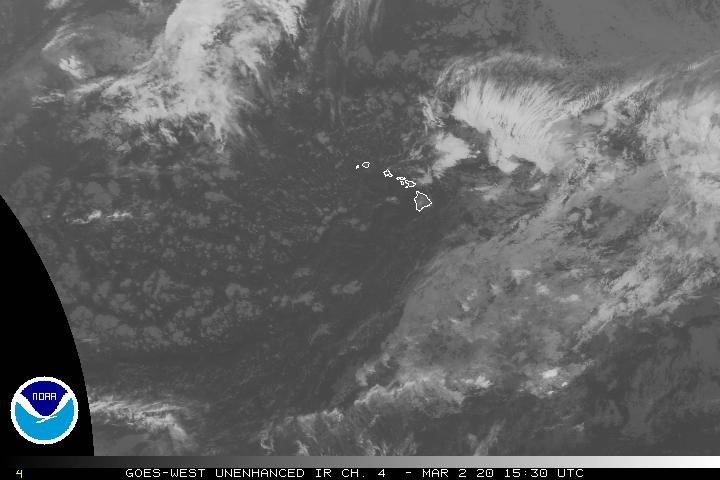
Satellite and Radar Images: To view the cloud conditions we have here in Hawaii, please use the following satellite links, starting off with this Infrared Satellite Image of the islands to see all the clouds around the state during the day and night. This next image is one that gives close images of the islands only during the daytime hours, and is referred to as a Close-up visible image. This next image shows a larger view of the Pacific…giving perspective to the wider ranging cloud patterns in the Pacific Ocean. Finally, here’s a Looping IR satellite image, making viewable the clouds around the islands 24 hours a day. To help you keep track of where any showers may be around the islands, here’s the latest animated radar image.
Hawaii’s Mountains – Here’s a link to the live webcam on the summit of near 14,000 foot Mauna Kea on the Big Island of Hawaii. The tallest peak on the island of Maui is the Haleakala Crater, which is near 10,000 feet in elevation. These two webcams are available during the daylight hours here in the islands…and when there’s a big moon rising just after sunset for an hour or two! Plus, during the nights and early mornings you will be able to see stars, and the sunrise too…depending upon weather conditions.
Tropical Cyclone activity in the eastern and central Pacific – Here’s the latest weather information coming out of the National Hurricane Center, covering the eastern north Pacific. You can find the latest tropical cyclone information for the central north Pacific (where Hawaii is located) by clicking on this link to the Central Pacific Hurricane Center. Here’s a tracking map covering both the eastern and central Pacific Ocean. A satellite image, which shows the entire ocean area between Hawaii and the Mexican coast…can be found here. Of course, as we know, our hurricane season won’t begin again until June 1st here in the central Pacific.
Aloha Paragraphs

Lighter winds just up ahead
The well advertised reduction in our local wind speeds remains on track to unfold as expected. The trade winds were still wound up Wednesday, with gusts reaching, or topping 35 mph in those windiest locations around
This frontal boundary will stop well before it gets near
It’s Wednesday as I begin writing this last section of today’s narrative.
Despite the presence of an upper level trough of low pressure, with its associated cold air, not much is happening in terms of enhanced rainfall. This trough is positioned near the
~~~ Looking out the window here in Kihei, before I take the drive back upcountry to Kula, I see clear to partly cloudy skies…what else is new. The trade winds are still blowing early this evening, with the top gust being a respectable 37 mph at Kahoolawe. We’re right on the verge of a wind shift to the ESE or even SE direction, which will calm our winds down, as noted above. I’ll be back early Thursday morning with your next new weather narrative waiting for you right here. I hope you have a great Wednesday night until then! Aloha for now…Glenn.
Extra: The month of May full moon will occur here in the islands at 1:08 pm Thursday afternoon.
Interesting: A milk shake that is the equivalent of 68 pieces of bacon or 30 chocolate chip cookies has been dubbed the worst drink in the US. Made with chocolate ice cream, milk and peanut butter, the drink – called the Cold Stone PB&C – packs a whopping 2010 calories, 68 grams of saturated fat and a massive 153 grams of sugar, The Sun reports. It topped Men’s Health magazine’s list of the 20 worst drinks in America, beating a McDonald’s Triple Thick Chocolate Milkshake to the post.
"In terms of saturated fat, drinking this Cold Stone catastrophe is like slurping up 68 strips of bacon," the magazine said. "Health experts recommend capping your saturated fat intake at about 20 grams per day, yet this beverage packs more than three times that into a cup." But this information did not bother tourists in Marina Del Rey, California, as they sampled a large size of the ice cream milk shake.
Christopher Fields said: "It’s delicious. I would definitely have it again." When told the milk shake was nearly the equivalent of the recommended daily calorie intake for men, the 45-year-old said, "I don’t care." Patting his stomach, he said: "I’d drink it without difficulty. I’d probably have it once a week." Josh Fein, who runs the Marina Del Rey ice cream eatery, said that health-conscious locals were not that keen on the PB&C shake.
"We probably only sell about eight to ten of those a week and mostly to tourists," he said. According to the Men’s Health column, the second worst drink in America is the Peanut Power Plus Grape from Smoothie King. A large cup is worth roughly 1,500 calories. The McDonald’s Triple Thick Chocolate Shake came in third. A large cup of that is worth 1160 calories, or the equivalent of 13 McDonald’s apple pies.
Interesting2: A Montreal study finds heterotrophic bacteria counts, in more than 70 percent of bottled water samples, exceed the recommended limits specified by the United States Pharmacopeia (USP). Researchers from Ccrest laboratories report their results May 25 at the 110th General Meeting of the American Society for Microbiology in San Diego.
"Despite having the cleanest tap water a large number of urban Canadians are switching over to bottled water for their daily hydration requirements. Unsurprisingly, the consumer assumes that since bottled water carries a price tag, it is purer and safer than most tap water," says Sonish Azam, a researcher on the study.
Regulatory bodies such as Food and Drug Administration (FDA), Environmental Protection Agency (EPA) and Health Canada have not set a limit for the heterotrophic bacteria counts in bottled drinking water. However, according to the USP not more than 500 colony forming units (cfu) per milliliter should be present in drinking water.
The study was initiated in response to a Ccrest employee’s complaint of fowl taste and sickness after consumption of bottled water at the company. Azam and her colleagues Ali Khamessan and Massimo Marino randomly purchased several brands of bottled water from a local marketplace and subjected them to microbiological analysis.
They discovered more than 70 percent of famous brands tested did not meet the USP specifications for drinking water. "Heterotrophic bacteria counts in some of the bottles were found to be in revolting figures of one hundred times more than the permitted limit," says Azam.
In comparison the average microbial count for different tap water samples was 170 cfu/mL. Azam stresses that these bacteria most likely do not cause disease and they have not confirmed the presence of disease-causing bacteria, but the high levels of bacteria in bottled water could pose a risk for vulnerable populations such as pregnant women, infants, immuno-compromised patients and the elderly.
"Bottled water is not expected to be free from microorganisms but the cfu observed in this study is surprisingly very high. Therefore, it is strongly recommended to establish a limit for the heterotrophic bacteria count as well as to identify the nature of microorganisms present in the bottled water," says Azam.
Interesting3: Humans have the unparalleled ability of altering their environment to suit their needs. We have shaped the entire face of the planet, from the densest cities to the rural countryside. Yet, on their own small level, other creatures in the animal kingdom can affect their environment as well.
Amazingly, a tiny organism like the termite can create a huge effect. What better place to observe this power than in the African Savannah, home to much of the world’s mega fauna such as the elephant, giraffe, lion, ostrich, zebra, antelope, hippopotamus, and many more mammals, birds, and reptiles.
However, it is not these great beasts that dominate the landscape. It is the lowly termite, capable of building large structures and increasing the overall production of the grassland ecosystem. A study recently published in the journal PLoS Biology looks into termite’s impact on the savannah in Kenya.
"One of the kind of typical things I think that people think about is, what drives a savanna in terms of its structure and function?" said Todd Palmer, one of the paper’s authors and an assistant professor of biology at the University of Florida. "We think about big animals, but these termites are having a massive impact on the system from below."
Robert M. Pringle, a research fellow at Harvard University and the lead author, said "As (famed biologist) E.O. Wilson likes to point out, in many respects it’s the little things that run the world." Termites have an incredibly structured social organization that is able to work like a machine towards a common goal.
Each colony has a reproducing pair, "king" and "queen", and it is not uncommon for there to be multiple pairs. The worker class of termites undertakes the arduous daily task of foraging and storing food, and building and maintaining the nest. Then there is the soldier class which has evolved anatomical and behavioral modifications.
They are much stronger and heavily armored than the relatively fragile worker termites. Their jaws are so large that they are not able to feed themselves, but are an effective tool in defending the colony from attacks from the termite nemesis, the ant. The social cohesion allows for the colony to act as a single organism and build large mounds and nests.
These mounds have been found to greatly enhance the surrounding plant and animal life. The even distribution of mounds over a large area maximizes the ecosystem productivity. The team led by Palmer and Pringle observed a higher than normal concentration of lizards by the termite mounds and decided to take a closer look at overall wildlife in the vicinity.
They found that each mound supports a dense aggregation of flora and fauna which grows more rapidly the closer to the mound it is. Conversely, animal population and reproductively noticeably declined at greater distances from the mound. One of the primary causes of this phenomenon is believed to be the actual construction and maintenance of the termite mounds.
The workers bring up relatively coarse particles to be deposited on the otherwise fine soil. The coarser particles aid in the absorption of rainwater into the soil and discourage movement of topsoil in response to precipitation and drought. The mounds also contain a high level of nitrogen and phosphorous, nutrients that enhance plant growth. Termites are typically considered pests.
They destroy lumber and are the bane of farmers and herders, especially in Africa. However, one has to admire the oversized power of such a small creature. They have evolved over millennia to be a major force on the African Savannah and instrumental to the overall ecosystem. Their lives are very short, but their mounds can last for centuries. Evenly placed throughout the landscape, termites are vital in expanding biomass and biodiversity.
Interesting4: An Icelandic volcano neighboring Eyjafjoell, whose eruptions paralyzed Europe’s skies last month, could come to life in the near future, according to experts. "An eruption in the short term is a strong possibility," experts said, referring to Katla, which is larger and fiercer than Eyjafjoell, in a report from the University College London (UCL) institute for risk and disaster reduction. The researchers also cautioned that Europe’s skies were likely to be hit by further ash cloud shutdowns, following April’s widespread closures and several smaller scale shutdowns since.
The report warned that "future moderately to highly explosive Icelandic eruptions combined with appropriate weather conditions are highly likely to cause a repeat of the recent air transport disruption." The Eyjafjoell volcano began erupting on April 14, and spewed out an ash cloud that drifted over Europe and led to massive flight disruption throughout the continent for several days. It caused the biggest airspace shutdown in Europe since World War II, affecting more than 100,000 flights and eight million passengers.
The UCL experts — encompassing scientists, engineers and statisticians also criticised the response to the eruption. "The severe disruption to European airspace in April from (the volcano’s) ash clouds reflect a lack of integration between the monitoring, warning and risk management systems," said Carina Fearnley, of UCL’s hazard research centre. In a second report released Thursday, a team of British researchers said they had discovered a significant electrical charge in the ash plume.
The scientists, from the Institute of Physics, said they found that "the ash plume which hovered over Scotland carried a significant and self-renewing electric charge." They warned that the charge could pose a risk to both planes and passengers. "Charged particles can cause aircraft radio interference and, if introduced into aircraft cabins, charged ash may present an electrostatic hazard to occupants or aircraft systems," said the report. The scientists used a specialist weather balloon to conduct research on a section of the ash cloud floating over Scotland.
 Email Glenn James: