May 20-21, 2010
Air Temperatures – The following maximum temperatures were recorded across the state of Hawaii Thursday afternoon:
Lihue, Kauai – 82
Honolulu, Oahu – 85
Kaneohe, Oahu – 81
Kaunakakai, Molokai – 85
Kahului, Maui – 87
Hilo, Hawaii – 83
Kailua-kona – 83
Air Temperatures ranged between these warmest and coolest spots near sea level around the state – and on the highest mountains…at 5pm Thursday evening:
Kahului, Maui – 85F
Hilo, Hawaii – 75
Haleakala Crater – 48 (near 10,000 feet on Maui)
Mauna Kea summit – 37 (near 14,000 feet on the Big Island)
Precipitation Totals – The following numbers represent the largest precipitation totals (inches) during the last 24 hours on each of the major islands, as of Thursday afternoon:
1.28 Mount Waialaele, Kauai
0.92 Moanalua RG, Oahu
0.02 Molokai
0.00 Lanai
0.00 Kahoolawe
0.39 Oheo Gulch, Maui
0.17 Mountain View, Big Island
Marine Winds – Here’s the latest (automatically updated) weather map showing a near 1030 millibar high pressure system to our northeast…with elongated ridges of high pressure extending southeast and southwest of our islands. The trade winds will increase in strength a little more Friday, maintaining their gusty nature into Saturday.
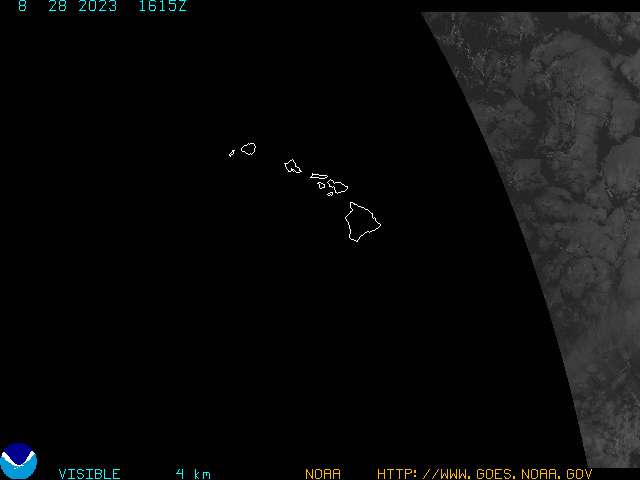
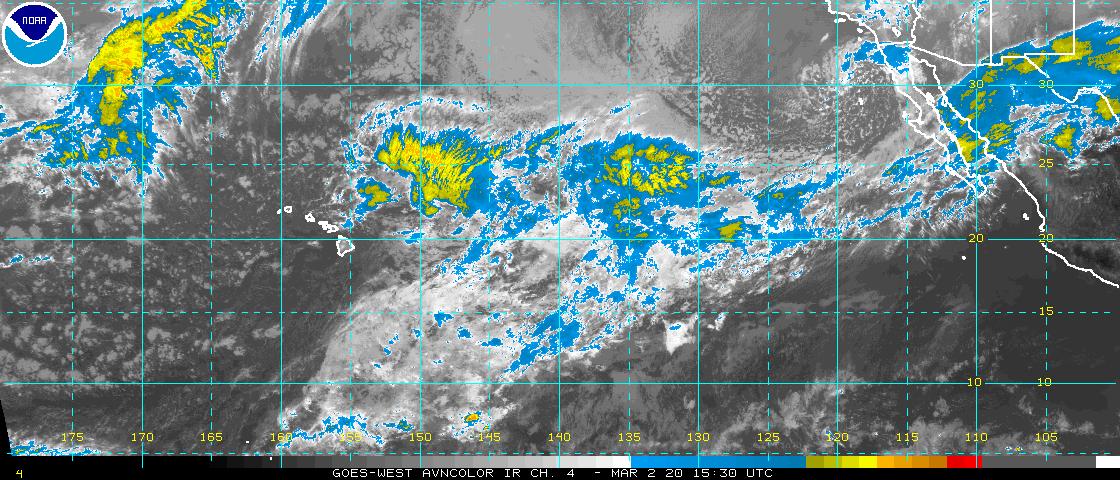
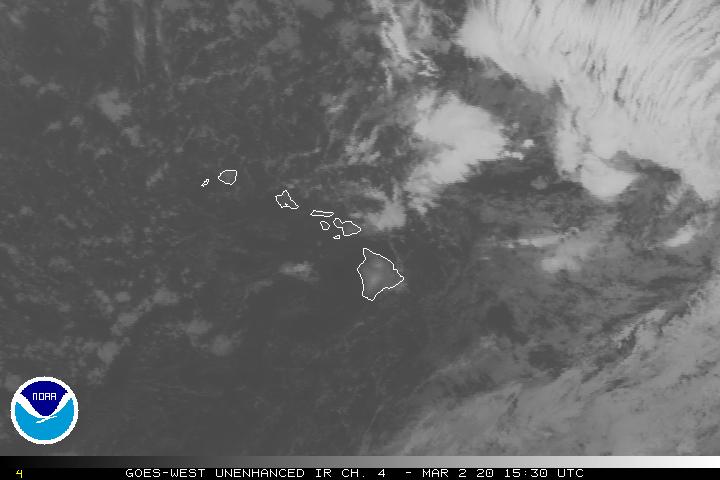
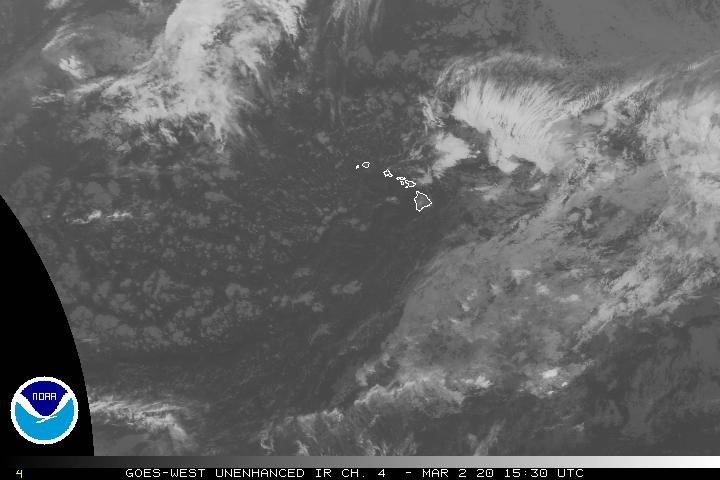
Satellite and Radar Images: To view the cloud conditions we have here in Hawaii, please use the following satellite links, starting off with this Infrared Satellite Image of the islands to see all the clouds around the state during the day and night. This next image is one that gives close images of the islands only during the daytime hours, and is referred to as a Close-up visible image. This next image shows a larger view of the Pacific…giving perspective to the wider ranging cloud patterns in the Pacific Ocean. Finally, here’s a Looping IR satellite image, making viewable the clouds around the islands 24 hours a day. To help you keep track of where any showers may be around the islands, here’s the latest animated radar image.
Hawaii’s Mountains – Here’s a link to the live webcam on the summit of near 14,000 foot Mauna Kea on the Big Island of Hawaii. The tallest peak on the island of Maui is the Haleakala Crater, which is near 10,000 feet in elevation. These two webcams are available during the daylight hours here in the islands…and when there’s a big moon rising just after sunset for an hour or two! Plus, during the nights and early mornings you will be able to see stars, and the sunrise too…depending upon weather conditions.
Tropical Cyclone activity in the eastern and central Pacific – Here’s the latest weather information coming out of the National Hurricane Center, covering the eastern north Pacific. You can find the latest tropical cyclone information for the central north Pacific (where Hawaii is located) by clicking on this link to the Central Pacific Hurricane Center. Here’s a tracking map covering both the eastern and central Pacific Ocean. A satellite image, which shows the entire ocean area between Hawaii and the Mexican coast…can be found here. Of course, as we know, our hurricane season won’t begin again until June 1st here in the central Pacific.
Aloha Paragraphs

The natural beauty of the islands
The late spring trade winds continue, becoming rather blustery in those typically windiest areas…into the weekend. Checking out this weather map, we see a trade wind producing high pressure system anchored to the northeast of the islands…weighing-in at near 1030 millibars Thursday night. The winds continued their upward trend in strength today, thus we now find the small craft wind advisory having been expanded across all the major channels from Kauai down through the Big Island. Meanwhile, all this wind isn’t restricted to the lower elevations near sea level, as a wind advisory for strong winds remains in effect over the mountain summits of Maui and the Big Island. The expectations are that these gusty trade winds will remain active through the rest of this week, on through the first several days of next week…when they may taper off thereafter.
As is often the case with the trade winds blowing, we’ll find some showers falling along the windward coasts and slopes…most generously during the night and early morning hours. The computer forecast models continue to show a trough of low pressure edging closer to the islands Friday into this weekend. At the same time, satellite imagery is now showing an increase in low level moisture coming our way now. This in turn will bring an associated increase in showers beginning tonight. This trough will destabilize our atmosphere to some degree, making the incoming clouds more shower prone along our windward sides. Thursday evening, using this IR satellite image, we see increased clouds to the east. Shifting over to this looping radar image, we can see the showers associated with these few clouds. Glancing at this larger satellite view, we find just a few thunderstorms down near the equator to our southeast, and a batch of high clouds to the northwest.
It’s Thursday as I begin writing this last section of today’s narrative.
The trade winds have increased today, remaining on the blustery side Friday into the weekend. To get an idea how strong they are, here were the top gusts early Thursday evening on each of the islands:
Kauai – 35 mph
Oahu – 40
Molokai – 33
Lanai – 10 – blocked from the strong trade winds
Kahoolawe – 46
Maui – 42
Big Island – 42
Our local winds, as noted above, are blustery now, in no uncertain terms. They may taper off a little during the night as usual, but will wind right up again during the day Friday…edging upwards towards the 50 mph mark in gusts. As the satellite links above showed, we have some added moisture heading our way now to, which will bring showers to our windeward sides. There may be a few showers streaking over into the leeward sides here and there too…especially overnight into early Friday morning. This increased shower activity will last into the weekend, and perhaps into the first day or two of the new week ahead. ~~~ Here in Kihei, Maui early this evening, before I take the drive back home to Kula, it’s mostly clear. Most of the showers that move in tonight, will remain fixed along the windward sides, at least here on Maui. The smaller islands, with the strong trade winds blowing, may find a few showers along those south and west leeward sections. I’ll be back early Friday morning with your next new weather narrative, I hope you have a great Thursday night until then! Aloha for now…Glenn.
Extra: Hail storm in Oklahoma City – Incredible!
Interesting: Heavy oil from the Gulf of Mexico spill threatened Louisiana marshlands on Thursday after washing ashore for the first time since a BP-operated rig exploded a month ago, sparking ecological disaster. Calling it a "day that we have all been fearing," Louisiana Governor Bobby Jindal said on Wednesday that heavy oil — not simply tar balls or sheen — had entered the state’s prized wetlands. "It’s already here but we know more is coming," he said.
The marshes are the nurseries for shrimp, oysters, crabs and fish that make Louisiana the leading producer of commercial seafood in the continental United States. A large no-fishing zone in Gulf waters seen as affected by the spill has been imposed. Energy giant BP Plc scrambled to contain crude from the gushing undersea well, which ruptured after an April 20 explosion of the Deepwater Horizon rig that killed 11 workers.
The company said it is now siphoning about 3,000 barrels (126,000 gallons/477,000 liters) a day of oil, from what it has estimated was a 5,000 barrels (210,000 gallons/795,000 liters) a day gusher. The company said it could begin injecting mud into the well as early as Sunday in a bid to permanently plug the leak.
BP shares rose nearly 3 percent on Thursday in early London trading. Adding another name to the group of companies connected to the doomed rig, Schlumberger Ltd said it had a crew on the Deepwater Horizon that departed only hours before the explosion and fire that engulfed it. The world’s largest oilfield services company had not previously revealed its work on the Horizon.
Interesting2: Existing technology can produce biodiesel fuel from municipal sewage sludge that is within a few cents a gallon of being competitive with conventional diesel refined from petroleum, according to an article in ACS’ Energy & Fuels. Sludge is the solid material left behind from the treatment of sewage at wastewater treatment plants. David M. Kargbo points out in the article that demand for biodiesel has led to the search for cost-effective biodiesel feedstocks, or raw materials.
Soybeans, sunflower seeds and other food crops have been used as raw materials but are expensive. Sewage sludge is an attractive alternative feedstock — the United States alone produces about seven million tons of it each year. Sludge is a good source of raw materials for biodiesel. To boost biodiesel production, sewage treatment plants could use microorganisms that produce higher amounts of oil, Kargbo says.
That step alone could increase biodiesel production to the 10 billion gallon mark, which is more than triple the nation’s current biodiesel production capacity, the report indicates. The report, however, cautions that to realize these commercial opportunities, huge challenges still exist, including challenges from collecting the sludge, separation of the biodiesel from other materials, maintaining biodiesel quality, soap formation during production, and regulatory concerns.
With the challenges addressed, "Biodiesel production from sludge could be very profitable in the long run," the report states. "Currently the estimated cost of production is $3.11 per gallon of biodiesel. To be competitive, this cost should be reduced to levels that are at or below [recent] petro diesel costs of $3.00 per gallon."
Interesting3: For centuries, ginger root has been used as a folk remedy for a variety of ailments such as colds and upset stomachs. But now, researchers at the University of Georgia have found that daily ginger consumption also reduces muscle pain caused by exercise.
While ginger had been shown to exert anti-inflammatory effects in rodents, its effect on experimentally-induced human muscle pain was largely unexplored, said Patrick O’Connor, a professor in the College of Education’s department of kinesiology. It was also believed that heating ginger, as occurs with cooking, might increase its pain-relieving effects.
O’Connor directed two studies examining the effects of 11 days of raw and heat-treated ginger supplementation on muscle pain. Collaborators included Chris Black, an assistant professor of kinesiology at Georgia College and State University in Milledgeville, UGA doctoral student Matt Herring and David Hurley, an associate professor of population health in UGA’s College of Veterinary Medicine.
Participants in the studies, 34 and 40 volunteers, respectively, consumed capsules containing two grams of either raw or heat-treated ginger or a placebo for 11 consecutive days. On the eighth day they performed 18 extensions of the elbow flexors with a heavy weight to induce moderate muscle injury to the arm. Arm function, inflammation, pain and a biochemical involved in pain were assessed prior to and for three days after exercise.
The studies showed that daily ginger supplementation reduced the exercise-induced pain by 25 percent, and the effect was not enhanced by heat-treating the ginger. "The economic and personal costs of pain are extremely high," said O’Connor. "Muscle pain generally is one of the most common types of pain and eccentric exercise-induced muscle pain specifically is a common type of injury related to sports and/or recreation (e.g., gardening). Anything that can truly relieve this type of pain will be greatly welcomed by the many people who are experiencing it." The study is published in the September issue of The Journal of Pain. It was funded by the McCormick Science Institute.
Interesting4: Psychiatrists should be included in disaster first-response teams because survivors have immediate need for help in alleviating early trauma symptoms ranging from sleeplessness to constant anxiety, says a new study of 9/11 survivors and victims’ family members published in the Journal of Psychiatric Practice. Although there have been many studies about the psychiatric needs of disaster survivors several months after they experience a catastrophe, this study gives a rare glimpse into the need for on-site psychiatrists in the immediate aftermath of a crisis, according to study author Anand Pandya, M.D., of Cedars-Sinai Medical Center.
"When the terrorists attacked the World Trade Center, it was very unusual to have psychiatrists available where the survivors were located," said Pandya, medical director of inpatient services for the Department of Psychiatry and Behavioral Neurosciences at Cedars-Sinai. "But we were at Ground Zero immediately after 9/11 and what we found was that people will seek psychiatric help immediately for early symptoms of post-traumatic stress disorder (PTSD) such as insomnia and feeling disconnected or numb."
Pandya is a co-founder of Disaster Psychiatry Outreach, a nonprofit organization of psychiatrists that has also provided immediate psychiatric medical help to survivors of Hurricane Katrina, the earthquake in Haiti and the Sri Lanka tsunami. His study of the psychiatric services provided to victims and their families immediately after the 9/11 terrorist attack on New York’s World Trade Center is to be published May 21 on the Journal of Psychiatric Practice website and in the May 2010 printed issue.
Within 24 hours of the attack, 268 psychiatrist volunteers from Disaster Psychiatry Outreach provided first-response aid to survivors. The psychiatrists served 848 patients in just over two months. The most commonly recorded symtoms were sleeplessness, anxiety, depression and constant, overwhelming bereavement.
Doctors evaluated each patient individually and gave patients information about symptoms. Doctors also referred survivors to nonprofit organizations and other medical professionals for follow-up care. Patients who needed medication were given short-term prescriptions until they were able to see a doctor for longterm care.
Trauma survivors are diagnosed with PTSD if they have symptoms such as flashbacks, nighmares and hypervigilance for a month. Pandya said future studies will address whether early psychiatric care is effective in reducing PTSD.
"What we know from this study is that if we are there, people will seek help at an earlier stage in the process than they would if psychiatrists were not available from the beginning," Pandya said. "Put psychiatrists where the Salvation Army and Red Cross workers are because people need us."
Interesting5: A five-year follow up study in Bangladesh finds that women are literally wearing the answer to better health for themselves, their families and even their neighbors. Using the simple sari to filter household water protects not only the household from cholera, but reduces the incidence of disease in neighboring households that do not filter. The results of this study appear in the inaugural issue of mBio™, the first online, open-access journal published by the American Society for Microbiology (ASM).
"A simple method for filtering pond and river water to reduce the incidence of cholera, field tested in Matlab, Bangladesh, proved effective in reducing the incidence of cholera by 48 percent. This follow-up study conducted 5 years later showed that 31 percent of the village women continued to filter water for their households, with both an expected and an unexpected benefit," says Rita Colwell of the University of Maryland, College Park, a researcher on the study.
In 2003, Colwell and her colleagues reported the results of a field study that demonstrated by simply teaching village women responsible for collecting water to filter the water through folded cotton sari cloth, they could reduce the incidence of cholera in that group by nearly half. Though the results were promising at the time of the research, there was concern that the practice of sari water filtration would not be sustained in later years.
Five years later they conducted the follow-up study to determine whether sari water filtration continued to be practiced by the same population of participants and, if it were, whether there would continue to be a beneficial effect of reduced incidence of cholera. Over 7,000 village women collecting water daily for their households in Bangladesh were selected from the same population used in the previous study.
Survey data showed that 31 percent continued to filter their water, of which 60 percent used a sari. Additionally, they found that of the control group (the one that did not receive any education or training in the first study) 26 percent of households now filter their water. "This is a clear indication of both compliance with instructions and the sustainability of the method, but it also shows the need for continuing education in the appropriate use and benefits of simple filtration," says Colwell.
The researchers also looked at the incidence of cholera in households during the 5-year follow-up period. While not statistically significant, they found the incidence of hospitalizations for cholera during that period reduced by 25 percent. "With the lower rate of filtration in this follow-up study, it is not surprising that the observed reduction in disease rate was not as high as the 48 percent observed in the original trial, suggesting that active reinforcement would have been effective in ensuring higher protection," says Colwell.
They also found an indirect benefit. Households that did not filter their water but were located in neighborhoods where water filtration was regularly practiced by others also had a lower incidence of cholera. "Results of the study showed that the practice of filtration not only was accepted and sustained by the villagers but also benefited those who filtered their water, as well as neighbors not filtering water for household use, in reducing the incidence of cholera," says Colwell.
 Email Glenn James: