May 2-3, 2010
Air Temperatures – The following maximum temperatures were recorded across the state of Hawaii Sunday afternoon:
Lihue, Kauai – 79
Honolulu, Oahu – 79
Kaneohe, Oahu – 75
Kaunakakai, Molokai – 82
Kahului, Maui – 86
Hilo, Hawaii – 82
Kailua-kona – 81
Air Temperatures ranged between these warmest and coolest spots near sea level around the state – and on the highest mountains…at 4pm Sunday afternoon:
Kahului, Maui – 84F
Kaneohe, Oahu – 73
Haleakala Crater – 50 (near 10,000 feet on Maui)
Mauna Kea summit – 41 (near 14,000 feet on the Big Island)
Precipitation Totals – The following numbers represent the largest precipitation totals (inches) during the last 24 hours on each of the major islands, as of Sunday afternoon:
1.90 Puu Opae, Kauai
1.68 Schofield South, Oahu
0.21 Molokai
0.00 Lanai
0.00 Kahoolawe
0.33 Kepuni, Maui
0.33 Glenwood, Big Island
Marine Winds – Here’s the latest (automatically updated) weather map showing a 1032 millibar high pressure system to the northeast of the islands. Meanwhile, 1004 millibar gale low pressure system is positioned to our north-northwest, with its associated cold front near Kauai. The winds be southwest to southeast Monday...then back to trade winds later Tuesday.
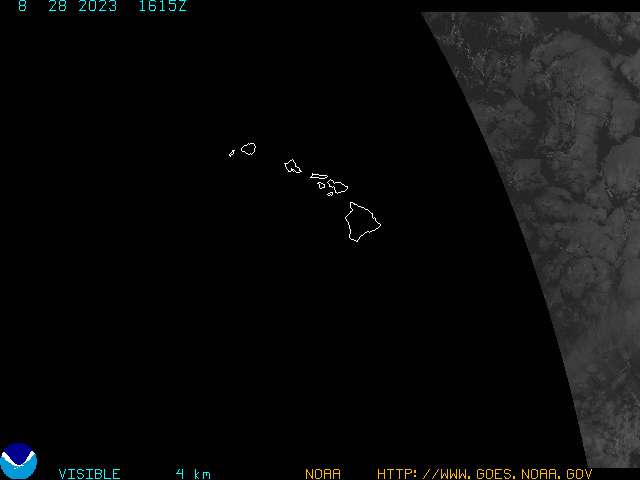
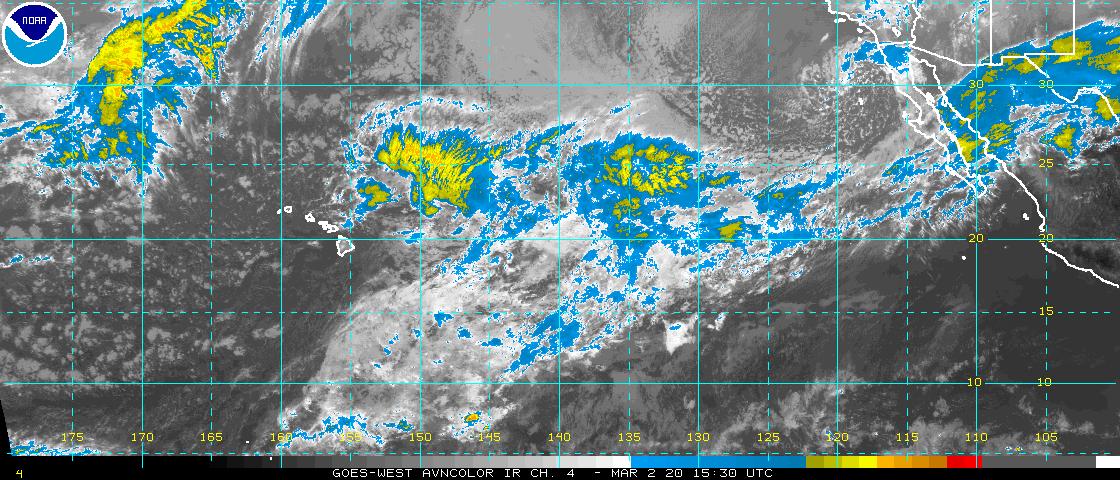
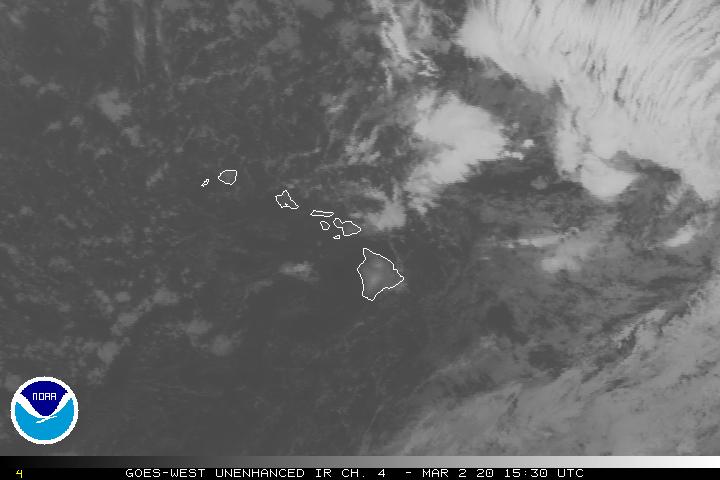
Satellite and Radar Images: To view the cloud conditions we have here in Hawaii, please use the following satellite links, starting off with this Infrared Satellite Image of the islands to see all the clouds around the state during the day and night. This next image is one that gives close images of the islands only during the daytime hours, and is referred to as a Close-up visible image. This next image shows a larger view of the Pacific…giving perspective to the wider ranging cloud patterns in the Pacific Ocean. Finally, here’s a Looping IR satellite image, making viewable the clouds around the islands 24 hours a day. To help you keep track of where any showers may be around the islands, here’s the latest animated radar image.
Hawaii’s Mountains – Here’s a link to the live webcam on the summit of near 14,000 foot Mauna Kea on the Big Island of Hawaii. The tallest peak on the island of Maui is the Haleakala Crater, which is near 10,000 feet in elevation. These two webcams are available during the daylight hours here in the islands…and when there’s a big moon rising just after sunset for an hour or two! Plus, during the nights and early mornings you will be able to see stars, and the sunrise too…depending upon weather conditions.
Tropical Cyclone activity in the eastern and central Pacific – Here’s the latest weather information coming out of the National Hurricane Center, covering the eastern north Pacific. You can find the latest tropical cyclone information for the central north Pacific (where Hawaii is located) by clicking on this link to the Central Pacific Hurricane Center. Here’s a tracking map covering both the eastern and central Pacific Ocean. A satellite image, which shows the entire ocean area between Hawaii and the Mexican coast…can be found here. Of course, as we know, our hurricane season won’t begin again until June 1st here in the central Pacific.
Aloha Paragraphs

Haze, light winds, and localized showers into Monday
Southeast through southwest Kona breezes blew Sunday…prompted by a cold front near Kauai. These winds have been quite light across the state, with the strongest gust being 25 mph, at South Point on the Big Island early in the evening hours. Looking at this weather map, we see a 1034 millibar high pressure system to the northeast of the islands. At the same time, we find a 1008 millibar gale low pressure system to the north-northwest of Hawaii….along with its associated cold front.
This cold front is located near Kauai, and will stall in the channel between there and Oahu Sunday night. This IR satellite image shows the thinning cold frontal cloud band near Kauai. Here’s a looping radar image, so we can keep track of where the rain is falling. We’re also seeing a rather thick canopy of high cirrus clouds over the state from Oahu down through the Big Island. This is very late in the season, for such a cold front to be in our area. The models continue to suggest it will retreat back to the northwest later Monday, never making it as far as Oahu…much less Maui and the Big Island.
Our local winds are coming out of the south and southwest, charged with tropical moisture…helping to fuel showers over Kauai and at times Oahu. At the same time, an upper trough of low pressure, is bringing colder air over the state as well. This is destabilizing the overlying atmosphere enough that locally heavy rainfall, over Kauai and Oahu, has occurred. The islands of Maui County, and the Big Island too, are just outside this area where the precipitation is falling. The NWS forecast office in Honolulu is keeping the flash flood watch active over Kauai and Oahu for the time being.
It’s Sunday evening as I begin writing this last section of today’s narrative. As expected, Kauai and Oahu got under the showery clouds associated the cold front. The rest of the state remained quite dry, unfortunately…as they are the driest of the island chain. The high cirrus clouds made for a day of muted sunshine, while the thick volcanic haze didn’t help the situation either. We’ve got one more day of influence from this soon to be gone cold front. Kauai and Oahu may remain shower prone into Monday. As we push into Tuesday, the trade winds will return, with generally fine weather through the rest of the new week. ~~~ I went on my longest bike ride today, since I’ve begun riding with my neighbor several weeks ago. We rode down the Haleakala Highway a distance, and then pulled over, and parked the bikes. We took a walk, and checked out one of the beautiful Jacaranda trees. These trees are all blossomed out now, nearing their peak in fullness. Their presence makes a trip upcountry worthwhile, at least in my humble opinion. ~~~ Here in Kula, Maui, it remained mostly cloudy all day, and hazy too. I didn’t see one drop of rain though, although we might still see some water falling, as the atmosphere remains charged with moisture. I’ll be back early Monday morning with your next new weather narrative, I hope you have a great Sunday night until then! Aloha for now…Glenn.
For the record:
During the month of April, this website received 314,124 hits, which was down from the 360,339 hits that it got during March, 2010. The weather conditions were more dynamic during the winter month of March, and have smoothed out during April…as would be expected during the spring season. At the same time, the google ad clicks came down from 6,106 in March, to 4,407 during April. What this is leading to, is my taking the opportunity to thank you all for your readership! It’s helpful knowing that so many of you
are interested enough in our weather here in the islands, to use my services. It’s also rewarding to know you are coming back here so often…which makes the daily updates worthwhile for me to do. Aloha, Glenn
Interesting: The United States could completely stop emissions of carbon dioxide from coal-fired electric power plants — a crucial step for controlling global warming — within 20 years by using technology that already exists or could be commercially available within a decade, according to a group of scientists, engineers, and architects. That’s the conclusion of an article published online, along with a news article on the topic, in the American Chemical Society’s semi-monthly journal Environmental Science & Technology (ES&T). Both are scheduled for the June 1 print edition of ES&T.
Pushker Kharecha and colleagues — from NASA’s Goddard Institute for Space Studies, the Columbia University Earth Institute, the National Renewable Energy Laboratory, and 2030 Inc./Architecture 2030 — say that the global climate change problem becomes manageable only if society deals quickly with emissions of carbon dioxide from burning coal in electric power plants.
"The only practical way to preserve a planet resembling that of the Holocene (today’s world) with reasonably stable shorelines and preservation of species, is to rapidly phase out coal emissions and prohibit emissions from unconventional fossil fuels such as oil shale and tar sands," they state.
The authors outline strategies to make that phase-out possible. They include elimination of subsidies for fossil fuels; putting rising prices on carbon emissions; major improvements in electricity transmission and the energy efficiency of homes, commercial buildings, and appliances; replacing coal power with biomass, geothermal, wind, solar, and third-generation nuclear power; and after successful demonstration at commercial scales, deployment of advanced (fourth-generation) nuclear power plants; and carbon capture and storage at remaining coal plants.
Interesting2: Iceland’s Eyjafjallajokull volcano continues to be active, but the full effects of volcanic ash on the aviation industry have yet to be seen, according to an aviation expert from the University of Leeds. Aviation lecturer Stephen Wright believes the impact of ash on airplane air-conditioning systems could be serious and will build over the next few weeks as planes begin to ‘hoover up’ the additional ash in the atmosphere.
Air-conditioning systems provide fresh air to pressurize the cabin as well as the warming the internal temperature of the plane. Once clogged with dirt, they can overheat, forcing the pilot to shut the system down and make an unscheduled or emergency landing. Overheating of the system can be serious, as on many planes the air-conditioning units are sited underneath the central fuel tank.
"As planes taxi round airports, the air-conditioning systems suck up dirt which then clogs up the heat exchangers," says Stephen Wright, who worked in the aviation industry before joining the University’s Faculty of Engineering. "Sometimes dirt levels are so high, systems are having to be changed after just three to four months, whereas they’re expected to last around 18 months.
The planes will now be sucking up ash as well which will put these systems under very high stress." Low concentrations of ash are deemed low risk by the UK Civil Aviation Authority as they have minimal effect on airplane engines. But air conditioning cooling systems filter all dirt out, so there will be a cumulative build up even when low levels of ash are present. "Once the air-con unit is clogged up, it is less effective and so tries to work harder to maintain pressure and temperature — and so begins to overheat," says Wright.
"The systems have built-in safety controls, so they’re unlikely to catch fire. However, overheating will mean pilots have to shut down the affected system, and as this provides fresh air to the cabin, the loss will normally result in either an unscheduled or emergency landing. "At the very least, the air industry will be looking at much higher maintenance on these systems to keep them working, at a time when the grounding of planes has put them under severe financial pressure."
Interesting3: Population growth, urbanization, increasing pollution, soil erosion and climate variations are all reflected in the management and adequacy of the world’s waters. The situation is particularly difficult in many developing countries, where there are growing concerns over escalating water crises and even outright water conflicts between countries and regions.
"The current rate of population growth and urbanization are already impacting food production. We need to improve the efficiency of agricultural output, as it’s unlikely that the acreage under cultivation can be much increased. Improved efficiency requires the efficient use of water resources," says Professor Olli Varis from the Water and Development Research Group at Aalto University.
The Group’s main research interests include integrated approaches to the management and planning of water resources as well as international water issues. Professor Varis points out that the utility of existing water resources is adversely affected by increasing industrial pollution and the breakdown of natural material circulation.
The utilization of water resources, and groundwater in particular, already exceeds the renewal capacity. "Up to 60-90 per cent of the world’s population live in countries that suffer from water shortages, and that figure will rise sharply in the future."
Interesting4: Scientists from NOAA and Texas A&M University-Corpus Christi were astounded to find that seamounts, mountains that rise from the seafloor, rank as some of the most common ocean habitats in the world. Their findings are published in a new study and reverse previous beliefs about the prevalence of seamounts, which are treasure troves of marine biodiversity.
"Unlike beaches or even coral reefs, most people will never see a seamount, but this study shows that they are clearly one of the predominant ecosystems on the planet," said Peter Etnoyer, Ph.D., principal investigator of the study and marine biologist at NOAA’s Center for Coastal Environmental Health and Biomolecular Research.
"We can only hope that through this study, people begin to realize what a vast unknown the ocean represents, and what a vital role it plays on Earth." Although researchers have thoroughly explored some 200 seamounts and mapped and sampled a hundred others, this study is the first to estimate that more than 45,000 seamounts dot the ocean floor worldwide — a total of roughly 28.8 million square kilometers or an area larger than the continent of South America.
The discovery was made possible using satellite altimetry data that measured incredibly slight changes in the sea surface height that, along with statistical analysis models, indicated the presence of these submerged mountains. "Seamounts are biodiversity ‘hotspots’, with higher abundance and variety of life forms than the surrounding seafloor," said Tom Shirley, Ph.D., contributing author of the study and a conservation scientist with the Harte Research Institute at Texas A&M University-Corpus Christi.
"In fact, new species are observed or collected on nearly every submersible dive." Two dozen new species of corals and sponges, for example, have been collected from seamounts in the Gulf of Alaska since 2002. Seamounts not only make up the largest area of ocean habitat, they are also highly productive environments that can serve as habitats for important commercial fish species like orange roughy and sablefish. This research, which is the first-ever comparison of the size of oceanic and land habitats, is featured in the journal Oceanography.
 Email Glenn James: