May 19-20, 2010
Air Temperatures – The following maximum temperatures were recorded across the state of Hawaii Wednesday afternoon:
Lihue, Kauai – 82
Honolulu, Oahu – 86
Kaneohe, Oahu – 82
Kaunakakai, Molokai – 82
Kahului, Maui – 86
Hilo, Hawaii – 84
Kailua-kona – 81
Air Temperatures ranged between these warmest and coolest spots near sea level around the state – and on the highest mountains…at 5pm Wednesday evening:
Barking Sands, Kauai – 84F
Molokai airport – 77
Haleakala Crater – 54 (near 10,000 feet on Maui)
Mauna Kea summit – 36 (near 14,000 feet on the Big Island)
Precipitation Totals – The following numbers represent the largest precipitation totals (inches) during the last 24 hours on each of the major islands, as of Wednesday afternoon:
0.18 Mount Waialaele, Kauai
0.03 Honouliuli, Oahu
0.01 Molokai
0.00 Lanai
0.00 Kahoolawe
0.74 Puu Kukui, Maui
1.39 Kawainui Stream, Big Island
Marine Winds – Here’s the latest (automatically updated) weather map showing a high pressure system to our northeast…with another high pressure cell to our north-northeast. The trade winds will increase in strength into Friday.
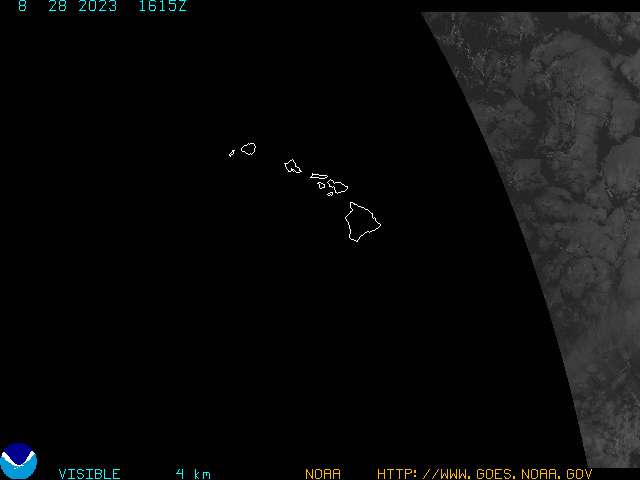
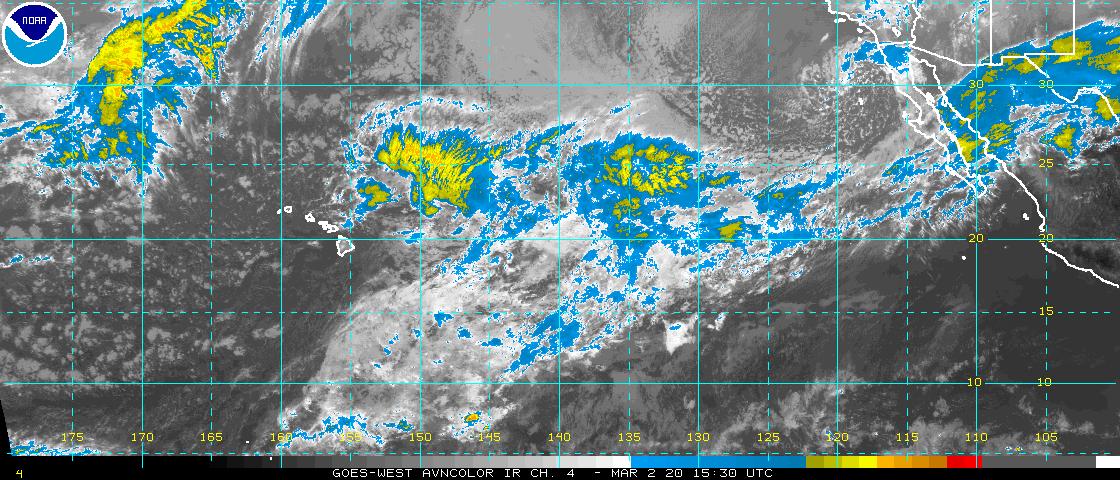
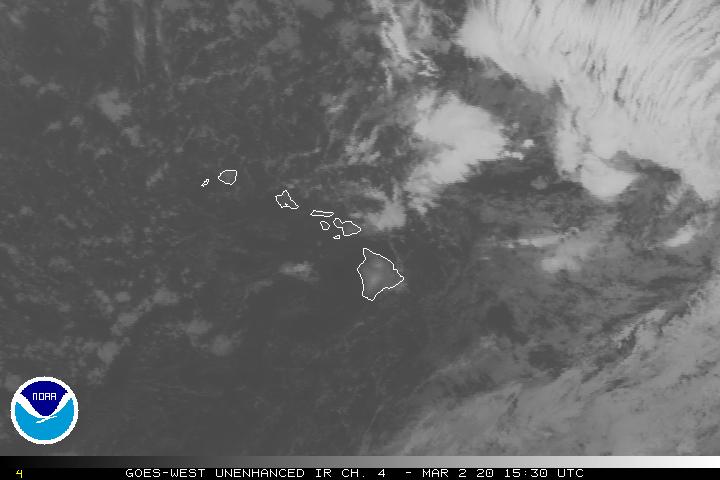
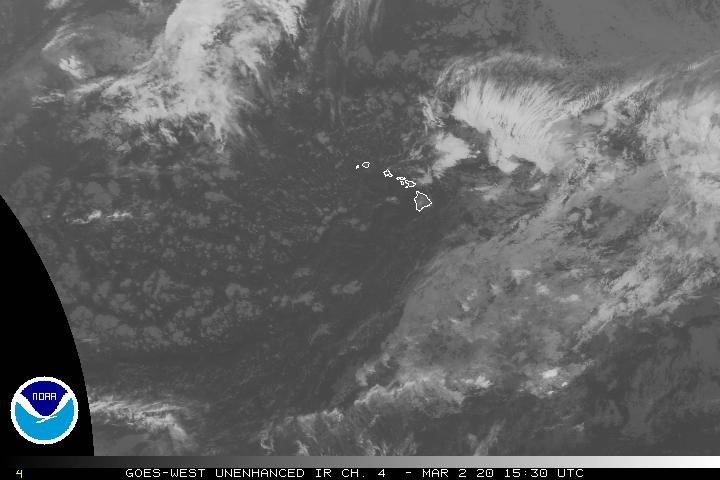
Satellite and Radar Images: To view the cloud conditions we have here in Hawaii, please use the following satellite links, starting off with this Infrared Satellite Image of the islands to see all the clouds around the state during the day and night. This next image is one that gives close images of the islands only during the daytime hours, and is referred to as a Close-up visible image. This next image shows a larger view of the Pacific…giving perspective to the wider ranging cloud patterns in the Pacific Ocean. Finally, here’s a Looping IR satellite image, making viewable the clouds around the islands 24 hours a day. To help you keep track of where any showers may be around the islands, here’s the latest animated radar image.
Hawaii’s Mountains – Here’s a link to the live webcam on the summit of near 14,000 foot Mauna Kea on the Big Island of Hawaii. The tallest peak on the island of Maui is the Haleakala Crater, which is near 10,000 feet in elevation. These two webcams are available during the daylight hours here in the islands…and when there’s a big moon rising just after sunset for an hour or two! Plus, during the nights and early mornings you will be able to see stars, and the sunrise too…depending upon weather conditions.
Tropical Cyclone activity in the eastern and central Pacific – Here’s the latest weather information coming out of the National Hurricane Center, covering the eastern north Pacific. You can find the latest tropical cyclone information for the central north Pacific (where Hawaii is located) by clicking on this link to the Central Pacific Hurricane Center. Here’s a tracking map covering both the eastern and central Pacific Ocean. A satellite image, which shows the entire ocean area between Hawaii and the Mexican coast…can be found here. Of course, as we know, our hurricane season won’t begin again until June 1st here in the central Pacific.
Aloha Paragraphs

Trade wind weather pattern continues
Strong and gusty trade winds will prevail…lasting through the rest of this week. Checking out this weather map, we see trade wind producing high pressure systems to the north-northeast and northeast. If we look at this 72 hour forecast weather map, we see that a moderately strong 1032 millibar high pressure system will be anchored to the northeast, ensuring the continuance of our breezy trade winds. The winds are already on the increase, thus the continuation of the small craft wind advisory from Molokai, down to
Precipitation over the islands has remained on the light side this week so far, with little change through through Thursday. The computer forecast models however continue to show a trough of low pressure edging over the islands Friday into this weekend, perhaps sticking around into early next week. At the same time, the models are showing a potential increase in low level moisture during that time frame as well. This in turn could bring an associated increase in showers. This trough will destabilize our atmosphere to some degree, making the incoming clouds more shower prone along our windward sides. Wednesday evening, using this IR satellite image, we see a fairly normal distribution of stable clouds…most notably to our east. Shifting over to this looping radar image, we can see just a few showers over the ocean moving in our direction. Glancing at this larger satellite view, we see nothing unusual, with just some thunderstorms down near the equato, and a batch of high clouds to the northwest…and just south of the Big Island too.
It’s Wednesday evening as I begin writing this last section of today’s narrative.
The trade winds will be on the increase both Thursday and Friday…right on into the weekend. To get an idea how strong they already are, here were the top gusts early Wednesday evening on each of the islands:
Kauai – 29 mph
Oahu – 37
Molokai – 31
Lanai – 08
Kahoolawe – 44
Maui – 38
Big Island – 37
If this trend continues, as expected, we’ll likely see the small craft wind advisory flags get extended across a larger area of Hawaii’s coastal and channel waters, during the end of this work week. Rainfall won’t be all that exceptional, and as a matter of fact, quite light through Thursday. As noted above, there’s a decent chance that our precipitation will increase Friday into the weekend, and perhaps right on into next week. This would be excellent news, in terms of pushing back our ongoing drought conditions. The bulk of these showers will end up on the windward sides, thanks to the strong and gusty trade winds. There is a chance however, that some of this much needed moisture will be carried over into the leeward sides locally. We may see some upcountry showers breaking out during the afternoon hours locally as well. ~~~ Here in Kihei, Maui, before I leave for the drive back upcountry to Kula, it’s clear to partly cloudy. I expect lots of these clouds to evaporate as we get into the night, except along the windward coasts and slopes, where they generally thicken during the cooler hours after dark…into the early morning hours. I’ll catch up with you again early Thursday morning, when I’ll have your next new weather narrative available, right here. I hope you have a great Wednesday night until then! Aloha for now…Glenn.
Extra: NOAA’s Central Pacific Hurricane Center Wednesday announced that projected climate conditions point to a below normal hurricane season in the Central Pacific basin this year.
Extra2: A walk on the beach…Maui
Interesting: Marine biologist Enric Sala relays some of the lessons he has learned from exploring pristine coral reefs. His findings turn the accepted view of the top predator biomass pyramid upside down. Sala also explores some of the economics of marine preserves, one of the only effective means of conserving ocean species.
He finds that the gains made from ecotourism and fisheries productivity far outweigh any losses related to the rezoning of fishing grounds. Sala estimates that setting aside 20—50 percent of the oceans as marine preserves (as scientists have recommended for preserving healthy ecosystems) would cost a mere $16 billion, less than half the amount the world already spends on fishing subsidies, much of which promotes destructive practices. In this sense, conservation can be a vehicle for local investment and development.
Interesting2: Shifting rivers in India’s largest tea producing state and abnormally high rainfall this year is destroying hundreds of acres of tea gardens and could cut output in the world’s second-largest tea grower. More than a tenth of the 18,000 hectares of plantations, or tea gardens, in India’s northeast state of Assam could be washed away as the mighty Himalaya-born Brahmaputra and other smaller rivers flood the region where century-old operations grow over half of India’s tea.
"Some tea gardens have already fallen into rivers and some of them are on the verge of disappearing," said Dipanjol Deka, secretary general of Tea Association of India (TAI) in Guwahati, the main city in the region. "In the long run there is a possibility of production loss and overall loss to the industry." India consumes the bulk of its tea production. Last year, it exported a fifth of its 979 million kilograms (kg) of tea output, earning about $570 million.
Tea has been commercially grown in Assam since the early 19th century, after the East India Company which governed British possessions in the subcontinent lost its monopoly on tea-trade with China. Assam’s 850 gardens employ over 800,000 people and export the strong tea to over 80 countries including Russia and Britain.
In 2009 the state produced nearly 500 million kg of tea. But annual summer floods in the state which receives heavy monsoon rains has led to rivers breaking banks and wearing away slopes of gardens where tea is grown. This year, the region has received more rain than usual, weather officials say.
Interesting3: In what could set the stage for a fundamental shift in commercial aviation, an MIT-led team has designed a green airplane that is estimated to use 70 percent less fuel than current planes while also reducing noise and emission of nitrogen oxides (NOx). The design was one of two that the team, led by faculty from the Department of Aeronautics and Astronautics, presented to NASA last month as part of a $2.1 million research contract to develop environmental and performance concepts that will help guide the agency’s aeronautics research over the next 25 years.
Known as "N+3" to denote three generations beyond today’s commercial transport fleet, the research program is aimed at identifying key technologies, such as advanced airframe configurations and propulsion systems, that will enable greener airplanes to take flight around 2035. MIT was the only university to lead one of the six U.S. teams that won contracts from NASA in October 2008.
Four teams — led by MIT, Boeing, GE Aviation and Northrop Grumman, respectively — studied concepts for subsonic (slower than the speed of sound) commercial planes, while teams led by Boeing and Lockheed-Martin studied concepts for supersonic (faster than the speed of sound) commercial aircraft. Led by AeroAstro faculty and students, including principal investigator Ed Greitzer, the H. Nelson Slater Professor of Aeronautics and Astronautics, the MIT team members include Aurora Flight Sciences Corporation and Pratt & Whitney.
Their objective was to develop concepts for, and evaluate the potential of, quieter subsonic commercial planes that would burn 70 percent less fuel and emit 75 percent less NOx than today’s commercial planes. NASA also wanted an aircraft that could take off from shorter runways. Designing an airplane that could meet NASA’s aggressive criteria while accounting for the changes in air travel in 2035 — when air traffic is expected to double — would require "a radical change," according to Greitzer.
Although automobiles have undergone extensive design changes over the last half-century, "aircraft silhouettes have basically remained the same over the past 50 years," he said, describing the traditional, easily recognizable "tube-and-wing" structure of an aircraft’s wings and fuselage.
Interesting4: A volcanic eruption, unlike a giant oil spill, is an act of nature, not the outcome of risky behavior on the part of man. Nothing we do could have caused or prevented a vent near Iceland’s Eyjafjallajokull glacier from spewing flames, molten lava and plumes of ash into the air. And yet, the relationship between man and volcano is not a simple one. Given the explosive nature of such sites, it would make sense for humans to give a wide berth.
But homes and farms are built right at the feet of volcanoes, and even up their flanks. From time to time we see news images of lava flowing over them, wiping them out. What were those people thinking? The fact is, volcanic sites are among the most fertile places on the planet. Volcanoes helped form our planet — its water, air and soils — and their eruptions continue to nourish us, bringing up huge payloads of elements in the form of lava, rock and ash that eventually break down into plant-nutritive forms.
Soils in places such as Java, New Zealand, Hawaii and Iceland have been greatly enriched by volcanic activity. Farming downwind of Mount St. Helens in Washington state will benefit in the long run from all that drifting ash. And numerous fertilizer products have been created from volcanic rock dusts, ash deposits and clays. Ash, because it travels on the wind, has a widespread effect.
Initially it can smother crops, but light deposits are usually benign. Ash has a dehydrating effect on insects, so that bees and other populations may decline temporarily after an eruption. Inert dusts made from volcanic ash can be used to control pest insects, if targeted to spare benign ones. Recently, ash dispersal stopped air traffic and stranded busy travelers.
It also made possible the first conclusive study of how much pollution is caused by air travel, by allowing its temporary decline to be quantified. The ash also affected the transportation of food, leading to shortages. How little that would matter if most of the world’s food supply were locally produced and countries could feed themselves, the way they used to. We could all sit back then and admire the spectacular fiery show.
Interesting5: The National Oceanic and Atmospheric Administration says a hurricane, or a succession of them, may bring oil up from the depths of the Gulf of Mexico and then push it ashore. Forecasters say a season with multiple storms could send oil farther inland and spread it as far as Cape Hatteras, N.C. "To think a storm surge could resuscitate a huge sum of oil (from the deep) and deposit it on land is truly catastrophic," says Joe Jaworski, mayor of Galveston, Texas, a city hit by Hurricane Ike in 2008.
This year’s hurricane season, June 1 to Nov. 30, is expected to be above average with 15 tropical storms of which eight could be hurricanes, according to experts at Colorado State University, the nation’s oldest hurricane forecasting team. Jeff Masters, chief meteorologist at forecaster Weather Underground, says the oil spill adds "an exclamation mark" to the "sense of foreboding" he has over the hurricane season.
Storms tend to break up and dilute large spills, but they also spread them over a greater area, he says. In 1989, when the Exxon Valdez spilled 11 million gallons near the coast of Alaska, workers contained the spill, but a storm with 70 mph winds "made the damage much greater," Masters says. A hurricane blows at 74 mph.
In 1979, the IXTOC I oil well blowout spilled 140 million gallons into the Gulf of Mexico. Padre Island, Texas, "got a huge fouling," Masters says, but "then a big storm came through, scrubbed all the oil off and it turned out to be a good thing." The federal Climate Prediction Center will issue its hurricane outlook May 27.
Masters and AccuWeather.com’s Joe Bastardi say record high sea surface temperatures in the Atlantic and cooling in the Pacific Ocean resemble conditions in 2004, 2005 and 2008, when multiple storms battered the USA. Kerry St. Pé, director of the Barataria-Terrebonne National Estuary Program in Thibodaux, La., which was hit by storm surges from hurricanes Katrina and Rita in 2005, says a storm surge would carry oil over the wetlands and deposit it farther inland.
A hurricane might render the oil less toxic, "but it might destroy a lot of homes," St. Pé says. None of the scenarios are good for the ecosystem, says Jim Edson, a University of Connecticut marine meteorologist. "We’ve never dealt with anything like this before," Edson says.
 Email Glenn James: